ELECTRONIC (DIGITAL)
GROUP MEMBERS:
•ADIL MUNAWAR JAFRI
•HAZIQ AHMAD
OUTLINE:
• INTRODUCTION
• COMPONENTS
• ELECTRONIC LED DICE CIRCUIT DIAGRAM
• Operation of Unbiased Electronic Dice with LEDs
• APPLICATIONS
INTRODUCTION
• Playing with dice is an age old game. We all love to play with it
too. Playing with dice needs us to pick up a dice and make sure
that it is unbiased. The dice becomes biased if the shape is not
cut well.Also, the dice can become biased due to deformations.
• To solve all these problems which we have with a conventional
dice, we have made a dice circuit which solves all the problems
of a conventional dice.
COMPONENTS
• 1X CD4017 IC
• 1X 555 TIMER IC
• 7X LEDS
• 6X 1N4148 DIODES
• 1X BUZZER
• 1X PUSH BUTTON
• 1X 0.1uF CAPACITORS
• 1X 1uF CAPACITORS
• 3X 100 OHM RESISTOR
• 1X 220 OHM RESISTOR
• 2X 10K RESISTOR
• 1X 47K RESISTOR
• PERF BOARD
• JUMPER WIRES
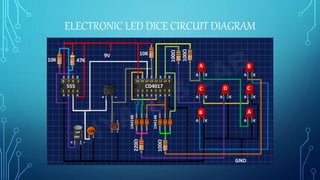
ELECTRONIC LED DICE CIRCUIT DIAGRAM
OPERATION OF UNBIASED ELECTRONIC DICE WITH LEDs
• This circuit uses 555 timer as an astable multivibrator. In this mode, the circuit is arranged with R2 = 100
KΩ, R3 = 100 KΩ and C2 = 0.1 µF.
• With this configuration, the circuit operates as a pulse generator with a frequency in order of kilo hertz. This
means that the circuit produces a clock cycle of about 0.000210 seconds which is imperceptible to the
human eye. We cannot observe the values which change at that faster rate so there is hardly any possibility of
getting the dice biased.
• The clock pulses are given to a counter cum decoder circuit IC 4017 with the seventh output given to reset. It
has nine possible outputs out of which, the seventh is given to reset because we only need a count up to 6 as
a dice has six faces only. The first six outputs are given respectively to the LEDs, so that the respective LED
will glow for the corresponding count.
OPERATION OF UNBIASED ELECTRONIC DICE WITH LEDs
• If the count is 1, LED-1 will glow. If the count if 2, LED-2 will glow and so
on until the sixth count. When the count is six, the sixth LED will glow and
after that for the next clock pulse the counter will advance and the count
increments to seven. In this count, the circuit resets itself as the seventh
count is given to the reset pin which is PIN-15.
• This is how the circuit functions and you can increase the frequency of the
circuit if you feel that you need more randomness so that it is very hard to
perceive.
APPLICATIONS
• Snakes and Ladders
• Chutes and Ladders
• Ludo
• Monopoly
This unbiased electronic dice with LEDs can be used wherever
traditional dice is used like:
End of presentation
Thank you

Electronic (digital) dice.pptx

  • 1.
  • 2.
    GROUP MEMBERS: •ADIL MUNAWARJAFRI •HAZIQ AHMAD
  • 3.
    OUTLINE: • INTRODUCTION • COMPONENTS •ELECTRONIC LED DICE CIRCUIT DIAGRAM • Operation of Unbiased Electronic Dice with LEDs • APPLICATIONS
  • 4.
    INTRODUCTION • Playing withdice is an age old game. We all love to play with it too. Playing with dice needs us to pick up a dice and make sure that it is unbiased. The dice becomes biased if the shape is not cut well.Also, the dice can become biased due to deformations. • To solve all these problems which we have with a conventional dice, we have made a dice circuit which solves all the problems of a conventional dice.
  • 5.
    COMPONENTS • 1X CD4017IC • 1X 555 TIMER IC • 7X LEDS • 6X 1N4148 DIODES • 1X BUZZER • 1X PUSH BUTTON • 1X 0.1uF CAPACITORS • 1X 1uF CAPACITORS • 3X 100 OHM RESISTOR • 1X 220 OHM RESISTOR • 2X 10K RESISTOR • 1X 47K RESISTOR • PERF BOARD • JUMPER WIRES
  • 6.
    ELECTRONIC LED DICECIRCUIT DIAGRAM
  • 7.
    OPERATION OF UNBIASEDELECTRONIC DICE WITH LEDs • This circuit uses 555 timer as an astable multivibrator. In this mode, the circuit is arranged with R2 = 100 KΩ, R3 = 100 KΩ and C2 = 0.1 µF. • With this configuration, the circuit operates as a pulse generator with a frequency in order of kilo hertz. This means that the circuit produces a clock cycle of about 0.000210 seconds which is imperceptible to the human eye. We cannot observe the values which change at that faster rate so there is hardly any possibility of getting the dice biased. • The clock pulses are given to a counter cum decoder circuit IC 4017 with the seventh output given to reset. It has nine possible outputs out of which, the seventh is given to reset because we only need a count up to 6 as a dice has six faces only. The first six outputs are given respectively to the LEDs, so that the respective LED will glow for the corresponding count.
  • 8.
    OPERATION OF UNBIASEDELECTRONIC DICE WITH LEDs • If the count is 1, LED-1 will glow. If the count if 2, LED-2 will glow and so on until the sixth count. When the count is six, the sixth LED will glow and after that for the next clock pulse the counter will advance and the count increments to seven. In this count, the circuit resets itself as the seventh count is given to the reset pin which is PIN-15. • This is how the circuit functions and you can increase the frequency of the circuit if you feel that you need more randomness so that it is very hard to perceive.
  • 9.
    APPLICATIONS • Snakes andLadders • Chutes and Ladders • Ludo • Monopoly This unbiased electronic dice with LEDs can be used wherever traditional dice is used like:
  • 10.