UNIVERSITY OF BOTSWANA
FACULTY OF ENGINEERING AND TECHNOLOGY
DEPARTMENT OF ELECTRICAL ENGINEERING
DIGITAL ELECTRONICS (EEB 322)
LAB 2: LOGIC GATES AND COMBINATIONAL CIRCUITS (HALF ADDERS
AND FULL ADDERS)
DATE OF LAB SESSION: 07 APRIL 2016
AUTHOR: BOSA THEOPHILUS NTSHOLE
STUDENT ID: 201301848
2
Table of Contents
AIMOF EXPERIMENT..........................................................................................................................3
INTRODUCTION..................................................................................................................................3
MATERIALS USED IN THE EXPERIMENT.................................................................................................4
THEORY..............................................................................................................................................5
a. The Half Adder........................................................................................................................5
b. The Full Adder.........................................................................................................................6
PROCEDURE.......................................................................................................................................7
RESULTS.............................................................................................................................................8
DISCUSSION .......................................................................................................................................9
RECOMMENDATIONS .........................................................................................................................9
CONCLUSION......................................................................................................................................9
REFFERENCES.....................................................................................................................................9
3
AIM OF EXPERIMENT
The main purpose of this experiment is to introduce the design of simple combinational circuits,
in this case half adder and full adders.
INTRODUCTION
In this experiment, the understanding of logic gates is used to perform basic hardware functions.
We will be looking at how binary addition may be implemented using combinational logic
circuits. We will consider the half and full adder for this particular experiment. The half adder is
the combinational circuit which consists of two inputs and outputs which performs the addition
of two bits. The output variables produce the sum and carry due to the input variables being
designated the augend and addened bits. Also, the combinational circuit that performs the three
bit addition which are made up of two significant bits and the previous carry is known as the full
adder. The full adder is made up of three inputs and two outputs and outputs are the sum and
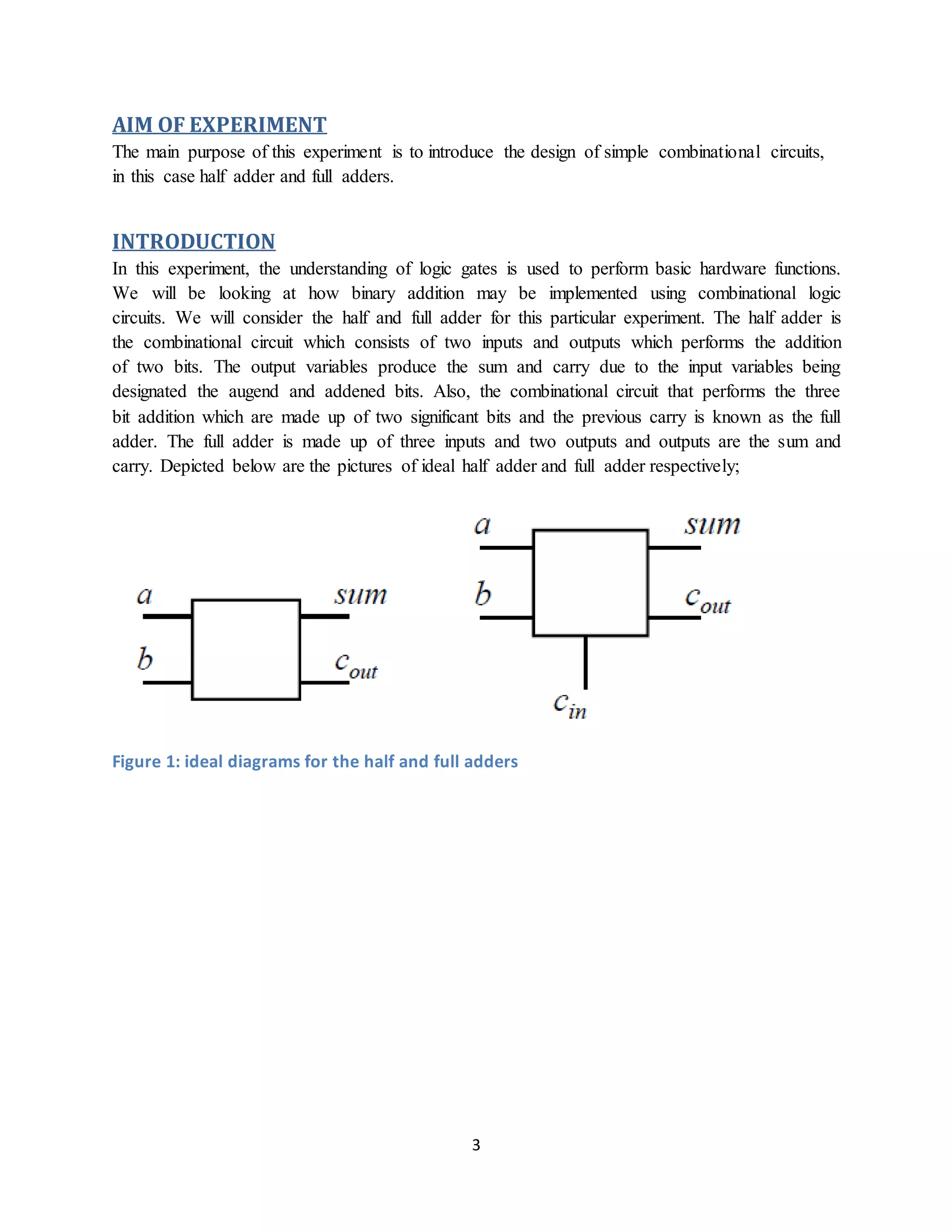
carry. Depicted below are the pictures of ideal half adder and full adder respectively;
Figure 1: ideal diagrams for the half and full adders
4
MATERIALS USED IN THE EXPERIMENT
- C.A.D.E.T breadboard
- 1 x 74LS08 Quad 2-input AND Gate
- 1 x 74LS32 Quad 2 –input OR Gate
- 1 x 74LS86 Quad 2- input XOR Gate
- Jumper wires
5
THEORY
a. The Half Adder
The half adder is combinational circuit that Adds together two, single bit binary numbers a and b
(note: no carry input). It has the following truth table;
By inspection of the truth table;
Depicted below is the actual circuit diagram of half adder;
U 1A
74 LS08D
1
2
3
74 LS86D
1
2
3
U 3A
Figure 2: ACTUAL CIRCUIT FOR HALF ADDER
6
b. The Full Adder
The full adder is a combinational circuit that Adds together two, single bit binary numbers a and
b (with a carry input). The full adder has the following truth table;
Such that;
So;
And;
7
So that;
Alternatively;
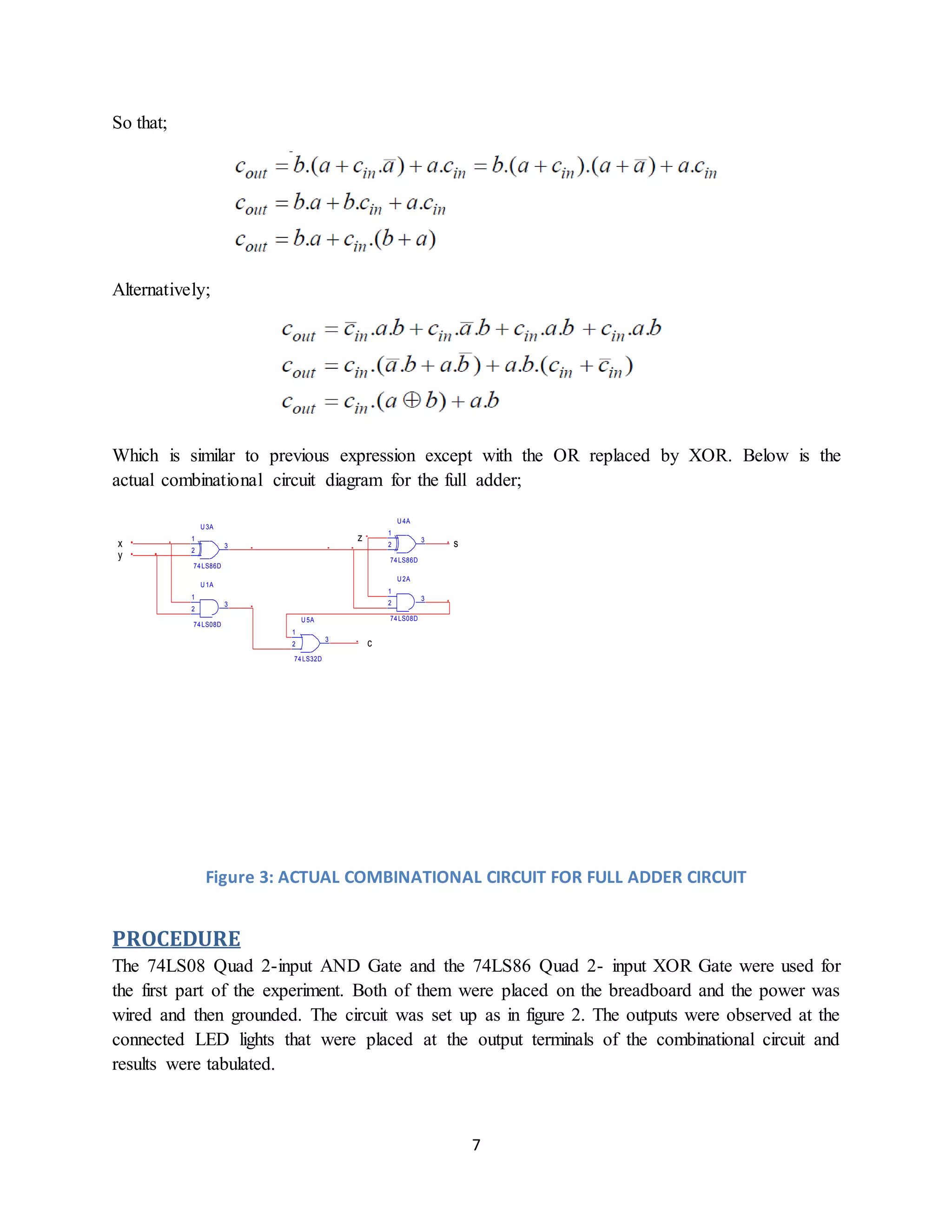
Which is similar to previous expression except with the OR replaced by XOR. Below is the
actual combinational circuit diagram for the full adder;
U 1A
74LS08D
1
2
3
74LS86D
1
2
3
U 3A
U 2A
74LS08D
1
2
3
74LS86D
1
2
3
U 4A
U 5A
74LS32D
1
2
3
c
s
z
y
x
Figure 3: ACTUAL COMBINATIONAL CIRCUIT FOR FULL ADDER CIRCUIT
PROCEDURE
The 74LS08 Quad 2-input AND Gate and the 74LS86 Quad 2- input XOR Gate were used for
the first part of the experiment. Both of them were placed on the breadboard and the power was
wired and then grounded. The circuit was set up as in figure 2. The outputs were observed at the
connected LED lights that were placed at the output terminals of the combinational circuit and
results were tabulated.
8
The circuit was then modified such that it is a full adder combinational circuit as in figure 3.
Outputs C and S were then observed and recorded respectively.
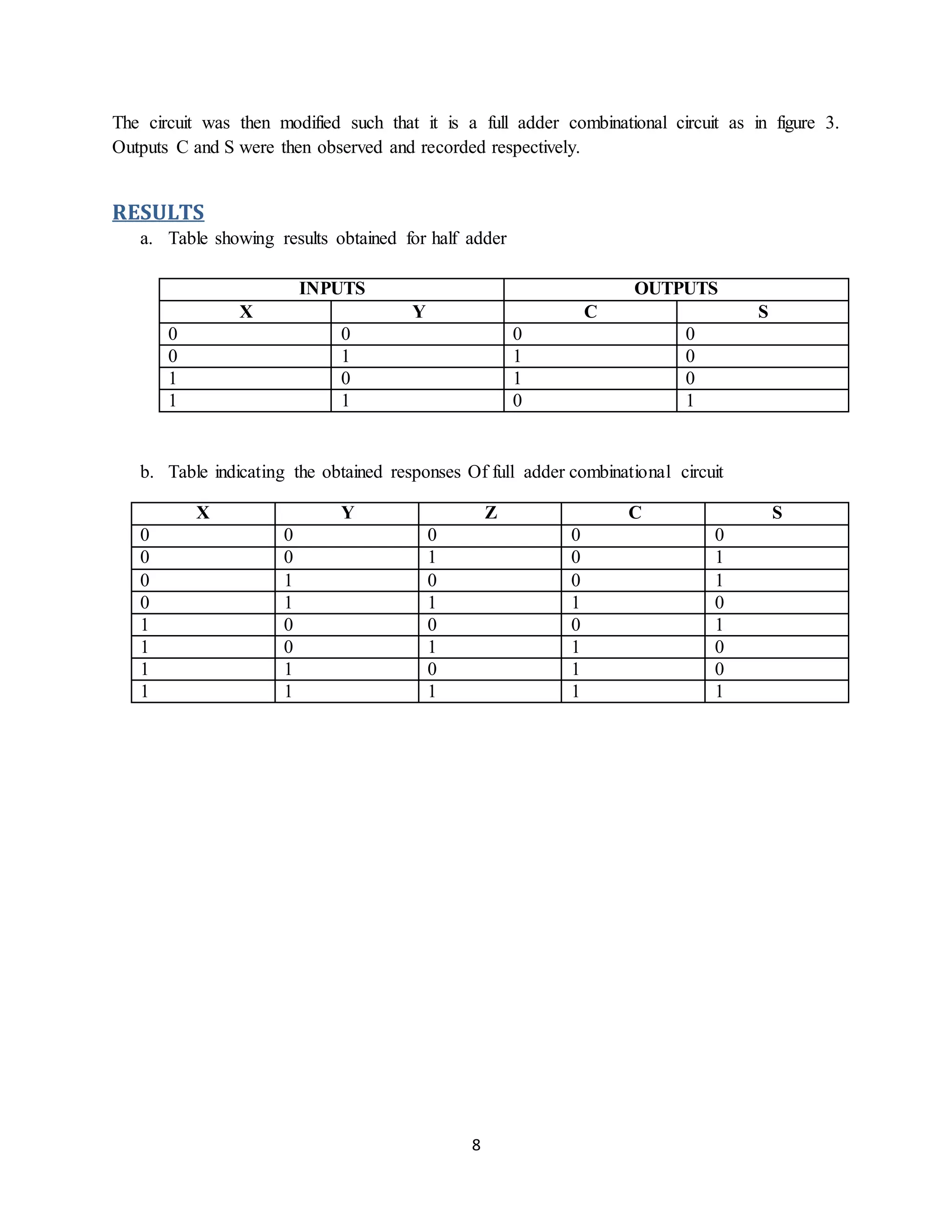
RESULTS
a. Table showing results obtained for half adder
INPUTS OUTPUTS
X Y C S
0 0 0 0
0 1 1 0
1 0 1 0
1 1 0 1
b. Table indicating the obtained responses Of full adder combinational circuit
X Y Z C S
0 0 0 0 0
0 0 1 0 1
0 1 0 0 1
0 1 1 1 0
1 0 0 0 1
1 0 1 1 0
1 1 0 1 0
1 1 1 1 1
9
DISCUSSION
A lot of time was consumed by arguments since each group was made up of six people per
working station. Other parties did not come prepared, a lot of time was consumed by trying to
figure out and understanding first the theory and methodology used to carry out the experiment
so much time which we could have used to carry out the experiment had elapsed. Another thing
that made the experiment almost impossible to perform was lack of space, our work station was
over crowded because the space in the work station was limited. This is a concern because time
and again we had to reconnect our circuits, more especially the combination circuit, due to
coiling up of jumper wires which made it difficult to trace the connections. Also, most of the
apparatus used was very old that after connections were made, in most cases no outcome was
traced or found leading to spending much time trouble shooting and fault finding rather than just
taking readings we are sure of. There was deflection in practical outcomes here and there
basically due to reasons stated in the discussion.
RECOMMENDATIONS
The University Of Botswana Electrical Engineering Department should start ordering laboratory
equipment that is up to date and the already existing laboratory materials should be services
regularly more especially before students come into the laboratory. The servicing should be
carried out by the laboratory technicians thoroughly and the Electrical Engineering Department
should perform thorough inspections on the serviced lab equipment in order to check if they need
to be replaced or not. Electrical engineering students should always come prepared to the
laboratory session so that much time can be spent on the experiment rather than discussing first
what exactly should be done. Each student should participate thus having a task that one is
capable of performing because they would have prepared thoroughly for the lab session. More
equipment should be availed at the labs to avoid students over-crowding on one working station.
CONCLUSION
The know-how in design of simple combinational circuits was acquired perfectly through gate
behavior observation and considerations. It was also found out that practical results recorded
were corresponding to theoretical results so every practical observation matched its expectations
thus the practical results were exactly the same as the theoretical results. The combination circuit
connections were perfect and all the other connections that were made gave all the right.
REFFERENCES
- Mechatronics, Electronic Control Systems in Mechanical and Electrical Engineering
(fifth edition) by W.Bolton.
- Lab manual
- Automation and Robotics.pdf by Miltiadis A. Boboulos.

Digital Electronics( half adders and full adders)

  • 1.
    UNIVERSITY OF BOTSWANA FACULTYOF ENGINEERING AND TECHNOLOGY DEPARTMENT OF ELECTRICAL ENGINEERING DIGITAL ELECTRONICS (EEB 322) LAB 2: LOGIC GATES AND COMBINATIONAL CIRCUITS (HALF ADDERS AND FULL ADDERS) DATE OF LAB SESSION: 07 APRIL 2016 AUTHOR: BOSA THEOPHILUS NTSHOLE STUDENT ID: 201301848
  • 2.
    2 Table of Contents AIMOFEXPERIMENT..........................................................................................................................3 INTRODUCTION..................................................................................................................................3 MATERIALS USED IN THE EXPERIMENT.................................................................................................4 THEORY..............................................................................................................................................5 a. The Half Adder........................................................................................................................5 b. The Full Adder.........................................................................................................................6 PROCEDURE.......................................................................................................................................7 RESULTS.............................................................................................................................................8 DISCUSSION .......................................................................................................................................9 RECOMMENDATIONS .........................................................................................................................9 CONCLUSION......................................................................................................................................9 REFFERENCES.....................................................................................................................................9
  • 3.
    3 AIM OF EXPERIMENT Themain purpose of this experiment is to introduce the design of simple combinational circuits, in this case half adder and full adders. INTRODUCTION In this experiment, the understanding of logic gates is used to perform basic hardware functions. We will be looking at how binary addition may be implemented using combinational logic circuits. We will consider the half and full adder for this particular experiment. The half adder is the combinational circuit which consists of two inputs and outputs which performs the addition of two bits. The output variables produce the sum and carry due to the input variables being designated the augend and addened bits. Also, the combinational circuit that performs the three bit addition which are made up of two significant bits and the previous carry is known as the full adder. The full adder is made up of three inputs and two outputs and outputs are the sum and carry. Depicted below are the pictures of ideal half adder and full adder respectively; Figure 1: ideal diagrams for the half and full adders
  • 4.
    4 MATERIALS USED INTHE EXPERIMENT - C.A.D.E.T breadboard - 1 x 74LS08 Quad 2-input AND Gate - 1 x 74LS32 Quad 2 –input OR Gate - 1 x 74LS86 Quad 2- input XOR Gate - Jumper wires
  • 5.
    5 THEORY a. The HalfAdder The half adder is combinational circuit that Adds together two, single bit binary numbers a and b (note: no carry input). It has the following truth table; By inspection of the truth table; Depicted below is the actual circuit diagram of half adder; U 1A 74 LS08D 1 2 3 74 LS86D 1 2 3 U 3A Figure 2: ACTUAL CIRCUIT FOR HALF ADDER
  • 6.
    6 b. The FullAdder The full adder is a combinational circuit that Adds together two, single bit binary numbers a and b (with a carry input). The full adder has the following truth table; Such that; So; And;
  • 7.
    7 So that; Alternatively; Which issimilar to previous expression except with the OR replaced by XOR. Below is the actual combinational circuit diagram for the full adder; U 1A 74LS08D 1 2 3 74LS86D 1 2 3 U 3A U 2A 74LS08D 1 2 3 74LS86D 1 2 3 U 4A U 5A 74LS32D 1 2 3 c s z y x Figure 3: ACTUAL COMBINATIONAL CIRCUIT FOR FULL ADDER CIRCUIT PROCEDURE The 74LS08 Quad 2-input AND Gate and the 74LS86 Quad 2- input XOR Gate were used for the first part of the experiment. Both of them were placed on the breadboard and the power was wired and then grounded. The circuit was set up as in figure 2. The outputs were observed at the connected LED lights that were placed at the output terminals of the combinational circuit and results were tabulated.
  • 8.
    8 The circuit wasthen modified such that it is a full adder combinational circuit as in figure 3. Outputs C and S were then observed and recorded respectively. RESULTS a. Table showing results obtained for half adder INPUTS OUTPUTS X Y C S 0 0 0 0 0 1 1 0 1 0 1 0 1 1 0 1 b. Table indicating the obtained responses Of full adder combinational circuit X Y Z C S 0 0 0 0 0 0 0 1 0 1 0 1 0 0 1 0 1 1 1 0 1 0 0 0 1 1 0 1 1 0 1 1 0 1 0 1 1 1 1 1
  • 9.
    9 DISCUSSION A lot oftime was consumed by arguments since each group was made up of six people per working station. Other parties did not come prepared, a lot of time was consumed by trying to figure out and understanding first the theory and methodology used to carry out the experiment so much time which we could have used to carry out the experiment had elapsed. Another thing that made the experiment almost impossible to perform was lack of space, our work station was over crowded because the space in the work station was limited. This is a concern because time and again we had to reconnect our circuits, more especially the combination circuit, due to coiling up of jumper wires which made it difficult to trace the connections. Also, most of the apparatus used was very old that after connections were made, in most cases no outcome was traced or found leading to spending much time trouble shooting and fault finding rather than just taking readings we are sure of. There was deflection in practical outcomes here and there basically due to reasons stated in the discussion. RECOMMENDATIONS The University Of Botswana Electrical Engineering Department should start ordering laboratory equipment that is up to date and the already existing laboratory materials should be services regularly more especially before students come into the laboratory. The servicing should be carried out by the laboratory technicians thoroughly and the Electrical Engineering Department should perform thorough inspections on the serviced lab equipment in order to check if they need to be replaced or not. Electrical engineering students should always come prepared to the laboratory session so that much time can be spent on the experiment rather than discussing first what exactly should be done. Each student should participate thus having a task that one is capable of performing because they would have prepared thoroughly for the lab session. More equipment should be availed at the labs to avoid students over-crowding on one working station. CONCLUSION The know-how in design of simple combinational circuits was acquired perfectly through gate behavior observation and considerations. It was also found out that practical results recorded were corresponding to theoretical results so every practical observation matched its expectations thus the practical results were exactly the same as the theoretical results. The combination circuit connections were perfect and all the other connections that were made gave all the right. REFFERENCES - Mechatronics, Electronic Control Systems in Mechanical and Electrical Engineering (fifth edition) by W.Bolton. - Lab manual - Automation and Robotics.pdf by Miltiadis A. Boboulos.