Quantum Numbers andElectron
Configuration
Understanding the Language of
Electrons
2.
Introduction
• Electrons determinechemical properties of atoms.
• To describe electrons, we use quantum numbers and electron
configurations.
• These concepts explain why elements behave differently.
• [Visual: Periodic table with electron shells highlighted]
3.
Quantum Numbers
• Quantumnumbers are a set of four numbers used to describe the location
and behavior of an electron in an atom.
4.
Principal Quantum Number(n)
• Describes the main energy level (shell).
• Values: n = 1, 2, 3, …
• Larger n → electron is farther from nucleus, higher energy.
• Example: Hydrogen electron → n = 1
5.
Angular Momentum Quantum
Number(l)
• Describes the shape of orbital (subshell).
• Values: l = 0 → s, 1 → p, 2 → d, 3 → f
• Shapes: s = spherical, p = dumbbell, d = clover, f = complex
6.
Magnetic Quantum Number(m )
ₗ
• Describes orientation of orbital in space.
• Range: –l → +l
• Example: For l = 1 (p orbital), m = –1, 0, +1 (3 orientations: px, py, pz)
ₗ
7.
Spin Quantum Number(m )
ₛ
• Describes spin of electron.
• Values: +½ (↑) or –½ (↓).
• Explains why orbitals can hold max 2 electrons with opposite spins.
• [Diagram suggestion: A table of quantum numbers with values and
examples.]
8.
Electron Configuration
• Electronconfiguration = distribution of electrons in orbitals of an atom.
• Example: Oxygen → 1s² 2s² 2p⁴
• Explains valence electrons → chemical bonding & reactivity.
9.
Aufbau Principle
• Electronsfill orbitals from lowest energy to highest.
• Order: 1s → 2s → 2p → 3s → 3p → 4s → 3d → 4p → …
• Rule shown by Aufbau diagram (diagonal arrows).
• Example: Carbon (Z = 6) → 1s² 2s² 2p²
• [Diagram suggestion: Aufbau filling diagram with arrows.]
10.
Pauli Exclusion Principle
•No two electrons in the same atom can have the same four quantum
numbers.
• Each orbital can hold a maximum of 2 electrons with opposite spins.
• Example: 1s orbital → holds 2 electrons, one ↑ and one ↓
• [Diagram suggestion: 1s orbital with two opposite spins.]
11.
Hund’s Rule
• Whenfilling orbitals of the same energy (degenerate orbitals), electrons
occupy empty orbitals singly first before pairing.
• This minimizes electron repulsion and stabilizes the atom.
• Example: Nitrogen (Z = 7) → 2p³ → ↑ ↑ ↑ instead of ↑↓ ↑ _
• [Diagram suggestion: p orbital boxes with arrows.]
12.
Diamagnetism & Paramagnetism
•Diamagnetic atoms → all electrons paired → weakly repelled by a
magnetic field.
• Paramagnetic atoms → have unpaired electrons → attracted to a magnetic
field.
• Examples:
• Neon (1s² 2s² 2p⁶) → all paired → diamagnetic.
• Oxygen (1s² 2s² 2p⁴) → 2 unpaired → paramagnetic.
• [Diagram suggestion: Oxygen orbital diagram showing unpaired spins.]
13.
Orbital Diagrams
• Visualrepresentation of electron configuration using boxes and arrows.
• Each box = one orbital; each arrow = one electron.
• Example: Carbon (Z = 6):
• 1s: ↑↓ , 2s: ↑↓ , 2p: ↑ _ _
• [Diagram suggestion: Show Carbon, Nitrogen, Oxygen orbital diagrams.]
14.
Applications in Chemistry
•Explains valence electrons → reactivity.
• Predicts bonding & molecular structure.
• Basis of periodic table arrangement.
• Example: Alkali metals all end in ns¹ → highly reactive.
15.
Practice Problems
• 1.Write the electron configuration of Magnesium (Z = 12).
• 2. How many unpaired electrons does Sulfur have?
• 3. Identify whether Iron (Z = 26) is paramagnetic or diamagnetic.
• 4. What are the 4 quantum numbers for the last electron in Chlorine (Z =
17)?
16.
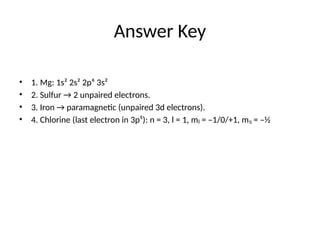
Answer Key
• 1.Mg: 1s² 2s² 2p⁶ 3s²
• 2. Sulfur → 2 unpaired electrons.
• 3. Iron → paramagnetic (unpaired 3d electrons).
• 4. Chlorine (last electron in 3p⁵): n = 3, l = 1, m = –1/0/+1, m = –½
ₗ ₛ
17.
Summary & Conclusion
•Quantum Numbers → address system for electrons.
• Electron Configuration → how electrons fill orbitals.
• Aufbau, Pauli, Hund → rules that govern electron arrangement.
• Magnetism depends on paired/unpaired electrons.
• Orbital diagrams visualize electron distribution.
• 👉 These concepts explain the chemical behavior of every element!
• [Closing visual: Periodic table with electron shells highlighted.]

![Introduction
• Electrons determine chemical properties of atoms.
• To describe electrons, we use quantum numbers and electron
configurations.
• These concepts explain why elements behave differently.
• [Visual: Periodic table with electron shells highlighted]](https://image.slidesharecdn.com/quantumnumberselectronconfigpresentation-250907015246-44340c42/85/Quantum_Numbers_Electron___Config_Presentation-pptx-2-320.jpg)
![Spin Quantum Number (m )
ₛ
• Describes spin of electron.
• Values: +½ (↑) or –½ (↓).
• Explains why orbitals can hold max 2 electrons with opposite spins.
• [Diagram suggestion: A table of quantum numbers with values and
examples.]](https://image.slidesharecdn.com/quantumnumberselectronconfigpresentation-250907015246-44340c42/85/Quantum_Numbers_Electron___Config_Presentation-pptx-7-320.jpg)
![Aufbau Principle
• Electrons fill orbitals from lowest energy to highest.
• Order: 1s → 2s → 2p → 3s → 3p → 4s → 3d → 4p → …
• Rule shown by Aufbau diagram (diagonal arrows).
• Example: Carbon (Z = 6) → 1s² 2s² 2p²
• [Diagram suggestion: Aufbau filling diagram with arrows.]](https://image.slidesharecdn.com/quantumnumberselectronconfigpresentation-250907015246-44340c42/85/Quantum_Numbers_Electron___Config_Presentation-pptx-9-320.jpg)
![Pauli Exclusion Principle
• No two electrons in the same atom can have the same four quantum
numbers.
• Each orbital can hold a maximum of 2 electrons with opposite spins.
• Example: 1s orbital → holds 2 electrons, one ↑ and one ↓
• [Diagram suggestion: 1s orbital with two opposite spins.]](https://image.slidesharecdn.com/quantumnumberselectronconfigpresentation-250907015246-44340c42/85/Quantum_Numbers_Electron___Config_Presentation-pptx-10-320.jpg)
![Hund’s Rule
• When filling orbitals of the same energy (degenerate orbitals), electrons
occupy empty orbitals singly first before pairing.
• This minimizes electron repulsion and stabilizes the atom.
• Example: Nitrogen (Z = 7) → 2p³ → ↑ ↑ ↑ instead of ↑↓ ↑ _
• [Diagram suggestion: p orbital boxes with arrows.]](https://image.slidesharecdn.com/quantumnumberselectronconfigpresentation-250907015246-44340c42/85/Quantum_Numbers_Electron___Config_Presentation-pptx-11-320.jpg)
![Diamagnetism & Paramagnetism
• Diamagnetic atoms → all electrons paired → weakly repelled by a
magnetic field.
• Paramagnetic atoms → have unpaired electrons → attracted to a magnetic
field.
• Examples:
• Neon (1s² 2s² 2p⁶) → all paired → diamagnetic.
• Oxygen (1s² 2s² 2p⁴) → 2 unpaired → paramagnetic.
• [Diagram suggestion: Oxygen orbital diagram showing unpaired spins.]](https://image.slidesharecdn.com/quantumnumberselectronconfigpresentation-250907015246-44340c42/85/Quantum_Numbers_Electron___Config_Presentation-pptx-12-320.jpg)
![Orbital Diagrams
• Visual representation of electron configuration using boxes and arrows.
• Each box = one orbital; each arrow = one electron.
• Example: Carbon (Z = 6):
• 1s: ↑↓ , 2s: ↑↓ , 2p: ↑ _ _
• [Diagram suggestion: Show Carbon, Nitrogen, Oxygen orbital diagrams.]](https://image.slidesharecdn.com/quantumnumberselectronconfigpresentation-250907015246-44340c42/85/Quantum_Numbers_Electron___Config_Presentation-pptx-13-320.jpg)
![Summary & Conclusion
• Quantum Numbers → address system for electrons.
• Electron Configuration → how electrons fill orbitals.
• Aufbau, Pauli, Hund → rules that govern electron arrangement.
• Magnetism depends on paired/unpaired electrons.
• Orbital diagrams visualize electron distribution.
• 👉 These concepts explain the chemical behavior of every element!
• [Closing visual: Periodic table with electron shells highlighted.]](https://image.slidesharecdn.com/quantumnumberselectronconfigpresentation-250907015246-44340c42/85/Quantum_Numbers_Electron___Config_Presentation-pptx-17-320.jpg)


![谷歌留痕技术 [ 𝙩𝙤𝙥 𝟮𝟯𝟯. 𝙘 𝙤𝙢 ]](https://cdn.slidesharecdn.com/ss_thumbnails/top233-260130174328-3833018c-thumbnail.jpg?width=640&height=640&fit=bounds)


