PAYMENT SYSTEMS IN BANKINGSUSHIL KAMBLE            PRN NO.10020242034VARUN PATNI                PRN NO.10020242031VIMAL PANJWANI        PRN NO.10020242032VISHAL RATAN              PRN NO.10020242033
PAYMENT SYSTEM:Under bank of international settlement(BIS) definition, a payment system consist of instruments, banking procedures and typically interbank funds transfer that ensures and facilitate the circulation of money. In essence, it facilitates corporation, businesses and consumers to transfer funds to one other.
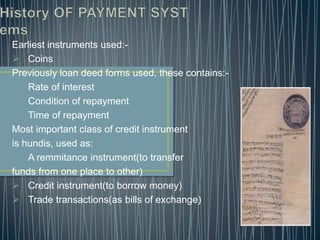
History OF PAYMENT SYSTemsEarliest instruments used:-CoinsPreviously loan deed forms used, these contains:-Rate of interest
Condition of repayment
Time of repaymentMost important class of credit instrument is hundis, used as:A remmitance instrument(to transfer funds from one place to other)Credit instrument(to borrow money)
Trade transactions(as bills of exchange)Moving forward to paper money.Origin in 18th century:Earlier issued by private banks and semi government banks,earliest of them were:-
General bank in Bengal
Bengal banks
Later 3 presidency banks established.
Paper currency act 1961, gives monopoly to government to issue notes, end to issue notes by private and presidency banks.
Other payment instruments include cheques(introduced by bank of Hindustan, estb. 1770)
In 1883,cash credit account added to bank of bengal’s array of credit instruments(includes granting loans against security of company’s paper, bullion, jewels etc. CONTINUED…Buying and selling bills of exchange become one of items of business to be conducted by bank of Bengal from 1839.
In 1881, the negotiable instrument act(NI). Formalizing usage of instruments like cheque, bills of exchange, promissory notes, provide legal framework for non-cash paper payment instrument.MILESTONES OF EVOLUTION OF PAYMENT SYSTEMS IN INDIA:The CLEARING SYSTEM in India provides a convenient and well established institutional mechanism to take care of the problem of physical delivery of instruments as well as funds transfer between different banks.Computerization of clearing operations was the first major step towards modernization of the payments system. The next important milestone was mechanization of the clearing operations with the introduction of Magnetic Ink Character Recognition (MICR) based cheque processing technology (in 1986) using High Speed Reader Sorter Systems (HSRS).
CONTINUED..The Computerized Cheque Clearing Process has been further consolidated through the introduction of magnetic media based input settlement as an Electronic Banking and Payment System – Reading Material 31 intermediate step towards complete automation of cheque clearing through MICR processing especially to facilitate the high-value and inter-bank clearing.Greyscale Imaging Technology has been introduced (in 2000) as a value added service to the members of the Clearing Houses in some cities which will serve as a forerunner for the introduction of electronic presentment and cheque truncation.
CONTINUED…The Electronic Clearing Service (ECS) was introduced (in 1994) whereby a series of electronic payment instructions are generated to replace paper instruments to meet the requirement of a cost-effective system which would serve as an alternate method of effecting bulk, low value, recurring payment transactions, thereby obviating the need to issue and handle paper instruments.Another development that took place in the payments system scenario was the introduction of the Electronic Funds Transfer Scheme (in 1998) which is a retail funds transfer system and enables an account holder of a bank to transfer funds to another person having an account with any of the participating banks, without any physical movement of instruments from one center to another.
CONTINUED…Centralised Funds Management System (CFMS) – was introduced (in 2002) to facilitate better funds management by account holders with RBI byproviding on-line consolidated information about their transactions / balances across accounts maintained with Deposit Accounts Departments in different offices.Negotiated Dealing System / Securities Settlement System - NDS/SSS – was developed (in 2002) as a system to provide an electronic platform for trading and reporting of transactions in government securities market and to facilitate settlement of these transactions through the delivery versus payment mechanism.
CONTINUED…Clearing of Forex transactions – was instituted (in 2002) as a system to provide net settlement arrangement for forex transactions between members /entities in the foreign exchange market in the country. The process of settling only net obligations reduced the liquidity requirements of foreign currency, sought to reduce transaction costs (SWIFT related) and also take care of settlement related risks since the mechanism was facilitated by guaranteed settlement through central counter party arrangement of the Clearing Corporation of India.
CONTINUED…Real Time Gross Settlement (RTGS) System – was introduced (in 2004) to facilitate predominantly the settlement of inter-bank payments on a real-time and gross basis so as to reduce the incidence of risks in the payment systems.
ROLE OF RBI IN PAYMENT SYSTEMS:The Reserve Bank of India participates in the payment systems as a user of the system, as the service provider for various components of the systems and is also the regulator of the systems in many instances.
CONTINUED…As a user, the RBI submits instruments for clearing in the cheque-based clearing operations. RBI also participates as an user in the ECS and EFT systems for making its own internal payments to its employees, vendor payments etc.Similarly, RBI transactions in Repo / Reverse Repo under LAF, Open Market Operations etc.,would also be settled through the respective components of payment systems.
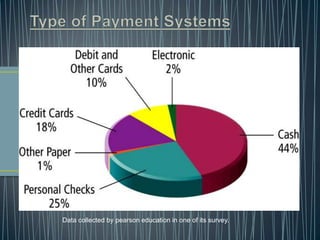
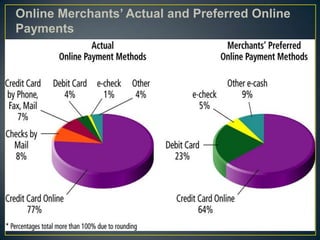
Type of Payment SystemsData collected by pearson education in one of its survey.
CashLegal tender defined by a national authority torepresent valueMost common form of payment in terms of number oftransactionsInstantly convertible into other forms of value withoutintermediation of any kindPortable, requires no authentication, and providesinstant purchasing power“Free” (no transaction fee), anonymous, low cognitivedemandsLimitations: easily stolen, limited to smallertransaction, does not provide any float (the period oftime between a purchase and actual payment for the purchase.
Checking TransferFunds transferred directly via a signed draft or checkfrom a consumer’s checking account to a merchantor other individualMost common form of payment in terms of amountspendCan be used for both small and large transactionsSome floatNot anonymous, require third-party intervention(banks)Introduce security risks for merchants (forgeries,stopped payments), so authentication typically required.
Credit CardRepresents an account that extends credit toconsumers, permitting consumers to purchase itemswhile deferring payment, and allows consumers tomake payments to multiple vendors at one timeCredit card associations – Nonprofit associations(Visa, MasterCard) that set standards for issuingbanksIssuing banks – Issue cards and process transactionsProcessing centers (clearinghouses) – Handleverification of accounts and balances.
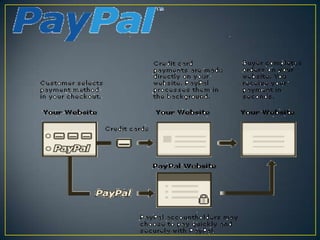
Stored ValueAccounts created by depositing funds into anaccount and from which funds are paid out orwithdrawn as neededExamples: Debit cards, gift certificates,prepaid cards, smart cardsDebit cards: Immediately debit a checking orother demand-deposit accountPeer-to-peer payment systems such asPayPal a variation
Accumulating BalanceAccounts that accumulate expenditures andto which consumers make period paymentsExamples: utility, phone, American Expressaccounts
Current Online Payment SystemsCredit cards are dominant form of online payment,accounting for around 80% of online payments in2002New forms of electronic payment include:Digital cashOnline stored value systemsDigital accumulating balance payment systemsDigital credit accountsDigital checking
E-commerce payment system facilitates the acceptance of ELECTRONIC PAAY MENT for ONLINE TRANSACTIONS. Also known as ELECTRONIC DATA INTERCHANGE(EDI), e-commerce payment systems have become increasingly popular due to the widespread use of the internet-based shopping and banking.
FACTS AND EXAPMLES:In the early years of B2C transactions, many consumers were apprehensive of using their credit and debit cards over the internet because of the perceived increased risk of fraud. Recent research shows that 30% of people in the United Kingdom still do not shop online because they do not trust online payment systems.

Payment systems

  • 1.
    PAYMENT SYSTEMS INBANKINGSUSHIL KAMBLE PRN NO.10020242034VARUN PATNI PRN NO.10020242031VIMAL PANJWANI PRN NO.10020242032VISHAL RATAN PRN NO.10020242033
  • 2.
    PAYMENT SYSTEM:Under bankof international settlement(BIS) definition, a payment system consist of instruments, banking procedures and typically interbank funds transfer that ensures and facilitate the circulation of money. In essence, it facilitates corporation, businesses and consumers to transfer funds to one other.
  • 3.
    History OF PAYMENTSYSTemsEarliest instruments used:-CoinsPreviously loan deed forms used, these contains:-Rate of interest
  • 4.
  • 5.
    Time of repaymentMostimportant class of credit instrument is hundis, used as:A remmitance instrument(to transfer funds from one place to other)Credit instrument(to borrow money)
  • 6.
    Trade transactions(as billsof exchange)Moving forward to paper money.Origin in 18th century:Earlier issued by private banks and semi government banks,earliest of them were:-
  • 7.
  • 8.
  • 9.
    Later 3 presidencybanks established.
  • 10.
    Paper currency act1961, gives monopoly to government to issue notes, end to issue notes by private and presidency banks.
  • 11.
    Other payment instrumentsinclude cheques(introduced by bank of Hindustan, estb. 1770)
  • 12.
    In 1883,cash creditaccount added to bank of bengal’s array of credit instruments(includes granting loans against security of company’s paper, bullion, jewels etc. CONTINUED…Buying and selling bills of exchange become one of items of business to be conducted by bank of Bengal from 1839.
  • 13.
    In 1881, thenegotiable instrument act(NI). Formalizing usage of instruments like cheque, bills of exchange, promissory notes, provide legal framework for non-cash paper payment instrument.MILESTONES OF EVOLUTION OF PAYMENT SYSTEMS IN INDIA:The CLEARING SYSTEM in India provides a convenient and well established institutional mechanism to take care of the problem of physical delivery of instruments as well as funds transfer between different banks.Computerization of clearing operations was the first major step towards modernization of the payments system. The next important milestone was mechanization of the clearing operations with the introduction of Magnetic Ink Character Recognition (MICR) based cheque processing technology (in 1986) using High Speed Reader Sorter Systems (HSRS).
  • 14.
    CONTINUED..The Computerized ChequeClearing Process has been further consolidated through the introduction of magnetic media based input settlement as an Electronic Banking and Payment System – Reading Material 31 intermediate step towards complete automation of cheque clearing through MICR processing especially to facilitate the high-value and inter-bank clearing.Greyscale Imaging Technology has been introduced (in 2000) as a value added service to the members of the Clearing Houses in some cities which will serve as a forerunner for the introduction of electronic presentment and cheque truncation.
  • 15.
    CONTINUED…The Electronic ClearingService (ECS) was introduced (in 1994) whereby a series of electronic payment instructions are generated to replace paper instruments to meet the requirement of a cost-effective system which would serve as an alternate method of effecting bulk, low value, recurring payment transactions, thereby obviating the need to issue and handle paper instruments.Another development that took place in the payments system scenario was the introduction of the Electronic Funds Transfer Scheme (in 1998) which is a retail funds transfer system and enables an account holder of a bank to transfer funds to another person having an account with any of the participating banks, without any physical movement of instruments from one center to another.
  • 16.
    CONTINUED…Centralised Funds ManagementSystem (CFMS) – was introduced (in 2002) to facilitate better funds management by account holders with RBI byproviding on-line consolidated information about their transactions / balances across accounts maintained with Deposit Accounts Departments in different offices.Negotiated Dealing System / Securities Settlement System - NDS/SSS – was developed (in 2002) as a system to provide an electronic platform for trading and reporting of transactions in government securities market and to facilitate settlement of these transactions through the delivery versus payment mechanism.
  • 17.
    CONTINUED…Clearing of Forextransactions – was instituted (in 2002) as a system to provide net settlement arrangement for forex transactions between members /entities in the foreign exchange market in the country. The process of settling only net obligations reduced the liquidity requirements of foreign currency, sought to reduce transaction costs (SWIFT related) and also take care of settlement related risks since the mechanism was facilitated by guaranteed settlement through central counter party arrangement of the Clearing Corporation of India.
  • 18.
    CONTINUED…Real Time GrossSettlement (RTGS) System – was introduced (in 2004) to facilitate predominantly the settlement of inter-bank payments on a real-time and gross basis so as to reduce the incidence of risks in the payment systems.
  • 19.
    ROLE OF RBIIN PAYMENT SYSTEMS:The Reserve Bank of India participates in the payment systems as a user of the system, as the service provider for various components of the systems and is also the regulator of the systems in many instances.
  • 20.
    CONTINUED…As a user,the RBI submits instruments for clearing in the cheque-based clearing operations. RBI also participates as an user in the ECS and EFT systems for making its own internal payments to its employees, vendor payments etc.Similarly, RBI transactions in Repo / Reverse Repo under LAF, Open Market Operations etc.,would also be settled through the respective components of payment systems.
  • 21.
    Type of PaymentSystemsData collected by pearson education in one of its survey.
  • 22.
    CashLegal tender definedby a national authority torepresent valueMost common form of payment in terms of number oftransactionsInstantly convertible into other forms of value withoutintermediation of any kindPortable, requires no authentication, and providesinstant purchasing power“Free” (no transaction fee), anonymous, low cognitivedemandsLimitations: easily stolen, limited to smallertransaction, does not provide any float (the period oftime between a purchase and actual payment for the purchase.
  • 23.
    Checking TransferFunds transferreddirectly via a signed draft or checkfrom a consumer’s checking account to a merchantor other individualMost common form of payment in terms of amountspendCan be used for both small and large transactionsSome floatNot anonymous, require third-party intervention(banks)Introduce security risks for merchants (forgeries,stopped payments), so authentication typically required.
  • 24.
    Credit CardRepresents anaccount that extends credit toconsumers, permitting consumers to purchase itemswhile deferring payment, and allows consumers tomake payments to multiple vendors at one timeCredit card associations – Nonprofit associations(Visa, MasterCard) that set standards for issuingbanksIssuing banks – Issue cards and process transactionsProcessing centers (clearinghouses) – Handleverification of accounts and balances.
  • 25.
    Stored ValueAccounts createdby depositing funds into anaccount and from which funds are paid out orwithdrawn as neededExamples: Debit cards, gift certificates,prepaid cards, smart cardsDebit cards: Immediately debit a checking orother demand-deposit accountPeer-to-peer payment systems such asPayPal a variation
  • 26.
    Accumulating BalanceAccounts thataccumulate expenditures andto which consumers make period paymentsExamples: utility, phone, American Expressaccounts
  • 27.
    Current Online PaymentSystemsCredit cards are dominant form of online payment,accounting for around 80% of online payments in2002New forms of electronic payment include:Digital cashOnline stored value systemsDigital accumulating balance payment systemsDigital credit accountsDigital checking
  • 28.
    E-commerce payment systemfacilitates the acceptance of ELECTRONIC PAAY MENT for ONLINE TRANSACTIONS. Also known as ELECTRONIC DATA INTERCHANGE(EDI), e-commerce payment systems have become increasingly popular due to the widespread use of the internet-based shopping and banking.
  • 29.
    FACTS AND EXAPMLES:Inthe early years of B2C transactions, many consumers were apprehensive of using their credit and debit cards over the internet because of the perceived increased risk of fraud. Recent research shows that 30% of people in the United Kingdom still do not shop online because they do not trust online payment systems.