APPLIED
PHYSICS
     1
CODE : 07A1BS05
     I B.TECH
CSE, IT, ECE & EEE
   UNIT-2
NO. OF SLIDES : 18


                     2
UNIT INDEX
                       UNIT-2
S.No          Module            Lectur PPT Slide
.                               e      No.
                                No.
 1        Waves & Particles -   L1     5
            Planck’s Quantum
            theory.
 2     De Broglie               L2     6-9
       hypothesis, matter
       waves.
 3     Verification of matter   L3-4   10
       waves

 4     Heisenberg uncertainty   L5     311-12
          principle.
5     Schrödinger’s    L6   13-14
    time independent
  wave equation
6   Physical           L7   15-16
  significance of
  wave function
7    Particle in one   L8   17-18
    dimensional
    potential box.
                            4
Introduction                   Lecture-1


1. According to Plank’s quantum
   theory, energy is emitted in the form
   of packets or quanta called Photons.

2. According to Plank’s law, the energy
   of photons per unit volume in black
   body radiation is given by
         Eλ=8πһс∕λ5[exp(h‫/ט‬kT) -1]
                                5
Waves-particles
                                         Lecture-
2

 According to Louis de Broglie since
  radiation such as light exhibits dual nature
  both wave and particle, the matter must
  also posses dual nature.
 The wave associated with matter called
  matter wave has the wavelength λ=h/m‫ט‬
  and is called de Broglie wavelength

                                     6
Characteristics of matter waves
                                                  Lecture-3


Since λ=h/m‫,ט‬
1. Lighter the particle, greater is the wavelength
    associated with it.
2. Lesser the velocity of the particle, longer the
    wavelength associated with it.
3. For v=0, λ=∞. This means that only with
    moving particle matter wave is associated.
4. Whether the particle is charged or not, matter
    wave is associated with it. This reveals that these
    waves are not electromagnetic but a new kind of
    waves.                                7
6.No single phenomena exhibits both particle nature
   and wave nature simultaneously.

7. While position of a particle is confined to a
    particular location at any time, the matter wave
    associated with it has some spread as it is a wave.
    Thus the wave nature of matter introduces an
    uncertainty in the location of the position of the
    particle. Heisenberg’s uncertainty principle is
    based on this concept.
                                          8
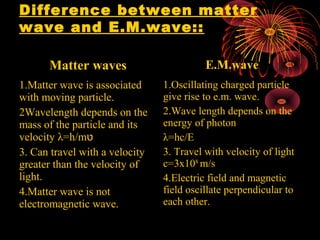
Difference between matter
wave and E.M.wave::

      Matter waves                        E.M.wave
1.Matter wave is associated     1.Oscillating charged particle
with moving particle.           give rise to e.m. wave.
2Wavelength depends on the      2.Wave length depends on the
mass of the particle and its    energy of photon
velocity λ=h/m‫ט‬                 λ=hc/E
3. Can travel with a velocity   3. Travel with velocity of light
greater than the velocity of    c=3x10⁸ m/s
light.                          4.Electric field and magnetic
4.Matter wave is not            field oscillate perpendicular to
electromagnetic wave.           each other.

                                                9
Lecture-4


   Davisson and Germer provided
    experimental evidence on matter wave
    when they conducted electron diffraction
    experiments.
   G.P.Thomson independently conducted
    experiments on diffraction of electrons
    when they fall on thin metallic films.
   x


                                   10
Heisenberg’s uncertainty principle
                             Lecture-5


 “It is impossible to specify precisely and
  simultaneously the values of both
  members of particular pair of physical
  variables that describe the behavior an
  atomic system”.

 If ∆x and ∆p are the uncertainties in the
  measurements of position and momentum
  of a system, according to uncertainty
  principle.
          ∆x∆p≥ h/4π


•
                                    11
9.If ∆E and ∆t are the uncertainties in the
  measurements of energy and time of a
  system, according to uncertainty
  parinciple.
        ∆E∆t≥ h/4π


                                   12
Schrödinger wave equation    Lecture-6


  Schrodinger developed a
  differential equation whose solutions
  yield the possible wave functions
  that can be associated with a
  particle in a given situation.
 This equation is popularly known as
  schrodinger equation.
 The equation tells us how the wave
  function changes as a result of
  forces acting on the particle.
                              13
• The one dimensional time
  independent schrodinger wave
  equation is given by     d2Ψ/dx2 +
  [2m(E-V)/ ћ2] Ψ=0
                 (or)
   d2Ψ/dx2+ [8π2m(E-V) / h2] Ψ=0


                            14
Physical significance of Wave
function Ψ          Lecture-7


1. The wave functions Ψn and the corresponding
  energies En, which are often called eigen functions
  and eigen values respectively, describe the
  quantum state of the particle.
2.The wave function Ψ has no direct physical
  meaning. It is a complex quantity
  representing the variation of matter wave.
  It connects the particle nature and its
  associated wave nature.
                                        15
3.ΨΨ* or |Ψ|2 is the probability density
  function. ΨΨ*dxdydz gives the probability
  of finding the electron in the region of
  space between x and x+dx, y and y+dy and
  z and z+dz.If the particle is present∫
  ∫ΨΨ*dxdydz=1
4.It can be considered as probability
  amplitude since it is used to find the
  location of the particle.


                                     16
Particle in one dimensional
potential box           Lecture-8


  • Quantum mechanics has many
    applications in atomic physics.
  • Consider one dimensional potential well
    of width L.
  • Let the potential V=0inside the well and
    V= ∞outside the well.
  • Substituting these values in Schrödinger
   wave equation and simplifying we get
   the energy of the nth quantum level,

                                  17
• En=(n2π2ћ2)/2mL2= n2h2/8mL2
• When the particle is in a potential
  well of width L, Ψn=(√2/L)sin(nπ/L)x
  & En = n2h2/8mL2,n=1,2,3,….
• When the particle is in a potential
  box of sides Lx,Ly,Lz Ψn=(√8/V)sin(nx
  π/Lx) x sin (ny π/Ly) ysin (nz π/Lz)z.
• Where nx, ny or nz is an integer under
  the constraint n2= nx2+ny2+ nz 2. 18

Unit 2

  • 1.
  • 2.
    CODE : 07A1BS05 I B.TECH CSE, IT, ECE & EEE UNIT-2 NO. OF SLIDES : 18 2
  • 3.
    UNIT INDEX UNIT-2 S.No Module Lectur PPT Slide . e No. No. 1 Waves & Particles - L1 5 Planck’s Quantum theory. 2 De Broglie L2 6-9 hypothesis, matter waves. 3 Verification of matter L3-4 10 waves 4 Heisenberg uncertainty L5 311-12 principle.
  • 4.
    5 Schrödinger’s L6 13-14 time independent wave equation 6 Physical L7 15-16 significance of wave function 7 Particle in one L8 17-18 dimensional potential box. 4
  • 5.
    Introduction Lecture-1 1. According to Plank’s quantum theory, energy is emitted in the form of packets or quanta called Photons. 2. According to Plank’s law, the energy of photons per unit volume in black body radiation is given by Eλ=8πһс∕λ5[exp(h‫/ט‬kT) -1] 5
  • 6.
    Waves-particles Lecture- 2  According to Louis de Broglie since radiation such as light exhibits dual nature both wave and particle, the matter must also posses dual nature.  The wave associated with matter called matter wave has the wavelength λ=h/m‫ט‬ and is called de Broglie wavelength 6
  • 7.
    Characteristics of matterwaves Lecture-3 Since λ=h/m‫,ט‬ 1. Lighter the particle, greater is the wavelength associated with it. 2. Lesser the velocity of the particle, longer the wavelength associated with it. 3. For v=0, λ=∞. This means that only with moving particle matter wave is associated. 4. Whether the particle is charged or not, matter wave is associated with it. This reveals that these waves are not electromagnetic but a new kind of waves. 7
  • 8.
    6.No single phenomenaexhibits both particle nature and wave nature simultaneously. 7. While position of a particle is confined to a particular location at any time, the matter wave associated with it has some spread as it is a wave. Thus the wave nature of matter introduces an uncertainty in the location of the position of the particle. Heisenberg’s uncertainty principle is based on this concept. 8
  • 9.
    Difference between matter waveand E.M.wave:: Matter waves E.M.wave 1.Matter wave is associated 1.Oscillating charged particle with moving particle. give rise to e.m. wave. 2Wavelength depends on the 2.Wave length depends on the mass of the particle and its energy of photon velocity λ=h/m‫ט‬ λ=hc/E 3. Can travel with a velocity 3. Travel with velocity of light greater than the velocity of c=3x10⁸ m/s light. 4.Electric field and magnetic 4.Matter wave is not field oscillate perpendicular to electromagnetic wave. each other. 9
  • 10.
    Lecture-4  Davisson and Germer provided experimental evidence on matter wave when they conducted electron diffraction experiments.  G.P.Thomson independently conducted experiments on diffraction of electrons when they fall on thin metallic films.  x 10
  • 11.
    Heisenberg’s uncertainty principle Lecture-5  “It is impossible to specify precisely and simultaneously the values of both members of particular pair of physical variables that describe the behavior an atomic system”.  If ∆x and ∆p are the uncertainties in the measurements of position and momentum of a system, according to uncertainty principle. ∆x∆p≥ h/4π • 11
  • 12.
    9.If ∆E and∆t are the uncertainties in the measurements of energy and time of a system, according to uncertainty parinciple. ∆E∆t≥ h/4π 12
  • 13.
    Schrödinger wave equation Lecture-6  Schrodinger developed a differential equation whose solutions yield the possible wave functions that can be associated with a particle in a given situation.  This equation is popularly known as schrodinger equation.  The equation tells us how the wave function changes as a result of forces acting on the particle. 13
  • 14.
    • The onedimensional time independent schrodinger wave equation is given by d2Ψ/dx2 + [2m(E-V)/ ћ2] Ψ=0 (or) d2Ψ/dx2+ [8π2m(E-V) / h2] Ψ=0 14
  • 15.
    Physical significance ofWave function Ψ Lecture-7 1. The wave functions Ψn and the corresponding energies En, which are often called eigen functions and eigen values respectively, describe the quantum state of the particle. 2.The wave function Ψ has no direct physical meaning. It is a complex quantity representing the variation of matter wave. It connects the particle nature and its associated wave nature. 15
  • 16.
    3.ΨΨ* or |Ψ|2is the probability density function. ΨΨ*dxdydz gives the probability of finding the electron in the region of space between x and x+dx, y and y+dy and z and z+dz.If the particle is present∫ ∫ΨΨ*dxdydz=1 4.It can be considered as probability amplitude since it is used to find the location of the particle. 16
  • 17.
    Particle in onedimensional potential box Lecture-8 • Quantum mechanics has many applications in atomic physics. • Consider one dimensional potential well of width L. • Let the potential V=0inside the well and V= ∞outside the well. • Substituting these values in Schrödinger wave equation and simplifying we get the energy of the nth quantum level, 17
  • 18.
    • En=(n2π2ћ2)/2mL2= n2h2/8mL2 •When the particle is in a potential well of width L, Ψn=(√2/L)sin(nπ/L)x & En = n2h2/8mL2,n=1,2,3,…. • When the particle is in a potential box of sides Lx,Ly,Lz Ψn=(√8/V)sin(nx π/Lx) x sin (ny π/Ly) ysin (nz π/Lz)z. • Where nx, ny or nz is an integer under the constraint n2= nx2+ny2+ nz 2. 18

Editor's Notes