Solutions to Theoretical Question 1
Gravitational Red Shift and the Measurement of Stellar Mass
(a)
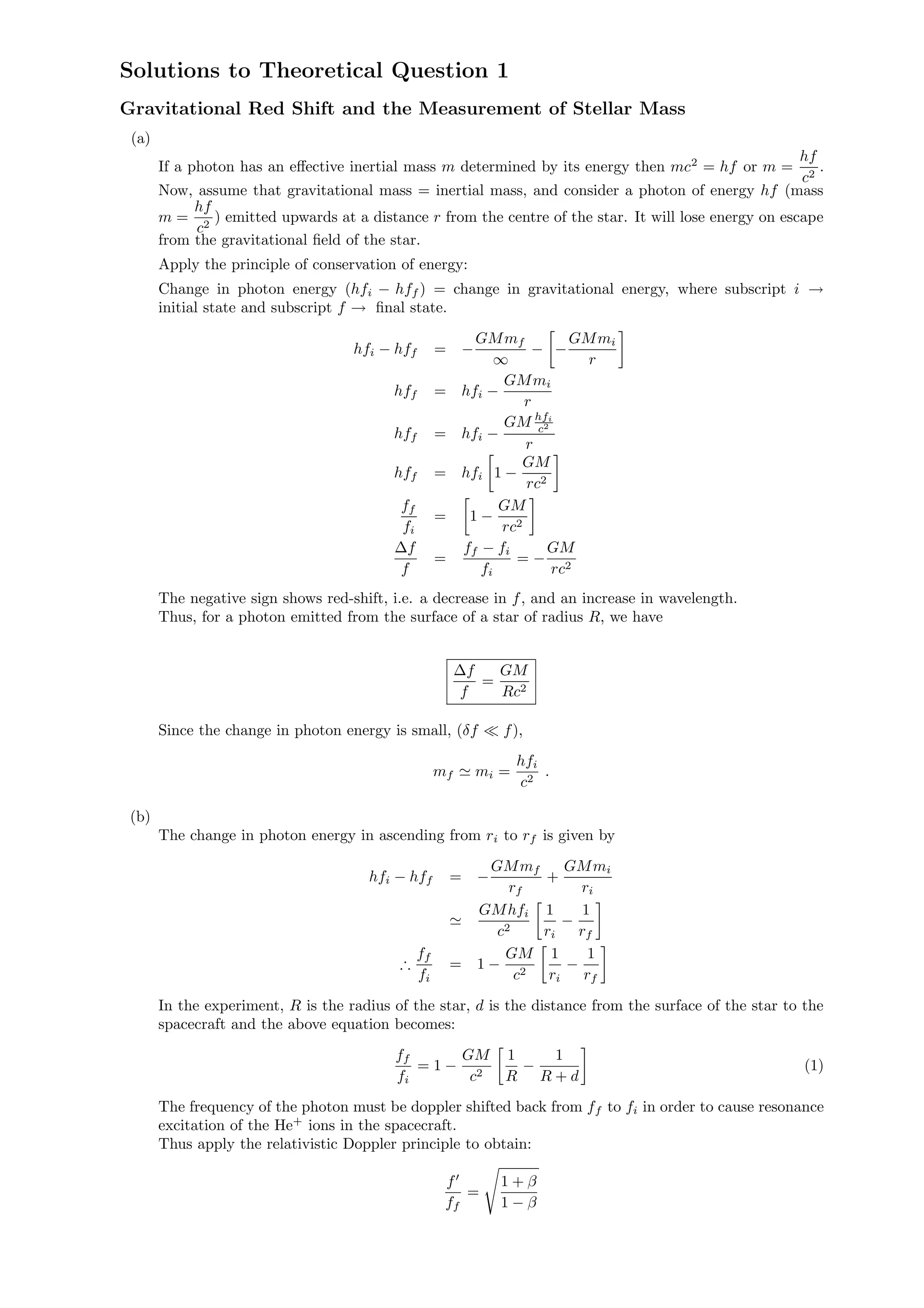
If a photon has an effective inertial mass m determined by its energy then mc2
= hf or m =
hf
c2
.
Now, assume that gravitational mass = inertial mass, and consider a photon of energy hf (mass
m =
hf
c2
) emitted upwards at a distance r from the centre of the star. It will lose energy on escape
from the gravitational field of the star.
Apply the principle of conservation of energy:
Change in photon energy (hfi − hff ) = change in gravitational energy, where subscript i →
initial state and subscript f → final state.
hfi − hff = −
GMmf
∞
− −
GMmi
r
hff = hfi −
GMmi
r
hff = hfi −
GM hfi
c2
r
hff = hfi 1 −
GM
rc2
ff
fi
= 1 −
GM
rc2
∆f
f
=
ff − fi
fi
= −
GM
rc2
The negative sign shows red-shift, i.e. a decrease in f, and an increase in wavelength.
Thus, for a photon emitted from the surface of a star of radius R, we have
∆f
f
=
GM
Rc2
Since the change in photon energy is small, (δf f),
mf mi =
hfi
c2
.
(b)
The change in photon energy in ascending from ri to rf is given by
hfi − hff = −
GMmf
rf
+
GMmi
ri
GMhfi
c2
1
ri
−
1
rf
∴
ff
fi
= 1 −
GM
c2
1
ri
−
1
rf
In the experiment, R is the radius of the star, d is the distance from the surface of the star to the
spacecraft and the above equation becomes:
ff
fi
= 1 −
GM
c2
1
R
−
1
R + d
(1)
The frequency of the photon must be doppler shifted back from ff to fi in order to cause resonance
excitation of the He+
ions in the spacecraft.
Thus apply the relativistic Doppler principle to obtain:
f
ff
=
1 + β
1 − β
where f is the frequency as received by He+
ions in the spacecraft, and β = v/c.
That is, the gravitationally reduced frequency ff has been increased to f because of the velocity
of the ions on the spacecraft towards the star. Since β 1,
ff
f
= (1 − β)
1
2 (1 + β)− 1
2 1 − β
Alternatively, since β 1, use the classical Doppler effect directly.
Thus
f =
ff
1 − β
or
ff
f
= 1 − β
Since f must be equal to fi for resonance absorption, we have
ff
fi
= 1 − β (2)
Substitution of 2 into 1 gives
β =
GM
c2
1
R
−
1
R + d
(3)
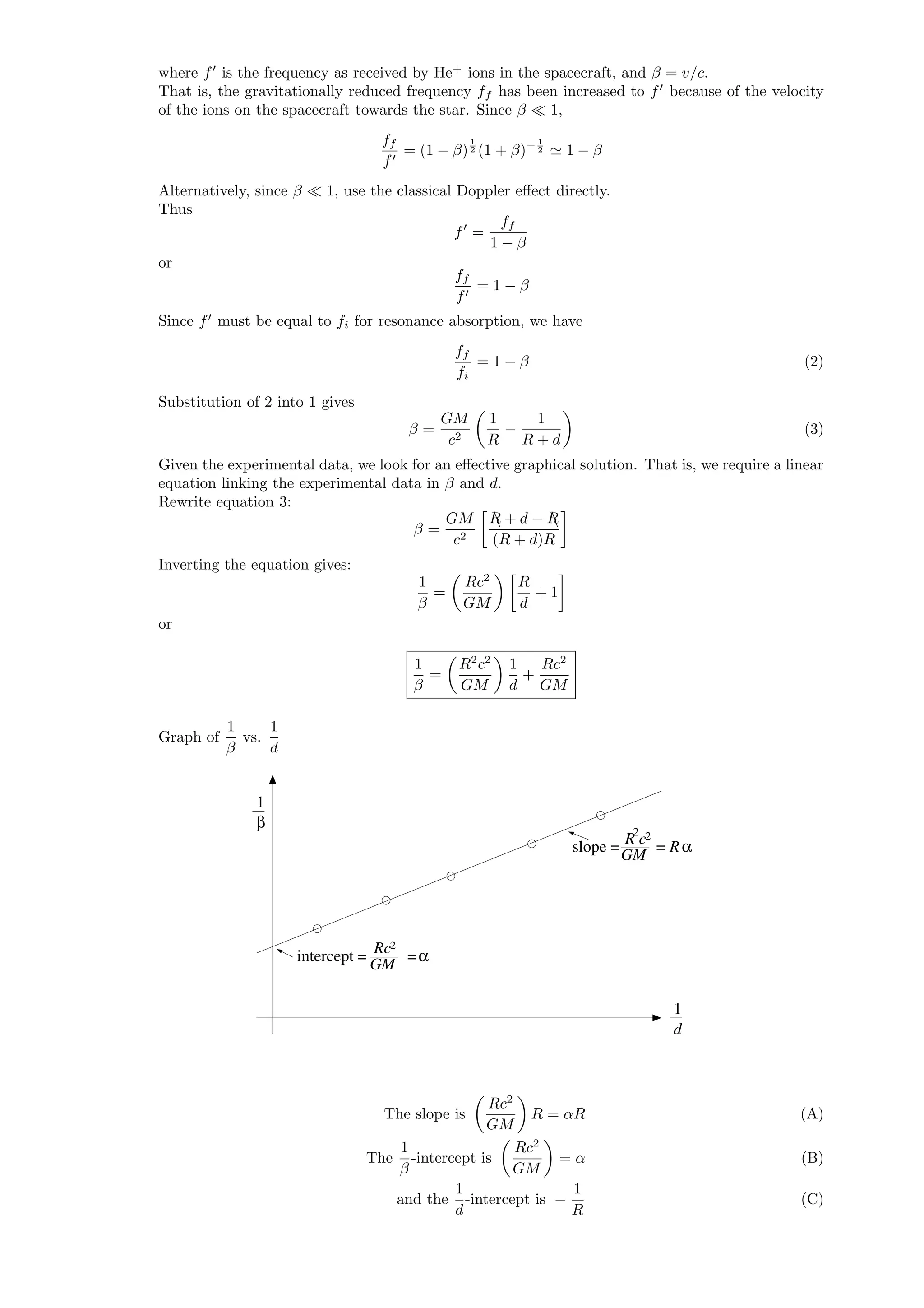
Given the experimental data, we look for an effective graphical solution. That is, we require a linear
equation linking the experimental data in β and d.
Rewrite equation 3:
β =
GM
c2
R + d − R
(R + d)R
Inverting the equation gives:
1
β
=
Rc2
GM
R
d
+ 1
or
1
β
=
R2
c2
GM
1
d
+
Rc2
GM
Graph of
1
β
vs.
1
d
1
1
intercept = =αRc
GM
GM
R cslope = = Rα
2 2
2
β
d
The slope is
Rc2
GM
R = αR (A)
The
1
β
-intercept is
Rc2
GM
= α (B)
and the
1
d
-intercept is −
1
R
(C)
R and M can be conveniently determined from (A) and (B). Equation (C) is redundant. However,
it may be used as an (inaccurate) check if needed.
From the given data:
R = 1.11 × 10⁸
m
M = 5.2 × 10³
0 kg
From the graph, the slope αR = 3.2 × 10¹²
m (A)
The
1
β
-intercept α =
Rc2
GM
= 0.29 × 10⁵
(B)
Dividing (A) by (B)
R =
3.2 × 10¹²
m
0.29 × 10⁵
1.104 × 10⁸
m
Substituting this value of R back into (B) gives:
M =
Rc2
gα
=
(1.104 × 10⁸
) × (3.0 × 10⁸
)2
(6.7 × 10−11) × (0.29 ×1 05)
or M = 5.11 × 1030
kg
(c)
(i)
Atom before the decay Atom and photon after the decay
+ hf
m m0 0
’
For the photon, photon momentum is p =
hf
c
and photon energy is E = hf.
Use the mass-energy equivalence, E = mc2
, to relate the internal energy change of the atom
to the rest-mass change. Thus:
∆E = (m0 = m0) c2
(1)
In the laboratory frame of reference the energy before emission is
E = m0c2
(2)
Recalling the relativistic relation
E2
= p2
c2
+ m2
0c4
The energy after emission of a photon is
E = p2c2 + m0
2c4 + hf (3)
where also p = hf/c by conservation of momentum.
Conservation of energy requires that (2) = (3), so that:
m0c2
− hf
2
= (hf)2
+ m2
0c4
m0c2 2
− 2hfm0c2
= m2
0c4
Carrying out the algebra and using equation (1):
hf(2m0c2
) = (m2
0 − m0
2
)c4
= (m0 − m0)c2
(m0 + m0)c2
= ∆E[2m0 − (m0 − m0)]c2
= ∆E[2m0c2
− ∆E]
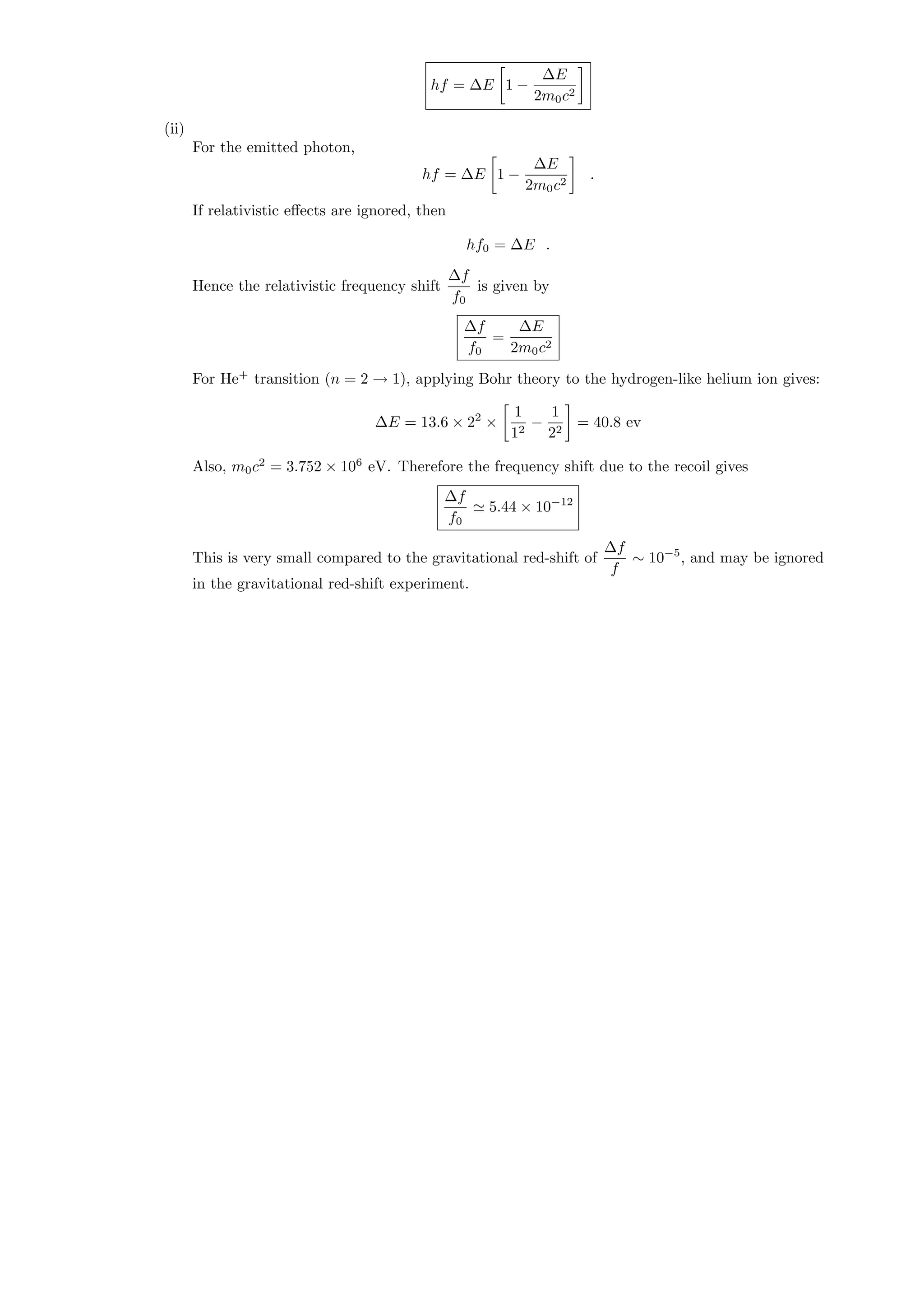
hf = ∆E 1 −
∆E
2m0c2
(ii)
For the emitted photon,
hf = ∆E 1 −
∆E
2m0c2
.
If relativistic effects are ignored, then
hf0 = ∆E .
Hence the relativistic frequency shift
∆f
f0
is given by
∆f
f0
=
∆E
2m0c2
For He+
transition (n = 2 → 1), applying Bohr theory to the hydrogen-like helium ion gives:
∆E = 13.6 × 22
×
1
12
−
1
22
= 40.8 ev
Also, m0c2
= 3.752 × 10⁶
eV. Therefore the frequency shift due to the recoil gives
∆f
f0
5.44 × 10⁻¹²
This is very small compared to the gravitational red-shift of
∆f
f
∼ 10−5
, and may be ignored
in the gravitational red-shift experiment.
Solutions to Theoretical Question 2
(a)
Snell’s Law may be expressed as
sin θ
sin θ0
=
c
c0
, (1)
where c is the speed of sound.
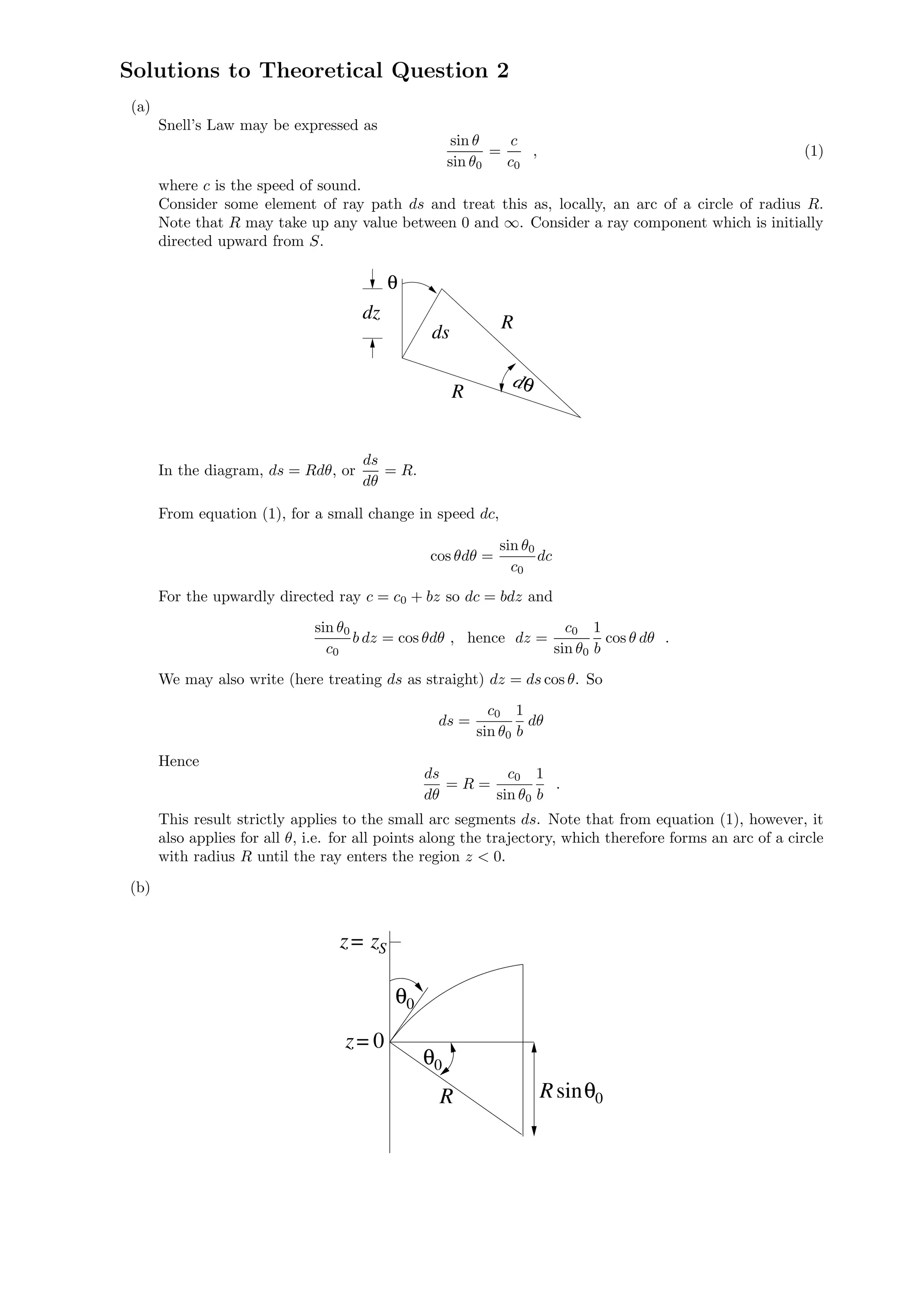
Consider some element of ray path ds and treat this as, locally, an arc of a circle of radius R.
Note that R may take up any value between 0 and ∞. Consider a ray component which is initially
directed upward from S.
dz
dθR
R
ds
θ
In the diagram, ds = Rdθ, or
ds
dθ
= R.
From equation (1), for a small change in speed dc,
cos θdθ =
sin θ0
c0
dc
For the upwardly directed ray c = c0 + bz so dc = bdz and
sin θ0
c0
b dz = cos θdθ , hence dz =
c0
sin θ0
1
b
cos θ dθ .
We may also write (here treating ds as straight) dz = ds cos θ. So
ds =
c0
sin θ0
1
b
dθ
Hence
ds
dθ
= R =
c0
sin θ0
1
b
.
This result strictly applies to the small arc segments ds. Note that from equation (1), however, it
also applies for all θ, i.e. for all points along the trajectory, which therefore forms an arc of a circle
with radius R until the ray enters the region z < 0.
(b)
0θ
0θ
z= 0
z z=
0θ
R sinR
S
Here
zs = R − R sin θ0
= R(1 − sin θ0)
=
c0
b sin θ0
(1 − sin θ0) ,
from which
θ0 = sin−1 c0
bzs + c0
.
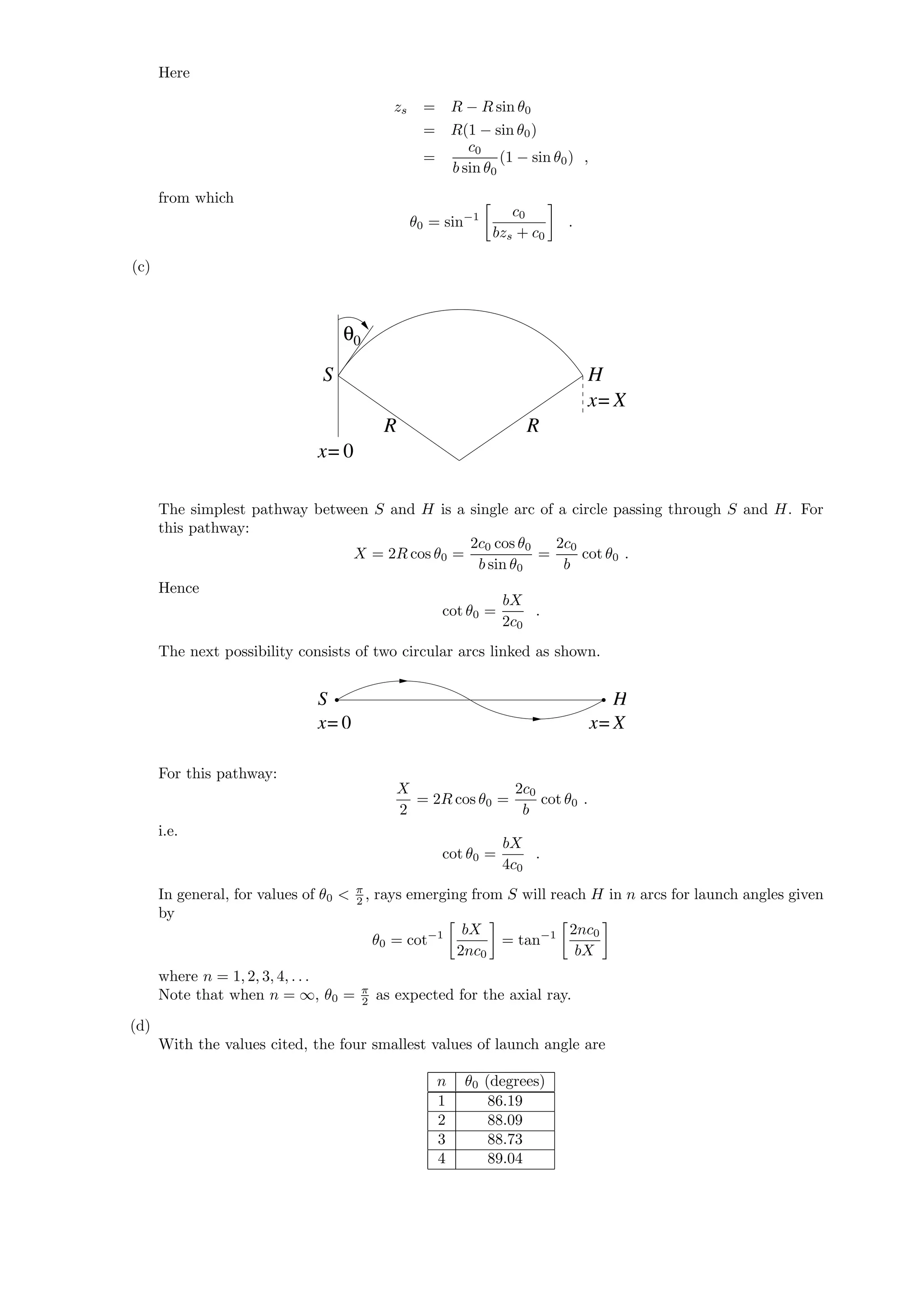
(c)
0θ
x= 0
x=
R
S
R
H
X
The simplest pathway between S and H is a single arc of a circle passing through S and H. For
this pathway:
X = 2R cos θ0 =
2c0 cos θ0
b sin θ0
=
2c0
b
cot θ0 .
Hence
cot θ0 =
bX
2c0
.
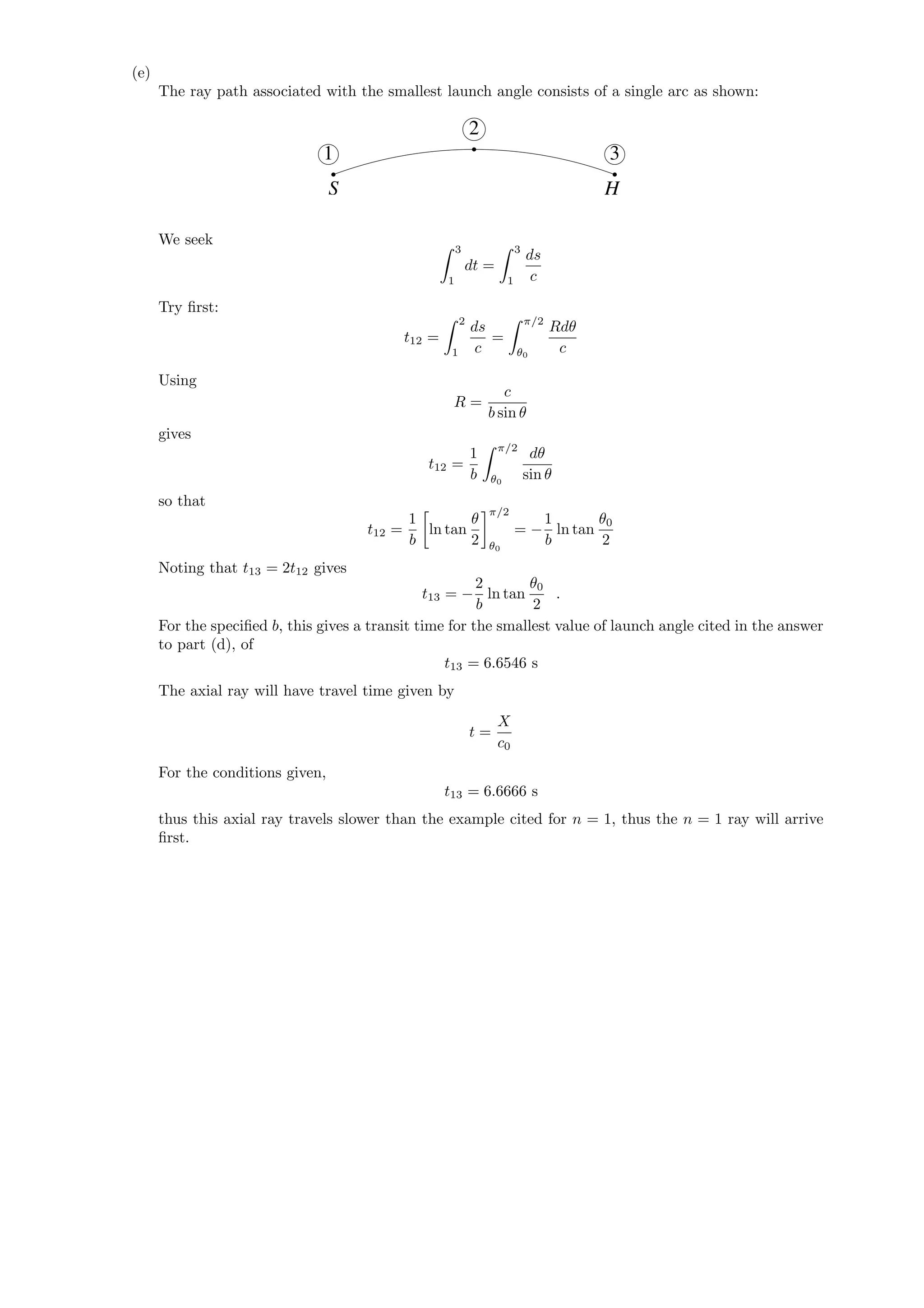
The next possibility consists of two circular arcs linked as shown.
x= 0 x= X
S H
For this pathway:
X
2
= 2R cos θ0 =
2c0
b
cot θ0 .
i.e.
cot θ0 =
bX
4c0
.
In general, for values of θ0 < π
2 , rays emerging from S will reach H in n arcs for launch angles given
by
θ0 = cot−1 bX
2nc0
= tan−1 2nc0
bX
where n = 1, 2, 3, 4, . . .
Note that when n = ∞, θ0 = π
2 as expected for the axial ray.
(d)
With the values cited, the four smallest values of launch angle are
n θ0 (degrees)
1 86.19
2 88.09
3 88.73
4 89.04
(e)
The ray path associated with the smallest launch angle consists of a single arc as shown:
1
2
3
S H
We seek
3
1
dt =
3
1
ds
c
Try first:
t12 =
2
1
ds
c
=
π/2
θ0
Rdθ
c
Using
R =
c
b sin θ
gives
t12 =
1
b
π/2
θ0
dθ
sin θ
so that
t12 =
1
b
ln tan
θ
2
π/2
θ0
= −
1
b
ln tan
θ0
2
Noting that t13 = 2t12 gives
t13 = −
2
b
ln tan
θ0
2
.
For the specified b, this gives a transit time for the smallest value of launch angle cited in the answer
to part (d), of
t13 = 6.6546 s
The axial ray will have travel time given by
t =
X
c0
For the conditions given,
t13 = 6.6666 s
thus this axial ray travels slower than the example cited for n = 1, thus the n = 1 ray will arrive
first.
Solutions to Theoretical Question 3
(a)
The mass of the rod is given equal to the mass of the cylinder M which itself is πa2
ld. Thus the
total mass equals 2M = 2πa2
ld. The mass of the displaced water is surely less than πa2
lρ (when
the buoy is on the verge of sinking). Using Archimedes’ principle, we may at the very least expect
that
2πa2
ld < πa2
lρ or d < ρ/2
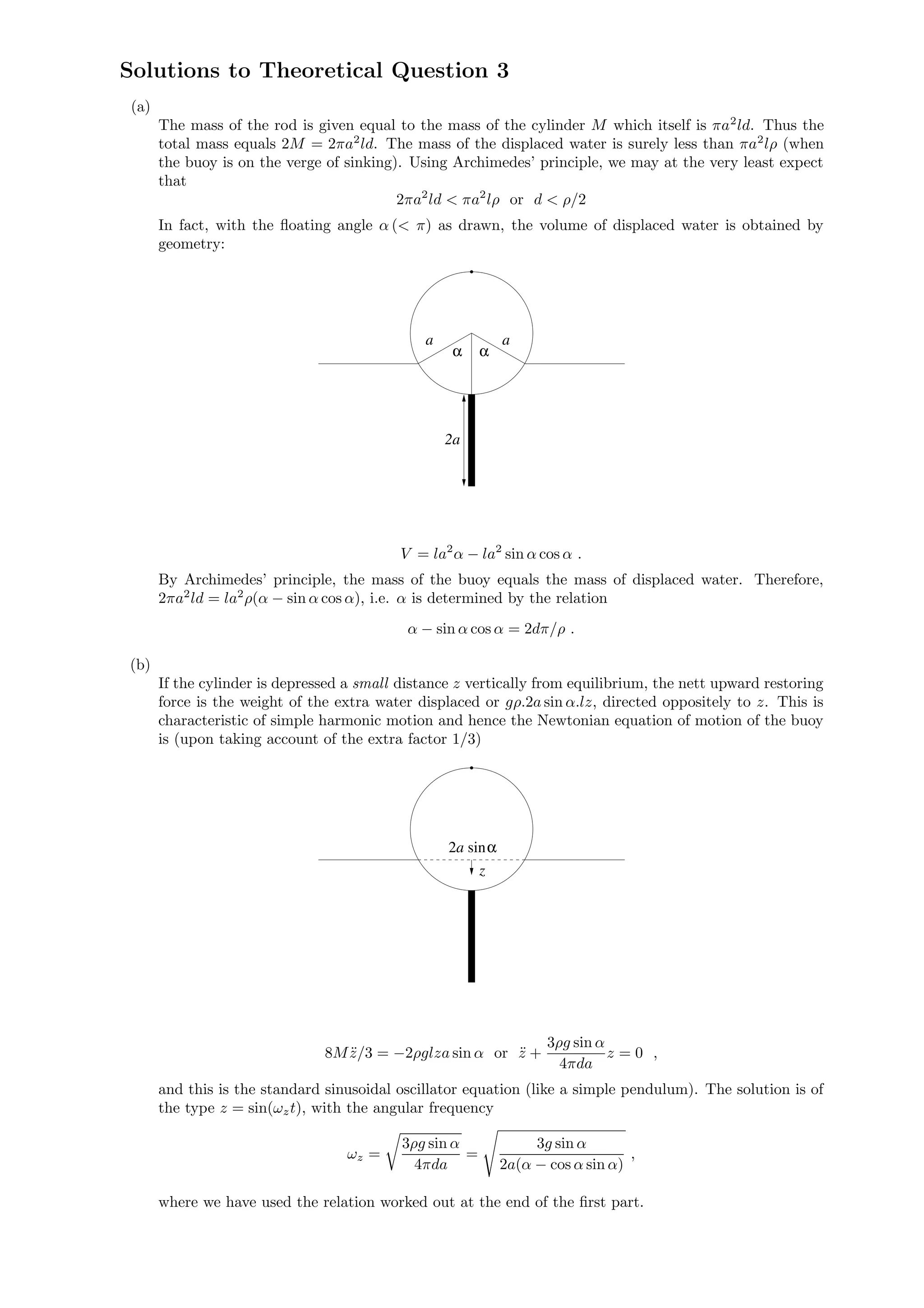
In fact, with the floating angle α (< π) as drawn, the volume of displaced water is obtained by
geometry:
α α
a a
2a
V = la2
α − la2
sin α cos α .
By Archimedes’ principle, the mass of the buoy equals the mass of displaced water. Therefore,
2πa2
ld = la2
ρ(α − sin α cos α), i.e. α is determined by the relation
α − sin α cos α = 2dπ/ρ .
(b)
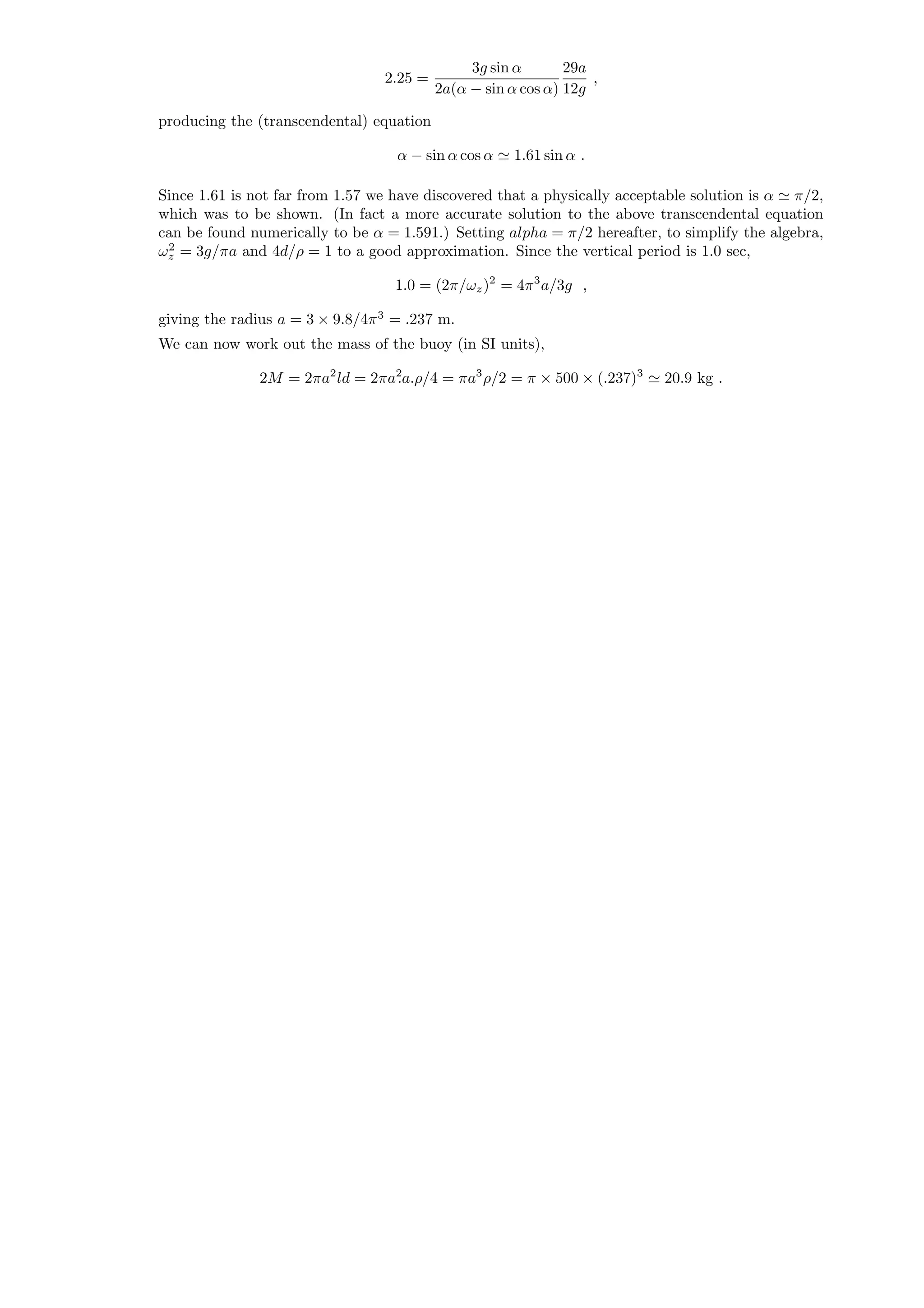
If the cylinder is depressed a small distance z vertically from equilibrium, the nett upward restoring
force is the weight of the extra water displaced or gρ.2a sin α.lz, directed oppositely to z. This is
characteristic of simple harmonic motion and hence the Newtonian equation of motion of the buoy
is (upon taking account of the extra factor 1/3)
z
a2 sinα
8M ¨z/3 = −2ρglza sin α or ¨z +
3ρg sin α
4πda
z = 0 ,
and this is the standard sinusoidal oscillator equation (like a simple pendulum). The solution is of
the type z = sin(ωzt), with the angular frequency
ωz =
3ρg sin α
4πda
=
3g sin α
2a(α − cos α sin α)
,
where we have used the relation worked out at the end of the first part.
(c)
Without regard to the torque and only paying heed to vertical forces, if the buoy is swung by some
angle so that its weight is supported by the nett pressure of the water outside, the volume of water
displaced is the same as in equilibrium. Thus the centre of buoyancy remains at the same distance
from the centre of the cylinder. Consequently we deduce that the buoyancy arc is an arc of a circle
centred at the middle of the cylinder. In other words, the metacentre M of the swinging motion is
just the centre of the cylinder. In fact the question assumes this.
We should also notice that the centre of mass G of the buoy is at the point where the rod touches the
cylinder, since the masses of rod and cylinder each equal M. Of course the cylinder will experience
a nett torque when the rod is inclined to the vertical. To find the period of swing, we first need to
determine the moment of inertia of the solid cylinder about the central axis; this is just like a disc
about the centre. Thus if M is the cylinder mass
2Mg
2Mg
θ
G
M
I0 = Ma2
/2 =
a
0
r2
dm =
a
0
r2
.2Mr dr/a
The next step is to find the moment of inertia of the rod about its middle,
Irod =
a
−a
(Mdx/2a).x2
= [Mx3
/6a]a
−a = Ma2
/3 .
Finally, use the parallel axis theorem to find the moment of inertia of the buoy (cylinder + rod)
about the metacentre M,
IM = Ma2
/2 + [Ma2
/3 + M(2a)2
] = 29Ma2
/6 .
(In this part we are neglecting the small horizontal motion of the bentre of mass; the water is the
only agent which can supply this force!) When the buoy swings by an angle θ about equilibrium the
restoring torque is 2Mga sin θ 2Mgaθ for small angles, which represents simple harmonic motion
(like simple pendulum). Therefore the Newtonian rotational equation of motion is
IM
¨θ −2Mgaθ , or ¨θ +
12g
29a
= 0 .
The solution is a sinusoidal function, θ ∝ sin(ωθt), with angular frequency
ωθ = 12g/29a .
(d)
The accelerometer measurements give
Tθ/Tz 1.5 or (ωz/ωθ)2
9/4 2.25 . Hence
2.25 =
3g sin α
2a(α − sin α cos α)
29a
12g
,
producing the (transcendental) equation
α − sin α cos α 1.61 sin α .
Since 1.61 is not far from 1.57 we have discovered that a physically acceptable solution is α π/2,
which was to be shown. (In fact a more accurate solution to the above transcendental equation
can be found numerically to be α = 1.591.) Setting alpha = π/2 hereafter, to simplify the algebra,
ω2
z = 3g/πa and 4d/ρ = 1 to a good approximation. Since the vertical period is 1.0 sec,
1.0 = (2π/ωz)2
= 4π3
a/3g ,
giving the radius a = 3 × 9.8/4π3
= .237 m.
We can now work out the mass of the buoy (in SI units),
2M = 2πa2
ld = 2πa2
.a.ρ/4 = πa3
ρ/2 = π × 500 × (.237)3
20.9 kg .
Solutions to Original Theoretical Question 3
(a)
Choose a frame where z is along the normal to the mirror and the light rays define the x–z plane.
For convenience, recording the energy-momentum in the four-vector form, (px, py, pz, E/c), the
initial photon has
Pi = (p sin θi, 0, p cos θi, p)
where p = Ei/c = hfi/c.
u
f f
θθi r
i r
By the given Lorentz transformation rules, in the moving mirror frame the energy-momentum of
the incident photon reads
Pmirror = p sin θi, 0,
p cos θi − up/c
1 − u2/c2
,
p − up cos θi/c
1 − u2/c2
.
Assuming the collision is elastic in that frame, the reflected photon has energy-momentum,
Pmirror = p sin θi, 0,
−p cos θi + up/c
1 − u2/c2
,
p − up cos θi/c
1 − u2/c2
.
Tansforming back to the original frame, we find that the reflected photon has
pxr = p sin θi , pyr = 0
pzr =
(−p cos θi + up/c) + u(p − up cos θi/c)/c
1 − u2/c2
Er/c =
(p − up cos θi/c) + u(−p cos θi + up/c)/c
1 − u2/c2
Simplifying these expressions, the energy-momentum of the reflected photon in the original frame
is
Pr = p sin θi, 0,
p(− cos θi + 2u/c − u2
cos θi/c2
)
1 − u2/c2
,
p(1 − 2u cos θi/c + u2
/c2
)
1 − u2/c2
.
Hence the angle of reflection θr is given by
tan θr = −
pxr
pzr
=
sin θi(1 − u2
/c2
)
cos θi − 2u/c + u2 cos θi/c2
=
tan θi(1 − u2
/c2
)
1 + u2/c2 − 2u sec θi/c2
,
while the ratio of reflected frequency fr to incident frequency fi is simply the energy ratio,
fr
fi
=
Er
Ei
=
1 − 2u cos θi/c + u2
/c2
1 − u2/c2
.
[For future use we may record the changes to first order in u/c:
tan θr tan θi(1 + 2u sec θi/c) so
tan(θr − θi) =
tan θr − tan θi
1 + tan θr tan θi
2u tan θi sec θi/c
1 + tan2
θi
2u sin θi
c
Thus, θr θi + 2u sin θi/c and fr = fi(1 − 2u cos θi/c).]
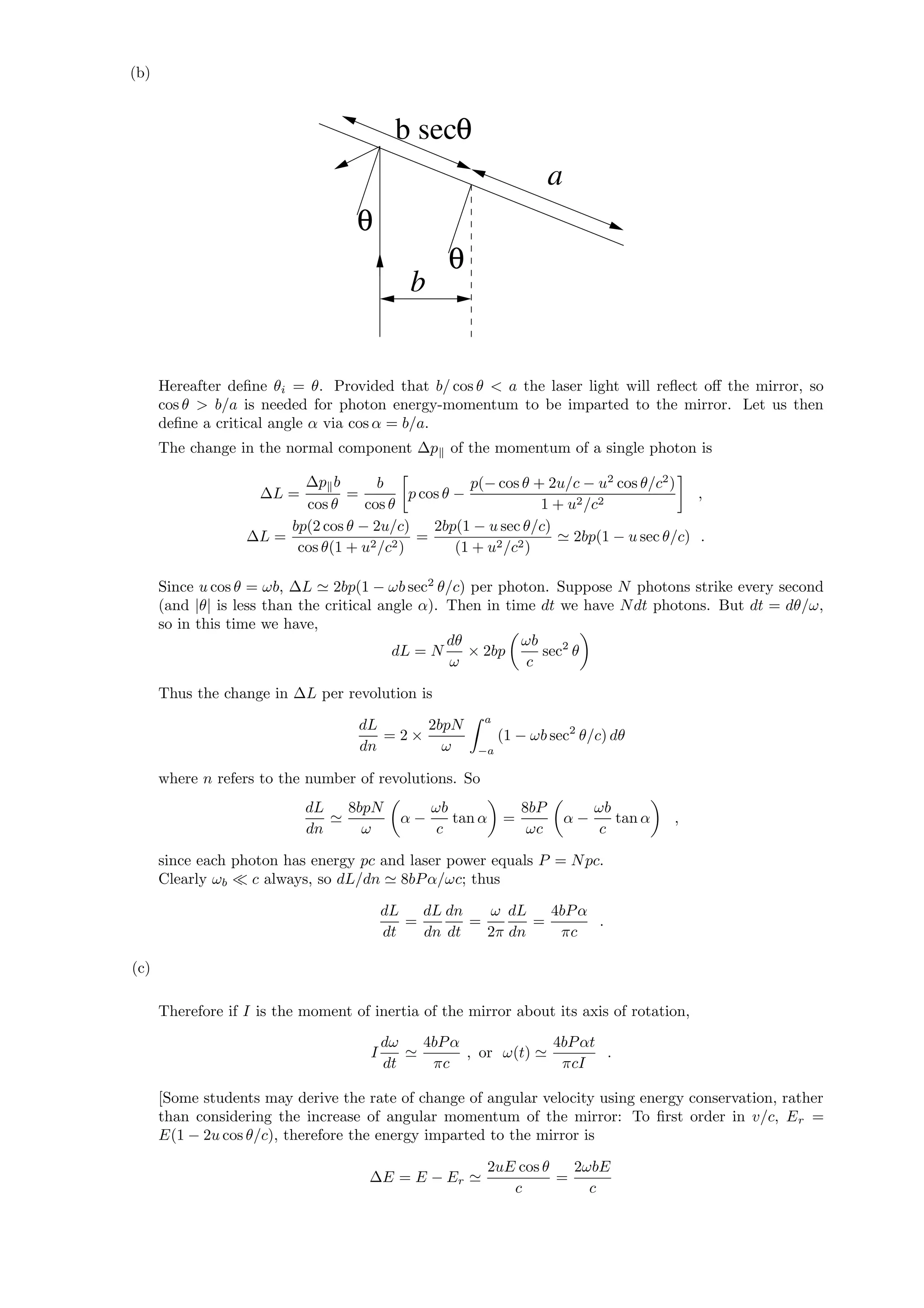
(b)
a
b
b secθ
θ
θ
Hereafter define θi = θ. Provided that b/ cos θ < a the laser light will reflect off the mirror, so
cos θ > b/a is needed for photon energy-momentum to be imparted to the mirror. Let us then
define a critical angle α via cos α = b/a.
The change in the normal component ∆p of the momentum of a single photon is
∆L =
∆p b
cos θ
=
b
cos θ
p cos θ −
p(− cos θ + 2u/c − u2
cos θ/c2
)
1 + u2/c2
,
∆L =
bp(2 cos θ − 2u/c)
cos θ(1 + u2/c2)
=
2bp(1 − u sec θ/c)
(1 + u2/c2)
2bp(1 − u sec θ/c) .
Since u cos θ = ωb, ∆L 2bp(1 − ωb sec2
θ/c) per photon. Suppose N photons strike every second
(and |θ| is less than the critical angle α). Then in time dt we have Ndt photons. But dt = dθ/ω,
so in this time we have,
dL = N
dθ
ω
× 2bp
ωb
c
sec2
θ
Thus the change in ∆L per revolution is
dL
dn
= 2 ×
2bpN
ω
a
−a
(1 − ωb sec2
θ/c) dθ
where n refers to the number of revolutions. So
dL
dn
8bpN
ω
α −
ωb
c
tan α =
8bP
ωc
α −
ωb
c
tan α ,
since each photon has energy pc and laser power equals P = Npc.
Clearly ωb c always, so dL/dn 8bPα/ωc; thus
dL
dt
=
dL
dn
dn
dt
=
ω
2π
dL
dn
=
4bPα
πc
.
(c)
Therefore if I is the moment of inertia of the mirror about its axis of rotation,
I
dω
dt
4bPα
πc
, or ω(t)
4bPαt
πcI
.
[Some students may derive the rate of change of angular velocity using energy conservation, rather
than considering the increase of angular momentum of the mirror: To first order in v/c, Er =
E(1 − 2u cos θ/c), therefore the energy imparted to the mirror is
∆E = E − Er
2uE cos θ
c
=
2ωbE
c
In one revolution, the number of photons intersected is
4α
2π
× n
2π
ω
=
4αn
ω
.
Therefore the rate of increase of rotational energy (Erot = Iω2
/2) is
dErot
dt
=
4αN
ω
2ωbE
c
dn
dt
=
8αbP
c
ω
2π
=
4αbPω
πc
Thus Iω.dω/dt = 4αbP/πc, leading to ω(t) 4αbPt/πcI, again.]
(d)
To estimate the deflection of the beam, one first needs to work out the moment of inertia of a
rectangle of mass m and side 2a about the central axis. This is just like a rod. From basic
principles,
I =
a
−a
m dx
2a
x2
=
mx3
6a
a
−a
=
ma2
3
=
mb2
sec2
α
3
.
With the stated geometry, a = b
√
2, or α = 45◦
, so
ω
12αPt cos2
α
πmcb
→
3Pt
mca
√
2
.
At the edge, u = ωa = 3Pt/mc
√
2, and the angle of deviation is
δ =
2u sin α
c
=
3Pt
mc2
[Interestingly, it is determined by the ratio of the energy produced by the laser to the rest-mass
energy of the mirror.]
Using the given numbers, and in SI units, the deviation is
ξ 104
δ =
104
× 3 × 100 × 24 × 3600
10−3 × (3 × 108)2
2.9 mm .
ξ
mirror
laser
screen δ
4
π/4
10 m

Solution i ph o 26

  • 1.
    Solutions to TheoreticalQuestion 1 Gravitational Red Shift and the Measurement of Stellar Mass (a) If a photon has an effective inertial mass m determined by its energy then mc2 = hf or m = hf c2 . Now, assume that gravitational mass = inertial mass, and consider a photon of energy hf (mass m = hf c2 ) emitted upwards at a distance r from the centre of the star. It will lose energy on escape from the gravitational field of the star. Apply the principle of conservation of energy: Change in photon energy (hfi − hff ) = change in gravitational energy, where subscript i → initial state and subscript f → final state. hfi − hff = − GMmf ∞ − − GMmi r hff = hfi − GMmi r hff = hfi − GM hfi c2 r hff = hfi 1 − GM rc2 ff fi = 1 − GM rc2 ∆f f = ff − fi fi = − GM rc2 The negative sign shows red-shift, i.e. a decrease in f, and an increase in wavelength. Thus, for a photon emitted from the surface of a star of radius R, we have ∆f f = GM Rc2 Since the change in photon energy is small, (δf f), mf mi = hfi c2 . (b) The change in photon energy in ascending from ri to rf is given by hfi − hff = − GMmf rf + GMmi ri GMhfi c2 1 ri − 1 rf ∴ ff fi = 1 − GM c2 1 ri − 1 rf In the experiment, R is the radius of the star, d is the distance from the surface of the star to the spacecraft and the above equation becomes: ff fi = 1 − GM c2 1 R − 1 R + d (1) The frequency of the photon must be doppler shifted back from ff to fi in order to cause resonance excitation of the He+ ions in the spacecraft. Thus apply the relativistic Doppler principle to obtain: f ff = 1 + β 1 − β
  • 2.
    where f isthe frequency as received by He+ ions in the spacecraft, and β = v/c. That is, the gravitationally reduced frequency ff has been increased to f because of the velocity of the ions on the spacecraft towards the star. Since β 1, ff f = (1 − β) 1 2 (1 + β)− 1 2 1 − β Alternatively, since β 1, use the classical Doppler effect directly. Thus f = ff 1 − β or ff f = 1 − β Since f must be equal to fi for resonance absorption, we have ff fi = 1 − β (2) Substitution of 2 into 1 gives β = GM c2 1 R − 1 R + d (3) Given the experimental data, we look for an effective graphical solution. That is, we require a linear equation linking the experimental data in β and d. Rewrite equation 3: β = GM c2 R + d − R (R + d)R Inverting the equation gives: 1 β = Rc2 GM R d + 1 or 1 β = R2 c2 GM 1 d + Rc2 GM Graph of 1 β vs. 1 d 1 1 intercept = =αRc GM GM R cslope = = Rα 2 2 2 β d The slope is Rc2 GM R = αR (A) The 1 β -intercept is Rc2 GM = α (B) and the 1 d -intercept is − 1 R (C)
  • 3.
    R and Mcan be conveniently determined from (A) and (B). Equation (C) is redundant. However, it may be used as an (inaccurate) check if needed. From the given data: R = 1.11 × 10⁸ m M = 5.2 × 10³ 0 kg From the graph, the slope αR = 3.2 × 10¹² m (A) The 1 β -intercept α = Rc2 GM = 0.29 × 10⁵ (B) Dividing (A) by (B) R = 3.2 × 10¹² m 0.29 × 10⁵ 1.104 × 10⁸ m Substituting this value of R back into (B) gives: M = Rc2 gα = (1.104 × 10⁸ ) × (3.0 × 10⁸ )2 (6.7 × 10−11) × (0.29 ×1 05) or M = 5.11 × 1030 kg (c) (i) Atom before the decay Atom and photon after the decay + hf m m0 0 ’ For the photon, photon momentum is p = hf c and photon energy is E = hf. Use the mass-energy equivalence, E = mc2 , to relate the internal energy change of the atom to the rest-mass change. Thus: ∆E = (m0 = m0) c2 (1) In the laboratory frame of reference the energy before emission is E = m0c2 (2) Recalling the relativistic relation E2 = p2 c2 + m2 0c4 The energy after emission of a photon is E = p2c2 + m0 2c4 + hf (3) where also p = hf/c by conservation of momentum. Conservation of energy requires that (2) = (3), so that: m0c2 − hf 2 = (hf)2 + m2 0c4 m0c2 2 − 2hfm0c2 = m2 0c4 Carrying out the algebra and using equation (1): hf(2m0c2 ) = (m2 0 − m0 2 )c4 = (m0 − m0)c2 (m0 + m0)c2 = ∆E[2m0 − (m0 − m0)]c2 = ∆E[2m0c2 − ∆E]
  • 4.
    hf = ∆E1 − ∆E 2m0c2 (ii) For the emitted photon, hf = ∆E 1 − ∆E 2m0c2 . If relativistic effects are ignored, then hf0 = ∆E . Hence the relativistic frequency shift ∆f f0 is given by ∆f f0 = ∆E 2m0c2 For He+ transition (n = 2 → 1), applying Bohr theory to the hydrogen-like helium ion gives: ∆E = 13.6 × 22 × 1 12 − 1 22 = 40.8 ev Also, m0c2 = 3.752 × 10⁶ eV. Therefore the frequency shift due to the recoil gives ∆f f0 5.44 × 10⁻¹² This is very small compared to the gravitational red-shift of ∆f f ∼ 10−5 , and may be ignored in the gravitational red-shift experiment.
  • 5.
    Solutions to TheoreticalQuestion 2 (a) Snell’s Law may be expressed as sin θ sin θ0 = c c0 , (1) where c is the speed of sound. Consider some element of ray path ds and treat this as, locally, an arc of a circle of radius R. Note that R may take up any value between 0 and ∞. Consider a ray component which is initially directed upward from S. dz dθR R ds θ In the diagram, ds = Rdθ, or ds dθ = R. From equation (1), for a small change in speed dc, cos θdθ = sin θ0 c0 dc For the upwardly directed ray c = c0 + bz so dc = bdz and sin θ0 c0 b dz = cos θdθ , hence dz = c0 sin θ0 1 b cos θ dθ . We may also write (here treating ds as straight) dz = ds cos θ. So ds = c0 sin θ0 1 b dθ Hence ds dθ = R = c0 sin θ0 1 b . This result strictly applies to the small arc segments ds. Note that from equation (1), however, it also applies for all θ, i.e. for all points along the trajectory, which therefore forms an arc of a circle with radius R until the ray enters the region z < 0. (b) 0θ 0θ z= 0 z z= 0θ R sinR S
  • 6.
    Here zs = R− R sin θ0 = R(1 − sin θ0) = c0 b sin θ0 (1 − sin θ0) , from which θ0 = sin−1 c0 bzs + c0 . (c) 0θ x= 0 x= R S R H X The simplest pathway between S and H is a single arc of a circle passing through S and H. For this pathway: X = 2R cos θ0 = 2c0 cos θ0 b sin θ0 = 2c0 b cot θ0 . Hence cot θ0 = bX 2c0 . The next possibility consists of two circular arcs linked as shown. x= 0 x= X S H For this pathway: X 2 = 2R cos θ0 = 2c0 b cot θ0 . i.e. cot θ0 = bX 4c0 . In general, for values of θ0 < π 2 , rays emerging from S will reach H in n arcs for launch angles given by θ0 = cot−1 bX 2nc0 = tan−1 2nc0 bX where n = 1, 2, 3, 4, . . . Note that when n = ∞, θ0 = π 2 as expected for the axial ray. (d) With the values cited, the four smallest values of launch angle are n θ0 (degrees) 1 86.19 2 88.09 3 88.73 4 89.04
  • 7.
    (e) The ray pathassociated with the smallest launch angle consists of a single arc as shown: 1 2 3 S H We seek 3 1 dt = 3 1 ds c Try first: t12 = 2 1 ds c = π/2 θ0 Rdθ c Using R = c b sin θ gives t12 = 1 b π/2 θ0 dθ sin θ so that t12 = 1 b ln tan θ 2 π/2 θ0 = − 1 b ln tan θ0 2 Noting that t13 = 2t12 gives t13 = − 2 b ln tan θ0 2 . For the specified b, this gives a transit time for the smallest value of launch angle cited in the answer to part (d), of t13 = 6.6546 s The axial ray will have travel time given by t = X c0 For the conditions given, t13 = 6.6666 s thus this axial ray travels slower than the example cited for n = 1, thus the n = 1 ray will arrive first.
  • 8.
    Solutions to TheoreticalQuestion 3 (a) The mass of the rod is given equal to the mass of the cylinder M which itself is πa2 ld. Thus the total mass equals 2M = 2πa2 ld. The mass of the displaced water is surely less than πa2 lρ (when the buoy is on the verge of sinking). Using Archimedes’ principle, we may at the very least expect that 2πa2 ld < πa2 lρ or d < ρ/2 In fact, with the floating angle α (< π) as drawn, the volume of displaced water is obtained by geometry: α α a a 2a V = la2 α − la2 sin α cos α . By Archimedes’ principle, the mass of the buoy equals the mass of displaced water. Therefore, 2πa2 ld = la2 ρ(α − sin α cos α), i.e. α is determined by the relation α − sin α cos α = 2dπ/ρ . (b) If the cylinder is depressed a small distance z vertically from equilibrium, the nett upward restoring force is the weight of the extra water displaced or gρ.2a sin α.lz, directed oppositely to z. This is characteristic of simple harmonic motion and hence the Newtonian equation of motion of the buoy is (upon taking account of the extra factor 1/3) z a2 sinα 8M ¨z/3 = −2ρglza sin α or ¨z + 3ρg sin α 4πda z = 0 , and this is the standard sinusoidal oscillator equation (like a simple pendulum). The solution is of the type z = sin(ωzt), with the angular frequency ωz = 3ρg sin α 4πda = 3g sin α 2a(α − cos α sin α) , where we have used the relation worked out at the end of the first part.
  • 9.
    (c) Without regard tothe torque and only paying heed to vertical forces, if the buoy is swung by some angle so that its weight is supported by the nett pressure of the water outside, the volume of water displaced is the same as in equilibrium. Thus the centre of buoyancy remains at the same distance from the centre of the cylinder. Consequently we deduce that the buoyancy arc is an arc of a circle centred at the middle of the cylinder. In other words, the metacentre M of the swinging motion is just the centre of the cylinder. In fact the question assumes this. We should also notice that the centre of mass G of the buoy is at the point where the rod touches the cylinder, since the masses of rod and cylinder each equal M. Of course the cylinder will experience a nett torque when the rod is inclined to the vertical. To find the period of swing, we first need to determine the moment of inertia of the solid cylinder about the central axis; this is just like a disc about the centre. Thus if M is the cylinder mass 2Mg 2Mg θ G M I0 = Ma2 /2 = a 0 r2 dm = a 0 r2 .2Mr dr/a The next step is to find the moment of inertia of the rod about its middle, Irod = a −a (Mdx/2a).x2 = [Mx3 /6a]a −a = Ma2 /3 . Finally, use the parallel axis theorem to find the moment of inertia of the buoy (cylinder + rod) about the metacentre M, IM = Ma2 /2 + [Ma2 /3 + M(2a)2 ] = 29Ma2 /6 . (In this part we are neglecting the small horizontal motion of the bentre of mass; the water is the only agent which can supply this force!) When the buoy swings by an angle θ about equilibrium the restoring torque is 2Mga sin θ 2Mgaθ for small angles, which represents simple harmonic motion (like simple pendulum). Therefore the Newtonian rotational equation of motion is IM ¨θ −2Mgaθ , or ¨θ + 12g 29a = 0 . The solution is a sinusoidal function, θ ∝ sin(ωθt), with angular frequency ωθ = 12g/29a . (d) The accelerometer measurements give Tθ/Tz 1.5 or (ωz/ωθ)2 9/4 2.25 . Hence
  • 10.
    2.25 = 3g sinα 2a(α − sin α cos α) 29a 12g , producing the (transcendental) equation α − sin α cos α 1.61 sin α . Since 1.61 is not far from 1.57 we have discovered that a physically acceptable solution is α π/2, which was to be shown. (In fact a more accurate solution to the above transcendental equation can be found numerically to be α = 1.591.) Setting alpha = π/2 hereafter, to simplify the algebra, ω2 z = 3g/πa and 4d/ρ = 1 to a good approximation. Since the vertical period is 1.0 sec, 1.0 = (2π/ωz)2 = 4π3 a/3g , giving the radius a = 3 × 9.8/4π3 = .237 m. We can now work out the mass of the buoy (in SI units), 2M = 2πa2 ld = 2πa2 .a.ρ/4 = πa3 ρ/2 = π × 500 × (.237)3 20.9 kg .
  • 11.
    Solutions to OriginalTheoretical Question 3 (a) Choose a frame where z is along the normal to the mirror and the light rays define the x–z plane. For convenience, recording the energy-momentum in the four-vector form, (px, py, pz, E/c), the initial photon has Pi = (p sin θi, 0, p cos θi, p) where p = Ei/c = hfi/c. u f f θθi r i r By the given Lorentz transformation rules, in the moving mirror frame the energy-momentum of the incident photon reads Pmirror = p sin θi, 0, p cos θi − up/c 1 − u2/c2 , p − up cos θi/c 1 − u2/c2 . Assuming the collision is elastic in that frame, the reflected photon has energy-momentum, Pmirror = p sin θi, 0, −p cos θi + up/c 1 − u2/c2 , p − up cos θi/c 1 − u2/c2 . Tansforming back to the original frame, we find that the reflected photon has pxr = p sin θi , pyr = 0 pzr = (−p cos θi + up/c) + u(p − up cos θi/c)/c 1 − u2/c2 Er/c = (p − up cos θi/c) + u(−p cos θi + up/c)/c 1 − u2/c2 Simplifying these expressions, the energy-momentum of the reflected photon in the original frame is Pr = p sin θi, 0, p(− cos θi + 2u/c − u2 cos θi/c2 ) 1 − u2/c2 , p(1 − 2u cos θi/c + u2 /c2 ) 1 − u2/c2 . Hence the angle of reflection θr is given by tan θr = − pxr pzr = sin θi(1 − u2 /c2 ) cos θi − 2u/c + u2 cos θi/c2 = tan θi(1 − u2 /c2 ) 1 + u2/c2 − 2u sec θi/c2 , while the ratio of reflected frequency fr to incident frequency fi is simply the energy ratio, fr fi = Er Ei = 1 − 2u cos θi/c + u2 /c2 1 − u2/c2 . [For future use we may record the changes to first order in u/c: tan θr tan θi(1 + 2u sec θi/c) so tan(θr − θi) = tan θr − tan θi 1 + tan θr tan θi 2u tan θi sec θi/c 1 + tan2 θi 2u sin θi c Thus, θr θi + 2u sin θi/c and fr = fi(1 − 2u cos θi/c).]
  • 12.
    (b) a b b secθ θ θ Hereafter defineθi = θ. Provided that b/ cos θ < a the laser light will reflect off the mirror, so cos θ > b/a is needed for photon energy-momentum to be imparted to the mirror. Let us then define a critical angle α via cos α = b/a. The change in the normal component ∆p of the momentum of a single photon is ∆L = ∆p b cos θ = b cos θ p cos θ − p(− cos θ + 2u/c − u2 cos θ/c2 ) 1 + u2/c2 , ∆L = bp(2 cos θ − 2u/c) cos θ(1 + u2/c2) = 2bp(1 − u sec θ/c) (1 + u2/c2) 2bp(1 − u sec θ/c) . Since u cos θ = ωb, ∆L 2bp(1 − ωb sec2 θ/c) per photon. Suppose N photons strike every second (and |θ| is less than the critical angle α). Then in time dt we have Ndt photons. But dt = dθ/ω, so in this time we have, dL = N dθ ω × 2bp ωb c sec2 θ Thus the change in ∆L per revolution is dL dn = 2 × 2bpN ω a −a (1 − ωb sec2 θ/c) dθ where n refers to the number of revolutions. So dL dn 8bpN ω α − ωb c tan α = 8bP ωc α − ωb c tan α , since each photon has energy pc and laser power equals P = Npc. Clearly ωb c always, so dL/dn 8bPα/ωc; thus dL dt = dL dn dn dt = ω 2π dL dn = 4bPα πc . (c) Therefore if I is the moment of inertia of the mirror about its axis of rotation, I dω dt 4bPα πc , or ω(t) 4bPαt πcI . [Some students may derive the rate of change of angular velocity using energy conservation, rather than considering the increase of angular momentum of the mirror: To first order in v/c, Er = E(1 − 2u cos θ/c), therefore the energy imparted to the mirror is ∆E = E − Er 2uE cos θ c = 2ωbE c
  • 13.
    In one revolution,the number of photons intersected is 4α 2π × n 2π ω = 4αn ω . Therefore the rate of increase of rotational energy (Erot = Iω2 /2) is dErot dt = 4αN ω 2ωbE c dn dt = 8αbP c ω 2π = 4αbPω πc Thus Iω.dω/dt = 4αbP/πc, leading to ω(t) 4αbPt/πcI, again.] (d) To estimate the deflection of the beam, one first needs to work out the moment of inertia of a rectangle of mass m and side 2a about the central axis. This is just like a rod. From basic principles, I = a −a m dx 2a x2 = mx3 6a a −a = ma2 3 = mb2 sec2 α 3 . With the stated geometry, a = b √ 2, or α = 45◦ , so ω 12αPt cos2 α πmcb → 3Pt mca √ 2 . At the edge, u = ωa = 3Pt/mc √ 2, and the angle of deviation is δ = 2u sin α c = 3Pt mc2 [Interestingly, it is determined by the ratio of the energy produced by the laser to the rest-mass energy of the mirror.] Using the given numbers, and in SI units, the deviation is ξ 104 δ = 104 × 3 × 100 × 24 × 3600 10−3 × (3 × 108)2 2.9 mm . ξ mirror laser screen δ 4 π/4 10 m