IITBBS MSc. 1ST
(2017)
SEMINAR
SEMINAR TOPIC –
ANGULAR MOMENTUM OF ELECTRON AND
STERN-GERLACH EXPERIMENT
OUTLINES
• Interaction of atoms with magnetic fields
• Stern-Gerlach experiment
• Electron spin
• Addition of angular momentum
• Summary
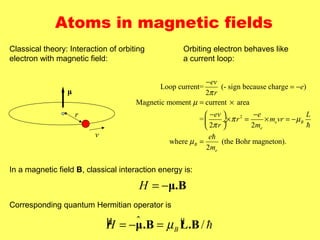
Atoms in magnetic fields
Classical theory: Interaction of orbiting
electron with magnetic field:
Orbiting electron behaves like
a current loop:
2
Loop current= (- sign because charge )
2
Magnetic moment current area
=
2 2
where (the Bohr magneton).
2
e B
e
B
e
ev
e
r
ev e L
r m vr
r m
e
m
π
µ
π µ
π
µ
−
= −
= ×
− − 
× = × = − ÷
 
=
h
h
In a magnetic field B, classical interaction energy is:
Corresponding quantum Hermitian operator is
v
r
μ
H = −μ.B
µ $ µ /BH µ= − =μ.B L.B h
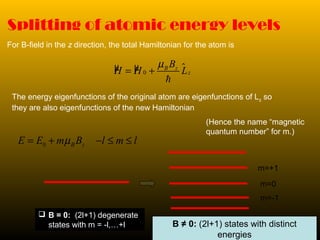
Splitting of atomic energy levels
For B-field in the z direction, the total Hamiltonian for the atom is
The energy eigenfunctions of the original atom are eigenfunctions of Lz so
they are also eigenfunctions of the new Hamiltonian
(Hence the name “magnetic
quantum number” for m.)
0 B zE E m B l m lµ= + − ≤ ≤
 B = 0: (2l+1) degenerate
states with m = -l,…+l
µ µ $0
B z
z
B
H H L
µ
= +
h
B ≠ 0: (2l+1) states with distinct
energies
m=0
m=-1
m=+1
The Stern-Gerlach experiment
(1922)
( ) z
B
dB
m
dz
µ= ∇ × = −Fμ B
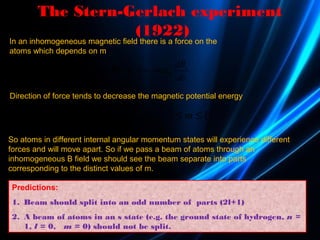
In an inhomogeneous magnetic field there is a force on the
atoms which depends on m
0 B zE E m B l m lµ= + − ≤ ≤
Direction of force tends to decrease the magnetic potential energy
So atoms in different internal angular momentum states will experience different
forces and will move apart. So if we pass a beam of atoms through an
inhomogeneous B field we should see the beam separate into parts
corresponding to the distinct values of m.
Predictions:
1. Beam should split into an odd number of parts (2l+1)
2. A beam of atoms in an s state (e.g. the ground state of hydrogen, n =
1, l = 0, m = 0) should not be split.
The STern-Gerlach
experimenT (2)
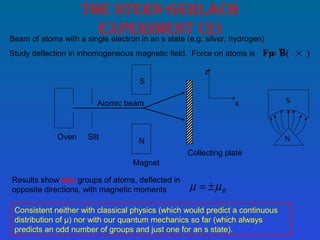
N
S
z
x
Oven Slit
Magnet
Atomic beam
Collecting plate
( )= ∇ ×Fμ B
Beam of atoms with a single electron in an s state (e.g. silver, hydrogen)
Study deflection in inhomogeneous magnetic field. Force on atoms is
Results show two groups of atoms, deflected in
opposite directions, with magnetic moments Bµ µ= ±
Consistent neither with classical physics (which would predict a continuous
distribution of μ) nor with our quantum mechanics so far (which always
predicts an odd number of groups and just one for an s state).
N
S
Electron spin
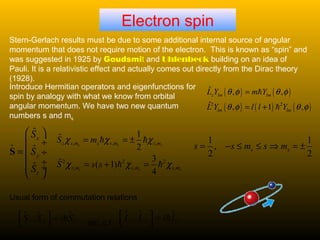
Stern-Gerlach results must be due to some additional internal source of angular
momentum that does not require motion of the electron. This is known as “spin” and
was suggested in 1925 by Goudsmit and Uhlenbeck building on an idea of
Pauli. It is a relativistic effect and actually comes out directly from the Dirac theory
(1928).
Introduce Hermitian operators and eigenfunctions for
spin by analogy with what we know from orbital
angular momentum. We have two new quantum
numbers s and ms
, , ,
2 2 2
, , ,
1ˆ
2
3ˆ ( 1)
4
s s s
s s s
z s m s s m s m
s m s m s m
S m
S s s
χ χ χ
χ χ χ
= = ±
= + =
h h
h h
1 1
,
2 2
s ss s m s m= − ≤ ≤ ⇒ = ±
( ) ( )
( ) ( ) ( )2 2
ˆ , ,
ˆ , 1 ,
z lm lm
lm lm
L Y m Y
L Y l l Y
θ φ θ φ
θ φ θ φ
=
= +
h
h
$
ˆ
ˆ
ˆ
x
y
z
S
S
S
 
 ÷
=  ÷
 ÷
 ÷
 
S
$ $ $,x y zL L i L  =
 
h$ $ $,x y zS S i S  =
 
h
Usual form of commutation relations
etc. c.f
Addition of angular momenta
So, an electron in an atom has two sources of angular momentum:
• Orbital angular momentum (from its motion around the nucleus)
• Spin angular momentum (an internal property of its own).
What is the total angular momentum produced by combining the two?
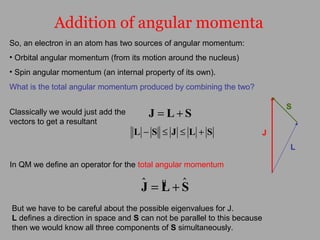
Classically we would just add the
vectors to get a resultant
= +J L S
− ≤ ≤ +L S J L S
But we have to be careful about the possible eigenvalues for J.
L defines a direction in space and S can not be parallel to this because
then we would know all three components of S simultaneously.
J
L
S
$ µ $= +J L S
In QM we define an operator for the total angular momentum
Addition of angular momentum (2)
However, we can certainly add the
z-components of angular momentum
2 2
2 2
2 2
ˆEigenvalues of are ( 1) with 0,1,2,3...
ˆEigenvalue of is ( 1) with 1/ 2
ˆEigenvalues of are ( 1) with - s in integer steps
L l l l
S s s s
J j j l s j l
+ =
+ =
+ ≤ ≤ +
h
h
h
ˆEigenvalues of are with -
ˆEigenvalues of are with 1/ 2
ˆEigenvalues of are with = m+
z
z s s
z j j s
L m l m l
S m m
J m m m
≤ ≤
= ±
h
h
h
This is like the classical rule but using the quantum numbers
rather than the angular momentum vector. The total angular
momentum quantum number j takes values between the sum
and difference of the corresponding quantum numbers for l
and s in integer steps. For each j, there are 2j+1 possible
values of the quantum number mj describing the z-component,
as usual for angular momentum.
1 1
2 2,
, ,j
j l l
m j j
= − +
= − +K
The possible values for the magnitude of the total
angular momentum J2
are given by the rule
Addition of angular momenta (3)
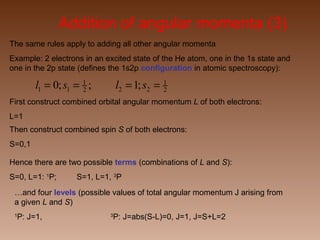
The same rules apply to adding all other angular momenta
Example: 2 electrons in an excited state of the He atom, one in the 1s state and
one in the 2p state (defines the 1s2p configuration in atomic spectroscopy):
First construct combined orbital angular momentum L of both electrons:
L=1
Then construct combined spin S of both electrons:
S=0,1
Hence there are two possible terms (combinations of L and S):
S=0, L=1: 1
P; S=1, L=1, 3
P
…and four levels (possible values of total angular momentum J arising from
a given L and S)
1
P: J=1, 3
P: J=abs(S-L)=0, J=1, J=S+L=2
1 1
1 1 2 22 20; ; 1;l s l s= = = =
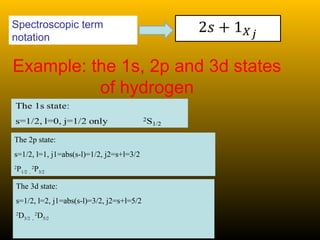
Example: the 1s, 2p and 3d states
of hydrogen
The 2p state:
s=1/2, l=1, j1=abs(s-l)=1/2, j2=s+l=3/2
2
P1/2 ,
2
P3/2
The 3d state:
s=1/2, l=2, j1=abs(s-l)=3/2, j2=s+l=5/2
2
D3/2 ,
2
D5/2
Spectroscopic term
notation
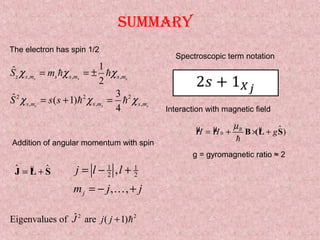
Summary
, , ,
2 2 2
, , ,
1ˆ
2
3ˆ ( 1)
4
s s s
s s s
z s m s s m s m
s m s m s m
S m
S s s
χ χ χ
χ χ χ
= = ±
= + =
h h
h h
The electron has spin 1/2
Interaction with magnetic field
µ µ µ $0 ( )B
H H g
µ
= + × +B L S
h
g = gyromagnetic ratio ≈ 2
1 1
2 2,
, ,j
j l l
m j j
= − +
= − +K
$ µ $= +J L S
Addition of angular momentum with spin
2 2ˆEigenvalues of are ( 1)J j j + h
Spectroscopic term notation
THANKING YOU
•REPRESENTED BY
JITENDRA KAPURIA
17PH05007
Email - jk12@iitbbs.ac.in

Seminar on angular momentum 2017 18

  • 1.
    IITBBS MSc. 1ST (2017) SEMINAR SEMINARTOPIC – ANGULAR MOMENTUM OF ELECTRON AND STERN-GERLACH EXPERIMENT
  • 2.
    OUTLINES • Interaction ofatoms with magnetic fields • Stern-Gerlach experiment • Electron spin • Addition of angular momentum • Summary
  • 3.
    Atoms in magneticfields Classical theory: Interaction of orbiting electron with magnetic field: Orbiting electron behaves like a current loop: 2 Loop current= (- sign because charge ) 2 Magnetic moment current area = 2 2 where (the Bohr magneton). 2 e B e B e ev e r ev e L r m vr r m e m π µ π µ π µ − = − = × − −  × = × = − ÷   = h h In a magnetic field B, classical interaction energy is: Corresponding quantum Hermitian operator is v r μ H = −μ.B µ $ µ /BH µ= − =μ.B L.B h
  • 4.
    Splitting of atomicenergy levels For B-field in the z direction, the total Hamiltonian for the atom is The energy eigenfunctions of the original atom are eigenfunctions of Lz so they are also eigenfunctions of the new Hamiltonian (Hence the name “magnetic quantum number” for m.) 0 B zE E m B l m lµ= + − ≤ ≤  B = 0: (2l+1) degenerate states with m = -l,…+l µ µ $0 B z z B H H L µ = + h B ≠ 0: (2l+1) states with distinct energies m=0 m=-1 m=+1
  • 5.
    The Stern-Gerlach experiment (1922) () z B dB m dz µ= ∇ × = −Fμ B In an inhomogeneous magnetic field there is a force on the atoms which depends on m 0 B zE E m B l m lµ= + − ≤ ≤ Direction of force tends to decrease the magnetic potential energy So atoms in different internal angular momentum states will experience different forces and will move apart. So if we pass a beam of atoms through an inhomogeneous B field we should see the beam separate into parts corresponding to the distinct values of m. Predictions: 1. Beam should split into an odd number of parts (2l+1) 2. A beam of atoms in an s state (e.g. the ground state of hydrogen, n = 1, l = 0, m = 0) should not be split.
  • 6.
    The STern-Gerlach experimenT (2) N S z x OvenSlit Magnet Atomic beam Collecting plate ( )= ∇ ×Fμ B Beam of atoms with a single electron in an s state (e.g. silver, hydrogen) Study deflection in inhomogeneous magnetic field. Force on atoms is Results show two groups of atoms, deflected in opposite directions, with magnetic moments Bµ µ= ± Consistent neither with classical physics (which would predict a continuous distribution of μ) nor with our quantum mechanics so far (which always predicts an odd number of groups and just one for an s state). N S
  • 7.
    Electron spin Stern-Gerlach resultsmust be due to some additional internal source of angular momentum that does not require motion of the electron. This is known as “spin” and was suggested in 1925 by Goudsmit and Uhlenbeck building on an idea of Pauli. It is a relativistic effect and actually comes out directly from the Dirac theory (1928). Introduce Hermitian operators and eigenfunctions for spin by analogy with what we know from orbital angular momentum. We have two new quantum numbers s and ms , , , 2 2 2 , , , 1ˆ 2 3ˆ ( 1) 4 s s s s s s z s m s s m s m s m s m s m S m S s s χ χ χ χ χ χ = = ± = + = h h h h 1 1 , 2 2 s ss s m s m= − ≤ ≤ ⇒ = ± ( ) ( ) ( ) ( ) ( )2 2 ˆ , , ˆ , 1 , z lm lm lm lm L Y m Y L Y l l Y θ φ θ φ θ φ θ φ = = + h h $ ˆ ˆ ˆ x y z S S S    ÷ =  ÷  ÷  ÷   S $ $ $,x y zL L i L  =   h$ $ $,x y zS S i S  =   h Usual form of commutation relations etc. c.f
  • 8.
    Addition of angularmomenta So, an electron in an atom has two sources of angular momentum: • Orbital angular momentum (from its motion around the nucleus) • Spin angular momentum (an internal property of its own). What is the total angular momentum produced by combining the two? Classically we would just add the vectors to get a resultant = +J L S − ≤ ≤ +L S J L S But we have to be careful about the possible eigenvalues for J. L defines a direction in space and S can not be parallel to this because then we would know all three components of S simultaneously. J L S $ µ $= +J L S In QM we define an operator for the total angular momentum
  • 9.
    Addition of angularmomentum (2) However, we can certainly add the z-components of angular momentum 2 2 2 2 2 2 ˆEigenvalues of are ( 1) with 0,1,2,3... ˆEigenvalue of is ( 1) with 1/ 2 ˆEigenvalues of are ( 1) with - s in integer steps L l l l S s s s J j j l s j l + = + = + ≤ ≤ + h h h ˆEigenvalues of are with - ˆEigenvalues of are with 1/ 2 ˆEigenvalues of are with = m+ z z s s z j j s L m l m l S m m J m m m ≤ ≤ = ± h h h This is like the classical rule but using the quantum numbers rather than the angular momentum vector. The total angular momentum quantum number j takes values between the sum and difference of the corresponding quantum numbers for l and s in integer steps. For each j, there are 2j+1 possible values of the quantum number mj describing the z-component, as usual for angular momentum. 1 1 2 2, , ,j j l l m j j = − + = − +K The possible values for the magnitude of the total angular momentum J2 are given by the rule
  • 10.
    Addition of angularmomenta (3) The same rules apply to adding all other angular momenta Example: 2 electrons in an excited state of the He atom, one in the 1s state and one in the 2p state (defines the 1s2p configuration in atomic spectroscopy): First construct combined orbital angular momentum L of both electrons: L=1 Then construct combined spin S of both electrons: S=0,1 Hence there are two possible terms (combinations of L and S): S=0, L=1: 1 P; S=1, L=1, 3 P …and four levels (possible values of total angular momentum J arising from a given L and S) 1 P: J=1, 3 P: J=abs(S-L)=0, J=1, J=S+L=2 1 1 1 1 2 22 20; ; 1;l s l s= = = =
  • 11.
    Example: the 1s,2p and 3d states of hydrogen The 2p state: s=1/2, l=1, j1=abs(s-l)=1/2, j2=s+l=3/2 2 P1/2 , 2 P3/2 The 3d state: s=1/2, l=2, j1=abs(s-l)=3/2, j2=s+l=5/2 2 D3/2 , 2 D5/2 Spectroscopic term notation
  • 12.
    Summary , , , 22 2 , , , 1ˆ 2 3ˆ ( 1) 4 s s s s s s z s m s s m s m s m s m s m S m S s s χ χ χ χ χ χ = = ± = + = h h h h The electron has spin 1/2 Interaction with magnetic field µ µ µ $0 ( )B H H g µ = + × +B L S h g = gyromagnetic ratio ≈ 2 1 1 2 2, , ,j j l l m j j = − + = − +K $ µ $= +J L S Addition of angular momentum with spin 2 2ˆEigenvalues of are ( 1)J j j + h Spectroscopic term notation
  • 13.
    THANKING YOU •REPRESENTED BY JITENDRAKAPURIA 17PH05007 Email - jk12@iitbbs.ac.in