Presented by:
Sumaiya
17MEIM024
GE7142
› Wire electric discharge machining
› Working principle
› Wire EDM machines
› Wire types and their selections
› Stratified wire
› Benefits of stratified wire
› Process variables
› Process characteristics
› Applications
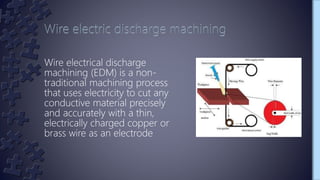
Wire electrical discharge
machining (EDM) is a non-
traditional machining process
that uses electricity to cut any
conductive material precisely
and accurately with a thin,
electrically charged copper or
brass wire as an electrode
› The spark theory on a wire EDM is basically is same as
that of the EDM process.
› In wire EDM, the conductive materials are machined with
a series of electric discharges(sparks) that are produced
between an accurately positioned moving wire(the
electrode) and the work piece.
› High frequency pulses of ac or dc current is discharged
from the wire to the work piece with a very small spark
gap through an insulated dielectric fluid(deionized water)
› The heat of electrical spark estimated at around 15,000 to
21,000 Fahrenheit, erodes away a tiny bit of material that is
vaporised and melted from the work piece(some of the
wire material is also eroded away).
› These particles(chips) are flushed away from the cut with
the stream of de-ionized water through the top and
bottom flushing nozzles.
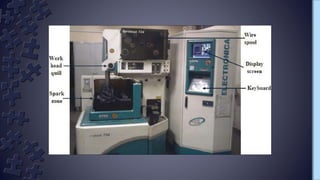
1.Computerised numerical control (CNC)
Think of this as BRAIN
2.Power supply
provides energy to the spark
3.mechanical section
worktable, work stand, taper unit, and wire drive mechanism.
4.Dielectric system
the water reservoir where filtration, condition of water
(resistivity/conductivity) and temperature of water is provided and
maintained.
Selection of wire in wire EDM should be done by taking
following criteria into consideration:-
› Tensile strength
› Fracture resistance
› Conductivity
› Vaporisation point(low is preferred)
› Copper wire
› Brass wire
› Coated or stratified wire
› Molybdenum wire
› “if I need the tensile strength of one material and the
conductivity or flush ability of another, why not coat or
plate one with another?”
› Stratified wires have a wire core coated with one or more
layer of different materials.
› Stratified wires usually consist of an alloy with low
vaporisation temperature, plated to a higher tensile
strength core.
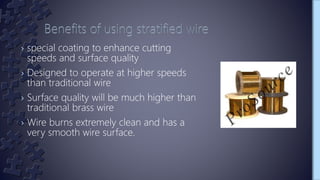
› special coating to enhance cutting
speeds and surface quality
› Designed to operate at higher speeds
than traditional wire
› Surface quality will be much higher than
traditional brass wire
› Wire burns extremely clean and has a
very smooth wire surface.
› Pulse duration
› Pulse interval
› Servo voltage
› Peak current
› Gap voltage
› Dielectric flow rate
› Wire feed rate
› Wire tension
During the pulse on time, the
voltage is applied in the gap
between work piece and the
electrode thereby producing
discharge. Higher the pulse on
time, higher will be the energy
applied there by generating
more amount of heat energy
during this period. Material
removal rate depends upon
amount of energy applied
during the pulse on time.
1.Pulse
duration
Reducing Off Time can
dramatically increase cutting
speed, by allowing more
productive discharges per unit
time. However, reducing Off
can overload the wire, causing
wire breakage and instability of
the cut by not allowing enough
time to evacuate the debris
the next discharge.
2.Pulse
interval
Servo voltage acts as the reference
voltage to control the wire advances
and retracts. If the mean machining
voltage is higher than the set servo
voltage level, the wire advances, and
it is lower, the wire retracts. When a
smaller value is set, the mean gap
becomes narrower, which leads to an
increase in number of electric sparks,
resulting in higher machining rate
3.Servo
voltage
The current increases until it reaches
pre-set value during each pulse on
time, which is known as peak current.
Peak current is governed by surface
area of cut. Higher peak current is
applied during roughing operation
and details with large surface area.
4.Peak
current
Gap voltage, also called open
circuit voltage specifies the supply
voltage to be placed on the gap.
Greater the gap voltage, greater
will be the electric discharge. If the
gap voltage increases, the peak
current will also increase.
5.Gap
voltage Dielectric flow rate is the rate at
which the dielectric fluid is
circulated. Flushing is important
efficient machining. Flushing
pressure is produced from both
top and bottom nozzles.
6.Dielectric
flow rate
As the wire feed rate
increases, the consumption
wire as well as cost of
machining will increase. Low
wire speed will cause wire
breakage in high cutting
speed.
7.Wire
feed Within considerable range, an
increase in wire tension
significantly increases the
cutting speed and accuracy.
higher tension decreases the
wire vibration amplitude and
hence decreases the cut width
so that the speed is higher for
the same discharge energy.
However, if the applied tension
exceeds the tensile strength of
the wire, it leads to wire
breakage.
8.Wire
tension
› Surface roughness
› Material removal rate
› Kerf(width of cut)
› Wire wear ratio
SURFACE ROUGHNESS
Surface roughness is greatly affected
by pulse on time, peak current and
cutting speed in WEDM. Among
these pulse on time is found to be
the most significant parameter
affecting the surface roughness.
MATERIAL REMOVAL RATE
In WEDM the material erodes from the work
piece by a series of discrete sparks between
the work and the tool electrode immersed in
the liquid dielectric medium. These electrical
discharges melt and vaporize minute
amounts of the work material, which are then
ejected and flushed away by the dielectric
fluid. MRR directly increases with increase in
pulse on time (Ton) and peak current (IP)
while decreases with increase in pulse off
time (Toff) and servo voltage
KERF
Kerf is one of the important
performance measures in WEDM.
Kerf is the measure of the amount
of the material that is wasted
during machining. It affects the
dimensional accuracy of the
finished part. Kerf of wire EDM
work piece depends on gap
voltage, pulse on time, pulse off
time, wire feed and flushing
pressure
WIRE WEAR RATIO
As WEDM is a thermo- electrical
process in which material is eroded
by a series of sparks between the
work piece and the wire electrode,
along with the work piece material
some particles from wire also will
erode, this phenomenon is called
wire wear and this should be kept to
a minimum. Wire failure occurs in
wire-EDM process as a result of
severity in wire wear rate, which is a
function of discharge current and
discharge time
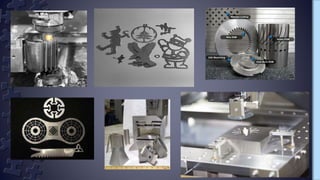
The process is used in the following areas:-
• Aerospace, medical, electronics and semiconductors applications
• Tool and die making industries
• For cutting hard extrusion dies
• In making fixtures, gauges and cams
• Cutting of gears, strippers, punches and dies
• Manufacturing hard electrodes
• Manufacturing micro-tooling for micro-EDM, micro-USM
and other such micro machining applications
Wire electric discharge machining

Wire electric discharge machining

  • 1.
  • 2.
    › Wire electricdischarge machining › Working principle › Wire EDM machines › Wire types and their selections › Stratified wire › Benefits of stratified wire › Process variables › Process characteristics › Applications
  • 3.
    Wire electrical discharge machining(EDM) is a non- traditional machining process that uses electricity to cut any conductive material precisely and accurately with a thin, electrically charged copper or brass wire as an electrode
  • 4.
    › The sparktheory on a wire EDM is basically is same as that of the EDM process. › In wire EDM, the conductive materials are machined with a series of electric discharges(sparks) that are produced between an accurately positioned moving wire(the electrode) and the work piece. › High frequency pulses of ac or dc current is discharged from the wire to the work piece with a very small spark gap through an insulated dielectric fluid(deionized water)
  • 5.
    › The heatof electrical spark estimated at around 15,000 to 21,000 Fahrenheit, erodes away a tiny bit of material that is vaporised and melted from the work piece(some of the wire material is also eroded away). › These particles(chips) are flushed away from the cut with the stream of de-ionized water through the top and bottom flushing nozzles.
  • 6.
    1.Computerised numerical control(CNC) Think of this as BRAIN 2.Power supply provides energy to the spark 3.mechanical section worktable, work stand, taper unit, and wire drive mechanism. 4.Dielectric system the water reservoir where filtration, condition of water (resistivity/conductivity) and temperature of water is provided and maintained.
  • 8.
    Selection of wirein wire EDM should be done by taking following criteria into consideration:- › Tensile strength › Fracture resistance › Conductivity › Vaporisation point(low is preferred)
  • 9.
    › Copper wire ›Brass wire › Coated or stratified wire › Molybdenum wire
  • 10.
    › “if Ineed the tensile strength of one material and the conductivity or flush ability of another, why not coat or plate one with another?” › Stratified wires have a wire core coated with one or more layer of different materials. › Stratified wires usually consist of an alloy with low vaporisation temperature, plated to a higher tensile strength core.
  • 11.
    › special coatingto enhance cutting speeds and surface quality › Designed to operate at higher speeds than traditional wire › Surface quality will be much higher than traditional brass wire › Wire burns extremely clean and has a very smooth wire surface.
  • 12.
    › Pulse duration ›Pulse interval › Servo voltage › Peak current › Gap voltage › Dielectric flow rate › Wire feed rate › Wire tension
  • 13.
    During the pulseon time, the voltage is applied in the gap between work piece and the electrode thereby producing discharge. Higher the pulse on time, higher will be the energy applied there by generating more amount of heat energy during this period. Material removal rate depends upon amount of energy applied during the pulse on time. 1.Pulse duration Reducing Off Time can dramatically increase cutting speed, by allowing more productive discharges per unit time. However, reducing Off can overload the wire, causing wire breakage and instability of the cut by not allowing enough time to evacuate the debris the next discharge. 2.Pulse interval
  • 14.
    Servo voltage actsas the reference voltage to control the wire advances and retracts. If the mean machining voltage is higher than the set servo voltage level, the wire advances, and it is lower, the wire retracts. When a smaller value is set, the mean gap becomes narrower, which leads to an increase in number of electric sparks, resulting in higher machining rate 3.Servo voltage The current increases until it reaches pre-set value during each pulse on time, which is known as peak current. Peak current is governed by surface area of cut. Higher peak current is applied during roughing operation and details with large surface area. 4.Peak current
  • 15.
    Gap voltage, alsocalled open circuit voltage specifies the supply voltage to be placed on the gap. Greater the gap voltage, greater will be the electric discharge. If the gap voltage increases, the peak current will also increase. 5.Gap voltage Dielectric flow rate is the rate at which the dielectric fluid is circulated. Flushing is important efficient machining. Flushing pressure is produced from both top and bottom nozzles. 6.Dielectric flow rate
  • 16.
    As the wirefeed rate increases, the consumption wire as well as cost of machining will increase. Low wire speed will cause wire breakage in high cutting speed. 7.Wire feed Within considerable range, an increase in wire tension significantly increases the cutting speed and accuracy. higher tension decreases the wire vibration amplitude and hence decreases the cut width so that the speed is higher for the same discharge energy. However, if the applied tension exceeds the tensile strength of the wire, it leads to wire breakage. 8.Wire tension
  • 17.
    › Surface roughness ›Material removal rate › Kerf(width of cut) › Wire wear ratio
  • 18.
    SURFACE ROUGHNESS Surface roughnessis greatly affected by pulse on time, peak current and cutting speed in WEDM. Among these pulse on time is found to be the most significant parameter affecting the surface roughness. MATERIAL REMOVAL RATE In WEDM the material erodes from the work piece by a series of discrete sparks between the work and the tool electrode immersed in the liquid dielectric medium. These electrical discharges melt and vaporize minute amounts of the work material, which are then ejected and flushed away by the dielectric fluid. MRR directly increases with increase in pulse on time (Ton) and peak current (IP) while decreases with increase in pulse off time (Toff) and servo voltage
  • 19.
    KERF Kerf is oneof the important performance measures in WEDM. Kerf is the measure of the amount of the material that is wasted during machining. It affects the dimensional accuracy of the finished part. Kerf of wire EDM work piece depends on gap voltage, pulse on time, pulse off time, wire feed and flushing pressure WIRE WEAR RATIO As WEDM is a thermo- electrical process in which material is eroded by a series of sparks between the work piece and the wire electrode, along with the work piece material some particles from wire also will erode, this phenomenon is called wire wear and this should be kept to a minimum. Wire failure occurs in wire-EDM process as a result of severity in wire wear rate, which is a function of discharge current and discharge time
  • 20.
    The process isused in the following areas:- • Aerospace, medical, electronics and semiconductors applications • Tool and die making industries • For cutting hard extrusion dies • In making fixtures, gauges and cams • Cutting of gears, strippers, punches and dies • Manufacturing hard electrodes • Manufacturing micro-tooling for micro-EDM, micro-USM and other such micro machining applications