POWER TRANSMISION SYSTEMS
ENG. H.M.A.I.HERATH
BSC ENG(HONS) , MSC, CENG, MIE(SL)
OVERVIEW OF ELECTRICAL POWER SYSTEM NETWORK
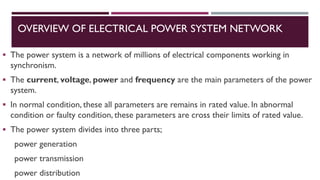
▪ The power system is a network of millions of electrical components working in
synchronism.
▪ The current, voltage, power and frequency are the main parameters of the power
system.
▪ In normal condition, these all parameters are remains in rated value. In abnormal
condition or faulty condition, these parameters are cross their limits of rated value.
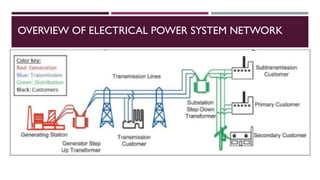
▪ The power system divides into three parts;
power generation
power transmission
power distribution
OVERVIEW OF ELECTRICAL POWER SYSTEM NETWORK
Power Generation
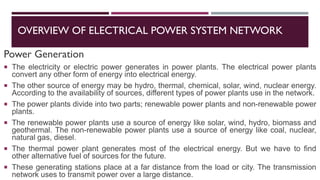
 The electricity or electric power generates in power plants. The electrical power plants
convert any other form of energy into electrical energy.
 The other source of energy may be hydro, thermal, chemical, solar, wind, nuclear energy.
According to the availability of sources, different types of power plants use in the network.
 The power plants divide into two parts; renewable power plants and non-renewable power
plants.
 The renewable power plants use a source of energy like solar, wind, hydro, biomass and
geothermal. The non-renewable power plants use a source of energy like coal, nuclear,
natural gas, diesel.
 The thermal power plant generates most of the electrical energy. But we have to find
other alternative fuel of sources for the future.
 These generating stations place at a far distance from the load or city. The transmission
network uses to transmit power over a large distance.
OVERVIEW OF ELECTRICAL POWER SYSTEM NETWORK
PowerTransmission
 The transmission system is a link between generating system and distribution
system. It has the largest area compare to power generation and power distribution
system.
 There are more chances to fault occur in the transmission line. The large capacity
of the transmission line carries a large amount of load. If this transmission line will
fail, a very large amount of load will disconnect from the system.
 Three types of transmission lines are available according to the length of the line;
o Short transmission line (Less than 60 km of the line)
o Medium transmission line (60 km to 250 km line )
o Long transmission line (more than 250 km line)
 TransmissionVoltages
400 kV, 220 kV, 132 kV
▪ Transmission Lines / Cables (As at 2013)
220 kV – 502 km
132 kV - 1846 km
OVERVIEW OF ELECTRICAL POWER SYSTEM NETWORK
Power Distribution
 These lines carry less power compare to the lines of transmission networks.
 The voltage level of the distribution network is less than 132 kV.
 Distribution Voltages : 33 kV, 11 kV, 400 V
 The electricity distribution in Sri Lanka: By CEB (33 kV and 11 kV) and LECO (11
kV)
 The power system network supplies electrical power to the residential, commercial
and industrial load.
 It supplies 3 phase power for industrial load and the voltage level is 400 V. It
supplies single phase power for commercial and residential load and voltage level
is 230 V.
OVERHEAD & UNDERGROUND TRANSMISSION SYSTEM
The transmission lines are used to transmit the power for long-distance.
There are two types of transmission lines;
▪ OverheadTransmission line
▪ UndergroundTransmission line
OVERHEADTRANSMISSION LINES
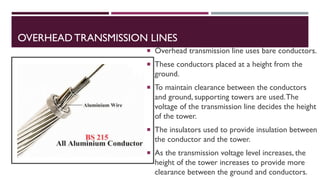
 Overhead transmission line uses bare conductors.
 These conductors placed at a height from the
ground.
 To maintain clearance between the conductors
and ground, supporting towers are used.The
voltage of the transmission line decides the height
of the tower.
 The insulators used to provide insulation between
the conductor and the tower.
 As the transmission voltage level increases, the
height of the tower increases to provide more
clearance between the ground and conductors.
UNDER GROUND TRANSMISSION LINES
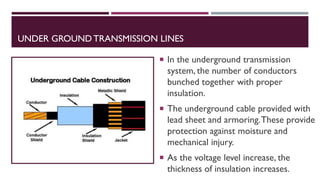
 In the underground transmission
system, the number of conductors
bunched together with proper
insulation.
 The underground cable provided with
lead sheet and armoring.These provide
protection against moisture and
mechanical injury.
 As the voltage level increase, the
thickness of insulation increases.
COMPARISON – OVERHEAD & UNDER GROUND
UNDERGROUND OVERHEAD
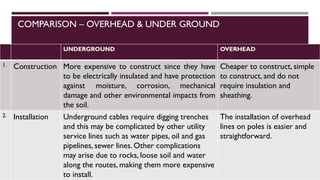
1. Construction More expensive to construct since they have
to be electrically insulated and have protection
against moisture, corrosion, mechanical
damage and other environmental impacts from
the soil.
Cheaper to construct, simple
to construct, and do not
require insulation and
sheathing.
2. Installation Underground cables require digging trenches
and this may be complicated by other utility
service lines such as water pipes, oil and gas
pipelines, sewer lines. Other complications
may arise due to rocks, loose soil and water
along the routes, making them more expensive
to install.
The installation of overhead
lines on poles is easier and
straightforward.
COMPARISON – OVERHEAD & UNDER GROUND
UNDERGROUND OVERHEAD
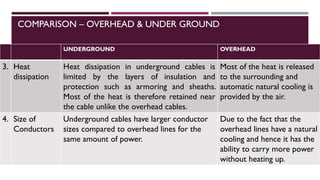
3. Heat
dissipation
Heat dissipation in underground cables is
limited by the layers of insulation and
protection such as armoring and sheaths.
Most of the heat is therefore retained near
the cable unlike the overhead cables.
Most of the heat is released
to the surrounding and
automatic natural cooling is
provided by the air.
4. Size of
Conductors
Underground cables have larger conductor
sizes compared to overhead lines for the
same amount of power.
Due to the fact that the
overhead lines have a natural
cooling and hence it has the
ability to carry more power
without heating up.
COMPARISON – OVERHEAD & UNDER GROUND
UNDERGROUND OVERHEAD
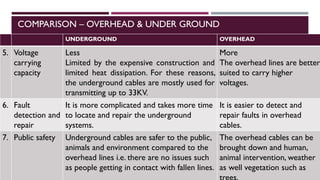
5. Voltage
carrying
capacity
Less
Limited by the expensive construction and
limited heat dissipation. For these reasons,
the underground cables are mostly used for
transmitting up to 33KV.
More
The overhead lines are better
suited to carry higher
voltages.
6. Fault
detection and
repair
It is more complicated and takes more time
to locate and repair the underground
systems.
It is easier to detect and
repair faults in overhead
cables.
7. Public safety Underground cables are safer to the public,
animals and environment compared to the
overhead lines i.e. there are no issues such
as people getting in contact with fallen lines.
The overhead cables can be
brought down and human,
animal intervention, weather
as well vegetation such as
COMPARISON – OVERHEAD & UNDER GROUND
UNDERGROUND OVERHEAD
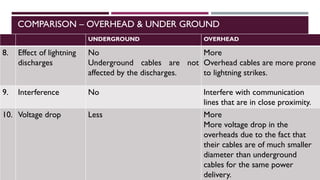
8. Effect of lightning
discharges
No
Underground cables are not
affected by the discharges.
More
Overhead cables are more prone
to lightning strikes.
9. Interference No Interfere with communication
lines that are in close proximity.
10. Voltage drop Less More
More voltage drop in the
overheads due to the fact that
their cables are of much smaller
diameter than underground
cables for the same power
delivery.
COMPARISON – OVERHEAD & UNDER GROUND
UNDERGROUND OVERHEAD
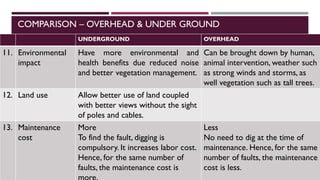
11. Environmental
impact
Have more environmental and
health benefits due reduced noise
and better vegetation management.
Can be brought down by human,
animal intervention, weather such
as strong winds and storms, as
well vegetation such as tall trees.
12. Land use Allow better use of land coupled
with better views without the sight
of poles and cables.
13. Maintenance
cost
More
To find the fault, digging is
compulsory. It increases labor cost.
Hence, for the same number of
faults, the maintenance cost is
Less
No need to dig at the time of
maintenance. Hence, for the same
number of faults, the maintenance
cost is less.
COMPARISON – OVERHEAD & UNDER GROUND
UNDERGROUND OVERHEAD
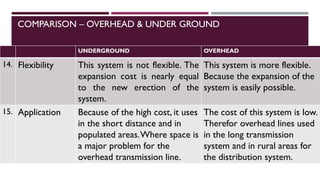
14. Flexibility This system is not flexible. The
expansion cost is nearly equal
to the new erection of the
system.
This system is more flexible.
Because the expansion of the
system is easily possible.
15. Application Because of the high cost, it uses
in the short distance and in
populated areas.Where space is
a major problem for the
overhead transmission line.
The cost of this system is low.
Therefor overhead lines used
in the long transmission
system and in rural areas for
the distribution system.
CLASSIFICATION OF OVERHEADTRANSMISSION LINE
 An overhead transmission line has three constants Resistance (R), Inductance (L), and
Capacitance (C).
 These parameters are uniformly distributed over the entire length of the transmission
line.
 The resistance and inductance form the series impedance.
 For single phase line, the capacitance presents between the conductors and present
between the conductor and natural. For three-phase transmission line, the capacitance
forms a shunt path throughout the length of the transmission line.
 Hence, the capacitance effects create more complication in the modeling and
calculation of transmission line.
CLASSIFICATION OF OVERHEADTRANSMISSION LINE
The overhead transmission line can be classified into three types
according to the manner in which capacitance is taken into
account.
❑Short transmission line
❑Medium transmission line
❑Long transmission line
CLASSIFICATION OF OVERHEADTRANSMISSION LINE
Short transmission line
▪ When the length of the line is up to about 50 km, the line considers
as a short transmission line.
▪ The line voltage is low (<20 kV).
▪ The capacitance effect in short overhead line is neglected. Because
due to the small length and lower voltage, the capacitance effect is
very small.
▪ Therefore, while designing, modeling and studying the performance
of the short line, only resistance and inductance are taken into
account.
CLASSIFICATION OF OVERHEADTRANSMISSION LINE
Medium transmission line
▪ When the length of the line between 50 km to 150 km and the
line voltage is between 20 kV to 100 kV, this type of overhead
line considered as a medium transmission line.
▪ In this type of line, the capacitance effect cannot be neglected.
▪ Hence, while studying the performance of the line, the
capacitance effect must take into account.
CLASSIFICATION OF OVERHEADTRANSMISSION LINE
Medium transmission line
▪ According to the distribution of the effect of capacitance, the medium
transmission line is further divides into three parts;
End condenser method : The capacitance of line is lumped and
concentrated at the receiving end or load end of the transmission line.
Nominal T method : The capacitance of the line assume to be concentrated
at the middle point of the line. Half of the resistance and inductance are
lumped on either side.
Nominal PI method : The capacitance of each conductor divides into two
halves. One half is lump at the sending end and the second half lump at the
receiving end.
CLASSIFICATION OF OVERHEADTRANSMISSION LINE
Long transmission line
▪ When the length of the transmission line is more than 150 km,
the line considers as a long transmission line.
▪ In this type of transmission line, the voltage is more than 100 kV.
▪ For the modeling and designing of the long overhead
transmission line, the capacitance effect is taken as uniformly
distribute over the entire length of the line.
TRANSMISSION LINE PARAMETERS
 The electrical behaviour of a transmission line under normal
operating condition is characterized by four electrical parameters.
I. Line resistance (Series) , R
II. Line inductance (Series), L
III. Line conductance (Shunt), G
IV. Line capacitance (Shunt), C
▪ Usually, these parameters are measured per unit length of the line.
TRANSMISSION LINE PARAMETERS: Line Resistance
 Vital parameter as it is responsible for the losses in the line.
 The value of the resistance depends on four factors; they are
Conductor material
Conductor geometry
Operating temperature
Transmission frequency
Conductor Material
▪ At the initial stage, Copper (Cu) was used as the conducting material.
▪ Copper has a very high specific conductivity and reasonable tensile strength.
▪ Gradually, Aluminium (Al) took the place of Cu as it is cheaper and lighter compared to
copper.
▪ However,Al has lower specific conductivity and lower tensile strength.
▪ The problem of lower specific conductivity can be overcome by using larger conductors.
▪ To overcome the problem of lower tensile strength, two techniques are used.
-Alloying Al with other metals
-Using stranded conductors with steel reinforcement
TRANSMISSION LINE PARAMETERS: Line Resistance
 Conductor material
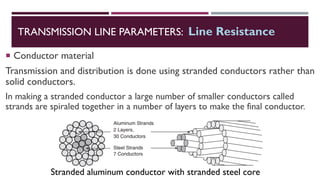
Transmission and distribution is done using stranded conductors rather than
solid conductors.
In making a stranded conductor a large number of smaller conductors called
strands are spiraled together in a number of layers to make the final conductor.
TRANSMISSION LINE PARAMETERS: Line Resistance
Stranded aluminum conductor with stranded steel core
 Conductor material
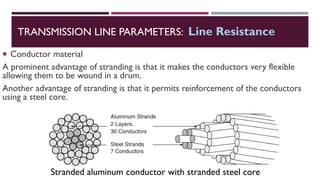
A prominent advantage of stranding is that it makes the conductors very flexible
allowing them to be wound in a drum.
Another advantage of stranding is that it permits reinforcement of the conductors
using a steel core.
TRANSMISSION LINE PARAMETERS: Line Resistance
Stranded aluminum conductor with stranded steel core
DifferentTypes of Conductors
 AAC – All Aluminium Conductors
 AAAC – All Aluminium Alloy- Conductors
 ACSR – Aluminium Conductor, Steel Reinforcement
 ACAR – Aluminium Conductor, Aluminium Alloy Reinforcement
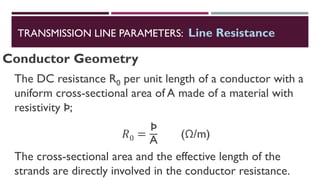
Conductor Geometry
The DC resistance R0 per unit length of a conductor with a
uniform cross-sectional area of A made of a material with
resistivity Þ;
𝑅0 =
Þ
A
(Ω/m)
The cross-sectional area and the effective length of the
strands are directly involved in the conductor resistance.
TRANSMISSION LINE PARAMETERS: Line Resistance
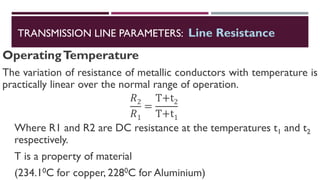
OperatingTemperature
The variation of resistance of metallic conductors with temperature is
practically linear over the normal range of operation.
𝑅2
𝑅1
=
T+t2
T+t1
Where R1 and R2 are DC resistance at the temperatures t1 and t2
respectively.
T is a property of material
(234.10C for copper, 2280C for Aluminium)
TRANSMISSION LINE PARAMETERS: Line Resistance
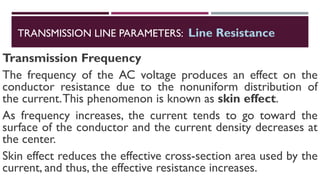
Transmission Frequency
The frequency of the AC voltage produces an effect on the
conductor resistance due to the nonuniform distribution of
the current.This phenomenon is known as skin effect.
As frequency increases, the current tends to go toward the
surface of the conductor and the current density decreases at
the center.
Skin effect reduces the effective cross-section area used by the
current, and thus, the effective resistance increases.
TRANSMISSION LINE PARAMETERS: Line Resistance
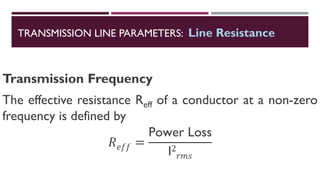
Transmission Frequency
The effective resistance Reff of a conductor at a non-zero
frequency is defined by
𝑅𝑒𝑓𝑓 =
Power Loss
I2
𝑟𝑚𝑠
TRANSMISSION LINE PARAMETERS: Line Resistance
▪ A current-carrying conductor produces concentric magnetic flux lines around
the conductor.
▪ If the current varies with the time, the magnetic flux changes and a voltage is
induced. Therefore, an inductance is present, defined as the ratio of the magnetic
flux linkage and the current.
▪ The magnetic flux produced by the current in transmission line conductors
produces a total inductance whose magnitude depends on the line configuration.
▪ To determine the inductance of the line, it is necessary to calculate, as in any
magnetic circuit with permeability µ, the following factors:
1. Magnetic field intensity H
2. Magnetic field density B
3. Flux linkage λ
TRANSMISSION LINE PARAMETERS: Line Inductance
▪ Capacitance exists among transmission line conductors
due to their potential difference.
▪ Line capacitance is responsible for the charging current
in transmission lines, which is the capacitive current that
is required to keep the line energized even under no
load conditions.
▪ It also plays an important role in partially compensating
the inductive loads.
TRANSMISSION LINE PARAMETERS: Line Capacitance
▪ To evaluate the capacitance between conductors in a
surrounding medium with permittivity €, it is necessary
to determine the voltage between the conductors, and
the electric field strength of the surrounding.
▪ Generally, the effect of earth can not be neglected in
capacitance calculation.
TRANSMISSION LINE PARAMETERS: Line Capacitance

Lec 1_POWER TRANSMISION SYTEMS for electrical engineers.pdf

  • 1.
    POWER TRANSMISION SYSTEMS ENG.H.M.A.I.HERATH BSC ENG(HONS) , MSC, CENG, MIE(SL)
  • 2.
    OVERVIEW OF ELECTRICALPOWER SYSTEM NETWORK ▪ The power system is a network of millions of electrical components working in synchronism. ▪ The current, voltage, power and frequency are the main parameters of the power system. ▪ In normal condition, these all parameters are remains in rated value. In abnormal condition or faulty condition, these parameters are cross their limits of rated value. ▪ The power system divides into three parts; power generation power transmission power distribution
  • 3.
    OVERVIEW OF ELECTRICALPOWER SYSTEM NETWORK
  • 4.
    OVERVIEW OF ELECTRICALPOWER SYSTEM NETWORK Power Generation  The electricity or electric power generates in power plants. The electrical power plants convert any other form of energy into electrical energy.  The other source of energy may be hydro, thermal, chemical, solar, wind, nuclear energy. According to the availability of sources, different types of power plants use in the network.  The power plants divide into two parts; renewable power plants and non-renewable power plants.  The renewable power plants use a source of energy like solar, wind, hydro, biomass and geothermal. The non-renewable power plants use a source of energy like coal, nuclear, natural gas, diesel.  The thermal power plant generates most of the electrical energy. But we have to find other alternative fuel of sources for the future.  These generating stations place at a far distance from the load or city. The transmission network uses to transmit power over a large distance.
  • 5.
    OVERVIEW OF ELECTRICALPOWER SYSTEM NETWORK PowerTransmission  The transmission system is a link between generating system and distribution system. It has the largest area compare to power generation and power distribution system.  There are more chances to fault occur in the transmission line. The large capacity of the transmission line carries a large amount of load. If this transmission line will fail, a very large amount of load will disconnect from the system.  Three types of transmission lines are available according to the length of the line; o Short transmission line (Less than 60 km of the line) o Medium transmission line (60 km to 250 km line ) o Long transmission line (more than 250 km line)
  • 6.
     TransmissionVoltages 400 kV,220 kV, 132 kV ▪ Transmission Lines / Cables (As at 2013) 220 kV – 502 km 132 kV - 1846 km OVERVIEW OF ELECTRICAL POWER SYSTEM NETWORK
  • 7.
    OVERVIEW OF ELECTRICALPOWER SYSTEM NETWORK Power Distribution  These lines carry less power compare to the lines of transmission networks.  The voltage level of the distribution network is less than 132 kV.  Distribution Voltages : 33 kV, 11 kV, 400 V  The electricity distribution in Sri Lanka: By CEB (33 kV and 11 kV) and LECO (11 kV)  The power system network supplies electrical power to the residential, commercial and industrial load.  It supplies 3 phase power for industrial load and the voltage level is 400 V. It supplies single phase power for commercial and residential load and voltage level is 230 V.
  • 8.
    OVERHEAD & UNDERGROUNDTRANSMISSION SYSTEM The transmission lines are used to transmit the power for long-distance. There are two types of transmission lines; ▪ OverheadTransmission line ▪ UndergroundTransmission line
  • 9.
    OVERHEADTRANSMISSION LINES  Overheadtransmission line uses bare conductors.  These conductors placed at a height from the ground.  To maintain clearance between the conductors and ground, supporting towers are used.The voltage of the transmission line decides the height of the tower.  The insulators used to provide insulation between the conductor and the tower.  As the transmission voltage level increases, the height of the tower increases to provide more clearance between the ground and conductors.
  • 10.
    UNDER GROUND TRANSMISSIONLINES  In the underground transmission system, the number of conductors bunched together with proper insulation.  The underground cable provided with lead sheet and armoring.These provide protection against moisture and mechanical injury.  As the voltage level increase, the thickness of insulation increases.
  • 11.
    COMPARISON – OVERHEAD& UNDER GROUND UNDERGROUND OVERHEAD 1. Construction More expensive to construct since they have to be electrically insulated and have protection against moisture, corrosion, mechanical damage and other environmental impacts from the soil. Cheaper to construct, simple to construct, and do not require insulation and sheathing. 2. Installation Underground cables require digging trenches and this may be complicated by other utility service lines such as water pipes, oil and gas pipelines, sewer lines. Other complications may arise due to rocks, loose soil and water along the routes, making them more expensive to install. The installation of overhead lines on poles is easier and straightforward.
  • 12.
    COMPARISON – OVERHEAD& UNDER GROUND UNDERGROUND OVERHEAD 3. Heat dissipation Heat dissipation in underground cables is limited by the layers of insulation and protection such as armoring and sheaths. Most of the heat is therefore retained near the cable unlike the overhead cables. Most of the heat is released to the surrounding and automatic natural cooling is provided by the air. 4. Size of Conductors Underground cables have larger conductor sizes compared to overhead lines for the same amount of power. Due to the fact that the overhead lines have a natural cooling and hence it has the ability to carry more power without heating up.
  • 13.
    COMPARISON – OVERHEAD& UNDER GROUND UNDERGROUND OVERHEAD 5. Voltage carrying capacity Less Limited by the expensive construction and limited heat dissipation. For these reasons, the underground cables are mostly used for transmitting up to 33KV. More The overhead lines are better suited to carry higher voltages. 6. Fault detection and repair It is more complicated and takes more time to locate and repair the underground systems. It is easier to detect and repair faults in overhead cables. 7. Public safety Underground cables are safer to the public, animals and environment compared to the overhead lines i.e. there are no issues such as people getting in contact with fallen lines. The overhead cables can be brought down and human, animal intervention, weather as well vegetation such as
  • 14.
    COMPARISON – OVERHEAD& UNDER GROUND UNDERGROUND OVERHEAD 8. Effect of lightning discharges No Underground cables are not affected by the discharges. More Overhead cables are more prone to lightning strikes. 9. Interference No Interfere with communication lines that are in close proximity. 10. Voltage drop Less More More voltage drop in the overheads due to the fact that their cables are of much smaller diameter than underground cables for the same power delivery.
  • 15.
    COMPARISON – OVERHEAD& UNDER GROUND UNDERGROUND OVERHEAD 11. Environmental impact Have more environmental and health benefits due reduced noise and better vegetation management. Can be brought down by human, animal intervention, weather such as strong winds and storms, as well vegetation such as tall trees. 12. Land use Allow better use of land coupled with better views without the sight of poles and cables. 13. Maintenance cost More To find the fault, digging is compulsory. It increases labor cost. Hence, for the same number of faults, the maintenance cost is Less No need to dig at the time of maintenance. Hence, for the same number of faults, the maintenance cost is less.
  • 16.
    COMPARISON – OVERHEAD& UNDER GROUND UNDERGROUND OVERHEAD 14. Flexibility This system is not flexible. The expansion cost is nearly equal to the new erection of the system. This system is more flexible. Because the expansion of the system is easily possible. 15. Application Because of the high cost, it uses in the short distance and in populated areas.Where space is a major problem for the overhead transmission line. The cost of this system is low. Therefor overhead lines used in the long transmission system and in rural areas for the distribution system.
  • 17.
    CLASSIFICATION OF OVERHEADTRANSMISSIONLINE  An overhead transmission line has three constants Resistance (R), Inductance (L), and Capacitance (C).  These parameters are uniformly distributed over the entire length of the transmission line.  The resistance and inductance form the series impedance.  For single phase line, the capacitance presents between the conductors and present between the conductor and natural. For three-phase transmission line, the capacitance forms a shunt path throughout the length of the transmission line.  Hence, the capacitance effects create more complication in the modeling and calculation of transmission line.
  • 18.
    CLASSIFICATION OF OVERHEADTRANSMISSIONLINE The overhead transmission line can be classified into three types according to the manner in which capacitance is taken into account. ❑Short transmission line ❑Medium transmission line ❑Long transmission line
  • 19.
    CLASSIFICATION OF OVERHEADTRANSMISSIONLINE Short transmission line ▪ When the length of the line is up to about 50 km, the line considers as a short transmission line. ▪ The line voltage is low (<20 kV). ▪ The capacitance effect in short overhead line is neglected. Because due to the small length and lower voltage, the capacitance effect is very small. ▪ Therefore, while designing, modeling and studying the performance of the short line, only resistance and inductance are taken into account.
  • 20.
    CLASSIFICATION OF OVERHEADTRANSMISSIONLINE Medium transmission line ▪ When the length of the line between 50 km to 150 km and the line voltage is between 20 kV to 100 kV, this type of overhead line considered as a medium transmission line. ▪ In this type of line, the capacitance effect cannot be neglected. ▪ Hence, while studying the performance of the line, the capacitance effect must take into account.
  • 21.
    CLASSIFICATION OF OVERHEADTRANSMISSIONLINE Medium transmission line ▪ According to the distribution of the effect of capacitance, the medium transmission line is further divides into three parts; End condenser method : The capacitance of line is lumped and concentrated at the receiving end or load end of the transmission line. Nominal T method : The capacitance of the line assume to be concentrated at the middle point of the line. Half of the resistance and inductance are lumped on either side. Nominal PI method : The capacitance of each conductor divides into two halves. One half is lump at the sending end and the second half lump at the receiving end.
  • 22.
    CLASSIFICATION OF OVERHEADTRANSMISSIONLINE Long transmission line ▪ When the length of the transmission line is more than 150 km, the line considers as a long transmission line. ▪ In this type of transmission line, the voltage is more than 100 kV. ▪ For the modeling and designing of the long overhead transmission line, the capacitance effect is taken as uniformly distribute over the entire length of the line.
  • 23.
    TRANSMISSION LINE PARAMETERS The electrical behaviour of a transmission line under normal operating condition is characterized by four electrical parameters. I. Line resistance (Series) , R II. Line inductance (Series), L III. Line conductance (Shunt), G IV. Line capacitance (Shunt), C ▪ Usually, these parameters are measured per unit length of the line.
  • 24.
    TRANSMISSION LINE PARAMETERS:Line Resistance  Vital parameter as it is responsible for the losses in the line.  The value of the resistance depends on four factors; they are Conductor material Conductor geometry Operating temperature Transmission frequency
  • 25.
    Conductor Material ▪ Atthe initial stage, Copper (Cu) was used as the conducting material. ▪ Copper has a very high specific conductivity and reasonable tensile strength. ▪ Gradually, Aluminium (Al) took the place of Cu as it is cheaper and lighter compared to copper. ▪ However,Al has lower specific conductivity and lower tensile strength. ▪ The problem of lower specific conductivity can be overcome by using larger conductors. ▪ To overcome the problem of lower tensile strength, two techniques are used. -Alloying Al with other metals -Using stranded conductors with steel reinforcement TRANSMISSION LINE PARAMETERS: Line Resistance
  • 26.
     Conductor material Transmissionand distribution is done using stranded conductors rather than solid conductors. In making a stranded conductor a large number of smaller conductors called strands are spiraled together in a number of layers to make the final conductor. TRANSMISSION LINE PARAMETERS: Line Resistance Stranded aluminum conductor with stranded steel core
  • 27.
     Conductor material Aprominent advantage of stranding is that it makes the conductors very flexible allowing them to be wound in a drum. Another advantage of stranding is that it permits reinforcement of the conductors using a steel core. TRANSMISSION LINE PARAMETERS: Line Resistance Stranded aluminum conductor with stranded steel core
  • 28.
    DifferentTypes of Conductors AAC – All Aluminium Conductors  AAAC – All Aluminium Alloy- Conductors  ACSR – Aluminium Conductor, Steel Reinforcement  ACAR – Aluminium Conductor, Aluminium Alloy Reinforcement
  • 29.
    Conductor Geometry The DCresistance R0 per unit length of a conductor with a uniform cross-sectional area of A made of a material with resistivity Þ; 𝑅0 = Þ A (Ω/m) The cross-sectional area and the effective length of the strands are directly involved in the conductor resistance. TRANSMISSION LINE PARAMETERS: Line Resistance
  • 30.
    OperatingTemperature The variation ofresistance of metallic conductors with temperature is practically linear over the normal range of operation. 𝑅2 𝑅1 = T+t2 T+t1 Where R1 and R2 are DC resistance at the temperatures t1 and t2 respectively. T is a property of material (234.10C for copper, 2280C for Aluminium) TRANSMISSION LINE PARAMETERS: Line Resistance
  • 31.
    Transmission Frequency The frequencyof the AC voltage produces an effect on the conductor resistance due to the nonuniform distribution of the current.This phenomenon is known as skin effect. As frequency increases, the current tends to go toward the surface of the conductor and the current density decreases at the center. Skin effect reduces the effective cross-section area used by the current, and thus, the effective resistance increases. TRANSMISSION LINE PARAMETERS: Line Resistance
  • 32.
    Transmission Frequency The effectiveresistance Reff of a conductor at a non-zero frequency is defined by 𝑅𝑒𝑓𝑓 = Power Loss I2 𝑟𝑚𝑠 TRANSMISSION LINE PARAMETERS: Line Resistance
  • 33.
    ▪ A current-carryingconductor produces concentric magnetic flux lines around the conductor. ▪ If the current varies with the time, the magnetic flux changes and a voltage is induced. Therefore, an inductance is present, defined as the ratio of the magnetic flux linkage and the current. ▪ The magnetic flux produced by the current in transmission line conductors produces a total inductance whose magnitude depends on the line configuration. ▪ To determine the inductance of the line, it is necessary to calculate, as in any magnetic circuit with permeability µ, the following factors: 1. Magnetic field intensity H 2. Magnetic field density B 3. Flux linkage λ TRANSMISSION LINE PARAMETERS: Line Inductance
  • 34.
    ▪ Capacitance existsamong transmission line conductors due to their potential difference. ▪ Line capacitance is responsible for the charging current in transmission lines, which is the capacitive current that is required to keep the line energized even under no load conditions. ▪ It also plays an important role in partially compensating the inductive loads. TRANSMISSION LINE PARAMETERS: Line Capacitance
  • 35.
    ▪ To evaluatethe capacitance between conductors in a surrounding medium with permittivity €, it is necessary to determine the voltage between the conductors, and the electric field strength of the surrounding. ▪ Generally, the effect of earth can not be neglected in capacitance calculation. TRANSMISSION LINE PARAMETERS: Line Capacitance