Indian Power System
(An Overview)
Presented By:
Parvindar Chaudhary
Deptt. of Electrical Engg.
MONAD University Hapur
Energy : The Building Block of Economy
Energy is essential for Economic growth.
Economic growth is essential for country like India.
Ratio of energy demand and GDP is useful indicator for
Economics growth.
Economic growth of country is depend upon rate of
improvement in per capita energy consumption.
Indian Power System
Electricity sector in India is growing at rapid pace.
During the current year 2016-17 (Up to 31.01.2017),
the Peak Demand is about 159 GW and the Installed
Capacity is 314.64 GW.
Thermal - 69.4%
Hydro- 13.9%
Renewable- 14.8%
Nuclear - 1.9%
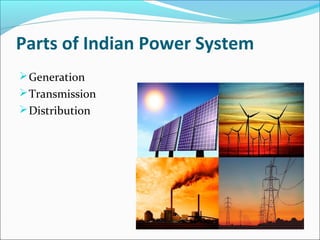
Parts of Indian Power System
Generation
Transmission
Distribution
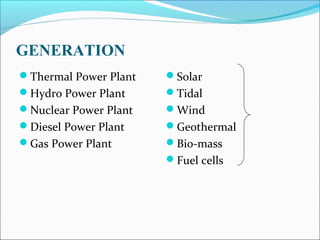
GENERATION
Thermal Power Plant
Hydro Power Plant
Nuclear Power Plant
Diesel Power Plant
Gas Power Plant
Solar
Tidal
Wind
Geothermal
Bio-mass
Fuel cells
Sector
Thermal
(MW)
      Nuclear
Renewabl
e (MW)
Total
(MW)
Coal Gas Diesel
Sub-
Total
(MW) Hydro Other
Sub-
Total
Thermal
Renewabl
e
Renewa
ble
Central 51,390.00 7,490.83 058,880.83
5,780.0
0 11,651.43 0
11,651.3
3 76,312.26
State 64,210.50 7,210.70 363.9371,785.13 0 28,197.00 1,963.8030,055.8 101,945.9
Private 70,992.38 10,355.6 554.9681,902.94 0 3,120.00 42,273.144,236.9 127,296.0
All India 186,592.8 25,057.1 918.89212,568.9
5,780.0
0 42,968.43 44,236.987,205.3 305,554.2
Percent
age
61.06 8.2 0.3 69.56 1.89 14.06 14.47 28.54 100
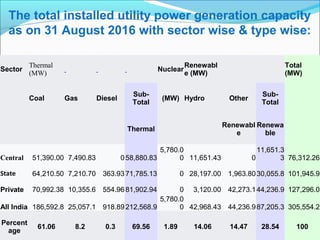
The total installed utility power generation capacity
as on 31 August 2016 with sector wise & type wise:
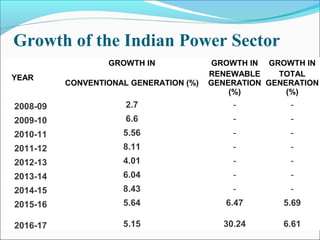
Growth of the Indian Power Sector
YEAR
GROWTH IN GROWTH IN GROWTH IN
CONVENTIONAL GENERATION (%)
RENEWABLE
GENERATION
(%)
TOTAL
GENERATION
(%)
2008-09 2.7 - -
2009-10 6.6 - -
2010-11 5.56 - -
2011-12 8.11 - -
2012-13 4.01 - -
2013-14 6.04 - -
2014-15 8.43 - -
2015-16 5.64 6.47 5.69
2016-17 5.15 30.24 6.61
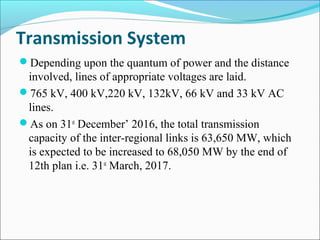
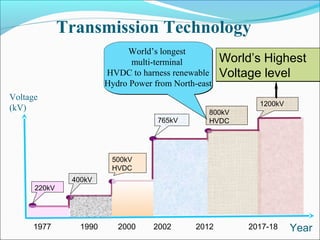
Transmission System
Depending upon the quantum of power and the distance
involved, lines of appropriate voltages are laid.
765 kV, 400 kV,220 kV, 132kV, 66 kV and 33 kV AC
lines.
As on 31st
December’ 2016, the total transmission
capacity of the inter-regional links is 63,650 MW, which
is expected to be increased to 68,050 MW by the end of
12th plan i.e. 31st
March, 2017.
Voltage
(kV)
1977 1990 2000 2002 2012 2017-18 Year
220kV
400kV
500kV
HVDC
765kV
800kV
HVDC
1200kV
World’s Highest
Voltage level
World’s Highest
Voltage level
World’s longest
multi-terminal
HVDC to harness renewable
Hydro Power from North-east
World’s longest
multi-terminal
HVDC to harness renewable
Hydro Power from North-east
Transmission Technology
Distribution system
That part of power system which distributes electric
power for local use is known as distribution system.
In general, the distribution system is the electrical system
between the sub-station fed by the transmission system
and the consumers meters.
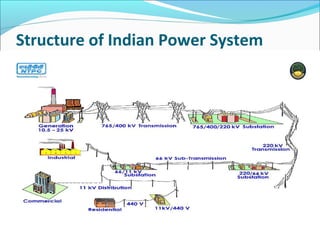
Structure of Indian Power System
Distribution Substation Equipment's
Supply Line
Transformers
Bus bars
Switching apparatus:
Switches
Fuses
Circuit breakers
Grounding
National
Grid
1950-60’s
1970-80s
2000 onwards
Local
1950’s
State Grids
by SEBs
Regional Grids
(Paradigm Shift from self sufficiency at
Regional level concept to National level)
Interconnecting
Regional Grids
with HVDC
1990s
EVOLUTION OF NATIONAL GRID
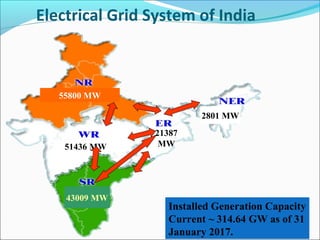
Electrical Grid System of India
16,000
51436 MW
43009 MW
55800 MW
21387
MW
2801 MW
Installed Generation Capacity
Current ~ 314.64 GW as of 31
January 2017.
objectives of formation of National Grid
To transfer power from surplus regions to deficit
regions.
Utilise maximum resources from diversified regions.
Ensure reliable, economical and quality power.
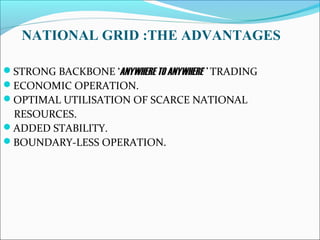
NATIONAL GRID :THE ADVANTAGES
STRONG BACKBONE ‘ANYWHERE TO ANYWHERE’ ’ TRADING
ECONOMIC OPERATION.
OPTIMAL UTILISATION OF SCARCE NATIONAL
RESOURCES.
ADDED STABILITY.
BOUNDARY-LESS OPERATION.
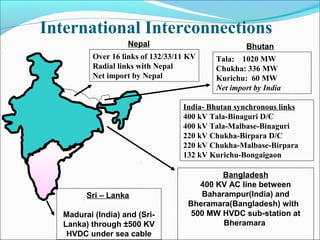
International Interconnections
BhutanNepal
Tala: 1020 MW
Chukha: 336 MW
Kurichu: 60 MW
Net import by India
India- Bhutan synchronous links
400 kV Tala-Binaguri D/C
400 kV Tala-Malbase-Binaguri
220 kV Chukha-Birpara D/C
220 kV Chukha-Malbase-Birpara
132 kV Kurichu-Bongaigaon
Over 16 links of 132/33/11 KV
Radial links with Nepal
Net import by Nepal
Bangladesh
400 KV AC line between
Baharampur(India) and
Bheramara(Bangladesh) with
500 MW HVDC sub-station at
Bheramara
Sri – Lanka
Madurai (India) and (Sri-
Lanka) through ±500 KV
HVDC under sea cable
(DDUGJY) OR (RGGVY)
Government of India has launched the scheme “Deendayal Upadhyaya
Gram Jyoti Yojana” for rural electrification.
Rural Electrification Corporation is the Nodal Agency for
implementation of DDUGJY.
Under DDUGJY-RE, Ministry of Power has sanctioned 921 projects
to electrify 1,21,225 un-electrified villages.
Global Energy Crises
Global Energy requirement increases continuously.
Fuel resources are depleted.
Oil price increase continuously.
It put pressure on country economic.
It is estimated that in next 50-60 year oil & gas
resources are consumed.
19
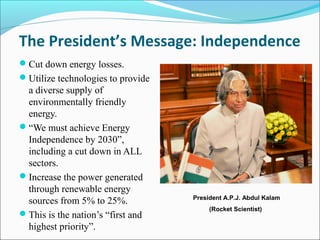
The President’s Message: Independence
Cut down energy losses.
Utilize technologies to provide
a diverse supply of
environmentally friendly
energy.
“We must achieve Energy
Independence by 2030”,
including a cut down in ALL
sectors.
Increase the power generated
through renewable energy
sources from 5% to 25%.
This is the nation’s “first and
highest priority”.
President A.P.J. Abdul Kalam
(Rocket Scientist)
Energy Scenario in India
India is a seventh largest country and have a
population of 1.2 billion people.
To maintain growth rate, need rapid growth in energy
sector.
Potentially, one of the largest power markets in the world.
Large pool of highly skilled technical personnel.
Abundant coal reserves (enough to last at least 200 years).
21
Indian power  system (an overview)

Indian power system (an overview)

  • 1.
    Indian Power System (AnOverview) Presented By: Parvindar Chaudhary Deptt. of Electrical Engg. MONAD University Hapur
  • 2.
    Energy : TheBuilding Block of Economy Energy is essential for Economic growth. Economic growth is essential for country like India. Ratio of energy demand and GDP is useful indicator for Economics growth. Economic growth of country is depend upon rate of improvement in per capita energy consumption.
  • 3.
    Indian Power System Electricitysector in India is growing at rapid pace. During the current year 2016-17 (Up to 31.01.2017), the Peak Demand is about 159 GW and the Installed Capacity is 314.64 GW. Thermal - 69.4% Hydro- 13.9% Renewable- 14.8% Nuclear - 1.9%
  • 4.
    Parts of IndianPower System Generation Transmission Distribution
  • 5.
    GENERATION Thermal Power Plant HydroPower Plant Nuclear Power Plant Diesel Power Plant Gas Power Plant Solar Tidal Wind Geothermal Bio-mass Fuel cells
  • 6.
    Sector Thermal (MW)      Nuclear Renewabl e (MW) Total (MW) Coal Gas Diesel Sub- Total (MW) Hydro Other Sub- Total Thermal Renewabl e Renewa ble Central 51,390.00 7,490.83 058,880.83 5,780.0 0 11,651.43 0 11,651.3 3 76,312.26 State 64,210.50 7,210.70 363.9371,785.13 0 28,197.00 1,963.8030,055.8 101,945.9 Private 70,992.38 10,355.6 554.9681,902.94 0 3,120.00 42,273.144,236.9 127,296.0 All India 186,592.8 25,057.1 918.89212,568.9 5,780.0 0 42,968.43 44,236.987,205.3 305,554.2 Percent age 61.06 8.2 0.3 69.56 1.89 14.06 14.47 28.54 100 The total installed utility power generation capacity as on 31 August 2016 with sector wise & type wise:
  • 7.
    Growth of theIndian Power Sector YEAR GROWTH IN GROWTH IN GROWTH IN CONVENTIONAL GENERATION (%) RENEWABLE GENERATION (%) TOTAL GENERATION (%) 2008-09 2.7 - - 2009-10 6.6 - - 2010-11 5.56 - - 2011-12 8.11 - - 2012-13 4.01 - - 2013-14 6.04 - - 2014-15 8.43 - - 2015-16 5.64 6.47 5.69 2016-17 5.15 30.24 6.61
  • 8.
    Transmission System Depending uponthe quantum of power and the distance involved, lines of appropriate voltages are laid. 765 kV, 400 kV,220 kV, 132kV, 66 kV and 33 kV AC lines. As on 31st December’ 2016, the total transmission capacity of the inter-regional links is 63,650 MW, which is expected to be increased to 68,050 MW by the end of 12th plan i.e. 31st March, 2017.
  • 9.
    Voltage (kV) 1977 1990 20002002 2012 2017-18 Year 220kV 400kV 500kV HVDC 765kV 800kV HVDC 1200kV World’s Highest Voltage level World’s Highest Voltage level World’s longest multi-terminal HVDC to harness renewable Hydro Power from North-east World’s longest multi-terminal HVDC to harness renewable Hydro Power from North-east Transmission Technology
  • 10.
    Distribution system That partof power system which distributes electric power for local use is known as distribution system. In general, the distribution system is the electrical system between the sub-station fed by the transmission system and the consumers meters.
  • 11.
    Structure of IndianPower System
  • 12.
    Distribution Substation Equipment's SupplyLine Transformers Bus bars Switching apparatus: Switches Fuses Circuit breakers Grounding
  • 13.
    National Grid 1950-60’s 1970-80s 2000 onwards Local 1950’s State Grids bySEBs Regional Grids (Paradigm Shift from self sufficiency at Regional level concept to National level) Interconnecting Regional Grids with HVDC 1990s EVOLUTION OF NATIONAL GRID
  • 14.
    Electrical Grid Systemof India 16,000 51436 MW 43009 MW 55800 MW 21387 MW 2801 MW Installed Generation Capacity Current ~ 314.64 GW as of 31 January 2017.
  • 15.
    objectives of formationof National Grid To transfer power from surplus regions to deficit regions. Utilise maximum resources from diversified regions. Ensure reliable, economical and quality power.
  • 16.
    NATIONAL GRID :THEADVANTAGES STRONG BACKBONE ‘ANYWHERE TO ANYWHERE’ ’ TRADING ECONOMIC OPERATION. OPTIMAL UTILISATION OF SCARCE NATIONAL RESOURCES. ADDED STABILITY. BOUNDARY-LESS OPERATION.
  • 17.
    International Interconnections BhutanNepal Tala: 1020MW Chukha: 336 MW Kurichu: 60 MW Net import by India India- Bhutan synchronous links 400 kV Tala-Binaguri D/C 400 kV Tala-Malbase-Binaguri 220 kV Chukha-Birpara D/C 220 kV Chukha-Malbase-Birpara 132 kV Kurichu-Bongaigaon Over 16 links of 132/33/11 KV Radial links with Nepal Net import by Nepal Bangladesh 400 KV AC line between Baharampur(India) and Bheramara(Bangladesh) with 500 MW HVDC sub-station at Bheramara Sri – Lanka Madurai (India) and (Sri- Lanka) through ±500 KV HVDC under sea cable
  • 18.
    (DDUGJY) OR (RGGVY) Governmentof India has launched the scheme “Deendayal Upadhyaya Gram Jyoti Yojana” for rural electrification. Rural Electrification Corporation is the Nodal Agency for implementation of DDUGJY. Under DDUGJY-RE, Ministry of Power has sanctioned 921 projects to electrify 1,21,225 un-electrified villages.
  • 19.
    Global Energy Crises GlobalEnergy requirement increases continuously. Fuel resources are depleted. Oil price increase continuously. It put pressure on country economic. It is estimated that in next 50-60 year oil & gas resources are consumed. 19
  • 20.
    The President’s Message:Independence Cut down energy losses. Utilize technologies to provide a diverse supply of environmentally friendly energy. “We must achieve Energy Independence by 2030”, including a cut down in ALL sectors. Increase the power generated through renewable energy sources from 5% to 25%. This is the nation’s “first and highest priority”. President A.P.J. Abdul Kalam (Rocket Scientist)
  • 21.
    Energy Scenario inIndia India is a seventh largest country and have a population of 1.2 billion people. To maintain growth rate, need rapid growth in energy sector. Potentially, one of the largest power markets in the world. Large pool of highly skilled technical personnel. Abundant coal reserves (enough to last at least 200 years). 21