COURSE NAME – BUILDING SERVICES
COURSE CODE – ARC 310
WIRING SYSTEM
SUBMITTED TO :-
AR. KIRANPREET KAUR
SUBMITTED BY :-
MANISHA BISHT
B. ARCH 4TH SEM
WIRING SYSTEM
• Electrical wiring is an electrical installation of
cabling and associated devices such as switches,
distribution boards, sockets, and light fittings in
a structure. Wiring is subject to safety standards
for design and installation.
• Electrical wiring is the electrical power distribution through
the wires in a perfect manner for economic use
of wiring conductors inside a room or building with better
load control.
SYSTEM OF WIRING
• State electricity board provide electric
supply up to a point outside the consumer
premises. From this point consumer take the
connection to his main board . Insulated
electrical wires will be taken out to various
places in the permises to supply power to
different type of loads like lights , fans ,
refrigerators , room coolers , heaters, etc.
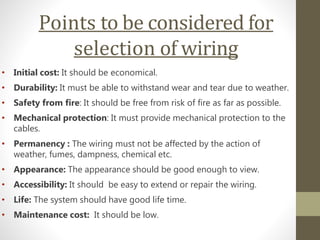
Points to be considered for
selection of wiring
• Initial cost: It should be economical.
• Durability: It must be able to withstand wear and tear due to weather.
• Safety from fire: It should be free from risk of fire as far as possible.
• Mechanical protection: It must provide mechanical protection to the
cables.
• Permanency : The wiring must not be affected by the action of
weather, fumes, dampness, chemical etc.
• Appearance: The appearance should be good enough to view.
• Accessibility: It should be easy to extend or repair the wiring.
• Life: The system should have good life time.
• Maintenance cost: It should be low.
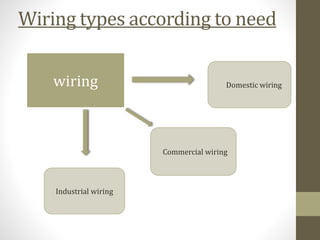
Wiring types according to need
Industrial wiring
Domestic wiring
Commercial wiring
wiring
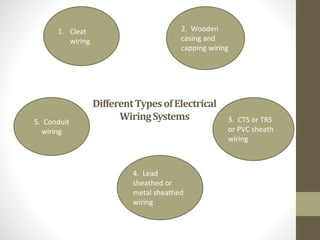
DifferentTypesofElectrical
WiringSystems 3. CTS or TRS
or PVC sheath
wiring
2. Wooden
casing and
capping wiring
5. Conduit
wiring
4. Lead
sheathed or
metal sheathed
wiring
1. Cleat
wiring
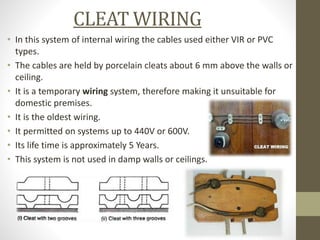
CLEAT WIRING
• In this system of internal wiring the cables used either VIR or PVC
types.
• The cables are held by porcelain cleats about 6 mm above the walls or
ceiling.
• It is a temporary wiring system, therefore making it unsuitable for
domestic premises.
• It is the oldest wiring.
• It permitted on systems up to 440V or 600V.
• Its life time is approximately 5 Years.
• This system is not used in damp walls or ceilings.
Wooden casing and
capping wiring
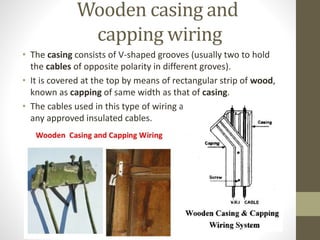
• The casing consists of V-shaped grooves (usually two to hold
the cables of opposite polarity in different groves).
• It is covered at the top by means of rectangular strip of wood,
known as capping of same width as that of casing.
• The cables used in this type of wiring are either VIR or PVC or
any approved insulated cables.
CTS or TRS or PVC
Sheath wiring
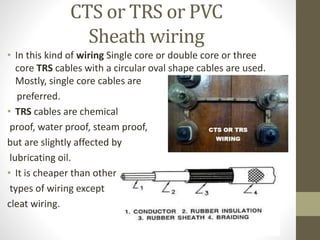
• In this kind of wiring Single core or double core or three
core TRS cables with a circular oval shape cables are used.
Mostly, single core cables are
preferred.
• TRS cables are chemical
proof, water proof, steam proof,
but are slightly affected by
lubricating oil.
• It is cheaper than other
types of wiring except
cleat wiring.
Lead sheathed or metal
sheathed wiring
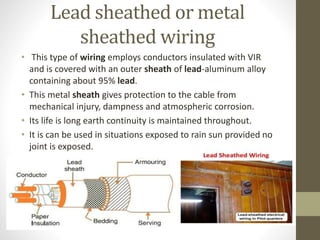
• This type of wiring employs conductors insulated with VIR
and is covered with an outer sheath of lead-aluminum alloy
containing about 95% lead.
• This metal sheath gives protection to the cable from
mechanical injury, dampness and atmospheric corrosion.
• Its life is long earth continuity is maintained throughout.
• It is can be used in situations exposed to rain sun provided no
joint is exposed.
Conduit wiring
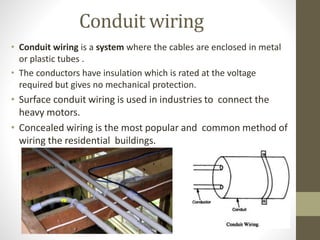
• Conduit wiring is a system where the cables are enclosed in metal
or plastic tubes .
• The conductors have insulation which is rated at the voltage
required but gives no mechanical protection.
• Surface conduit wiring is used in industries to connect the
heavy motors.
• Concealed wiring is the most popular and common method of
wiring the residential buildings.
THANK YOU

Wiring system building services

  • 1.
    COURSE NAME –BUILDING SERVICES COURSE CODE – ARC 310 WIRING SYSTEM SUBMITTED TO :- AR. KIRANPREET KAUR SUBMITTED BY :- MANISHA BISHT B. ARCH 4TH SEM
  • 2.
    WIRING SYSTEM • Electricalwiring is an electrical installation of cabling and associated devices such as switches, distribution boards, sockets, and light fittings in a structure. Wiring is subject to safety standards for design and installation. • Electrical wiring is the electrical power distribution through the wires in a perfect manner for economic use of wiring conductors inside a room or building with better load control.
  • 3.
    SYSTEM OF WIRING •State electricity board provide electric supply up to a point outside the consumer premises. From this point consumer take the connection to his main board . Insulated electrical wires will be taken out to various places in the permises to supply power to different type of loads like lights , fans , refrigerators , room coolers , heaters, etc.
  • 4.
    Points to beconsidered for selection of wiring • Initial cost: It should be economical. • Durability: It must be able to withstand wear and tear due to weather. • Safety from fire: It should be free from risk of fire as far as possible. • Mechanical protection: It must provide mechanical protection to the cables. • Permanency : The wiring must not be affected by the action of weather, fumes, dampness, chemical etc. • Appearance: The appearance should be good enough to view. • Accessibility: It should be easy to extend or repair the wiring. • Life: The system should have good life time. • Maintenance cost: It should be low.
  • 5.
    Wiring types accordingto need Industrial wiring Domestic wiring Commercial wiring wiring
  • 6.
    DifferentTypesofElectrical WiringSystems 3. CTSor TRS or PVC sheath wiring 2. Wooden casing and capping wiring 5. Conduit wiring 4. Lead sheathed or metal sheathed wiring 1. Cleat wiring
  • 7.
    CLEAT WIRING • Inthis system of internal wiring the cables used either VIR or PVC types. • The cables are held by porcelain cleats about 6 mm above the walls or ceiling. • It is a temporary wiring system, therefore making it unsuitable for domestic premises. • It is the oldest wiring. • It permitted on systems up to 440V or 600V. • Its life time is approximately 5 Years. • This system is not used in damp walls or ceilings.
  • 8.
    Wooden casing and cappingwiring • The casing consists of V-shaped grooves (usually two to hold the cables of opposite polarity in different groves). • It is covered at the top by means of rectangular strip of wood, known as capping of same width as that of casing. • The cables used in this type of wiring are either VIR or PVC or any approved insulated cables.
  • 9.
    CTS or TRSor PVC Sheath wiring • In this kind of wiring Single core or double core or three core TRS cables with a circular oval shape cables are used. Mostly, single core cables are preferred. • TRS cables are chemical proof, water proof, steam proof, but are slightly affected by lubricating oil. • It is cheaper than other types of wiring except cleat wiring.
  • 10.
    Lead sheathed ormetal sheathed wiring • This type of wiring employs conductors insulated with VIR and is covered with an outer sheath of lead-aluminum alloy containing about 95% lead. • This metal sheath gives protection to the cable from mechanical injury, dampness and atmospheric corrosion. • Its life is long earth continuity is maintained throughout. • It is can be used in situations exposed to rain sun provided no joint is exposed.
  • 11.
    Conduit wiring • Conduitwiring is a system where the cables are enclosed in metal or plastic tubes . • The conductors have insulation which is rated at the voltage required but gives no mechanical protection. • Surface conduit wiring is used in industries to connect the heavy motors. • Concealed wiring is the most popular and common method of wiring the residential buildings.
  • 12.