Power Cable Technology
Contents:


  Importance of Cable
  Construction of Power Cable
  Cable Insulating materials and property
  Cable Rating and rating factors
  Cable laying installation practices
About us:


     Kirit Rana                   Debayan Dey
 Joined CESC in 1989               Joined CESC in 2008

 From Distribution to Technical    From Distribution to Project
 to Power                         to Technical Cell.

 B.E.E from Jadavpur University    B.E.E from Burdwan University

 Attached as Manager (Jointing)   Attached as Mains Engineer (Tech Cell)
Why Cable is Important?


• Residential & Industrial load density :Growing trend

• Greater services reliability & increased safety

• High acceptability on aesthetic point of view.
INTRODUCTION
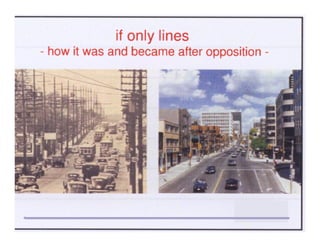
Cables or Over Head Lines ?
*costs cable versus O.H line
         - investment costs cable always high
         - maintenance and operational costs are less
         - investment costs + operation costs
                  * 10 kV cable : costs = costs O.H line
                  * 110 kV cable : costs = 7 x costs of O.H line
                  * 380 kV cable : costs = 20 x costs of a O.H line
•For transmission, arguments pro cable are often :
         -public requirements and environmental reasons
         -sometimes technical reasons
INTRODUCTION
are cable important ?

1.   Cables represent large part of the capital
     (often > 50%) of a network owner.
INTRODUCTION
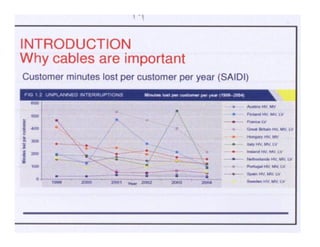
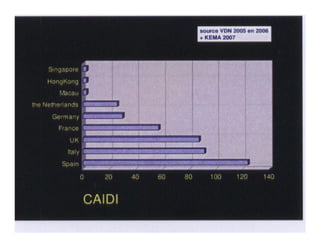
are cables important ?
2. Reliability cables (and O.H lines) is
     dominant for outage time
  SAIDI mainly related to mv
System Average Interruption Duration Index -
SAIDI
Importance of Cable
Construction of Power Cable
Cable Insulating materials and property
Cable Rating and rating factors
Cable laying installation practices
Types of Cable


  LV Cables
  HV Cables
  EHV Cables
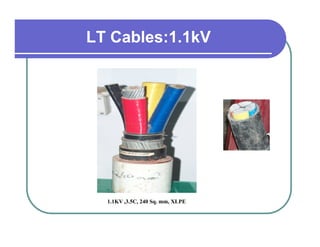
LV Cables : 1.1kV

Standard Sizes
400,240,150,70 & 25 Sq.mm


Standard Construction
Sector Shaped & Stranded Al Conductor
PVC / XLPE Insulation
PVC Inner Sheath
Flat Stripped G.I Armour
PVC Outer Sheath
LT Cables:1.1kV


  1.1KV ,3.5C, 240 Sq. mm, XLPE
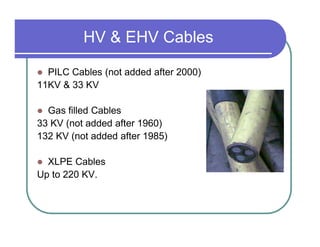
HV & EHV Cables

  PILC Cables (not added after 2000)
11KV & 33 KV

  Gas filled Cables
33 KV (not added after 1960)
132 KV (not added after 1985)

  XLPE Cables
Up to 220 KV.
Types of HV Cables: XLPE
11KV,3C,225 Sq. mm, PILC

                           Standard Construction
                             Sector Shaped Conductor
                             Oil Impregnated Paper
                             Belt Paper
                             Jute/Paper fillers
                             Lead Sleeve
                             Bituminized Hessian Bedding
                             Double Steel Tape armour
                             Bituminized Hessian Serving with
                             anti – termite coating
Electrical Field

What is Electrical Stress (E):
    It can be defined as the gradient of voltage with
    respect to distance.


So Electrical Stress at distance x from conductor
         E = - dU / dx
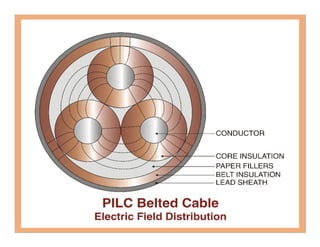
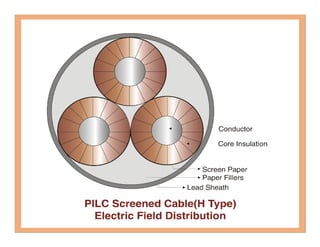
Electrical Field in a Cable


                       CESC
                       CESC
Development of PILC Cables for Higher
              Voltage


  Particular Designs fails at more than 22KV


  Failure analysis: High Electric flux outside core
  insulation led to deterioration of filler papers.
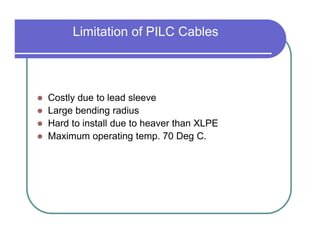
Limitation of PILC Cables


Costly due to lead sleeve
Large bending radius
Hard to install due to heaver than XLPE
Maximum operating temp. 70 Deg C.
Importance of Cable
Construction of Power Cable
Cable Insulating materials and property
Cable Rating and rating factors
Cable laying installation practices
Other Insulating Materials


PE
EPR
PILC
PVC
XLPE
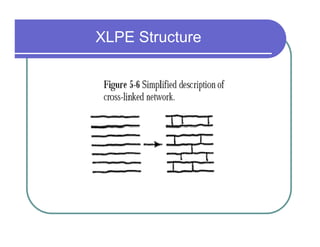
What is XLPE ?


                              POLY
                              ETHELYNE

  Classification of POLYMER

  Thermoplastic

   Thermoset
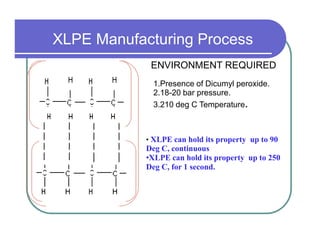
XLPE Manufacturing Process
             ENVIRONMENT REQUIRED
              1.Presence of Dicumyl peroxide.
              2.18-20 bar pressure.
              3.210 deg C Temperature.


            • XLPE can hold its property up to 90
            Deg C, continuous
            •XLPE can hold its property up to 250
            Deg C, for 1 second.
XLPE Structure
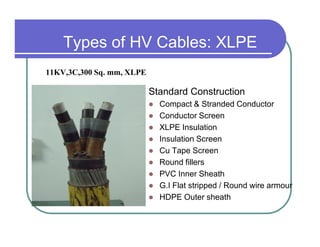
Types of HV Cables: XLPE
11KV,3C,300 Sq. mm, XLPE

                           Standard Construction
                             Compact & Stranded Conductor
                             Conductor Screen
                             XLPE Insulation
                             Insulation Screen
                             Cu Tape Screen
                             Round fillers
                             PVC Inner Sheath
                             G.I Flat stripped / Round wire armour
                             HDPE Outer sheath
Effect of Conductor Screen


           Electrical stress will follow the less di-electric
           strength path, means through the air inclosure,
           possible lead to breakdown of insulation
Cable with out Insulation Screen
        Equipotential Lines


                                          Electric Field Lines


                              Conductor

                              Electric stress may concentrate
                              on one side of the cable
                              insulation, possible lead to
                              break down
Cable with Grounded Insulation
             Screen
Equipotential Lines


                                 Insulation Screen

                                  Conductor
                                  Conductor Screen


                                    Field Lines
Grounded insulation screen ensures that the equipotential lines are
evenly distributed through the cable insulation.
Purpose of Cu Tape Screen


Used only in 3-core Cable
Provide circular earth path over Insulation Screen
Connected with armour at Joints & Termiations.
Purpose of Armour


To carry Earth Fault current during fault condition

To provide Earth path for Screen current

To provide mechanical Protection.
Purpose of Outer Sheath


Provides Protection against
  Soil pressure
  Spiking of external Agencies
  Damages during Cable laying
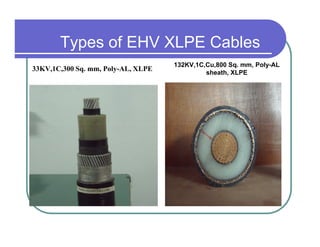
Types of EHV XLPE Cables
                                    132KV,1C,Cu,800 Sq. mm, Poly-AL
33KV,1C,300 Sq. mm, Poly-AL, XLPE            sheath, XLPE
TR-XLPE

Tree Retardant XLPE Cables:

 XLPE with regard to resistance to water treeing.
 It gives more life to cable.
 Using polar co-polymer in place of polyethylene homo-
 polymer.
 AC Breakdown strength is increased.
Importance of Cable
Construction of Power Cable
Cable Insulating materials and property
Cable Rating and rating factors
Cable laying installation practices
Cable Losses


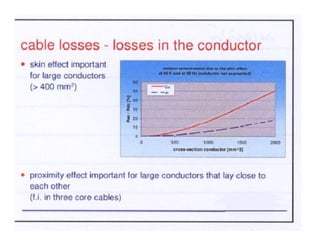
Losses in conductor
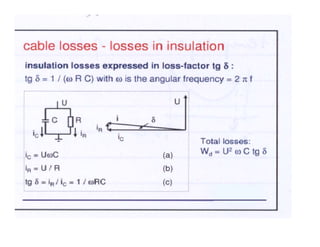
Losses in Insulation
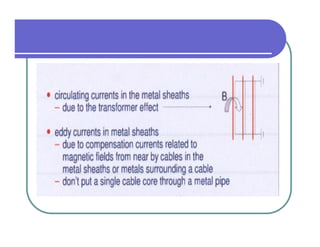
Losses in sheath.
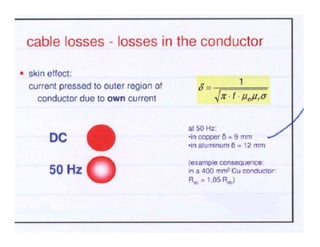
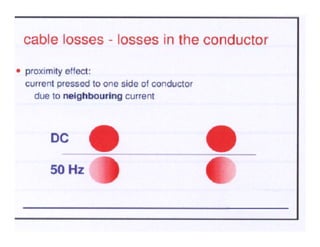
Losses in Conductor
effect is due to mutual induction
 due to self- induction causing
Types of EHV Cable Conductors
a higher current density towards the
                                             between conductors of adjacent cables
                                             causing a higher current density along one
outer surface of the conductor               Side of the conductor


                              Skin and Proximity effects.

   Rac = Rdc ((1+Y5+Yp)           Rac = AC resistance of conductor
                                 Rdc = DC resistance of conductor
                                 Y5 = skin effect factor
                                 Yp = proximate effect factor
Calculation methods indicated in IEC : 287


The phenomena of skin and proximity effect
is responsible for increased in the AC resistance of the conductor.
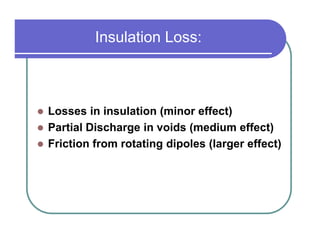
Insulation Loss:


Losses in insulation (minor effect)
Partial Discharge in voids (medium effect)
Friction from rotating dipoles (larger effect)
Sheath Losses
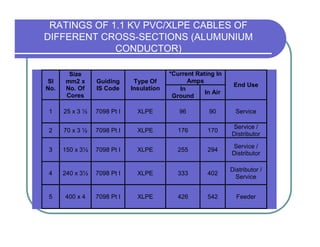
Cable Ratings
RATINGS OF 1.1 KV PVC/XLPE CABLES OF
DIFFERENT CROSS-SECTIONS (ALUMUNIUM
             CONDUCTOR)

       Size                               *Current Rating In
Sl    mm2 x      Guiding      Type Of           Amps
                                                                End Use
No.   No. Of     IS Code     Insulation      In
                                                      In Air
      Cores                                Ground

1     25 x 3 ½   7098 Pt I     XLPE          96        90        Service

                                                               Service /
2     70 x 3 ½   7098 Pt I     XLPE         176        170
                                                               Distributor

                                                               Service /
3     150 x 3½   7098 Pt I     XLPE         255        294
                                                               Distributor

                                                               Distributor /
4     240 x 3½   7098 Pt I     XLPE         333        402
                                                                 Service


5     400 x 4    7098 Pt I     XLPE         426        542       Feeder
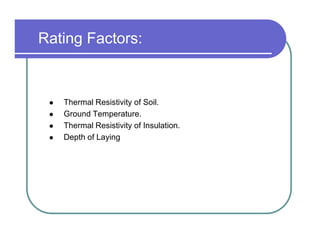
Rating Factors:


   Thermal Resistivity of Soil.
   Ground Temperature.
   Thermal Resistivity of Insulation.
   Depth of Laying
RATINGS OF 11 KV PILC CABLES OF DIFFERENT
CROSS-SECTIONS (ALUMUNIUM CONDUCTOR)

              Continuous Current Ratings
     Maximum allowable conductor temperature = 650C
            SIZE                     BURRIED UNDER
                                     GROUND(Amps)
         3 X 50 mm2                       105
         3 X 150 mm2                      190


         3 X 225 mm2                      240


         3 X 300 mm2                      280
INSTALLATION CONDITIONS FOR 6 / 11 KV CABLES


     GROUND TEMPERATURE = 30O C
     AIR TEMPERATURE = 40O C
     SOIL THERMAL RESITIVITY = 150O C-CM / WATT
     DEPTH OF LAYING = 900 MM
     DIRECTLY BURIED IN GROUND
     BOTH END EARTHED
Importance of Cable
Construction of Power Cable
Cable Insulating materials and property
Cable Rating and rating factors
Cable laying installation practices
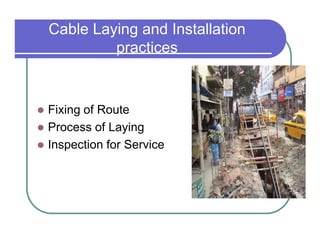
Cable Laying and Installation
         practices


Fixing of Route
Process of Laying
Inspection for Service
Route Fixation
Straight Cable route..

Adequate Width of route

Avoid major Road/Railway tracks Crossing.

Maximum usage of Footpath.
Plan Sanction


Preparation of detailed plan of route

Approval of the concerned Authority.

Intimation of tentative programme of work.

Permission of Public Common Passage
Trial Pits

Trial pits are to be dug approx at 10 meters intervals or
less as necessary.

This determines exact cable alignment to be followed
during laying. Thus creating minimum interference with
underground obstructions and installations of other
agencies.
B) Process Of Laying
a) Pipes and Pipe Laying
Pipes used now for cable laying below ground are
made from HDPE.

Pipes are laid for crossing roads, tram tracks, petrol
pumps garage entry or entry to multistoried buildings.

For wide roads pipe laying is done by excavating half
the road width at one time. Preferred to be done at
night
b) Trenching Work

The CESC notice board should be deployed at site and
work area should be cordoned off.
Depth of trench should not be less than 75 cm and 60
cm wide.
The trench should not be continuous to enable
pedestrian crossing.
Holes should be bored into the earth at uncut
pedestrian crossings.
Excavated earth should be retained besides the trench
on either side.
b) Trenching Work

Exposed cables      and   pipes   should   be   suitably
supported.

In case of damage to installation of other agencies they
should be immediately informed.

An attempt should also be made for temporary
repairing of damaged installations.

Standby pumps and shuttering planks are required for
exigencies.
c) Laying Procedure
Before placing drum at site the following needs checking -
condition of drum, cable size, cable length and integrity of
cable end sealing.

The drum is then placed around spindle and lifted by
Jacks, both of suitable capacity.

A few lashings of a manila rope of adequate strength are
made around outer sheath of cable end.

Cable payout is done by rolling drum in direction opposite
to marked “Roll This Way”.
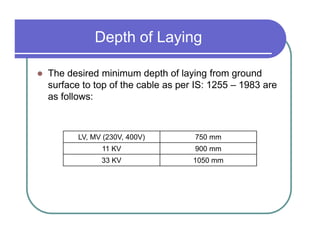
Depth of Laying

The desired minimum depth of laying from ground
surface to top of the cable as per IS: 1255 – 1983 are
as follows:


       LV, MV (230V, 400V)        750 mm
             11 KV                900 mm
             33 KV                1050 mm
Tests after Laying

For 11 KV: Only moisture test along with IR value
checking
For 33KV : Moisture test and Serving test to be done

Serving Test:
Test to check any damaged occurred at outer sheath
during laying.
Power cable technology in cesc ltd

Power cable technology in cesc ltd

  • 1.
  • 2.
    Contents: Importanceof Cable Construction of Power Cable Cable Insulating materials and property Cable Rating and rating factors Cable laying installation practices
  • 3.
    About us: Kirit Rana Debayan Dey Joined CESC in 1989 Joined CESC in 2008 From Distribution to Technical From Distribution to Project to Power to Technical Cell. B.E.E from Jadavpur University B.E.E from Burdwan University Attached as Manager (Jointing) Attached as Mains Engineer (Tech Cell)
  • 4.
    Why Cable isImportant? • Residential & Industrial load density :Growing trend • Greater services reliability & increased safety • High acceptability on aesthetic point of view.
  • 5.
    INTRODUCTION Cables or OverHead Lines ? *costs cable versus O.H line - investment costs cable always high - maintenance and operational costs are less - investment costs + operation costs * 10 kV cable : costs = costs O.H line * 110 kV cable : costs = 7 x costs of O.H line * 380 kV cable : costs = 20 x costs of a O.H line •For transmission, arguments pro cable are often : -public requirements and environmental reasons -sometimes technical reasons
  • 6.
    INTRODUCTION are cable important? 1. Cables represent large part of the capital (often > 50%) of a network owner.
  • 8.
    INTRODUCTION are cables important? 2. Reliability cables (and O.H lines) is dominant for outage time SAIDI mainly related to mv System Average Interruption Duration Index - SAIDI
  • 13.
    Importance of Cable Constructionof Power Cable Cable Insulating materials and property Cable Rating and rating factors Cable laying installation practices
  • 14.
    Types of Cable LV Cables HV Cables EHV Cables
  • 15.
    LV Cables :1.1kV Standard Sizes 400,240,150,70 & 25 Sq.mm Standard Construction Sector Shaped & Stranded Al Conductor PVC / XLPE Insulation PVC Inner Sheath Flat Stripped G.I Armour PVC Outer Sheath
  • 16.
    LT Cables:1.1kV 1.1KV ,3.5C, 240 Sq. mm, XLPE
  • 17.
    HV & EHVCables PILC Cables (not added after 2000) 11KV & 33 KV Gas filled Cables 33 KV (not added after 1960) 132 KV (not added after 1985) XLPE Cables Up to 220 KV.
  • 18.
    Types of HVCables: XLPE 11KV,3C,225 Sq. mm, PILC Standard Construction Sector Shaped Conductor Oil Impregnated Paper Belt Paper Jute/Paper fillers Lead Sleeve Bituminized Hessian Bedding Double Steel Tape armour Bituminized Hessian Serving with anti – termite coating
  • 19.
    Electrical Field What isElectrical Stress (E): It can be defined as the gradient of voltage with respect to distance. So Electrical Stress at distance x from conductor E = - dU / dx
  • 20.
    Electrical Field ina Cable CESC CESC
  • 22.
    Development of PILCCables for Higher Voltage Particular Designs fails at more than 22KV Failure analysis: High Electric flux outside core insulation led to deterioration of filler papers.
  • 24.
    Limitation of PILCCables Costly due to lead sleeve Large bending radius Hard to install due to heaver than XLPE Maximum operating temp. 70 Deg C.
  • 25.
    Importance of Cable Constructionof Power Cable Cable Insulating materials and property Cable Rating and rating factors Cable laying installation practices
  • 26.
  • 27.
    What is XLPE? POLY ETHELYNE Classification of POLYMER Thermoplastic Thermoset
  • 28.
    XLPE Manufacturing Process ENVIRONMENT REQUIRED 1.Presence of Dicumyl peroxide. 2.18-20 bar pressure. 3.210 deg C Temperature. • XLPE can hold its property up to 90 Deg C, continuous •XLPE can hold its property up to 250 Deg C, for 1 second.
  • 29.
  • 30.
    Types of HVCables: XLPE 11KV,3C,300 Sq. mm, XLPE Standard Construction Compact & Stranded Conductor Conductor Screen XLPE Insulation Insulation Screen Cu Tape Screen Round fillers PVC Inner Sheath G.I Flat stripped / Round wire armour HDPE Outer sheath
  • 31.
    Effect of ConductorScreen Electrical stress will follow the less di-electric strength path, means through the air inclosure, possible lead to breakdown of insulation
  • 32.
    Cable with outInsulation Screen Equipotential Lines Electric Field Lines Conductor Electric stress may concentrate on one side of the cable insulation, possible lead to break down
  • 33.
    Cable with GroundedInsulation Screen Equipotential Lines Insulation Screen Conductor Conductor Screen Field Lines Grounded insulation screen ensures that the equipotential lines are evenly distributed through the cable insulation.
  • 34.
    Purpose of CuTape Screen Used only in 3-core Cable Provide circular earth path over Insulation Screen Connected with armour at Joints & Termiations.
  • 35.
    Purpose of Armour Tocarry Earth Fault current during fault condition To provide Earth path for Screen current To provide mechanical Protection.
  • 36.
    Purpose of OuterSheath Provides Protection against Soil pressure Spiking of external Agencies Damages during Cable laying
  • 37.
    Types of EHVXLPE Cables 132KV,1C,Cu,800 Sq. mm, Poly-AL 33KV,1C,300 Sq. mm, Poly-AL, XLPE sheath, XLPE
  • 38.
    TR-XLPE Tree Retardant XLPECables: XLPE with regard to resistance to water treeing. It gives more life to cable. Using polar co-polymer in place of polyethylene homo- polymer. AC Breakdown strength is increased.
  • 39.
    Importance of Cable Constructionof Power Cable Cable Insulating materials and property Cable Rating and rating factors Cable laying installation practices
  • 40.
    Cable Losses Losses inconductor Losses in Insulation Losses in sheath.
  • 41.
  • 44.
    effect is dueto mutual induction due to self- induction causing Types of EHV Cable Conductors a higher current density towards the between conductors of adjacent cables causing a higher current density along one outer surface of the conductor Side of the conductor Skin and Proximity effects. Rac = Rdc ((1+Y5+Yp) Rac = AC resistance of conductor Rdc = DC resistance of conductor Y5 = skin effect factor Yp = proximate effect factor Calculation methods indicated in IEC : 287 The phenomena of skin and proximity effect is responsible for increased in the AC resistance of the conductor.
  • 46.
    Insulation Loss: Losses ininsulation (minor effect) Partial Discharge in voids (medium effect) Friction from rotating dipoles (larger effect)
  • 50.
  • 52.
  • 53.
    RATINGS OF 1.1KV PVC/XLPE CABLES OF DIFFERENT CROSS-SECTIONS (ALUMUNIUM CONDUCTOR) Size *Current Rating In Sl mm2 x Guiding Type Of Amps End Use No. No. Of IS Code Insulation In In Air Cores Ground 1 25 x 3 ½ 7098 Pt I XLPE 96 90 Service Service / 2 70 x 3 ½ 7098 Pt I XLPE 176 170 Distributor Service / 3 150 x 3½ 7098 Pt I XLPE 255 294 Distributor Distributor / 4 240 x 3½ 7098 Pt I XLPE 333 402 Service 5 400 x 4 7098 Pt I XLPE 426 542 Feeder
  • 54.
    Rating Factors: Thermal Resistivity of Soil. Ground Temperature. Thermal Resistivity of Insulation. Depth of Laying
  • 55.
    RATINGS OF 11KV PILC CABLES OF DIFFERENT CROSS-SECTIONS (ALUMUNIUM CONDUCTOR) Continuous Current Ratings Maximum allowable conductor temperature = 650C SIZE BURRIED UNDER GROUND(Amps) 3 X 50 mm2 105 3 X 150 mm2 190 3 X 225 mm2 240 3 X 300 mm2 280
  • 56.
    INSTALLATION CONDITIONS FOR6 / 11 KV CABLES GROUND TEMPERATURE = 30O C AIR TEMPERATURE = 40O C SOIL THERMAL RESITIVITY = 150O C-CM / WATT DEPTH OF LAYING = 900 MM DIRECTLY BURIED IN GROUND BOTH END EARTHED
  • 57.
    Importance of Cable Constructionof Power Cable Cable Insulating materials and property Cable Rating and rating factors Cable laying installation practices
  • 58.
    Cable Laying andInstallation practices Fixing of Route Process of Laying Inspection for Service
  • 59.
    Route Fixation Straight Cableroute.. Adequate Width of route Avoid major Road/Railway tracks Crossing. Maximum usage of Footpath.
  • 60.
    Plan Sanction Preparation ofdetailed plan of route Approval of the concerned Authority. Intimation of tentative programme of work. Permission of Public Common Passage
  • 61.
    Trial Pits Trial pitsare to be dug approx at 10 meters intervals or less as necessary. This determines exact cable alignment to be followed during laying. Thus creating minimum interference with underground obstructions and installations of other agencies.
  • 62.
  • 63.
    a) Pipes andPipe Laying Pipes used now for cable laying below ground are made from HDPE. Pipes are laid for crossing roads, tram tracks, petrol pumps garage entry or entry to multistoried buildings. For wide roads pipe laying is done by excavating half the road width at one time. Preferred to be done at night
  • 64.
    b) Trenching Work TheCESC notice board should be deployed at site and work area should be cordoned off. Depth of trench should not be less than 75 cm and 60 cm wide. The trench should not be continuous to enable pedestrian crossing. Holes should be bored into the earth at uncut pedestrian crossings. Excavated earth should be retained besides the trench on either side.
  • 65.
    b) Trenching Work Exposedcables and pipes should be suitably supported. In case of damage to installation of other agencies they should be immediately informed. An attempt should also be made for temporary repairing of damaged installations. Standby pumps and shuttering planks are required for exigencies.
  • 66.
    c) Laying Procedure Beforeplacing drum at site the following needs checking - condition of drum, cable size, cable length and integrity of cable end sealing. The drum is then placed around spindle and lifted by Jacks, both of suitable capacity. A few lashings of a manila rope of adequate strength are made around outer sheath of cable end. Cable payout is done by rolling drum in direction opposite to marked “Roll This Way”.
  • 67.
    Depth of Laying Thedesired minimum depth of laying from ground surface to top of the cable as per IS: 1255 – 1983 are as follows: LV, MV (230V, 400V) 750 mm 11 KV 900 mm 33 KV 1050 mm
  • 68.
    Tests after Laying For11 KV: Only moisture test along with IR value checking For 33KV : Moisture test and Serving test to be done Serving Test: Test to check any damaged occurred at outer sheath during laying.