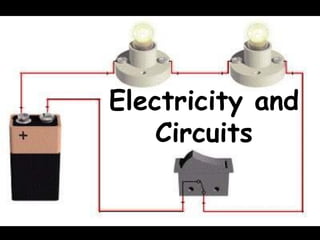
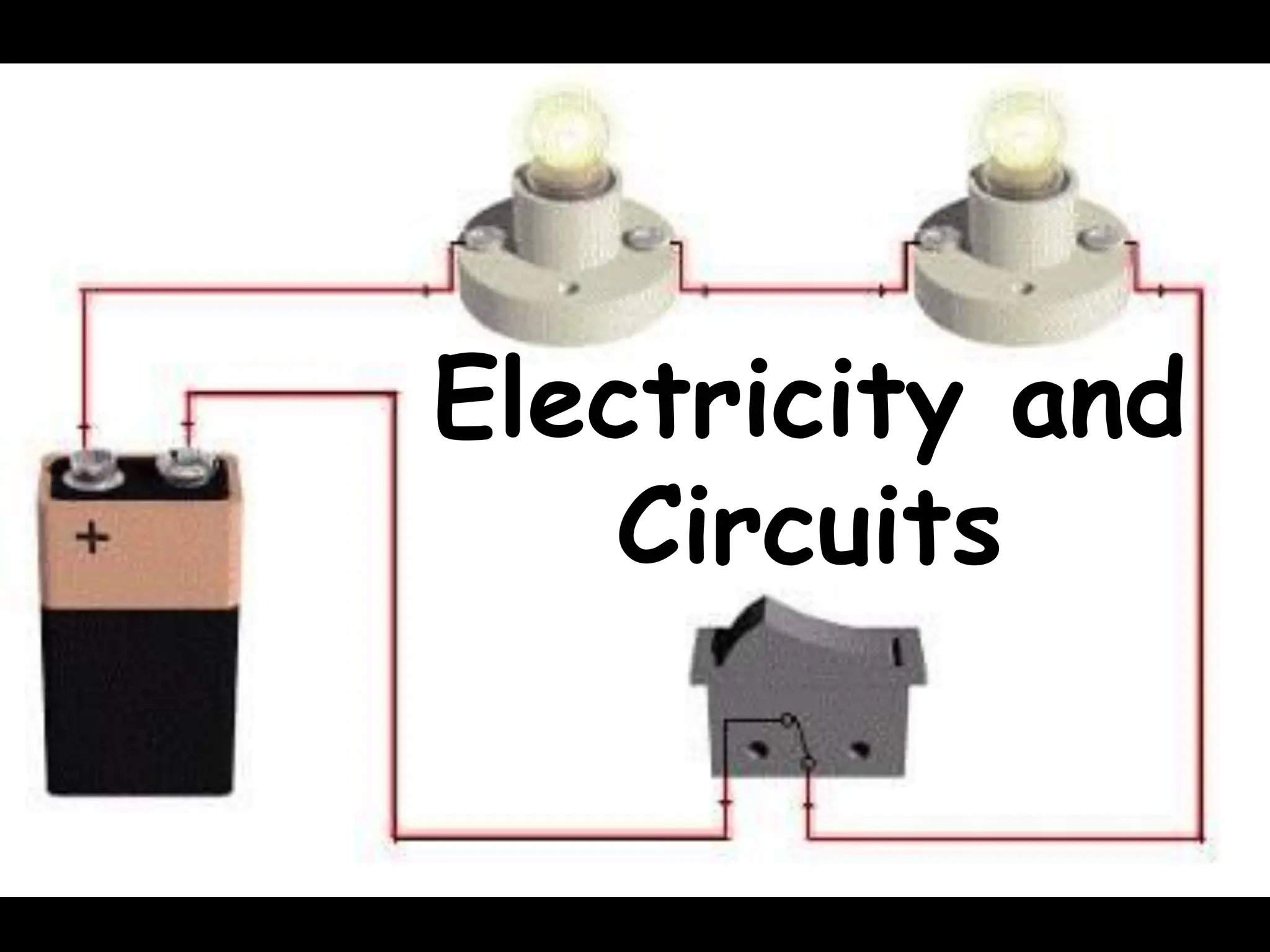
Electricity and
Circuits
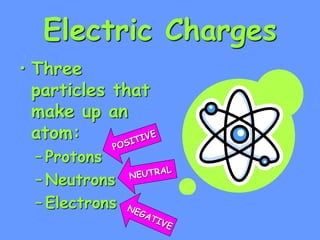
Electric Charges
• Three
particles that
make up an
atom:
– Protons
– Neutrons
– Electrons
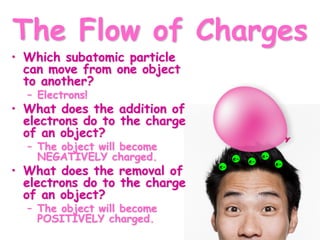
The Flow of Charges
• Which subatomic particle
can move from one object
to another?
– Electrons!
• What does the addition of
electrons do to the charge
of an object?
– The object will become
NEGATIVELY charged.
• What does the removal of
electrons do to the charge
of an object?
– The object will become
POSITIVELY charged.
e-
e-
e-
e-
e-
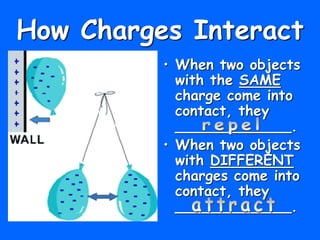
How Charges Interact
• When two objects
with the SAME
charge come into
contact, they
_____________.
• When two objects
with DIFFERENT
charges come into
contact, they
_____________.
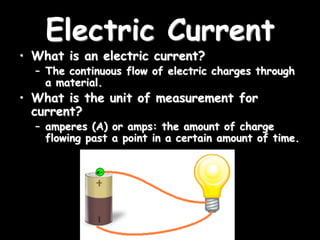
Electric Current
• What is an electric current?
– The continuous flow of electric charges through
a material.
• What is the unit of measurement for
current?
– amperes (A) or amps: the amount of charge
flowing past a point in a certain amount of time.
e-
Potential Difference
• What’s potential energy (PE)?
• On a roller coaster, where
does the car have more
potential energy?
• Can the car move from an
area of low PE to high PE
without the help of a motor?
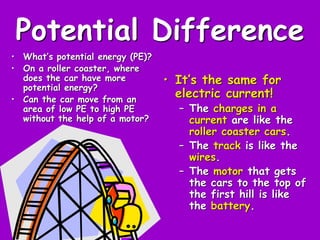
• It’s the same for
electric current!
– The charges in a
current are like the
roller coaster cars.
– The track is like the
wires.
– The motor that gets
the cars to the top of
the first hill is like
the battery.
Potential Difference Cont.
• So what is Potential
Difference?
– The difference in
potential energy
between two locations.
• The difference
between a
rollercoaster and an
electric current is
that the potential
difference is caused
by the difference in
electrical charges in
two locations, not
height.
Potential Difference Cont.
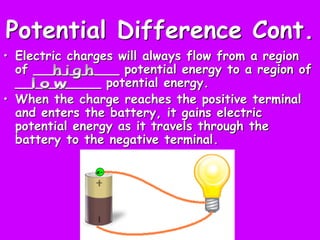
• Electric charges will always flow from a region
of ___________ potential energy to a region of
___________ potential energy.
• When the charge reaches the positive terminal
and enters the battery, it gains electric
potential energy as it travels through the
battery to the negative terminal.
e-
Voltage
• What is it?
– Another term for
potential difference.
• What unit is used to
measure voltage?
– Volts (V)
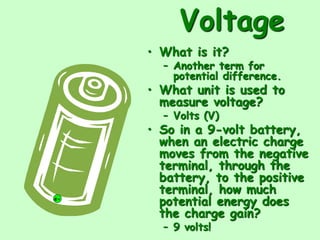
• So in a 9-volt battery,
when an electric charge
moves from the negative
terminal, through the
battery, to the positive
terminal, how much
potential energy does
the charge gain?
– 9 volts!
e-
Basic Circuits
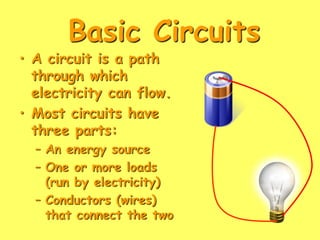
• A circuit is a path
through which
electricity can flow.
• Most circuits have
three parts:
– An energy source
– One or more loads
(run by electricity)
– Conductors (wires)
that connect the two
Parts of a Circuit
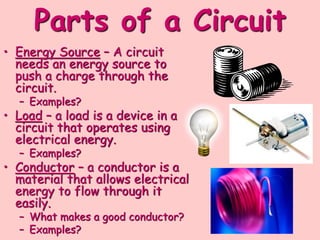
• Energy Source – A circuit
needs an energy source to
push a charge through the
circuit.
– Examples?
• Load – a load is a device in a
circuit that operates using
electrical energy.
– Examples?
• Conductor – a conductor is a
material that allows electrical
energy to flow through it
easily.
– What makes a good conductor?
– Examples?
Parts of a Circuit Cont.
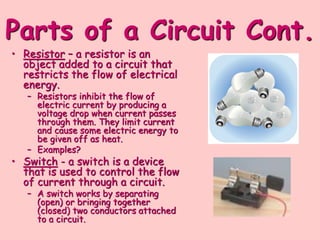
• Resistor – a resistor is an
object added to a circuit that
restricts the flow of electrical
energy.
– Resistors inhibit the flow of
electric current by producing a
voltage drop when current passes
through them. They limit current
and cause some electric energy to
be given off as heat.
– Examples?
• Switch - a switch is a device
that is used to control the flow
of current through a circuit.
– A switch works by separating
(open) or bringing together
(closed) two conductors attached
to a circuit.
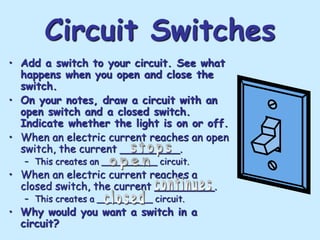
Circuit Switches
• Add a switch to your circuit. See what
happens when you open and close the
switch.
• On your notes, draw a circuit with an
open switch and a closed switch.
Indicate whether the light is on or off.
• When an electric current reaches an open
switch, the current _________.
– This creates an __________ circuit.
• When an electric current reaches a
closed switch, the current _________.
– This creates a __________ circuit.
• Why would you want a switch in a
circuit?
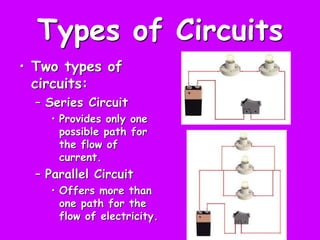
Types of Circuits
• Two types of
circuits:
– Series Circuit
• Provides only one
possible path for
the flow of
current.
– Parallel Circuit
• Offers more than
one path for the
flow of electricity.
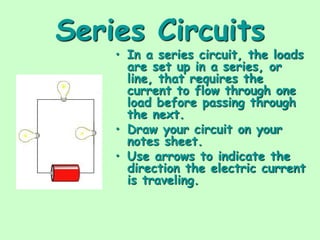
Series Circuits
• In a series circuit, the loads
are set up in a series, or
line, that requires the
current to flow through one
load before passing through
the next.
• Draw your circuit on your
notes sheet.
• Use arrows to indicate the
direction the electric current
is traveling.
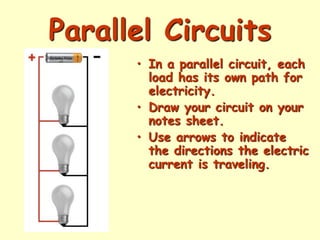
Parallel Circuits
• In a parallel circuit, each
load has its own path for
electricity.
• Draw your circuit on your
notes sheet.
• Use arrows to indicate
the directions the electric
current is traveling.

Electricity and Circuits types ks2 level

  • 1.
  • 2.
    Electric Charges • Three particlesthat make up an atom: – Protons – Neutrons – Electrons
  • 3.
    The Flow ofCharges • Which subatomic particle can move from one object to another? – Electrons! • What does the addition of electrons do to the charge of an object? – The object will become NEGATIVELY charged. • What does the removal of electrons do to the charge of an object? – The object will become POSITIVELY charged. e- e- e- e- e-
  • 4.
    How Charges Interact •When two objects with the SAME charge come into contact, they _____________. • When two objects with DIFFERENT charges come into contact, they _____________.
  • 5.
    Electric Current • Whatis an electric current? – The continuous flow of electric charges through a material. • What is the unit of measurement for current? – amperes (A) or amps: the amount of charge flowing past a point in a certain amount of time. e-
  • 6.
    Potential Difference • What’spotential energy (PE)? • On a roller coaster, where does the car have more potential energy? • Can the car move from an area of low PE to high PE without the help of a motor? • It’s the same for electric current! – The charges in a current are like the roller coaster cars. – The track is like the wires. – The motor that gets the cars to the top of the first hill is like the battery.
  • 7.
    Potential Difference Cont. •So what is Potential Difference? – The difference in potential energy between two locations. • The difference between a rollercoaster and an electric current is that the potential difference is caused by the difference in electrical charges in two locations, not height.
  • 8.
    Potential Difference Cont. •Electric charges will always flow from a region of ___________ potential energy to a region of ___________ potential energy. • When the charge reaches the positive terminal and enters the battery, it gains electric potential energy as it travels through the battery to the negative terminal. e-
  • 9.
    Voltage • What isit? – Another term for potential difference. • What unit is used to measure voltage? – Volts (V) • So in a 9-volt battery, when an electric charge moves from the negative terminal, through the battery, to the positive terminal, how much potential energy does the charge gain? – 9 volts! e-
  • 10.
    Basic Circuits • Acircuit is a path through which electricity can flow. • Most circuits have three parts: – An energy source – One or more loads (run by electricity) – Conductors (wires) that connect the two
  • 11.
    Parts of aCircuit • Energy Source – A circuit needs an energy source to push a charge through the circuit. – Examples? • Load – a load is a device in a circuit that operates using electrical energy. – Examples? • Conductor – a conductor is a material that allows electrical energy to flow through it easily. – What makes a good conductor? – Examples?
  • 12.
    Parts of aCircuit Cont. • Resistor – a resistor is an object added to a circuit that restricts the flow of electrical energy. – Resistors inhibit the flow of electric current by producing a voltage drop when current passes through them. They limit current and cause some electric energy to be given off as heat. – Examples? • Switch - a switch is a device that is used to control the flow of current through a circuit. – A switch works by separating (open) or bringing together (closed) two conductors attached to a circuit.
  • 13.
    Circuit Switches • Adda switch to your circuit. See what happens when you open and close the switch. • On your notes, draw a circuit with an open switch and a closed switch. Indicate whether the light is on or off. • When an electric current reaches an open switch, the current _________. – This creates an __________ circuit. • When an electric current reaches a closed switch, the current _________. – This creates a __________ circuit. • Why would you want a switch in a circuit?
  • 14.
    Types of Circuits •Two types of circuits: – Series Circuit • Provides only one possible path for the flow of current. – Parallel Circuit • Offers more than one path for the flow of electricity.
  • 15.
    Series Circuits • Ina series circuit, the loads are set up in a series, or line, that requires the current to flow through one load before passing through the next. • Draw your circuit on your notes sheet. • Use arrows to indicate the direction the electric current is traveling.
  • 16.
    Parallel Circuits • Ina parallel circuit, each load has its own path for electricity. • Draw your circuit on your notes sheet. • Use arrows to indicate the directions the electric current is traveling.