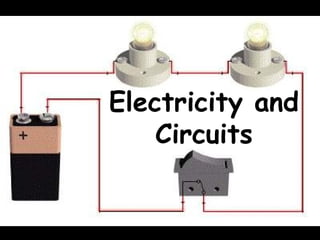
Electric Charges
Electric Charges
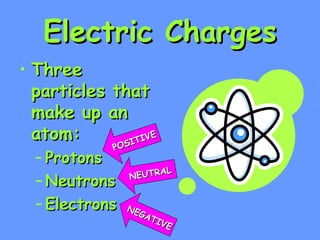
•Three
Three
particles that
particles that
make up an
make up an
atom:
atom:
– Protons
Protons
– Neutrons
Neutrons
– Electrons
Electrons
POSITIVE
POSITIVE
NEUTRAL
NEUTRAL
NEGATIVE
NEGATIVE
3.
The Flow ofCharges
The Flow of Charges
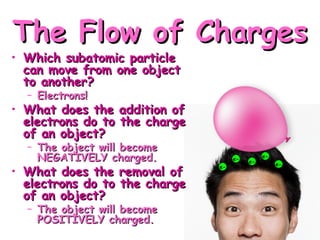
• Which subatomic particle
Which subatomic particle
can move from one object
can move from one object
to another?
to another?
– Electrons!
Electrons!
• What does the addition of
What does the addition of
electrons do to the charge
electrons do to the charge
of an object?
of an object?
– The object will become
The object will become
NEGATIVELY charged.
NEGATIVELY charged.
• What does the removal of
What does the removal of
electrons do to the charge
electrons do to the charge
of an object?
of an object?
– The object will become
The object will become
POSITIVELY charged.
POSITIVELY charged.
e- e-
e-
e-
e-
4.
How Charges Interact
HowCharges Interact
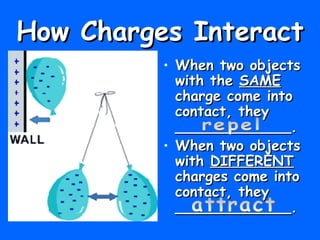
• When two objects
When two objects
with the
with the SAME
SAME
charge come into
charge come into
contact, they
contact, they
_____________.
_____________.
• When two objects
When two objects
with
with DIFFERENT
DIFFERENT
charges come into
charges come into
contact, they
contact, they
_____________.
_____________.
5.
Electric Current
Electric Current
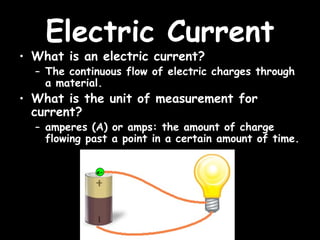
•What is an electric current?
What is an electric current?
– The continuous flow of electric charges through
The continuous flow of electric charges through
a material.
a material.
• What is the unit of measurement for
What is the unit of measurement for
current?
current?
– amperes (A) or amps: the amount of charge
amperes (A) or amps: the amount of charge
flowing past a point in a certain amount of time.
flowing past a point in a certain amount of time.
e-
6.
Basic Circuits
Basic Circuits
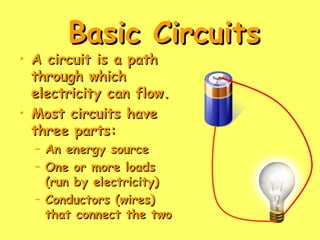
•A circuit is a path
A circuit is a path
through which
through which
electricity can flow.
electricity can flow.
• Most circuits have
Most circuits have
three parts:
three parts:
– An energy source
An energy source
– One or more loads
One or more loads
(run by electricity)
(run by electricity)
– Conductors (wires)
Conductors (wires)
that connect the two
that connect the two
7.
Parts of aCircuit
Parts of a Circuit
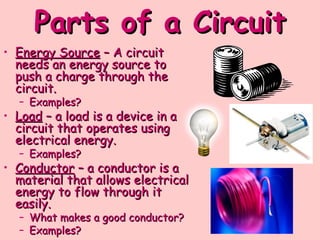
• Energy Source
Energy Source – A circuit
– A circuit
needs an energy source to
needs an energy source to
push a charge through the
push a charge through the
circuit.
circuit.
– Examples?
Examples?
• Load
Load – a load is a device in a
– a load is a device in a
circuit that operates using
circuit that operates using
electrical energy.
electrical energy.
– Examples?
Examples?
• Conductor
Conductor – a conductor is a
– a conductor is a
material that allows electrical
material that allows electrical
energy to flow through it
energy to flow through it
easily.
easily.
– What makes a good conductor?
What makes a good conductor?
– Examples?
Examples?
8.
Parts of aCircuit
Parts of a Circuit
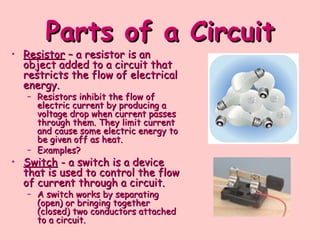
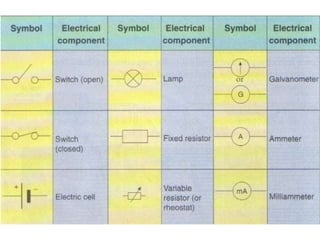
• Resistor
Resistor – a resistor is an
– a resistor is an
object added to a circuit that
object added to a circuit that
restricts the flow of electrical
restricts the flow of electrical
energy.
energy.
– Resistors inhibit the flow of
Resistors inhibit the flow of
electric current by producing a
electric current by producing a
voltage drop when current passes
voltage drop when current passes
through them. They limit current
through them. They limit current
and cause some electric energy to
and cause some electric energy to
be given off as heat.
be given off as heat.
– Examples?
Examples?
• Switch
Switch - a switch is a device
- a switch is a device
that is used to control the flow
that is used to control the flow
of current through a circuit.
of current through a circuit.
– A switch works by separating
A switch works by separating
(open) or bringing together
(open) or bringing together
(closed) two conductors attached
(closed) two conductors attached
to a circuit.
to a circuit.
9.
Circuit Switches
Circuit Switches
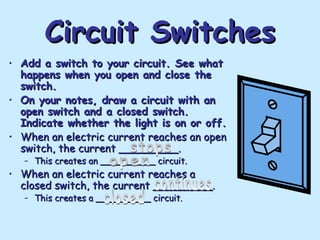
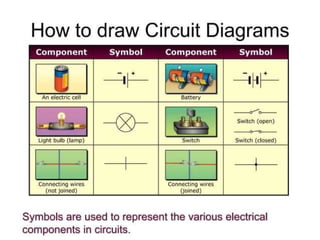
•Add a switch to your circuit. See what
Add a switch to your circuit. See what
happens when you open and close the
happens when you open and close the
switch.
switch.
• On your notes, draw a circuit with an
On your notes, draw a circuit with an
open switch and a closed switch.
open switch and a closed switch.
Indicate whether the light is on or off.
Indicate whether the light is on or off.
• When an electric current reaches an open
When an electric current reaches an open
switch, the current _________.
switch, the current _________.
– This creates an __________ circuit.
This creates an __________ circuit.
• When an electric current reaches a
When an electric current reaches a
closed switch, the current _________.
closed switch, the current _________.
– This creates a __________ circuit.
This creates a __________ circuit.
10.
Types of Circuits
Typesof Circuits
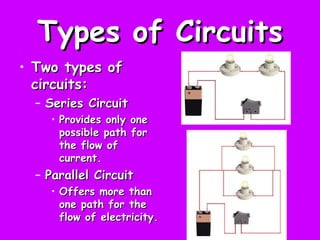
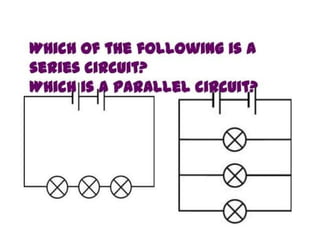
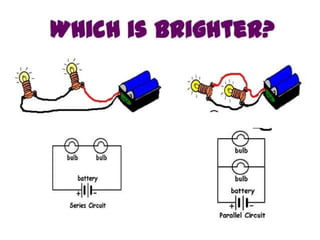
• Two types of
Two types of
circuits:
circuits:
– Series Circuit
Series Circuit
• Provides only one
Provides only one
possible path for
possible path for
the flow of
the flow of
current.
current.
– Parallel Circuit
Parallel Circuit
• Offers more than
Offers more than
one path for the
one path for the
flow of electricity.
flow of electricity.
11.
Series Circuits
Series Circuits
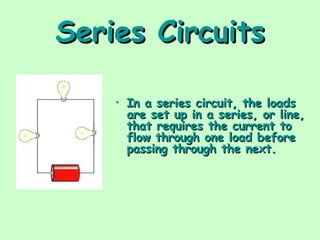
•In a series circuit, the loads
In a series circuit, the loads
are set up in a series, or line,
are set up in a series, or line,
that requires the current to
that requires the current to
flow through one load before
flow through one load before
passing through the next.
passing through the next.
12.
Series Circuits
Series Circuits
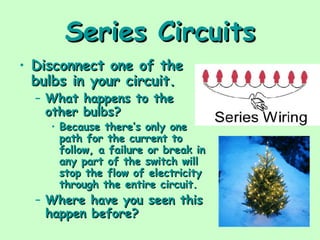
•Disconnect one of the
Disconnect one of the
bulbs in your circuit.
bulbs in your circuit.
– What happens to the
What happens to the
other bulbs?
other bulbs?
• Because there’s only one
Because there’s only one
path for the current to
path for the current to
follow, a failure or break in
follow, a failure or break in
any part of the switch will
any part of the switch will
stop the flow of electricity
stop the flow of electricity
through the entire circuit.
through the entire circuit.
– Where have you seen this
Where have you seen this
happen before?
happen before?
13.
Parallel Circuits
Parallel Circuits
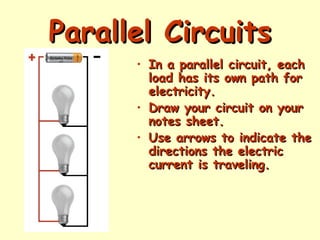
•In a parallel circuit, each
In a parallel circuit, each
load has its own path for
load has its own path for
electricity.
electricity.
• Draw your circuit on your
Draw your circuit on your
notes sheet.
notes sheet.
• Use arrows to indicate the
Use arrows to indicate the
directions the electric
directions the electric
current is traveling.
current is traveling.
14.
Parallel Circuits
Parallel Circuits
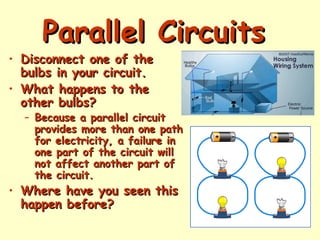
•Disconnect one of the
Disconnect one of the
bulbs in your circuit.
bulbs in your circuit.
• What happens to the
What happens to the
other bulbs?
other bulbs?
– Because a parallel circuit
Because a parallel circuit
provides more than one path
provides more than one path
for electricity, a failure in
for electricity, a failure in
one part of the circuit will
one part of the circuit will
not affect another part of
not affect another part of
the circuit.
the circuit.
• Where have you seen this
Where have you seen this
happen before?
happen before?
15.
Series/Parallel
Series/Parallel
• Think backto
Think back to
your series
your series
circuit.
circuit.
– What happened
What happened
when you added
when you added
more loads?
more loads?
• Think back to
Think back to
your parallel
your parallel
circuit.
circuit.
– What happened
What happened
when you added
when you added
more loads?
more loads?
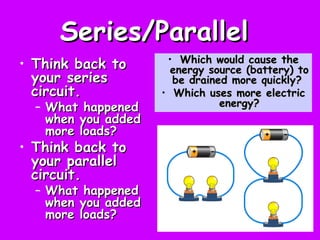
• Which would cause the
Which would cause the
energy source (battery) to
energy source (battery) to
be drained more quickly?
be drained more quickly?
• Which uses more electric
Which uses more electric
energy?
energy?
Editor's Notes
#4 ⚡ When two objects have the SAME charge:
They repel (push away from each other).
Like charges (both positive-positive or negative-negative) don’t like to be close together.
🧪 Example:
Rub two balloons with wool. Each balloon gains the same charge (negative). When you try to bring them close, they push away from each other.
⚡ When two objects have DIFFERENT charges:
They attract (pull toward each other).
Opposite charges (positive and negative) attract each other.
🧪 Example:
Rub a balloon on your hair—your hair becomes positive and the balloon becomes negative. The balloon will stick to your hair because of attraction between opposite charges.
#11 Low resistance – It doesn’t block or slow down the flow of electricity.
✅ Stable structure – It doesn’t overheat or break easily when current passes.
✅ Durability and flexibility – Useful in wires and electronic components
Examples of Good Conductors:
Copper (used in electrical wiring)
Silver (best conductor but expensive)
Aluminum (used in power lines)
Gold (used in electronics for reliability)
#12 Its main job is to limit or control the flow of electric current. It does this by providing resistance, which slows down or reduces how much current passes through a wire.
This helps prevent damage to other components and allows devices to work safely and properly.
Without the resistor, the LED might receive too much current and be damaged
#21 In a series circuit:
The total resistance increases.
Each load gets dimmer (if using bulbs).
Since the current is the same throughout, and there's more resistance, each bulb gets less power.
The battery drains more slowly per second, but not always efficiently.
Less current means slower drain, but the energy may not be used efficiently across many loads.
If one load is removed or burns out, the whole circuit stops working.
That’s a key feature of series circuits—one break stops everything.
In a parallel circuit:
Each load gets the full voltage from the battery.
Unlike in a series circuit, the brightness of each bulb stays the same even if you add more.
The total current increases.
Each added load provides a new path for current to flow, so more current is drawn from the battery.
The battery drains faster.
More current being used means the energy source is used up more quickly.
If one load is removed or burns out, the others keep working.
That’s one of the biggest advantages of parallel circuits—one path can break, but the rest still work.
🧠 Example:
You have one light bulb in a parallel circuit — it's bright.
You add another bulb — both stay equally bright.
You add a third — still bright, but the battery drains faster.
If one bulb is removed, the others stay on.
#23 So based on the definition of series and parallel……………..