PHYSICS
INVESTIGATORY
PROJECT
ON
TRANSFORMERS
NAME: ASHNA
CLASS:
XII
SECTION: ‘C’
ROLL NO.: 1
Lovely Public Sr. Sec. School
Physics Department
CERTIFICATE
This is to certify that Ashna, a student of class
XII-C has successfully completed the research
on the below mentioned project under the
guidance of Mrs. Premlata Prasad Mam ( Subject
Teacher ) during the year 2016-17 in partial
fulfillment of physics practical examination
conducted by AISSCE, New Delhi.
Signature of external examiner Signature of physics teacher
ACKNOWLEDGEMENT
I am extremely grateful to Mrs.
Premlata Prasad Mam, Teacher of
Department of Physics for her
able guidance and useful
suggestions, which helped me in
completing the project work, in
time.
I would also like to thank all the
teaching and non-teaching staff
of Physics Department who
helped me directly or indirectly in
the completion of this project.
Finally, yet importantly, I would
like to express my heartfelt thanks
to my beloved parents for their
blessings.
INDEX
 Certificate
 Acknowledgement
 Aim
 Introduction
 Theory
 Apparatus required
 Procedure followed
 Uses of Transformer
 Conclusion
 Precaution
 Source of error
 Bibliography
AIM OF THE PROJECT
To investigate the relation between the
ratio of –
 Input and output voltage.
 Number of turnings in the secondary
coil and primary coil of a self-made
transformer.
INTRODUCTION
The transformer is a device used for converting a low
alternating voltage to a high alternating voltage or vice-versa.
A Transformer based on the Principle of mutual induction
according to this principle, the amount of magnetic flux linked
with a coil changing, an e.m.f is induced in the neighboring coil.
A transformer is an electrical device which is used for changing
the A.C. voltages. A transformer is most widely used device in
both low and high current circuit. As such transformers are built
in an amazing strength of sizes. In electronic, measurement and
control circuits, transformer size may be so small that it weight
only a few tens of grams where as in high voltage power
circuits, it may weight hundreds of tones.
In a transformer, the electrical energy transfer from one circuit
to another circuit takes place without the use of moving parts.
A transformer which increases the voltages is called a step-up
transformer. A transformer which decreases the A.C. voltages is
called a step-down transformer.
Transformer is, therefore, an essential piece of apparatus both
for high and low current circuits.
Theory
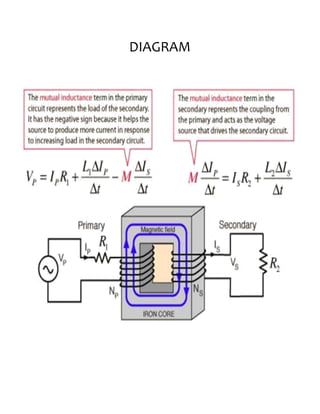
When an altering e.m.f. is supplied to the primary coil p1p2, an
alternating current starts falling in it. The altering current in the primary
produces a changing magnetic flux, which induces altering voltage in
the primary as well as in the secondary. In a good-transformer, whole
of the magnetic flux linked with primary is also linked with the
secondary, and then the induced e.m.f. induced in each turn of the
secondary is equal to that induced in each turn of the primary. Thus if
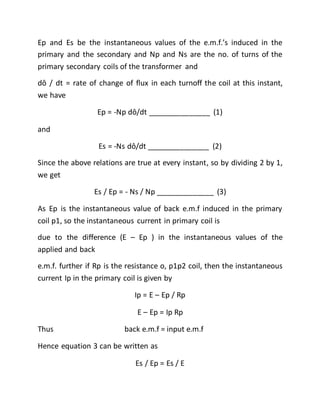
Ep and Es be the instantaneous values of the e.m.f.’s induced in the
primary and the secondary and Np and Ns are the no. of turns of the
primary secondary coils of the transformer and
dô / dt = rate of change of flux in each turnoff the coil at this instant,
we have
Ep = -Np dô/dt _______________ (1)
and
Es = -Ns dô/dt _______________ (2)
Since the above relations are true at every instant, so by dividing 2 by 1,
we get
Es / Ep = - Ns / Np ______________ (3)
As Ep is the instantaneous value of back e.m.f induced in the primary
coil p1, so the instantaneous current in primary coil is
due to the difference (E – Ep ) in the instantaneous values of the
applied and back
e.m.f. further if Rp is the resistance o, p1p2 coil, then the instantaneous
current Ip in the primary coil is given by
Ip = E – Ep / Rp
E – Ep = Ip Rp
Thus back e.m.f = input e.m.f
Hence equation 3 can be written as
Es / Ep = Es / E
= output e.m.f / input e.m.f
= Ns / Np = K
Where K is constant, called turn or transformation ratio.
I
N
A
S
T
E
P
DOWN TRANSFORMER
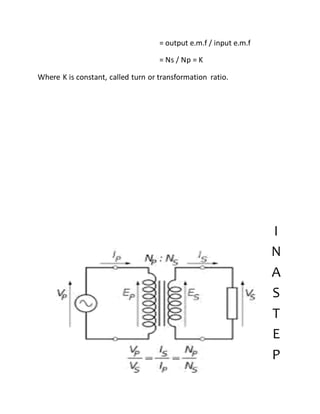
Es < E so K < 1, hence Ns < Np
If Ip = value of primary current at the same instant and
Is = value of secondary current at this instant, then
Input power at the instant = Ep Ip and Output power at the same instant = Es Is
If there are no losses of power in the transformer, then Input power = output
power Or Ep Ip = Es Is Or Es / Ep = Ip / Is = K
ILLUSTRATION
IN A STEP UP TRANSFORMER
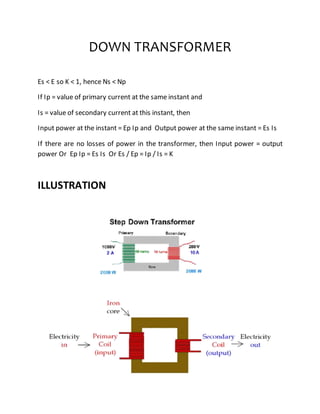
Es > E so K > 1, hence Ns > Np As, k > 1, so Ip > Is or Is < Ip
i.e. current in secondary is weaker when secondary voltage is higher.
Hence, whatever we gain in voltage, we lose in current in the same ratio.
Similarly it can be shown, that in a step down transformer, whatever we lose in
voltage, we gain in current in the same ratio.
Thus a step up transformer in reality steps down the current &a step down
transformer steps up the current.
ILLUSTRATION
EFFICIENCY
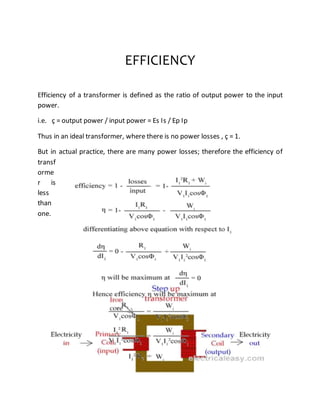
Efficiency of a transformer is defined as the ratio of output power to the input
power.
i.e. ç = output power / input power = Es Is / Ep Ip
Thus in an ideal transformer, where there is no power losses , ç = 1.
But in actual practice, there are many power losses; therefore the efficiency of
transf
orme
r is
less
than
one.
ENERGY LOSSES
Following are the major sources of energy loss in a
transformer:
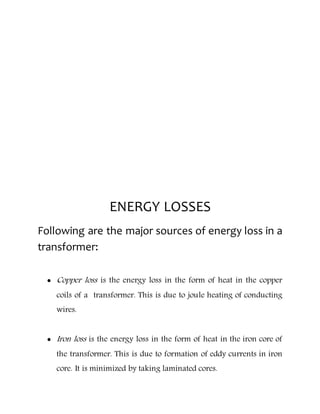
 Copper loss is the energy loss in the form of heat in the copper
coils of a transformer. This is due to joule heating of conducting
wires.
 Iron loss is the energy loss in the form of heat in the iron core of
the transformer. This is due to formation of eddy currents in iron
core. It is minimized by taking laminated cores.
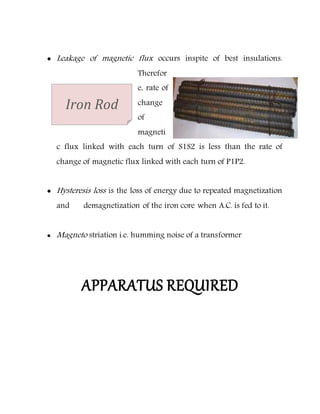
 Leakage of magnetic flux occurs inspite of best insulations.
Therefor
e, rate of
change
of
magneti
c flux linked with each turn of S1S2 is less than the rate of
change of magnetic flux linked with each turn of P1P2.
 Hysteresis loss is the loss of energy due to repeated magnetization
and demagnetization of the iron core when A.C. is fed to it.
 Magneto striation i.e. humming noise of a transformer
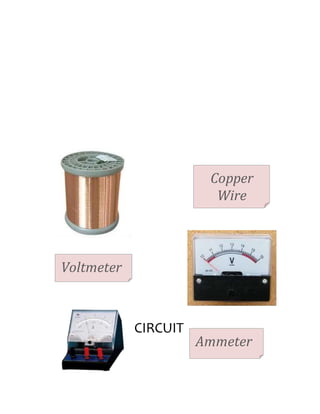
APPARATUS REQUIRED
Iron Rod
CIRCUIT
Ammeter
Voltmeter
Copper
Wire
DIAGRAM
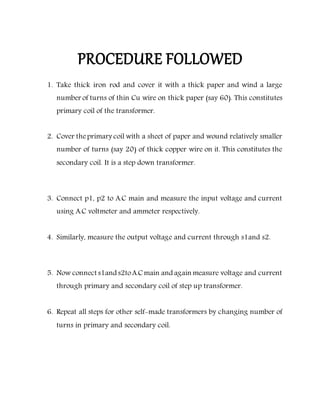
PROCEDURE FOLLOWED
1. Take thick iron rod and cover it with a thick paper and wind a large
number of turns of thin Cu wire on thick paper (say 60). This constitutes
primary coil of the transformer.
2. Cover theprimary coil with a sheet of paper and wound relatively smaller
number of turns (say 20) of thick copper wire on it. This constitutes the
secondary coil. It is a step down transformer.
3. Connect p1, p2 to A.C main and measure the input voltage and current
using A.C voltmeter and ammeter respectively.
4. Similarly, measure the output voltage and current through s1and s2.
5. Now connect s1and s2toA.C main and again measure voltage and current
through primary and secondary coil of step up transformer.
6. Repeat all steps for other self-made transformers by changing number of
turns in primary and secondary coil.
USES OF TRANSFORMERS
 In voltage regulator for T.V., refrigerator, computer, air
conditioner, etc.
 A step down transformer is used for welding purposes.
 A step down transformer is used for obtaining large current.
 A step up transformer is used for the production of X-Rays and
NEON advertisement.
 Transformers are used in voltage regulators and stabilized
power supplies.
 Transformers are used in the transmissions of a.c. over long
distances.
 Small transformers are used in Radio sets, telephones, loud
speakers and electric bells etc
CONCLUSION
1. The output voltage of the transformer across the secondary
coil depends upon the ratio (Ns/Np) with respect to the
input voltage
2. The output voltage of the transformer across the secondary
coil depends upon the ratio (Ns/N p) with respect to the
input voltage
3. There is a loss of power between input and output coil of a
transformer.
PRECAUTIONS
1. Keep safe yourself from high voltage.
2. While taking the readings of current and voltage the A.C
should remain constant.
SOURCES OF ERROR
1. Values of current can be changed due to heating effect.
2. Eddy current can change the readings.
BIBILIOGRAPHY
1) NCERT textbook class 12
2) NCERT physics lab Manuel
3) INTERNET
4) www.yahoo.com
5) www.scribd.com
6) www.google.com
Physics Project

Physics Project

  • 2.
  • 3.
    CLASS: XII SECTION: ‘C’ ROLL NO.:1 Lovely Public Sr. Sec. School Physics Department CERTIFICATE This is to certify that Ashna, a student of class XII-C has successfully completed the research on the below mentioned project under the guidance of Mrs. Premlata Prasad Mam ( Subject
  • 4.
    Teacher ) duringthe year 2016-17 in partial fulfillment of physics practical examination conducted by AISSCE, New Delhi. Signature of external examiner Signature of physics teacher ACKNOWLEDGEMENT I am extremely grateful to Mrs. Premlata Prasad Mam, Teacher of Department of Physics for her able guidance and useful
  • 5.
    suggestions, which helpedme in completing the project work, in time. I would also like to thank all the teaching and non-teaching staff of Physics Department who helped me directly or indirectly in the completion of this project. Finally, yet importantly, I would like to express my heartfelt thanks
  • 6.
    to my belovedparents for their blessings. INDEX  Certificate  Acknowledgement  Aim  Introduction  Theory  Apparatus required  Procedure followed  Uses of Transformer
  • 7.
     Conclusion  Precaution Source of error  Bibliography AIM OF THE PROJECT To investigate the relation between the ratio of –  Input and output voltage.
  • 8.
     Number ofturnings in the secondary coil and primary coil of a self-made transformer. INTRODUCTION The transformer is a device used for converting a low alternating voltage to a high alternating voltage or vice-versa. A Transformer based on the Principle of mutual induction according to this principle, the amount of magnetic flux linked with a coil changing, an e.m.f is induced in the neighboring coil. A transformer is an electrical device which is used for changing the A.C. voltages. A transformer is most widely used device in
  • 9.
    both low andhigh current circuit. As such transformers are built in an amazing strength of sizes. In electronic, measurement and control circuits, transformer size may be so small that it weight only a few tens of grams where as in high voltage power circuits, it may weight hundreds of tones. In a transformer, the electrical energy transfer from one circuit to another circuit takes place without the use of moving parts. A transformer which increases the voltages is called a step-up transformer. A transformer which decreases the A.C. voltages is called a step-down transformer. Transformer is, therefore, an essential piece of apparatus both for high and low current circuits. Theory When an altering e.m.f. is supplied to the primary coil p1p2, an alternating current starts falling in it. The altering current in the primary produces a changing magnetic flux, which induces altering voltage in the primary as well as in the secondary. In a good-transformer, whole of the magnetic flux linked with primary is also linked with the secondary, and then the induced e.m.f. induced in each turn of the secondary is equal to that induced in each turn of the primary. Thus if
  • 10.
    Ep and Esbe the instantaneous values of the e.m.f.’s induced in the primary and the secondary and Np and Ns are the no. of turns of the primary secondary coils of the transformer and dô / dt = rate of change of flux in each turnoff the coil at this instant, we have Ep = -Np dô/dt _______________ (1) and Es = -Ns dô/dt _______________ (2) Since the above relations are true at every instant, so by dividing 2 by 1, we get Es / Ep = - Ns / Np ______________ (3) As Ep is the instantaneous value of back e.m.f induced in the primary coil p1, so the instantaneous current in primary coil is due to the difference (E – Ep ) in the instantaneous values of the applied and back e.m.f. further if Rp is the resistance o, p1p2 coil, then the instantaneous current Ip in the primary coil is given by Ip = E – Ep / Rp E – Ep = Ip Rp Thus back e.m.f = input e.m.f Hence equation 3 can be written as Es / Ep = Es / E
  • 11.
    = output e.m.f/ input e.m.f = Ns / Np = K Where K is constant, called turn or transformation ratio. I N A S T E P
  • 12.
    DOWN TRANSFORMER Es <E so K < 1, hence Ns < Np If Ip = value of primary current at the same instant and Is = value of secondary current at this instant, then Input power at the instant = Ep Ip and Output power at the same instant = Es Is If there are no losses of power in the transformer, then Input power = output power Or Ep Ip = Es Is Or Es / Ep = Ip / Is = K ILLUSTRATION
  • 13.
    IN A STEPUP TRANSFORMER Es > E so K > 1, hence Ns > Np As, k > 1, so Ip > Is or Is < Ip i.e. current in secondary is weaker when secondary voltage is higher. Hence, whatever we gain in voltage, we lose in current in the same ratio. Similarly it can be shown, that in a step down transformer, whatever we lose in voltage, we gain in current in the same ratio. Thus a step up transformer in reality steps down the current &a step down transformer steps up the current. ILLUSTRATION
  • 14.
    EFFICIENCY Efficiency of atransformer is defined as the ratio of output power to the input power. i.e. ç = output power / input power = Es Is / Ep Ip Thus in an ideal transformer, where there is no power losses , ç = 1. But in actual practice, there are many power losses; therefore the efficiency of transf orme r is less than one.
  • 15.
    ENERGY LOSSES Following arethe major sources of energy loss in a transformer:  Copper loss is the energy loss in the form of heat in the copper coils of a transformer. This is due to joule heating of conducting wires.  Iron loss is the energy loss in the form of heat in the iron core of the transformer. This is due to formation of eddy currents in iron core. It is minimized by taking laminated cores.
  • 16.
     Leakage ofmagnetic flux occurs inspite of best insulations. Therefor e, rate of change of magneti c flux linked with each turn of S1S2 is less than the rate of change of magnetic flux linked with each turn of P1P2.  Hysteresis loss is the loss of energy due to repeated magnetization and demagnetization of the iron core when A.C. is fed to it.  Magneto striation i.e. humming noise of a transformer APPARATUS REQUIRED Iron Rod
  • 17.
  • 18.
  • 19.
    PROCEDURE FOLLOWED 1. Takethick iron rod and cover it with a thick paper and wind a large number of turns of thin Cu wire on thick paper (say 60). This constitutes primary coil of the transformer. 2. Cover theprimary coil with a sheet of paper and wound relatively smaller number of turns (say 20) of thick copper wire on it. This constitutes the secondary coil. It is a step down transformer. 3. Connect p1, p2 to A.C main and measure the input voltage and current using A.C voltmeter and ammeter respectively. 4. Similarly, measure the output voltage and current through s1and s2. 5. Now connect s1and s2toA.C main and again measure voltage and current through primary and secondary coil of step up transformer. 6. Repeat all steps for other self-made transformers by changing number of turns in primary and secondary coil.
  • 20.
    USES OF TRANSFORMERS In voltage regulator for T.V., refrigerator, computer, air conditioner, etc.  A step down transformer is used for welding purposes.  A step down transformer is used for obtaining large current.  A step up transformer is used for the production of X-Rays and NEON advertisement.  Transformers are used in voltage regulators and stabilized power supplies.  Transformers are used in the transmissions of a.c. over long distances.  Small transformers are used in Radio sets, telephones, loud speakers and electric bells etc
  • 21.
    CONCLUSION 1. The outputvoltage of the transformer across the secondary coil depends upon the ratio (Ns/Np) with respect to the input voltage 2. The output voltage of the transformer across the secondary coil depends upon the ratio (Ns/N p) with respect to the input voltage 3. There is a loss of power between input and output coil of a transformer. PRECAUTIONS 1. Keep safe yourself from high voltage. 2. While taking the readings of current and voltage the A.C should remain constant. SOURCES OF ERROR 1. Values of current can be changed due to heating effect. 2. Eddy current can change the readings.
  • 22.
    BIBILIOGRAPHY 1) NCERT textbookclass 12 2) NCERT physics lab Manuel 3) INTERNET 4) www.yahoo.com 5) www.scribd.com
  • 23.