Department of Plastic And
Reconstructive Surgery
Sher i Kashmir Institute of Medical
Sciences Srinagar
Seminar Topic: Electric Injuries
Electrical Injuries
Presentor : Dr Junaid khiurshid
Moderator : Dr Haroon Rashid Zargar
Definition
An electrical burn is a burn that results from
electricity passing through the body causing
rapid injury
Physics
• I= V/R ohms law
• Intensity expressed in amperes
• DC lightning, rails, autos, batteries
• AC most power lines
• E=IVR (Joules Law)
The higher is the resistance of tissue the greater
transformation of electrical to thermal injuries
• Muscles & blood vessels has low resistance &
good conductor
• Bone tendon & fat have high resistance &
tend to heat & coagulate rather than transmit
the current
Callosed skin > >normal skin>> Moister & sweaty
Resistance of body tissues
• Most
• tendon
• Fat
• Bone
• Intermediate
• Dry skin
• Least
• Nerve
• Blood
• Muscle Membrane
• Muscle
Electrical Burns -
Pathophysiology
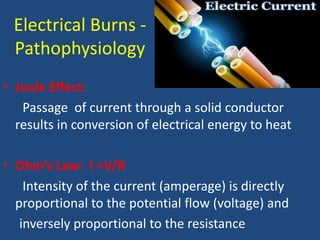
• Joule Effect:
Passage of current through a solid conductor
results in conversion of electrical energy to heat
• Ohm’s Law: I =V/R
Intensity of the current (amperage) is directly
proportional to the potential flow (voltage) and
inversely proportional to the resistance
Epidemology
• Accounts for 3% of all burn related injuries
• Estimated 3000 annual admits to burn units in USA
• 30 % fatal 1000 deaths in USA
Age distribution
• Bimodal distribution
• 1/3 in children <6 years
• 2/3 in adult electrical, construction
workers and miners
• Common cause occupational deaths
• In children usually occurs at home associated with
electrical and extension cords (in about 60–70%)
and with wall outlets (another 10–15%)
• One unique entity that affects children
(particularly < 5 years of age) is electrical burns
due to biting a live wire from an electric
appliance or mouthing the female end of a
connected extension cord.
• Injury pattern consists of burn to the oral
commissure.
• Can lead to poor outcomes, both functionally and
aesthetically.
– The low voltage nature of these injuries typically spares
the deep tissues.
– Can injury local labial artery and develop significant
bleeding, even in a delayed fashion when scab sloughs
off.
Wall outlet injury
• Most deaths in adults due to electrocution are
work related (5–6% of all workers’ deaths)
• Miners and construction workers account for most
of these cases, with rates of 1.8 to 2.0 deaths per
100 000 workers
Allmost all of current transmission is via AC
lines which are more dangerous than DC of
same voltage
Alternating more dangerous than direct
"let go" current
The maximum current at which a person can grasp the
current and then release it before muscle tetany
makes letting go impossible.
For child it is 3-5 mA; this is well below the 15-30 A of
common household circuit breakers.
For adults, the "let go" current is 6-9 mA, slightly higher
for men than for women
Once this is surpassed
• Tetany
• Respiratory arrest
• Ventricular fibrillation
• Occurs more readily at higher currents,
and alternating current (AC)
Extent of injury depends on:
• Direct vs Alternating current
• Pathway of flow
• Local tissue resistance
• Duration of contact
Low-voltage
• <1000 volts
• Alternating current
• Prolonged contact
• Ventricular Fibrillation
• Tetanic contraction
• Superficial Burns
• Rhabdomyolysis unlikely
High-voltage
• >1000 volts
• AC or DC
• Brief Contact
• Asystole
• Tetanic Sometimes
• Deep Burns
• Rhabdomyolysis Likely
High Voltage Accidental Electric Burn
• Mortality of electrical burns
Low voltage injuries Alter the cardiac cycle
• High-voltage injuries Cause concomitant
tissue damage
• Survival of contact with voltage greater than
70,000 volts uncommon
Mechanisms of injury
• Direct effect of current
• Thermal burns
• Mechanical trauma
• Post trauma sequel
• May be the result of contact with high- or low-
voltage electricity
• For electricity to flow, there must be a
complete circuit between the source and the
ground.
– Any substance that prevents this circuit is called
an insulator.
– Any substance that allows a current to flow is
called a conductor.
Completion of circuit needed
A burn injury appears where the
electricity enters and exits the body.
Histological changes
• Coagulation necrosis of muscles (periosteal ,
shortening of sarcomers)
• Vascular damage ( hemorrhage , thrombosis,
progressive tissue necrosis)
• Neural tissue damage ( Coagulation necrosis ,
compartment syndrome)
Cardiac
• Incidence of arrhythmia ranging from 4–17%
• VF more common in low voltage DC shocks.
Asystole more common in High voltage events.
• Virtually any abnormality possible: Increased
PR/QT, Ectopics, St segment, bundle branch blocks,
etc
• Also: Direct myocardial injury
Respiratory
• Respiratory arrest
• Tetanic contractions of thoracic muscles
• Autonomic nerve dysfunction
• Blunt chest trauma
Neurological
• CNS damage: High voltage injuries
• Temp paralysis (keraunoparalysis)
• Loss of consciousness, agitation, coma, seizures
• Spinal cord damage, secoundry to muscle contraction
• PNS damage: Low voltage injuries
• Parasthesiae, Brachial plexus injuries
Orthopaedic
• Direct thermal energy leading to coagulation
necrosis.
• Secondary rhabdomyolysis, compartment
syndrome.
• Osteonecrosis.
• Secondary fractures/dislocations from tetany
and falls.
Dermatological
• A kissing burn is an electric arc generated between
two skin surfaces facing each other and
sandwiching a joint, typically the elbow and knee
flexures. The arc crosses the flexor crease and burns
the two 'kissing' skin surfaces causing vast
underlying tissue destruction
Others
• Abdominal: Stress (Curling) ulcer, abdominal
perforation
• Renal: AKI secondary to rhabdomyolysis
• Ocular: Delayed onset cataracts in 6% high voltage
injuries, higher in lightning strike
• Auditory: Perforated TM, cochlear damage, VIII
CN damage
Ocular manifestation of electric injury
Post-trauma sequelae
• Crush injury syndrome (rhabdomyolysis,
myoglobinuria)
• Multi-organ ischemic injury secondary to vascular
coagulation or dissection
• Hypovolemic shock secondary to massive 3rd space
loss
• Iatrogenic injuries from acute resuscitation,
Abdominal compartment syndromeand ARDS
ARC BURN
Electrical Arc Burn
• Formed between two objects differing in potential ,
not in contact
• Occurs when high amperage current travels or arc
through the air temp as high as 36000 f have been
noted
• Result in deep thermal injury because of high temp of
the electrical arc or sometimes flame burn or
splashing across the entire body
• Arc burns do not require direct contact with an
electrical source. The burn is caused by electrical
energy travelling from an area of high resistance
to an area of low resistance. The circuit is
completed when the air particles are ionized
Some ARC flash injury statistics
• Five to ten ARC flash explosions occur in electrical
equipment every day in the United States.
• Injuries from arc flash events range from minor
injuries to third degree burns and potential death
due to the energy released.
• Other injuries include blindness, hearing loss,
nerve damage, and cardiac arrest.
• The average cost of medical treatment for
survivors of arc flash incidents is $ 1,500,000, Total
costs including litigation can be $8M - $10M
Lightning Injuries
Lightning Strikes
• 150 to 300 deaths annually in the USA causes
cardiac and respiratory arrest, resulting in a 25%
to 30% mortality rate
• High voltage but short duration
• Amount of energy delivered may be less than with
other high-voltage electrical injuries because of
the short exposure
Lichtenberg Figures
• Rare pathognomonic “flower-like” branching skin
lesions in persons struck by lightning
• Caused by “flashover” effect of non-penetrating
current
• Rapidly fade, not typically serious
Keraunoparalysis
• A specific form of reversible, transient
paralysis that is associated with sensory
disturbances and peripheral
vasoconstriction and is seen in some
patients following lightning injury
Secoundary to massive catecholamine release
• Typically after lightening injury
• Clinical manifestation
– Paraplegia/quadriplegia
– Autonomic instability
• Hypertension
• Peripheral vasospasm
• Mydriasis and anisocoria
• Resolves within a few hours
Mechanical Trauma
• Trauma can result from fall or muscle contraction
• Classic example is shock wave of lightning causing blast injuries
Even at low V, tetanic muscle contraction can result in bone fracture
• Cord injury can result from severe muscle contraction, w/o any
external signs of trauma
• Acute hypotension should always prompt search for thoracic or
intra-abdominal bleeding
Management
No treatment just assurance
• Low voltage injuries <240 volts:
• Asymptomatic patients with a normal ECG on
arrival, no abnormal clinical findings on
examination
• Can be discharged with advice.
• No other investigations needed
Red flags in low voltage
• chest pain, palpations
• loss of consciousness, altered mental status,
confusion, weakness
• dyspnoea, abdominal pain, weakness, burn with
subcutaneous damage
• vascular compromise, or abnormal results on ECG
Management in the ED
Further investigations in red flag patients:
• Urinary and serum myoglobin
• CK
• FBCs, U&Es, LFTS, Lipase, Coag studies
• Imaging where appropriate
• Admit these patients
• Admit all high voltage (>600 volts) injuries
• These patients will likely need transfer to a
burns centre if not immediate life threatening
injuries
Asessmernt
• Often see superficial burns
– Rule of 9’s, but not the full story
• Not able to asses internal burns along path of
electricity
• Often extensive internal organ injury
• Third spacing is often significant and ongoing
So how do you decide how much fluid
to give?
• Titrate to normal urine output (0.5 cc/kg/hr)
• How much is too much?
– Klein et al.
• 5ml/ % BSA = increased pneumonia + death
– Compartment syndromes
• Abdominal
• Extremity
• Ocular
Physicians tend to over resuscitate follow BP, unwilling to
decrease when good U/O
• Standard ABCDEs of any major trauma
• Pulmonary, Low threshold for intubation, as
respiratory failure is common
• Cardiac, Serial monitoring if high V, abnormal ECG,
LOC, respiratory arrest, or PMH of CV dysfunction
• Neuro, C-spine and log-roll precautions; CT head &
spine often warranted, Thorough serial neurological
exams, as vessel coagulation can result in late
sequelae
• Musculoskeletal, Thorough evaluation for fractures,
Serial evaluations of limbs for compartment,
syndrome requiring emergent decompression, Even
in absence of compartment syndrome, persistent
aciduria or myoglobinuria may require limb
amputation
Fasciotomy
• Skin, Early debridement and later reconstruction
Antibiotic prophylaxis (controversial)
• Renal, Fluid resuscitation key, as 3rd spacing
common & myoglobinuria sec to rhabdomyolysis
can cause ARF
• GI, Ulcer prophylaxis, as gastric ulcers (Curling’s
ulcers) can develop Ileus uncommon, but should
prompt evaluation for other injury Serial
evaluation of liver, pancreatic, & renal function for
traumatic/anoxic/ischemic injury, Judicious
management of fluid and electrolytes to avoid
acidosis and compartment syndromes
Prevention
Prevention
Have basic knowledge about electricity
Cover sockets and outlets
Replace worn out or damaged equipment
Find out electricity
Avoid water
Protective Gear
• Children who are younger than 10 years are more
prone to suffer from electrical injuries from power
cords. So families with children of that age group
should take precautions by inspecting the power
and extension cords and replacing any broken or
cracked outer covering of the cords, which expose
the internal wire.
• Never allow your children to play with electrical
cords/appliances.
• Always use outlet covers over the electrical outlets
to protect infants from harm.
• Replace any old, ungrounded electrical outlets to
grounded systems.
• Ensure that the power is off before starting any
work on electrical systems.
• Never use any electrical device located near the
water.
• Never ever stand in water while working with
electricity equipment.
• Be careful when outside during a thunderstorm and
lightning. Seek shelter during lightning strikes. Also
steer clear from trees and metal objects.
While helping others take care of yourself
Prognosis
• Highly variable, depending on severity of both
initial injury and subsequent complications
• High morbidity/mortality in patients with
multisystem organ failure
• Advances in surgical interventions (early excision,
fasciotomy, skin grafts, etc…) have improved
outcome
Thank you

Electric Injuries

  • 1.
    Department of PlasticAnd Reconstructive Surgery Sher i Kashmir Institute of Medical Sciences Srinagar Seminar Topic: Electric Injuries
  • 2.
    Electrical Injuries Presentor :Dr Junaid khiurshid Moderator : Dr Haroon Rashid Zargar
  • 3.
    Definition An electrical burnis a burn that results from electricity passing through the body causing rapid injury
  • 4.
    Physics • I= V/Rohms law • Intensity expressed in amperes • DC lightning, rails, autos, batteries • AC most power lines • E=IVR (Joules Law)
  • 5.
    The higher isthe resistance of tissue the greater transformation of electrical to thermal injuries • Muscles & blood vessels has low resistance & good conductor • Bone tendon & fat have high resistance & tend to heat & coagulate rather than transmit the current Callosed skin > >normal skin>> Moister & sweaty
  • 6.
    Resistance of bodytissues • Most • tendon • Fat • Bone • Intermediate • Dry skin • Least • Nerve • Blood • Muscle Membrane • Muscle
  • 7.
    Electrical Burns - Pathophysiology •Joule Effect: Passage of current through a solid conductor results in conversion of electrical energy to heat • Ohm’s Law: I =V/R Intensity of the current (amperage) is directly proportional to the potential flow (voltage) and inversely proportional to the resistance
  • 8.
    Epidemology • Accounts for3% of all burn related injuries • Estimated 3000 annual admits to burn units in USA • 30 % fatal 1000 deaths in USA
  • 9.
    Age distribution • Bimodaldistribution • 1/3 in children <6 years • 2/3 in adult electrical, construction workers and miners • Common cause occupational deaths
  • 10.
    • In childrenusually occurs at home associated with electrical and extension cords (in about 60–70%) and with wall outlets (another 10–15%)
  • 11.
    • One uniqueentity that affects children (particularly < 5 years of age) is electrical burns due to biting a live wire from an electric appliance or mouthing the female end of a connected extension cord. • Injury pattern consists of burn to the oral commissure.
  • 12.
    • Can leadto poor outcomes, both functionally and aesthetically. – The low voltage nature of these injuries typically spares the deep tissues. – Can injury local labial artery and develop significant bleeding, even in a delayed fashion when scab sloughs off.
  • 13.
  • 14.
    • Most deathsin adults due to electrocution are work related (5–6% of all workers’ deaths) • Miners and construction workers account for most of these cases, with rates of 1.8 to 2.0 deaths per 100 000 workers
  • 16.
    Allmost all ofcurrent transmission is via AC lines which are more dangerous than DC of same voltage
  • 17.
  • 18.
    "let go" current Themaximum current at which a person can grasp the current and then release it before muscle tetany makes letting go impossible. For child it is 3-5 mA; this is well below the 15-30 A of common household circuit breakers. For adults, the "let go" current is 6-9 mA, slightly higher for men than for women
  • 19.
    Once this issurpassed • Tetany • Respiratory arrest • Ventricular fibrillation • Occurs more readily at higher currents, and alternating current (AC)
  • 20.
    Extent of injurydepends on: • Direct vs Alternating current • Pathway of flow • Local tissue resistance • Duration of contact
  • 21.
    Low-voltage • <1000 volts •Alternating current • Prolonged contact • Ventricular Fibrillation • Tetanic contraction • Superficial Burns • Rhabdomyolysis unlikely High-voltage • >1000 volts • AC or DC • Brief Contact • Asystole • Tetanic Sometimes • Deep Burns • Rhabdomyolysis Likely
  • 22.
  • 23.
    • Mortality ofelectrical burns Low voltage injuries Alter the cardiac cycle • High-voltage injuries Cause concomitant tissue damage • Survival of contact with voltage greater than 70,000 volts uncommon
  • 24.
    Mechanisms of injury •Direct effect of current • Thermal burns • Mechanical trauma • Post trauma sequel
  • 25.
    • May bethe result of contact with high- or low- voltage electricity • For electricity to flow, there must be a complete circuit between the source and the ground. – Any substance that prevents this circuit is called an insulator. – Any substance that allows a current to flow is called a conductor.
  • 26.
  • 27.
    A burn injuryappears where the electricity enters and exits the body.
  • 28.
    Histological changes • Coagulationnecrosis of muscles (periosteal , shortening of sarcomers) • Vascular damage ( hemorrhage , thrombosis, progressive tissue necrosis) • Neural tissue damage ( Coagulation necrosis , compartment syndrome)
  • 29.
    Cardiac • Incidence ofarrhythmia ranging from 4–17% • VF more common in low voltage DC shocks. Asystole more common in High voltage events. • Virtually any abnormality possible: Increased PR/QT, Ectopics, St segment, bundle branch blocks, etc • Also: Direct myocardial injury
  • 30.
    Respiratory • Respiratory arrest •Tetanic contractions of thoracic muscles • Autonomic nerve dysfunction • Blunt chest trauma
  • 31.
    Neurological • CNS damage:High voltage injuries • Temp paralysis (keraunoparalysis) • Loss of consciousness, agitation, coma, seizures • Spinal cord damage, secoundry to muscle contraction • PNS damage: Low voltage injuries • Parasthesiae, Brachial plexus injuries
  • 32.
    Orthopaedic • Direct thermalenergy leading to coagulation necrosis. • Secondary rhabdomyolysis, compartment syndrome. • Osteonecrosis. • Secondary fractures/dislocations from tetany and falls.
  • 33.
    Dermatological • A kissingburn is an electric arc generated between two skin surfaces facing each other and sandwiching a joint, typically the elbow and knee flexures. The arc crosses the flexor crease and burns the two 'kissing' skin surfaces causing vast underlying tissue destruction
  • 35.
    Others • Abdominal: Stress(Curling) ulcer, abdominal perforation • Renal: AKI secondary to rhabdomyolysis • Ocular: Delayed onset cataracts in 6% high voltage injuries, higher in lightning strike • Auditory: Perforated TM, cochlear damage, VIII CN damage
  • 36.
    Ocular manifestation ofelectric injury
  • 37.
    Post-trauma sequelae • Crushinjury syndrome (rhabdomyolysis, myoglobinuria) • Multi-organ ischemic injury secondary to vascular coagulation or dissection • Hypovolemic shock secondary to massive 3rd space loss • Iatrogenic injuries from acute resuscitation, Abdominal compartment syndromeand ARDS
  • 38.
  • 39.
    Electrical Arc Burn •Formed between two objects differing in potential , not in contact • Occurs when high amperage current travels or arc through the air temp as high as 36000 f have been noted • Result in deep thermal injury because of high temp of the electrical arc or sometimes flame burn or splashing across the entire body
  • 40.
    • Arc burnsdo not require direct contact with an electrical source. The burn is caused by electrical energy travelling from an area of high resistance to an area of low resistance. The circuit is completed when the air particles are ionized
  • 41.
    Some ARC flashinjury statistics • Five to ten ARC flash explosions occur in electrical equipment every day in the United States. • Injuries from arc flash events range from minor injuries to third degree burns and potential death due to the energy released.
  • 42.
    • Other injuriesinclude blindness, hearing loss, nerve damage, and cardiac arrest. • The average cost of medical treatment for survivors of arc flash incidents is $ 1,500,000, Total costs including litigation can be $8M - $10M
  • 43.
  • 45.
    Lightning Strikes • 150to 300 deaths annually in the USA causes cardiac and respiratory arrest, resulting in a 25% to 30% mortality rate • High voltage but short duration • Amount of energy delivered may be less than with other high-voltage electrical injuries because of the short exposure
  • 46.
    Lichtenberg Figures • Rarepathognomonic “flower-like” branching skin lesions in persons struck by lightning • Caused by “flashover” effect of non-penetrating current • Rapidly fade, not typically serious
  • 48.
    Keraunoparalysis • A specificform of reversible, transient paralysis that is associated with sensory disturbances and peripheral vasoconstriction and is seen in some patients following lightning injury
  • 49.
    Secoundary to massivecatecholamine release • Typically after lightening injury • Clinical manifestation – Paraplegia/quadriplegia – Autonomic instability • Hypertension • Peripheral vasospasm • Mydriasis and anisocoria • Resolves within a few hours
  • 50.
    Mechanical Trauma • Traumacan result from fall or muscle contraction • Classic example is shock wave of lightning causing blast injuries Even at low V, tetanic muscle contraction can result in bone fracture • Cord injury can result from severe muscle contraction, w/o any external signs of trauma • Acute hypotension should always prompt search for thoracic or intra-abdominal bleeding
  • 51.
  • 52.
    No treatment justassurance • Low voltage injuries <240 volts: • Asymptomatic patients with a normal ECG on arrival, no abnormal clinical findings on examination • Can be discharged with advice. • No other investigations needed
  • 53.
    Red flags inlow voltage • chest pain, palpations • loss of consciousness, altered mental status, confusion, weakness • dyspnoea, abdominal pain, weakness, burn with subcutaneous damage • vascular compromise, or abnormal results on ECG
  • 54.
    Management in theED Further investigations in red flag patients: • Urinary and serum myoglobin • CK • FBCs, U&Es, LFTS, Lipase, Coag studies • Imaging where appropriate • Admit these patients
  • 55.
    • Admit allhigh voltage (>600 volts) injuries • These patients will likely need transfer to a burns centre if not immediate life threatening injuries
  • 56.
    Asessmernt • Often seesuperficial burns – Rule of 9’s, but not the full story • Not able to asses internal burns along path of electricity • Often extensive internal organ injury • Third spacing is often significant and ongoing
  • 57.
    So how doyou decide how much fluid to give? • Titrate to normal urine output (0.5 cc/kg/hr) • How much is too much? – Klein et al. • 5ml/ % BSA = increased pneumonia + death – Compartment syndromes • Abdominal • Extremity • Ocular Physicians tend to over resuscitate follow BP, unwilling to decrease when good U/O
  • 58.
    • Standard ABCDEsof any major trauma • Pulmonary, Low threshold for intubation, as respiratory failure is common • Cardiac, Serial monitoring if high V, abnormal ECG, LOC, respiratory arrest, or PMH of CV dysfunction
  • 59.
    • Neuro, C-spineand log-roll precautions; CT head & spine often warranted, Thorough serial neurological exams, as vessel coagulation can result in late sequelae • Musculoskeletal, Thorough evaluation for fractures, Serial evaluations of limbs for compartment, syndrome requiring emergent decompression, Even in absence of compartment syndrome, persistent aciduria or myoglobinuria may require limb amputation
  • 60.
  • 61.
    • Skin, Earlydebridement and later reconstruction Antibiotic prophylaxis (controversial) • Renal, Fluid resuscitation key, as 3rd spacing common & myoglobinuria sec to rhabdomyolysis can cause ARF
  • 62.
    • GI, Ulcerprophylaxis, as gastric ulcers (Curling’s ulcers) can develop Ileus uncommon, but should prompt evaluation for other injury Serial evaluation of liver, pancreatic, & renal function for traumatic/anoxic/ischemic injury, Judicious management of fluid and electrolytes to avoid acidosis and compartment syndromes
  • 63.
  • 65.
    Prevention Have basic knowledgeabout electricity Cover sockets and outlets Replace worn out or damaged equipment Find out electricity Avoid water
  • 67.
  • 68.
    • Children whoare younger than 10 years are more prone to suffer from electrical injuries from power cords. So families with children of that age group should take precautions by inspecting the power and extension cords and replacing any broken or cracked outer covering of the cords, which expose the internal wire.
  • 69.
    • Never allowyour children to play with electrical cords/appliances. • Always use outlet covers over the electrical outlets to protect infants from harm. • Replace any old, ungrounded electrical outlets to grounded systems.
  • 70.
    • Ensure thatthe power is off before starting any work on electrical systems. • Never use any electrical device located near the water. • Never ever stand in water while working with electricity equipment. • Be careful when outside during a thunderstorm and lightning. Seek shelter during lightning strikes. Also steer clear from trees and metal objects.
  • 71.
    While helping otherstake care of yourself
  • 72.
    Prognosis • Highly variable,depending on severity of both initial injury and subsequent complications • High morbidity/mortality in patients with multisystem organ failure • Advances in surgical interventions (early excision, fasciotomy, skin grafts, etc…) have improved outcome
  • 73.