-ELECTROCUTION- Madalyn Oliver
Electrocution Injuries or death resulting from the passage of electric  current through the body.
The nature of electrocution An electrical current through the body can cause breathing or heart to stop and can also cause burns.  The current which causes electrocution usually comes from low or high voltage electricity and lightening.
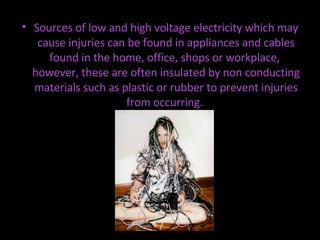
Sources of low and high voltage electricity which may cause injuries can be found in appliances and cables found in the home, office, shops or workplace,  however, these are often insulated by non conducting materials such as plastic or rubber to prevent injuries from occurring.
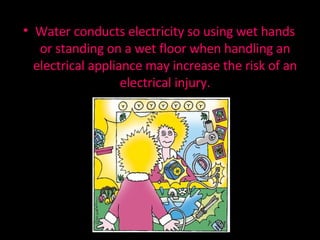
Water conducts electricity so using wet hands or standing on a wet floor when handling an electrical appliance may increase the risk of an electrical injury.
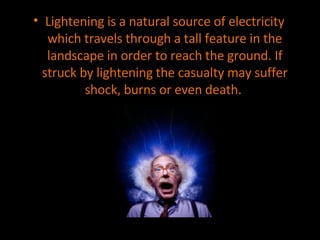
Lightening is a natural source of electricity which travels through a tall feature in the landscape in order to reach the ground. If struck by lightening the casualty may suffer shock, burns or even death.
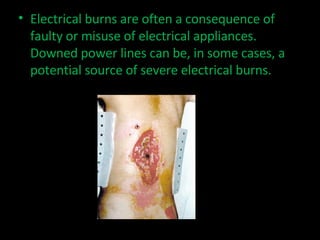
Electrical burns are often a consequence of faulty or misuse of electrical appliances. Downed power lines can be, in some cases, a potential source of severe electrical burns.
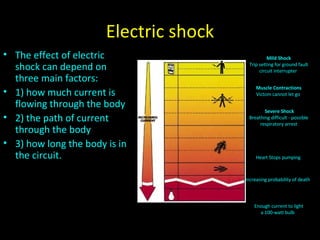
Electric shock The effect of electric shock can depend on three main factors: 1) how much current is flowing through the body 2) the path of current through the body 3) how long the body is in the circuit.    Mild Shock   Mild Shock Trip setting for ground fault circuit interrupter  Muscle Contractions Victom cannot let go    Severe Shock Breathing difficult - possible respiratory arrest     Heart Stops pumping  Increasing probability of death     Enough current to light a 100-watt bulb    
Signs and symptoms  Burns on the skin surface where the energy has entered and exited the body Dazed and confused condition Problems with sight Paralysis (from disrupted nerve pathways) Irritable or restless, whether conscious or unconscious  Weak, irregular, or absent pulse Damage to internal muscles and tissues
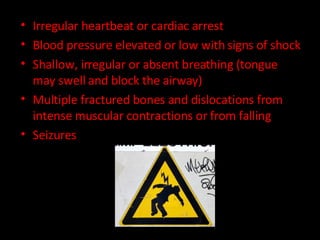
Irregular heartbeat or cardiac arrest Blood pressure elevated or low with signs of shock Shallow, irregular or absent breathing (tongue may swell and block the airway) Multiple fractured bones and dislocations from intense muscular contractions or from falling Seizures
Current primary management techniques The first and most important step in helping someone who has suffered from electrocution is to promptly begin DRABCD. Danger- Check for any dangers surrounding the victim.  If power lines are down both first aiders and bystanders should stay at least 8-10 metres away from the lines.  Make sure all power sources are turned off. Never touch the casualty with bare hands unless you are sure that there is no danger to yourself.  Response-  Assessment of the victims response by “squeeze and shout” Airway- Open the airway and look for signs of life Breathing- Give 2 initial rescue breaths  Compression- Give 30 compressions followed by 2 breaths Defibrillation -  Attach the AED and follow the prompts
It necessary to remove the victim from the source or to break the current if conditions allow and then immediately arrange for transport to a hospital to be treated properly.
When treating Electrical and lightening burns it is important to: Avoid or neutralise electrical and other dangers Conduct a primary survey Arrange medical aid as required Remove victim to a safe environment Remove all jewellery from the affected area Provide oxygen to victims if necessary Apply a dry sterile dressing to the wound
If the victim suffers a fracture: Prevent any movement at the site of the fracture Immobilise the joint above and below the fracture site, if possible If ambulance transport is not available, splint the fractured area in a position that is comfortable for the victim Do not attempt to realign the body If the victim suffers shock: Lay the victim down and elevate their legs If possible, treat the cause Monitor and record the victims vital signs Comfort and reassure Provide supplementary oxygen if able to Maintain body temperature Seek medical assistance
 
Bibliography 1. CSAO ( no date) Electrocution (online) http://www.csao.org/Uploadfiles/Magazine/VOL11NO1/shock.htm  Retrieved 23-8-08 WD (25-8-08) Electrocution (online) http:// www.wrongdiagnosis.com/e/electrocution/intro.htm  Retrieved 23-8-08 3. Integrated publishing ( no date) Signs and symptoms of electrocution (online) http://www.tpub.com/content/armymedical/MD0576/MD05760040.htm   Retrieved 23-8-08 4. Charles Gomersall , Ross Calcroft (September 1999) Electrocution (online) http://www.aic.cuhk.edu.hk/web8/electrocution.htm   Retrieved 23-8-08 Lippmann, J and Natoli , D (2008) First aid, pg. 55, J.L publications: Australia Pearson Education Australia (2007) First aid, pg. 95, Able publishing: Australia

Electrocution-1

  • 1.
  • 2.
    Electrocution Injuries ordeath resulting from the passage of electric current through the body.
  • 3.
    The nature ofelectrocution An electrical current through the body can cause breathing or heart to stop and can also cause burns. The current which causes electrocution usually comes from low or high voltage electricity and lightening.
  • 4.
    Sources of lowand high voltage electricity which may cause injuries can be found in appliances and cables found in the home, office, shops or workplace, however, these are often insulated by non conducting materials such as plastic or rubber to prevent injuries from occurring.
  • 5.
    Water conducts electricityso using wet hands or standing on a wet floor when handling an electrical appliance may increase the risk of an electrical injury.
  • 6.
    Lightening is anatural source of electricity which travels through a tall feature in the landscape in order to reach the ground. If struck by lightening the casualty may suffer shock, burns or even death.
  • 7.
    Electrical burns areoften a consequence of faulty or misuse of electrical appliances. Downed power lines can be, in some cases, a potential source of severe electrical burns.
  • 8.
    Electric shock Theeffect of electric shock can depend on three main factors: 1) how much current is flowing through the body 2) the path of current through the body 3) how long the body is in the circuit.   Mild Shock   Mild Shock Trip setting for ground fault circuit interrupter  Muscle Contractions Victom cannot let go    Severe Shock Breathing difficult - possible respiratory arrest     Heart Stops pumping  Increasing probability of death     Enough current to light a 100-watt bulb   
  • 9.
    Signs and symptoms Burns on the skin surface where the energy has entered and exited the body Dazed and confused condition Problems with sight Paralysis (from disrupted nerve pathways) Irritable or restless, whether conscious or unconscious Weak, irregular, or absent pulse Damage to internal muscles and tissues
  • 10.
    Irregular heartbeat orcardiac arrest Blood pressure elevated or low with signs of shock Shallow, irregular or absent breathing (tongue may swell and block the airway) Multiple fractured bones and dislocations from intense muscular contractions or from falling Seizures
  • 11.
    Current primary managementtechniques The first and most important step in helping someone who has suffered from electrocution is to promptly begin DRABCD. Danger- Check for any dangers surrounding the victim. If power lines are down both first aiders and bystanders should stay at least 8-10 metres away from the lines. Make sure all power sources are turned off. Never touch the casualty with bare hands unless you are sure that there is no danger to yourself. Response- Assessment of the victims response by “squeeze and shout” Airway- Open the airway and look for signs of life Breathing- Give 2 initial rescue breaths Compression- Give 30 compressions followed by 2 breaths Defibrillation - Attach the AED and follow the prompts
  • 12.
    It necessary toremove the victim from the source or to break the current if conditions allow and then immediately arrange for transport to a hospital to be treated properly.
  • 13.
    When treating Electricaland lightening burns it is important to: Avoid or neutralise electrical and other dangers Conduct a primary survey Arrange medical aid as required Remove victim to a safe environment Remove all jewellery from the affected area Provide oxygen to victims if necessary Apply a dry sterile dressing to the wound
  • 14.
    If the victimsuffers a fracture: Prevent any movement at the site of the fracture Immobilise the joint above and below the fracture site, if possible If ambulance transport is not available, splint the fractured area in a position that is comfortable for the victim Do not attempt to realign the body If the victim suffers shock: Lay the victim down and elevate their legs If possible, treat the cause Monitor and record the victims vital signs Comfort and reassure Provide supplementary oxygen if able to Maintain body temperature Seek medical assistance
  • 15.
  • 16.
    Bibliography 1. CSAO( no date) Electrocution (online) http://www.csao.org/Uploadfiles/Magazine/VOL11NO1/shock.htm Retrieved 23-8-08 WD (25-8-08) Electrocution (online) http:// www.wrongdiagnosis.com/e/electrocution/intro.htm Retrieved 23-8-08 3. Integrated publishing ( no date) Signs and symptoms of electrocution (online) http://www.tpub.com/content/armymedical/MD0576/MD05760040.htm Retrieved 23-8-08 4. Charles Gomersall , Ross Calcroft (September 1999) Electrocution (online) http://www.aic.cuhk.edu.hk/web8/electrocution.htm Retrieved 23-8-08 Lippmann, J and Natoli , D (2008) First aid, pg. 55, J.L publications: Australia Pearson Education Australia (2007) First aid, pg. 95, Able publishing: Australia