Ved Prakash Verma
B. Tech (Electrical), M.E. Electrical (Instrumentation &Control)
Lecturer, Electrical Engineering Department
Atal Bihari Vajpayee Govt. Institute of Engineering &
Technology Pragatinagar Shimla-171202(HP)
 The 1st human carrying EV with its own power source was
tested along a Paris street in April 1881 by French
inventor Gustave Trouve.
 In 1880 Trouve improved the efficiency of a small electric
motor developed by Siemens and using the recently
developed rechargeable battery, fitted it to an
English James Straley tricycle, so inventing the world’s
1st EV.
 This EV was successfully tested on 19 April 1881 along
the Rue Valois in central Paris but he was unable to
patent it.
 Later on 26th May 1881, the 5 metre Trouve boat
prototype, called Le Telephone reached a speed of
3.6 km/h (2.2mph) going upstream and 9.0 km/h
(5.6 mph) downstream.
 Although in 1859, with the invention of the lead-acid
battery by French physicist Gaston Plante and Camile
Alphonse Faure, another French scientist, significantly
improved the design of the battery in 1881.
 The 1881 improvements in battery design greatly
increased the capacity of such batteries and led directly
to their manufacture on an industrial scale.
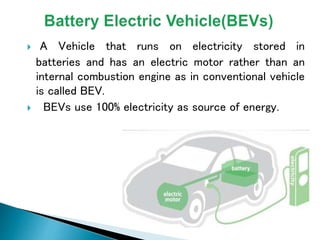
 A Vehicle that runs on electricity stored in
batteries and has an electric motor rather than an
internal combustion engine as in conventional vehicle
is called BEV.
 BEVs use 100% electricity as source of energy.
 EVs with only batteries to provide power to the drive train are
known as BEVs.
 BEVs have to rely solely on the energy stored in their battery
packs therefore the range of such vehicles depends directly on the
battery capacity.
 Typically they can cover 100–250km on one charge, whereas the
top-tier models can go a lot further, from 300-500km.
 These ranges depend on driving condition and style, vehicle
configurations, road conditions, climate, battery type and age.
 Once battery pack depleted, charging takes quite a lot of time
compared to refueling a conventional ICE vehicle.
 It can take as long as 36Hours completely replenish the batteries
there are far less time consuming ones as well, but none is
comparable to the little time required to refill fuel tank.
 Charging time depends on the charger configuration, its
infrastructure and operating power level.
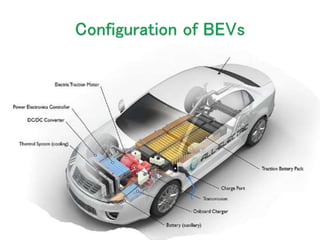
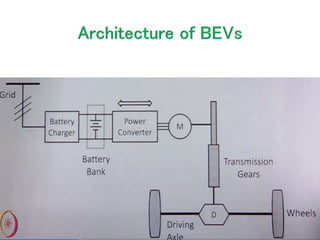
 Battery Charger
 Traction Batteries/ Traction Battery Pack
 Power Converters
 Traction Motor/ Electric Motor
 Motor controller/ Power Electronics Controller
 Transmission/ Differential System/Gear
 The BEVs are further classified into four categories
on the basis energy storage sources;
 PEV: [Battery]
 FCEV: [FC+ Battery]
 UCEV: [UC+ Battery]
 UFEV: [UF+ Battery]
 Note: PEV are most commonly known as BEVs.
 PEV: Pure Electric Vehicles or Battery Electric Vehicle
are those EVs in which 100% vehicle propulsion is
developed through battery. In this type of EV, the battery
is used as sole energy source .
 FCEV: The Fuel Cell Electric Vehicle are those EVs in
which the vehicle/electric propulsion is developed as
combination of energy stored in fuel cell and battery. The
battery used in this type of EV is a hybrid energy source.
In FCEV, battery is primarily used for absorbing the
regenerative power because the fuel cell is incapable of
storing the regenerative energy during braking mode of
EVs.
 UCEV: The Ultra-Capacitors Electric Vehicle are those
EVs in which vehicle propulsion is developed as
combination of energy stored in ultra-capacitor and
battery. Again the battery used in type of EV is a hybrid
energy source. Although in UCFV based EVs, batteries
are required for storing energy because ultra-capacitor
have very low specific energy and they are unable to
store the regenerative energy.
 UFEV: The Ultra- Flywheel Electric Vehicle are those
EVs which vehicle propulsion is developed as
combination of energy stored in ultra-flywheel and
battery. The battery used in this type of EV as a hybrid
source of energy similar to UCEV. In UFEV, batteries
are required for storing energy because ultra-flywheel
also have very low specific energy.
 No emission
 Not dependent on oil
 Driving range largely depend on the type of
battery used
 They available commercially in market
 Battery price and capacity
 Less driving range
 Large charging time
 Insufficient number of charging station
 High capital cost
What is BEVs? Describe the essential
component of BEVS? Also, explain BEVs
classifications.
Any Questions????....

Battery electric vehicle ppt

  • 1.
    Ved Prakash Verma B.Tech (Electrical), M.E. Electrical (Instrumentation &Control) Lecturer, Electrical Engineering Department Atal Bihari Vajpayee Govt. Institute of Engineering & Technology Pragatinagar Shimla-171202(HP)
  • 2.
     The 1sthuman carrying EV with its own power source was tested along a Paris street in April 1881 by French inventor Gustave Trouve.  In 1880 Trouve improved the efficiency of a small electric motor developed by Siemens and using the recently developed rechargeable battery, fitted it to an English James Straley tricycle, so inventing the world’s 1st EV.  This EV was successfully tested on 19 April 1881 along the Rue Valois in central Paris but he was unable to patent it.
  • 3.
     Later on26th May 1881, the 5 metre Trouve boat prototype, called Le Telephone reached a speed of 3.6 km/h (2.2mph) going upstream and 9.0 km/h (5.6 mph) downstream.  Although in 1859, with the invention of the lead-acid battery by French physicist Gaston Plante and Camile Alphonse Faure, another French scientist, significantly improved the design of the battery in 1881.  The 1881 improvements in battery design greatly increased the capacity of such batteries and led directly to their manufacture on an industrial scale.
  • 4.
     A Vehiclethat runs on electricity stored in batteries and has an electric motor rather than an internal combustion engine as in conventional vehicle is called BEV.  BEVs use 100% electricity as source of energy.
  • 5.
     EVs withonly batteries to provide power to the drive train are known as BEVs.  BEVs have to rely solely on the energy stored in their battery packs therefore the range of such vehicles depends directly on the battery capacity.  Typically they can cover 100–250km on one charge, whereas the top-tier models can go a lot further, from 300-500km.  These ranges depend on driving condition and style, vehicle configurations, road conditions, climate, battery type and age.  Once battery pack depleted, charging takes quite a lot of time compared to refueling a conventional ICE vehicle.  It can take as long as 36Hours completely replenish the batteries there are far less time consuming ones as well, but none is comparable to the little time required to refill fuel tank.  Charging time depends on the charger configuration, its infrastructure and operating power level.
  • 8.
     Battery Charger Traction Batteries/ Traction Battery Pack  Power Converters  Traction Motor/ Electric Motor  Motor controller/ Power Electronics Controller  Transmission/ Differential System/Gear
  • 9.
     The BEVsare further classified into four categories on the basis energy storage sources;  PEV: [Battery]  FCEV: [FC+ Battery]  UCEV: [UC+ Battery]  UFEV: [UF+ Battery]  Note: PEV are most commonly known as BEVs.
  • 10.
     PEV: PureElectric Vehicles or Battery Electric Vehicle are those EVs in which 100% vehicle propulsion is developed through battery. In this type of EV, the battery is used as sole energy source .  FCEV: The Fuel Cell Electric Vehicle are those EVs in which the vehicle/electric propulsion is developed as combination of energy stored in fuel cell and battery. The battery used in this type of EV is a hybrid energy source. In FCEV, battery is primarily used for absorbing the regenerative power because the fuel cell is incapable of storing the regenerative energy during braking mode of EVs.
  • 11.
     UCEV: TheUltra-Capacitors Electric Vehicle are those EVs in which vehicle propulsion is developed as combination of energy stored in ultra-capacitor and battery. Again the battery used in type of EV is a hybrid energy source. Although in UCFV based EVs, batteries are required for storing energy because ultra-capacitor have very low specific energy and they are unable to store the regenerative energy.  UFEV: The Ultra- Flywheel Electric Vehicle are those EVs which vehicle propulsion is developed as combination of energy stored in ultra-flywheel and battery. The battery used in this type of EV as a hybrid source of energy similar to UCEV. In UFEV, batteries are required for storing energy because ultra-flywheel also have very low specific energy.
  • 12.
     No emission Not dependent on oil  Driving range largely depend on the type of battery used  They available commercially in market
  • 13.
     Battery priceand capacity  Less driving range  Large charging time  Insufficient number of charging station  High capital cost
  • 14.
    What is BEVs?Describe the essential component of BEVS? Also, explain BEVs classifications.
  • 15.