Dynamic Charging (On the Move) of
        Electric Vehicles

           Building the Future
            “Energy Internet”

         Bill.st.arnaud@gmail.com
             November 17, 2011
    Unless otherwise noted all material in this slide deck may be reproduced,
    modified or distributed without prior permission of the author
                                                                                1
Current limitations of eVehicles (EV)
• High capital cost due to large cost of batteries

• High operating cost because batteries need to be replaced every 2-5 years

• Limited range, especially in cold weather when battery capacity is reduced

• Battery capacity reduced by up to 1/3 if air conditioning or cabin heating
  is required

• Long time to re-charge between trips
    – So a small number of short trips within a day can deplete batteries
    – Inhibits spontaneity of taking a long trip because of uncertainty of charge state

• Although operational cost (i.e. fuel consumption) is less than traditional
  automobile overall amortized cost higher

                                                                                      2
Alternative to the battery
• Rather than waiting for perfect battery why not change
  the charging system?

• Old world thinking that vehicles must be stationary to
  be refueled.
   – This was true when using fossil fuels

• But with electric vehicles there is no reason why they
  cannot be charged while on the move

• Dynamic (on the move) charging

                                                           3
Dynamic (on the move) charging
• Also sometimes referred to “pathway” charging

• Charging systems are located enroute
    – eVehicle can be charged while moving or at drive through locations

• Initial applications are drive through banks, drive through fast food
  restaurants, parking lots
    – Eventually deployed along road ways at traffic lights and toll plazas

• Dynamic charging enables frequent charges with small charging
  cycles and smaller battery capacity

• Today’s charging infrastructures assumes infrequent charges with
  deep charging cycles and large battery capacity

                                                                              4
Advantages of dynamic charging
• Smaller batteries possible -reducing capital costs

• Frequent charging of batteries prevents battery depletion and
  longer life

• Reduces concerns of range anxiety

• Heavier eVehicles such as trucks and buses are realistically possible

• Vehicle can be charged enroute and then used as an alternate
  power source for the home

• Eventually concepts of “packet” based power are conceivable
  leading to future “Energy Internet”

                                                                          5
Two alternative approaches
•   Induction charging with embedded induction pads in the road
    – Auckland University company in $70m deal with Qualcomm for
      inductive car charging technology
    – http://tinyurl.com/73pdksw
    – But induction charging requires precise tolerances and alignment
    – Difficult to maintain in heavy traffic and inclement weather such as ice
      and snow
    – Also requires specialized electronics in vehicle

•   Capacitive Charging using overhead “electrical umbrellas” -
    capabuses
    – Currently operation in Shanghai with public buses
    – http://www.technologyreview.com/energy/23754/


                                                                             6
New Zealand HaloIPT Induction
          Charging


       http://www.haloipt.com/
                                 7
Shanghai Capabus – Capacitive
          Charging
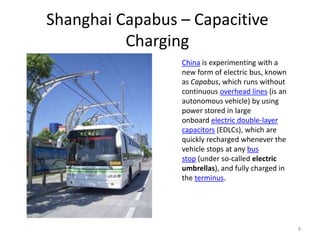
                 China is experimenting with a
                 new form of electric bus, known
                 as Capabus, which runs without
                 continuous overhead lines (is an
                 autonomous vehicle) by using
                 power stored in large
                 onboard electric double-layer
                 capacitors (EDLCs), which are
                 quickly recharged whenever the
                 vehicle stops at any bus
                 stop (under so-called electric
                 umbrellas), and fully charged in
                 the terminus.


                                                    8
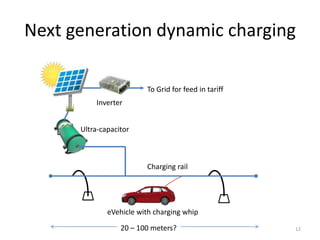
Next-gen dynamic charging concept
• Rather than drawing power from grid use local solar panels
  and/or windmills
   – Potential demonstrated with Shanghai buses at Washington U

• When solar panel or windmill is not charging vehicles it can
  be used to feed power into grid
   – Ontario FIT program will pay 80.5 cents/kwh
   – Annual payback of 6-10%

• Unknowns and challenges
   – Can we build a dynamic charging system for automobiles based
     on Shanghai bus model using renewable energy alone?


                                                                    9
Ontario to invest $80m in EV charging
                systems
• Seed money will fund electric car charging development

• The Ontario provincial government announced it would set aside an
  $80 million fund to channel seed money to public and private
  companies who want to develop electric car recharging facilities.

• Premier Dalton McGuinty is hoping this will encourage companies
  to draft proposals to build and test recharging docks, and also to
  expand the availability of rechargers in the province.

• The move is part of the province's clean energy goals; other
  initiatives include a $5,000 to $8,500 rebate on electric cars and
  "green licence plates" to let EV drivers use HOV lanes.


                                                                       10
Other Ontario Incentives
• Effective July 1, 2010, Ontario consumers will be eligible for
  an incentive ranging from $5,000 to $8,500 towards the
  purchase or lease of a new plug-in hybrid electric or battery
  electric vehicle.

• The province's vision is to have one out of 20 cars in
  Ontario electrically powered by 2020.

• Toyota recently announced it chose Woodstock, Ontario as
  the place to manufacture the RAV4 EV.

• More cars are built in Ontario than any other state or
  province in North America.
                                                              11
Next generation dynamic charging

                         To Grid for feed in tariff
          Inverter


      Ultra-capacitor


                         Charging rail


              eVehicle with charging whip

                  20 – 100 meters?                    12
How does it work
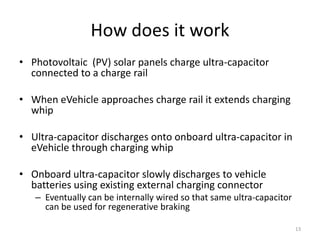
• Photovoltaic (PV) solar panels charge ultra-capacitor
  connected to a charge rail

• When eVehicle approaches charge rail it extends charging
  whip

• Ultra-capacitor discharges onto onboard ultra-capacitor in
  eVehicle through charging whip

• Onboard ultra-capacitor slowly discharges to vehicle
  batteries using existing external charging connector
   – Eventually can be internally wired so that same ultra-capacitor
     can be used for regenerative braking

                                                                       13
Things that need to be researched
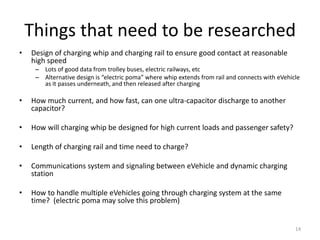
•   Design of charging whip and charging rail to ensure good contact at reasonable
    high speed
     – Lots of good data from trolley buses, electric railways, etc
     – Alternative design is “electric poma” where whip extends from rail and connects with eVehicle
       as it passes underneath, and then released after charging

•   How much current, and how fast, can one ultra-capacitor discharge to another
    capacitor?

•   How will charging whip be designed for high current loads and passenger safety?

•   Length of charging rail and time need to charge?

•   Communications system and signaling between eVehicle and dynamic charging
    station

•   How to handle multiple eVehicles going through charging system at the same
    time? (electric poma may solve this problem)


                                                                                                  14
Why not use fixed static charging
                 stations?
• Fixed charging stations are difficult to find and get blocked by charging
  vehicle
    – Consider a dynamic charging station on entrance to parking garage versus
      fixed charging stations at each parking spot

• Fixed charging stations require driver to get out of vehicle and connect
  charging cable

• Current systems may require several hours to provide full charge
    – Ultra capacitors could help reduce charging time

• Revenue per vehicle and per station very small

• Static or fixed charging assumes infrequent charges with deep charging
  cycles and large battery capacity versus dynamic charging assumes
  frequent charges with small charging cycles and smaller battery capacity

                                                                                 15
Why not use power from grid for
           dynamic charging?
• Most grid systems have large percentage of coal power
    – CO2 savings are marginal
    – Scant CO2 Benefit from China’s Coal-Powered Electric Cars
    – http://green-broadband.blogspot.com/2011/10/scant-co2-benefit-
      from-chinas-coal.html

• Within 3- 4 years it is expected electricity from solar panels will be
  cheaper than from grid
    – http://e360.yale.edu/feature/solar_power_nrg_president_crane_ties_
      future_to_renewable_energy/2462/

• Grid interconnection fees, transformers, debt retirement charges,
  etc significantly drive up costs
    – However in some locations using solar panel to feed power to grid
      may allow for additional revenue

                                                                           16
Initial target markets
• Drive through banks, fast food restaurants, parking garages,
  universities, golf courses, etc
    – “Will that be fries with your free electrical charge?”
    – Complete package of PV system on roof connected to ultra-capacitor
      and charge rail
    – When PV is not charging vehicles it can be making money from feed in
      tariff
    – Guaranteed 6-10% return even if not a single vehicle charged

• Initial target vehicles: campus service vehicles, utility fleets, golf
  carts, ride sharing, early EV adopters

• Eventually deployed at toll plazas, on/off ramps, stop lights and
  intersections


                                                                           17
The Future – “Energy Internet”
•   In future dynamic charging stations can be designed to receive energy as well as
    deliver energy from passing vehicles

•   eVehicle becomes more than a transportation system – it also becomes an energy
    transport system to transfer energy between dynamic charging stations
     – E.g. power from under utilized charging stations can be delivered by eVehicle to charging stations
       that are heavily used
     – Or power can be brought to the home to provide backup power to the home

•   Dynamic charging station becomes energy packet router/switch!

•   Rather than eVehicle coming home with depleted batteries, instead it comes home
    fully charged in order to provide power to the home

•   eVehicle becomes competitive alternative to the electrical grid

•   Interconnect to distributed computing clouds and networks like Greenstar to provide
    power for distributed caches, cell phone towers, etc -- especially on cloudy days or
    little wind


                                                                                                     18
Next steps?
• Pilot project demonstrating concept of
  dynamic charging of vehicles

• Seeking partners and interested parties who
  may want to participate

• Research needed into design of charging
  whips and rails
                                                19
Further Reading
•   Green Investment Opportunity for small business - on the move electric car
    charging
    http://green-broadband.blogspot.com/2010/04/green-investment-opportunity-
    for-small.html

•   How California suburban sprawl could be the answer to global warming
    http://green-broadband.blogspot.com/2010/12/how-california-suburban-sprawl-
    could-be.html

•   The "Energy Internet" - how the Internet + renewable energy can transform the
    economy
    http://green-broadband.blogspot.com/2011/10/energy-internet-how-internet-
    renewable.html#more

•   Electric roads and Internet will allow coast to coast driving with no stopping and
    no emissions
    http://green-broadband.blogspot.com/2011/05/electric-roads-and-internet-will-
    allow.html


                                                                                         20

Dynamic charging (on the move) of

  • 1.
    Dynamic Charging (Onthe Move) of Electric Vehicles Building the Future “Energy Internet” Bill.st.arnaud@gmail.com November 17, 2011 Unless otherwise noted all material in this slide deck may be reproduced, modified or distributed without prior permission of the author 1
  • 2.
    Current limitations ofeVehicles (EV) • High capital cost due to large cost of batteries • High operating cost because batteries need to be replaced every 2-5 years • Limited range, especially in cold weather when battery capacity is reduced • Battery capacity reduced by up to 1/3 if air conditioning or cabin heating is required • Long time to re-charge between trips – So a small number of short trips within a day can deplete batteries – Inhibits spontaneity of taking a long trip because of uncertainty of charge state • Although operational cost (i.e. fuel consumption) is less than traditional automobile overall amortized cost higher 2
  • 3.
    Alternative to thebattery • Rather than waiting for perfect battery why not change the charging system? • Old world thinking that vehicles must be stationary to be refueled. – This was true when using fossil fuels • But with electric vehicles there is no reason why they cannot be charged while on the move • Dynamic (on the move) charging 3
  • 4.
    Dynamic (on themove) charging • Also sometimes referred to “pathway” charging • Charging systems are located enroute – eVehicle can be charged while moving or at drive through locations • Initial applications are drive through banks, drive through fast food restaurants, parking lots – Eventually deployed along road ways at traffic lights and toll plazas • Dynamic charging enables frequent charges with small charging cycles and smaller battery capacity • Today’s charging infrastructures assumes infrequent charges with deep charging cycles and large battery capacity 4
  • 5.
    Advantages of dynamiccharging • Smaller batteries possible -reducing capital costs • Frequent charging of batteries prevents battery depletion and longer life • Reduces concerns of range anxiety • Heavier eVehicles such as trucks and buses are realistically possible • Vehicle can be charged enroute and then used as an alternate power source for the home • Eventually concepts of “packet” based power are conceivable leading to future “Energy Internet” 5
  • 6.
    Two alternative approaches • Induction charging with embedded induction pads in the road – Auckland University company in $70m deal with Qualcomm for inductive car charging technology – http://tinyurl.com/73pdksw – But induction charging requires precise tolerances and alignment – Difficult to maintain in heavy traffic and inclement weather such as ice and snow – Also requires specialized electronics in vehicle • Capacitive Charging using overhead “electrical umbrellas” - capabuses – Currently operation in Shanghai with public buses – http://www.technologyreview.com/energy/23754/ 6
  • 7.
    New Zealand HaloIPTInduction Charging http://www.haloipt.com/ 7
  • 8.
    Shanghai Capabus –Capacitive Charging China is experimenting with a new form of electric bus, known as Capabus, which runs without continuous overhead lines (is an autonomous vehicle) by using power stored in large onboard electric double-layer capacitors (EDLCs), which are quickly recharged whenever the vehicle stops at any bus stop (under so-called electric umbrellas), and fully charged in the terminus. 8
  • 9.
    Next-gen dynamic chargingconcept • Rather than drawing power from grid use local solar panels and/or windmills – Potential demonstrated with Shanghai buses at Washington U • When solar panel or windmill is not charging vehicles it can be used to feed power into grid – Ontario FIT program will pay 80.5 cents/kwh – Annual payback of 6-10% • Unknowns and challenges – Can we build a dynamic charging system for automobiles based on Shanghai bus model using renewable energy alone? 9
  • 10.
    Ontario to invest$80m in EV charging systems • Seed money will fund electric car charging development • The Ontario provincial government announced it would set aside an $80 million fund to channel seed money to public and private companies who want to develop electric car recharging facilities. • Premier Dalton McGuinty is hoping this will encourage companies to draft proposals to build and test recharging docks, and also to expand the availability of rechargers in the province. • The move is part of the province's clean energy goals; other initiatives include a $5,000 to $8,500 rebate on electric cars and "green licence plates" to let EV drivers use HOV lanes. 10
  • 11.
    Other Ontario Incentives •Effective July 1, 2010, Ontario consumers will be eligible for an incentive ranging from $5,000 to $8,500 towards the purchase or lease of a new plug-in hybrid electric or battery electric vehicle. • The province's vision is to have one out of 20 cars in Ontario electrically powered by 2020. • Toyota recently announced it chose Woodstock, Ontario as the place to manufacture the RAV4 EV. • More cars are built in Ontario than any other state or province in North America. 11
  • 12.
    Next generation dynamiccharging To Grid for feed in tariff Inverter Ultra-capacitor Charging rail eVehicle with charging whip 20 – 100 meters? 12
  • 13.
    How does itwork • Photovoltaic (PV) solar panels charge ultra-capacitor connected to a charge rail • When eVehicle approaches charge rail it extends charging whip • Ultra-capacitor discharges onto onboard ultra-capacitor in eVehicle through charging whip • Onboard ultra-capacitor slowly discharges to vehicle batteries using existing external charging connector – Eventually can be internally wired so that same ultra-capacitor can be used for regenerative braking 13
  • 14.
    Things that needto be researched • Design of charging whip and charging rail to ensure good contact at reasonable high speed – Lots of good data from trolley buses, electric railways, etc – Alternative design is “electric poma” where whip extends from rail and connects with eVehicle as it passes underneath, and then released after charging • How much current, and how fast, can one ultra-capacitor discharge to another capacitor? • How will charging whip be designed for high current loads and passenger safety? • Length of charging rail and time need to charge? • Communications system and signaling between eVehicle and dynamic charging station • How to handle multiple eVehicles going through charging system at the same time? (electric poma may solve this problem) 14
  • 15.
    Why not usefixed static charging stations? • Fixed charging stations are difficult to find and get blocked by charging vehicle – Consider a dynamic charging station on entrance to parking garage versus fixed charging stations at each parking spot • Fixed charging stations require driver to get out of vehicle and connect charging cable • Current systems may require several hours to provide full charge – Ultra capacitors could help reduce charging time • Revenue per vehicle and per station very small • Static or fixed charging assumes infrequent charges with deep charging cycles and large battery capacity versus dynamic charging assumes frequent charges with small charging cycles and smaller battery capacity 15
  • 16.
    Why not usepower from grid for dynamic charging? • Most grid systems have large percentage of coal power – CO2 savings are marginal – Scant CO2 Benefit from China’s Coal-Powered Electric Cars – http://green-broadband.blogspot.com/2011/10/scant-co2-benefit- from-chinas-coal.html • Within 3- 4 years it is expected electricity from solar panels will be cheaper than from grid – http://e360.yale.edu/feature/solar_power_nrg_president_crane_ties_ future_to_renewable_energy/2462/ • Grid interconnection fees, transformers, debt retirement charges, etc significantly drive up costs – However in some locations using solar panel to feed power to grid may allow for additional revenue 16
  • 17.
    Initial target markets •Drive through banks, fast food restaurants, parking garages, universities, golf courses, etc – “Will that be fries with your free electrical charge?” – Complete package of PV system on roof connected to ultra-capacitor and charge rail – When PV is not charging vehicles it can be making money from feed in tariff – Guaranteed 6-10% return even if not a single vehicle charged • Initial target vehicles: campus service vehicles, utility fleets, golf carts, ride sharing, early EV adopters • Eventually deployed at toll plazas, on/off ramps, stop lights and intersections 17
  • 18.
    The Future –“Energy Internet” • In future dynamic charging stations can be designed to receive energy as well as deliver energy from passing vehicles • eVehicle becomes more than a transportation system – it also becomes an energy transport system to transfer energy between dynamic charging stations – E.g. power from under utilized charging stations can be delivered by eVehicle to charging stations that are heavily used – Or power can be brought to the home to provide backup power to the home • Dynamic charging station becomes energy packet router/switch! • Rather than eVehicle coming home with depleted batteries, instead it comes home fully charged in order to provide power to the home • eVehicle becomes competitive alternative to the electrical grid • Interconnect to distributed computing clouds and networks like Greenstar to provide power for distributed caches, cell phone towers, etc -- especially on cloudy days or little wind 18
  • 19.
    Next steps? • Pilotproject demonstrating concept of dynamic charging of vehicles • Seeking partners and interested parties who may want to participate • Research needed into design of charging whips and rails 19
  • 20.
    Further Reading • Green Investment Opportunity for small business - on the move electric car charging http://green-broadband.blogspot.com/2010/04/green-investment-opportunity- for-small.html • How California suburban sprawl could be the answer to global warming http://green-broadband.blogspot.com/2010/12/how-california-suburban-sprawl- could-be.html • The "Energy Internet" - how the Internet + renewable energy can transform the economy http://green-broadband.blogspot.com/2011/10/energy-internet-how-internet- renewable.html#more • Electric roads and Internet will allow coast to coast driving with no stopping and no emissions http://green-broadband.blogspot.com/2011/05/electric-roads-and-internet-will- allow.html 20