International Research Journal of Engineering and Technology (IRJET) e-ISSN: 2395-0056
Volume: 06 Issue: 08 | Aug 2019 www.irjet.net p-ISSN: 2395-0072
© 2019, IRJET | Impact Factor value: 7.34 | ISO 9001:2008 Certified Journal | Page 1234
Modeling of PV based Bidirectional Battery Charger for Electric
Vehicles
Moturu Arun Bhargav1, Dr. Gadi Venkata Siva Krishna Rao2
1Post graduate scholar, Dept. of Electrical Engineering, Andhra University, Visakhapatnam, Andhrapradesh, India
2Professor, Dept. of Electrical Engineering, Andhra University, Visakhapatnam, Andhrapradesh, India
---------------------------------------------------------------------***----------------------------------------------------------------------
Abstract - As hybrid vehicles gain popularity among the
consumers, current research initiatives are focused towards
developing plug-in electric andhybridvehiclesthatcanexploit
utility power to charge vehicle batteries and therefore less
dependent on the gasoline usage. Powerelectronicsystemsare
being developed to allow plug-in vehicles to be vehicle-to-grid
(V2G) capable where the vehicles can work as distributed
resources and power can be sent back to the utility. In this
paper a review of different plug-in and V2G capable vehicles
are given along with their power electronics topologies. The
economic implication of chargingthevehicleorsendingpower
back to the utility is described in brief. Finally, allvehicles with
V2G capability must meet the IEEE Standard 1547 for
connecting to the utility. Brief descriptionsoftherequirements
and testing that must be followed for V2G vehicles to conform
the IEEE 1547 standards are also discussed.
Key Words: Autonomous energy management system,
plugin electric vehicle, energy storage,bidirectional charger,
grid-to-vehicle, vehicle-to-grid.
1. INTRODUCTION
The continuous rise in gasoline prices along with the
increased concerns about the pollutions produced by fossil
fuel engines are forcing the current vehicle market to find
new alternatives to reduce the fossil fuel usage. Along with
the research on bio-fuel driven engines; different electric
vehicles and hybrid electric vehicles are evolving as viable
alternatives to replace, or at least reduce, the current fleetof
fossil fuel driven vehicles. Although current manufactured
electric/hybrid vehicles are being marketed as a way to
reduce fossil fuel usage, several promising technologies are
being demonstrated that can utilize power electronics to
charge the battery from the utility using plug-in vehicles or
act as a distributed resource to send power back to the
utility with vehicle-to-grid capabilities.
In this paper, different plug-in vehicle topologies are
described to review the power electronicsrequiredforthem.
The newly evolving V2G technology is also discussed along
with economics and compliance requirements to allow the
vehicle to be connected to the grid. Before going into the
details of power electronics required for the electric/hybrid
vehicles, the common forms of these vehicles are described
next to get accustomed with the terminologies.
1.1 Electric Vehicles
A typical electric vehicle (EV) has a battery pack
connected to an electric motor and provides traction power
through the use of a transmission. The batteries are charged
primarily by a batterychargerthatreceivesitspowerfroman
external source such as the electrical utility. Also during
regenerative braking, the motor acts as a generator which
provides power back to thebatteriesandintheprocessslows
down the vehicle. The primary advantage of an EV is that the
design is simple and has a low part count. The primary
disadvantage is that the driving range ofthevehicleislimited
to the size of the battery and the timeto re-chargethebattery
can be from 15 minutes to 8 hours depending on how far the
vehicle was last driven, the battery typeandbatterycharging
method.
1.2 Hybrid Electric Vehicles
The components that make up a typical hybrid electric
vehicle (HEV) include a battery pack, motor controller,
motor/generator, internal combustion engine,transmission
and driveline components. The batteries are charged
through the use of the on-board internal combustion engine
and generator. In a plug-in hybrid electric vehicle (PHEV),
the batteries can also be charged throughtheuseofa battery
charger that receives its power from the utility. The best
PHEV design will allow the vehicle to operate on electric
power only reducing the amount of time that the engine
runs. When the vehicle is not operating, the battery can be
charged through the use of a battery chargerthatis“plugged
in” to the electrical utility or other energy sources. A PHEV
normally has a larger battery pack than a HEV. The
advantage of a PHEV over an HEV is that due to external
battery charging, the vehicle can run longer on electric
power which in-turn reduces engine fuel consumption.
1.3 Fuel Cell Vehicles
The prototype fuel cell vehicles (FCV) that are currently
under development mostly utilize an on-board tank to store
pressurized hydrogen. Hydrogenandconditionedairare fed
to a proton exchange membrane (PEM) stack to develop DC
power. The configuration is very similar to the electric
vehicle configuration in which a electric motor/generator
provides the mechanical power for traction. The on-board
batteries allow the energy to be stored during regenerative
braking and provide peak power to the motor controller
International Research Journal of Engineering and Technology (IRJET) e-ISSN: 2395-0056
Volume: 06 Issue: 08 | Aug 2019 www.irjet.net p-ISSN: 2395-0072
© 2019, IRJET | Impact Factor value: 7.34 | ISO 9001:2008 Certified Journal | Page 1235
during vehicle acceleration. A plug-infuel cell vehicle(PFCV)
has a battery pack and a fuel cell that is connected to an
electric motor that provides traction power to the wheels
through a transmission. The batteries can be charged by the
use of a battery charger that receives its power from the
utility but can also be charged by using the fuel cell.
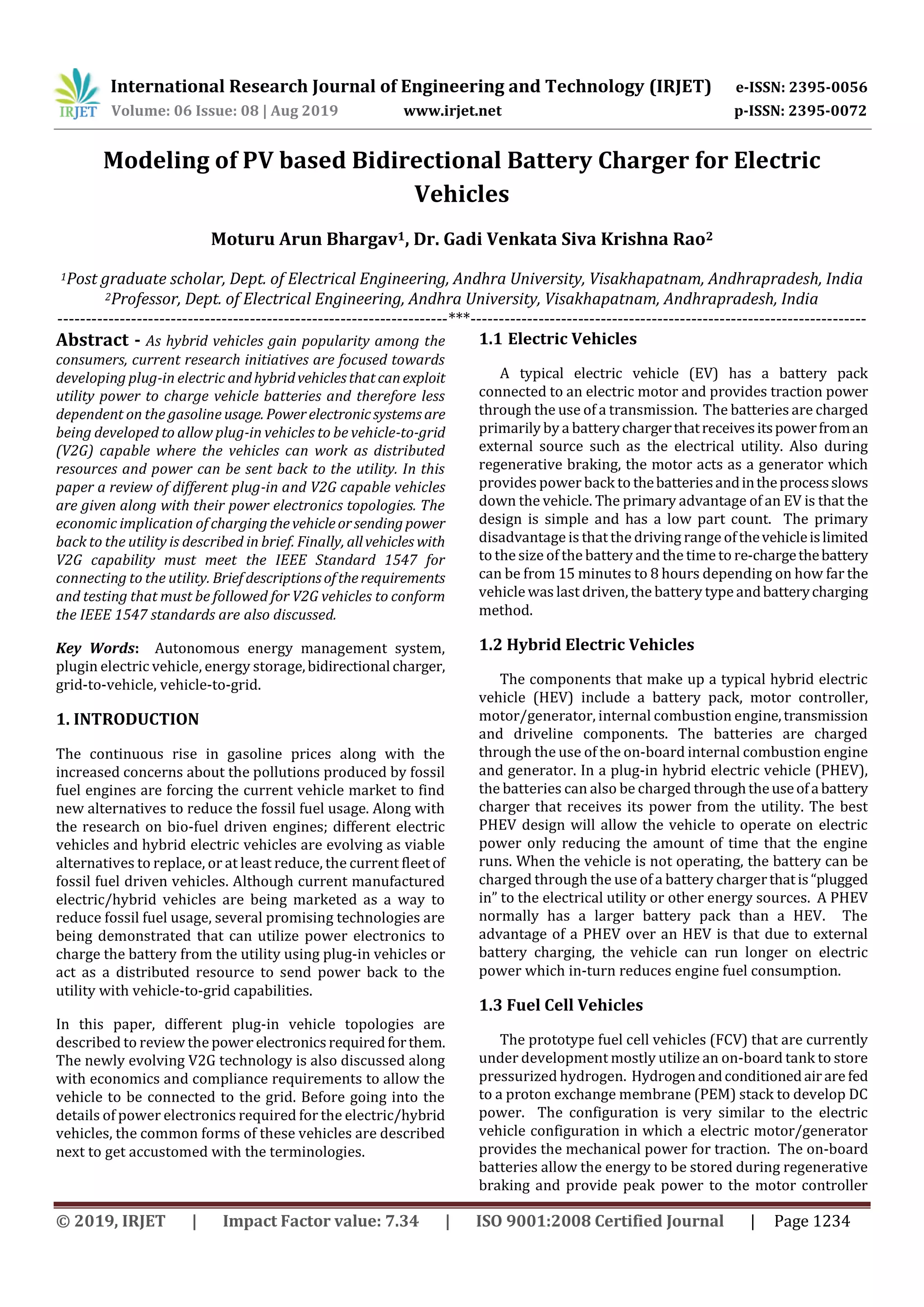
Fig -1: Typical EV configuration
2. PLUG-IN VEHICLES
According to the Electric Power Research Institute (EPRI),
more than 40% of U.S. generating capacity operates
overnight at a reduced load overnight, and it is during these
off-peak hours that most PHEVs could be recharged. Recent
studies show that if PHEVs replace one-half of all vehicleson
the road by 2050, only an 8% increase in electricity
generation (4% increase in capacity) will be required. Most
of the electric vehicles that are of plug-in type, utilize on-
board battery chargers to recharge thebatteriesusingutility
power. The simplest form of a plug-in electric vehicle is
shown in Fig. 1. This configuration consists of a battery
system and a motor controller that provides power to the
motor, which in-turn supplies power to the wheels for
traction. Many of today’s EVs use a permanent magnet
electric motor that can also actasa generatortorecharge the
batteries when the brakes are applied. During regenerative
braking, the motor acts as a generator that provides power
back to the batteries and in the process slows down the
vehicle. Friction brakes are used when the vehicle must be
stopped quickly or if the batteries are at full charge.
The components that make up a typical HEV include a
battery pack, motor controller, motor/generator, internal
combustion engine, transmission anddrivelinecomponents.
The primary power electronics include a DC-AC motor
controller which provides three-phase power to a
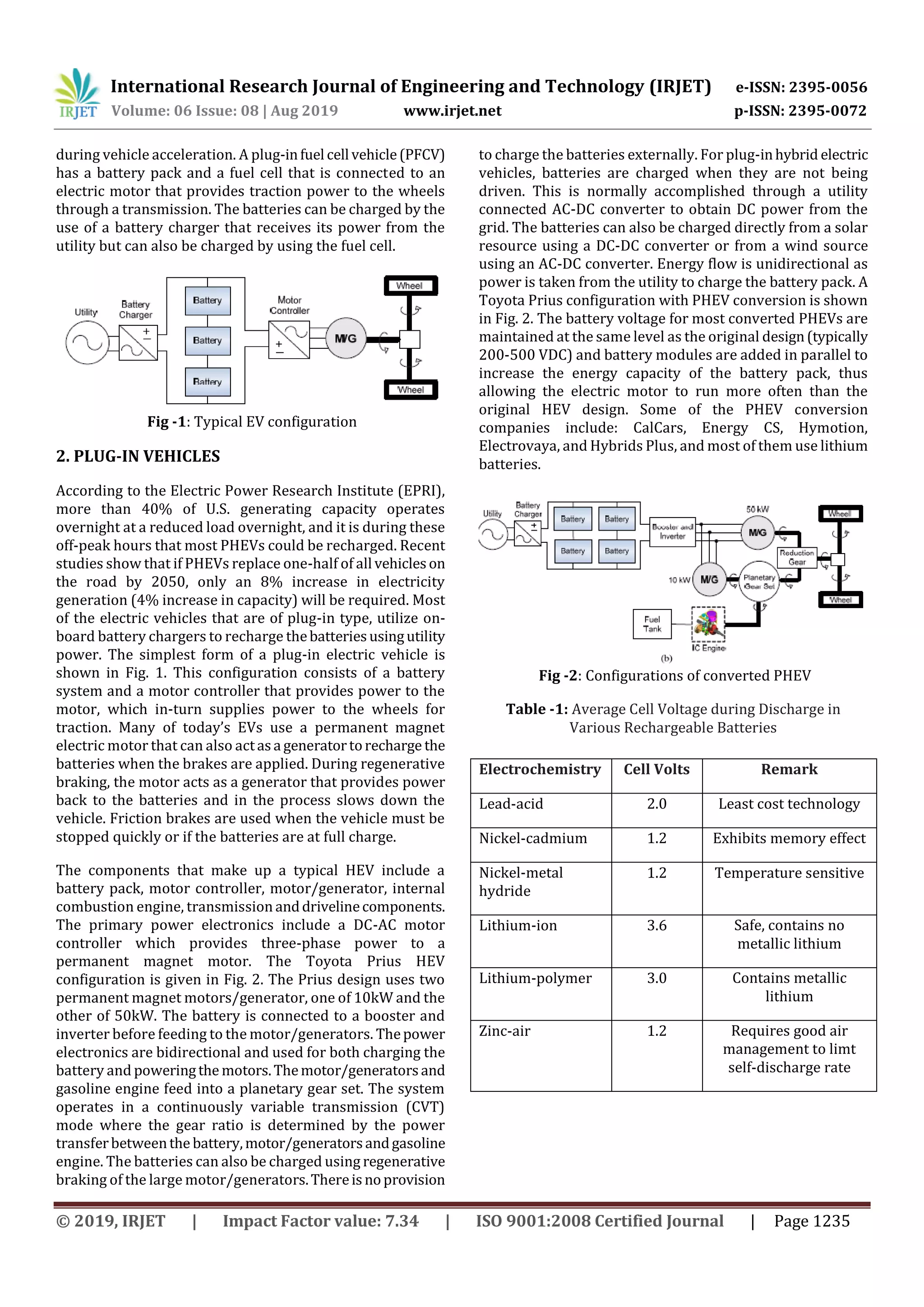
permanent magnet motor. The Toyota Prius HEV
configuration is given in Fig. 2. The Prius design uses two
permanent magnet motors/generator, one of 10kW and the
other of 50kW. The battery is connected to a booster and
inverter before feeding to the motor/generators. Thepower
electronics are bidirectional and used for both charging the
battery and poweringthe motors.Themotor/generatorsand
gasoline engine feed into a planetary gear set. The system
operates in a continuously variable transmission (CVT)
mode where the gear ratio is determined by the power
transferbetweenthe battery,motor/generatorsandgasoline
engine. The batteries can also be charged using regenerative
braking of the large motor/generators.Thereisnoprovision
to charge the batteries externally. For plug-inhybrid electric
vehicles, batteries are charged when they are not being
driven. This is normally accomplished through a utility
connected AC-DC converter to obtain DC power from the
grid. The batteries can also be charged directly from a solar
resource using a DC-DC converter or from a wind source
using an AC-DC converter. Energy flow is unidirectional as
power is taken from the utility to charge the battery pack. A
Toyota Prius configuration with PHEV conversion is shown
in Fig. 2. The battery voltage for most converted PHEVs are
maintained at the same level as the original design(typically
200-500 VDC) and battery modules are added in parallel to
increase the energy capacity of the battery pack, thus
allowing the electric motor to run more often than the
original HEV design. Some of the PHEV conversion
companies include: CalCars, Energy CS, Hymotion,
Electrovaya, and Hybrids Plus, and most of them use lithium
batteries.
Fig -2: Configurations of converted PHEV
Table -1: Average Cell Voltage during Discharge in
Various Rechargeable Batteries
Electrochemistry Cell Volts Remark
Lead-acid 2.0 Least cost technology
Nickel-cadmium 1.2 Exhibits memory effect
Nickel-metal
hydride
1.2 Temperature sensitive
Lithium-ion 3.6 Safe, contains no
metallic lithium
Lithium-polymer 3.0 Contains metallic
lithium
Zinc-air 1.2 Requires good air
management to limt
self-discharge rate
International Research Journal of Engineering and Technology (IRJET) e-ISSN: 2395-0056
Volume: 06 Issue: 08 | Aug 2019 www.irjet.net p-ISSN: 2395-0072
© 2019, IRJET | Impact Factor value: 7.34 | ISO 9001:2008 Certified Journal | Page 1236
2.1 Plug-in Electric Vehicle Charger Topology
The desirable characteristics for the charger are power
bi-directionality (V2G and G2V), power factor equal to one,
capability of performing power control, low PQ impact,
construction and topology simplicity, and regular 16 A
single-phase plug compatibility. This charger does notallow
performing fast charge, being 2.3 kW (10 A, 230 V) the
advisable maximum power for a single-phase household-
type plug. This power range is defined based on EU
standards and power grid restrictions, since higher power
ranges could represent a negative impact on the low voltage
(LV) grid in terms of PQ and EMS requirements [22]–[24].
Regarding the voltage level of the battery pack,theproposed
design is focused on L-category vehicles (two-, three- and
four-wheel vehiclessuchasmotorcycles,mopeds,quads, and
minicars), as the one studied in [25], but could be extended
to other voltage levels.
Fig -3: PEV charger topology
The topology presented in Figure 3 is formed by three
legs of two Insulated Gate Bipolar Transistors (IGBT),
denoted by Sj ∈ {1, . . . , 6}. The IGBTs are used due to their
good compromise characteristics associated with voltage,
switching frequency and current limits. These power
switches are used for an AC/DC converter that operates as a
controlled rectifier or as an inverter for G2V or V2G
operation modes, respectively, and fora DC/DCconverter (C
class chopper) in which the power used for both modes is
restricted, as discussed below. The features of converters
meet the desired bi-directionality, where the chopper
operates as buck and boost for G2V and V2G operation
modes, respectively. Some passive elements forfiltering and
energy storage purposes are also designed and
implemented, which are relevant for achieving proper
system dynamics, stability and power quality.
3. CONTROLLERS DESIGN
The controllers are PI-based and they aim at properly
controlling the IGBT switching followingvoltageandcurrent
references.
For the chopper controller design, some assumptions were
made to facilitate circuit analysis: capacities in both sides of
the chopper are high enough for considering constant
voltage, low L capacity (when comparedtotheCbus capacity),
and negligible switching losses.
For establishing the control laws, it was necessary to
determine the differential equations describing the energy
demand of the converter (see (21)–(24)), according to
Kirchhoff laws. Typically, the state variables in the
converters are associated with the energy stored in
capacitors and inductors, leading to VCbus in the DC bus,
VBAT in the batteries, and IL in the chopper inductor as
displayed in Figure 4.
Fig -4: DC/DC converter controller architecture for V2G
and G2V operation modes
Fig -5: AC/DC converter controller architecture for V2G
and G2V operation modes.
The controller for the rectifier is also PI based. A daisy chain
of two PI controllers for DC bus voltage and AC current
regulation is used. For AC current regulation,a phase-locked
loop (PLL) is also used providing AC current control
reference as stated in [30]. This controller was firstly tuned
using a pole placement approach and then refined through
experimental tests, being the final IGBT PWM signal
provided by the unipolar PWM generator. The controller
used for the AC/DC converter when this works as inverter is
based only on the unipolar switching method. A unit
sinusoid reference provided by a PLL is used, which is
synchronized with the voltage grid. In this operation mode,
the DC bus available power was already restricted by the
chopper, being at this point only mandatoryinvertingthe DC
bus voltage in a proper way. Both AC/DC converter
controllers are presented in Figure 5.
International Research Journal of Engineering and Technology (IRJET) e-ISSN: 2395-0056
Volume: 06 Issue: 08 | Aug 2019 www.irjet.net p-ISSN: 2395-0072
© 2019, IRJET | Impact Factor value: 7.34 | ISO 9001:2008 Certified Journal | Page 1237
4. EXPERIMENTAL RESULTS
The experimental results have been obtained using a
reduced scale setup (with power levels 5 times lower than
the full scale). It is important to note that in this reduced
scale setup the DCBUS voltage was stabilized around 108 V
and Pmax was ±460W, being the “Advisable Energy Levels”
used for sizing, simulation and further full-scale
implementation. This setup uses theLEMHY25-PandLV 25-
P transducers for current and voltage acquisition,
respectively, as presented in Figs. 3 and 4. A DSP from NI for
control and data logging purpose is also used, jointly with
other laboratory equipment and several electronic
components, as presented in Fig. 6.
Fig -6: Simulation Diagram for PV based V2G System
Fig -7: Simulation Result for PV, Grid and Battery Powers
Fig -8: Simulation Result for DC Voltage and Current
Fig -9: Simulation Result for Inverter Voltage and Current
5. CONCLUSION
Use of power electronics can convert electric and hybrid
vehicles into plug-in or even V2G capable. With adequate
power conversion, a plug-in vehicle can be charged from
utility or a V2G capable vehicle can send power back to the
utility. With ever rising gas prices and with energy policy
thrust towards distributed resources, electric and hybrid
vehicle with plug-in and V2G capability will surely get
increased consumer and commercial attention in near
future. Currently,theNational RenewableEnergyLaboratory
(NREL) is reviewing various plug-in and V2G capable
vehicles and performing tests to verify utility connection
standards for these vehicles. The test results will be
published in future papers as soon as thetestingiscomplete.
6. REFERENCES
[1] Pacific Gas and Electric Company (PG&E) NewsRelease,
“Pacific Gas and Electric Company energizes silicon
valley with vehicle-to-grid technology,” April 2007.
[2] Electric Power Research Institute (EPRI) Report,
“Technology primer: the plug-in hybridelectricvehicle,”
pp. 1-2, 2007.
[3] T. Jahns and V. Blasko, “Recent advances in power
electronics technology for industrial and traction
machine drives,” Proc. of the IEEE, vol. 89, no. 6, pp. 963
– 975, June 2001.
[4] K. Wipke, S. Sprik, J. Kurtz, and H. Thomas, “Learning
demonstration progress report – September 2007,”
National Renewable Energy Laboratory Report, NREL
TP-560-42264, pp. 41, September 2007.
[5] K. Parks, P. Denholm, and T. Markel, “Costs and
emissions associated withplug-inhybridelectricvehicle
charging in the Xcel Energy Colorado service territory,”
National Renewable Energy Laboratory Report, NREL
TP-640-41410, pp. 29, May 2007.
[6] T. Markel, A. Brooker, J. Gonder, M. O'Keefe, A. Simpson,
and M. Thornton, “Plug-in hybrid vehicle analysis,” DOE
Milestone Report, NREL MP-540-40609, pp. 189,
November 2006.
International Research Journal of Engineering and Technology (IRJET) e-ISSN: 2395-0056
Volume: 06 Issue: 08 | Aug 2019 www.irjet.net p-ISSN: 2395-0072
© 2019, IRJET | Impact Factor value: 7.34 | ISO 9001:2008 Certified Journal | Page 1238
[7] W. Short and P. Denholm, “Preliminary assessment of
plug-in hybrid electric vehicles on wind energy
markets,” National Renewable Energy Laboratory
Report, NREL TP-620-39729, pp. 41, April 2006.
[8] J. Tomic and W. Kempton, “Using fleets of electric-drive
vehicles for grid support,” Elsevier J. of Power Sources,
vol. 168, no. 2, pp. 459– 468, June 2007.
[9] E. Hirst and B. Kirby, “What is system control,” Proc. of
American Power Conference, Chicago, IL, April 1999.
[10] B. Kirby, “Frequency regulation basics and trends,” Oak
Ridge National Laboratory Report, ORNL TM-2004-29,
pp. 32, December 2004.

IRJET- Modeling of PV based Bidirectional Battery Charger for Electric Vehicles

  • 1.
    International Research Journalof Engineering and Technology (IRJET) e-ISSN: 2395-0056 Volume: 06 Issue: 08 | Aug 2019 www.irjet.net p-ISSN: 2395-0072 © 2019, IRJET | Impact Factor value: 7.34 | ISO 9001:2008 Certified Journal | Page 1234 Modeling of PV based Bidirectional Battery Charger for Electric Vehicles Moturu Arun Bhargav1, Dr. Gadi Venkata Siva Krishna Rao2 1Post graduate scholar, Dept. of Electrical Engineering, Andhra University, Visakhapatnam, Andhrapradesh, India 2Professor, Dept. of Electrical Engineering, Andhra University, Visakhapatnam, Andhrapradesh, India ---------------------------------------------------------------------***---------------------------------------------------------------------- Abstract - As hybrid vehicles gain popularity among the consumers, current research initiatives are focused towards developing plug-in electric andhybridvehiclesthatcanexploit utility power to charge vehicle batteries and therefore less dependent on the gasoline usage. Powerelectronicsystemsare being developed to allow plug-in vehicles to be vehicle-to-grid (V2G) capable where the vehicles can work as distributed resources and power can be sent back to the utility. In this paper a review of different plug-in and V2G capable vehicles are given along with their power electronics topologies. The economic implication of chargingthevehicleorsendingpower back to the utility is described in brief. Finally, allvehicles with V2G capability must meet the IEEE Standard 1547 for connecting to the utility. Brief descriptionsoftherequirements and testing that must be followed for V2G vehicles to conform the IEEE 1547 standards are also discussed. Key Words: Autonomous energy management system, plugin electric vehicle, energy storage,bidirectional charger, grid-to-vehicle, vehicle-to-grid. 1. INTRODUCTION The continuous rise in gasoline prices along with the increased concerns about the pollutions produced by fossil fuel engines are forcing the current vehicle market to find new alternatives to reduce the fossil fuel usage. Along with the research on bio-fuel driven engines; different electric vehicles and hybrid electric vehicles are evolving as viable alternatives to replace, or at least reduce, the current fleetof fossil fuel driven vehicles. Although current manufactured electric/hybrid vehicles are being marketed as a way to reduce fossil fuel usage, several promising technologies are being demonstrated that can utilize power electronics to charge the battery from the utility using plug-in vehicles or act as a distributed resource to send power back to the utility with vehicle-to-grid capabilities. In this paper, different plug-in vehicle topologies are described to review the power electronicsrequiredforthem. The newly evolving V2G technology is also discussed along with economics and compliance requirements to allow the vehicle to be connected to the grid. Before going into the details of power electronics required for the electric/hybrid vehicles, the common forms of these vehicles are described next to get accustomed with the terminologies. 1.1 Electric Vehicles A typical electric vehicle (EV) has a battery pack connected to an electric motor and provides traction power through the use of a transmission. The batteries are charged primarily by a batterychargerthatreceivesitspowerfroman external source such as the electrical utility. Also during regenerative braking, the motor acts as a generator which provides power back to thebatteriesandintheprocessslows down the vehicle. The primary advantage of an EV is that the design is simple and has a low part count. The primary disadvantage is that the driving range ofthevehicleislimited to the size of the battery and the timeto re-chargethebattery can be from 15 minutes to 8 hours depending on how far the vehicle was last driven, the battery typeandbatterycharging method. 1.2 Hybrid Electric Vehicles The components that make up a typical hybrid electric vehicle (HEV) include a battery pack, motor controller, motor/generator, internal combustion engine,transmission and driveline components. The batteries are charged through the use of the on-board internal combustion engine and generator. In a plug-in hybrid electric vehicle (PHEV), the batteries can also be charged throughtheuseofa battery charger that receives its power from the utility. The best PHEV design will allow the vehicle to operate on electric power only reducing the amount of time that the engine runs. When the vehicle is not operating, the battery can be charged through the use of a battery chargerthatis“plugged in” to the electrical utility or other energy sources. A PHEV normally has a larger battery pack than a HEV. The advantage of a PHEV over an HEV is that due to external battery charging, the vehicle can run longer on electric power which in-turn reduces engine fuel consumption. 1.3 Fuel Cell Vehicles The prototype fuel cell vehicles (FCV) that are currently under development mostly utilize an on-board tank to store pressurized hydrogen. Hydrogenandconditionedairare fed to a proton exchange membrane (PEM) stack to develop DC power. The configuration is very similar to the electric vehicle configuration in which a electric motor/generator provides the mechanical power for traction. The on-board batteries allow the energy to be stored during regenerative braking and provide peak power to the motor controller
  • 2.
    International Research Journalof Engineering and Technology (IRJET) e-ISSN: 2395-0056 Volume: 06 Issue: 08 | Aug 2019 www.irjet.net p-ISSN: 2395-0072 © 2019, IRJET | Impact Factor value: 7.34 | ISO 9001:2008 Certified Journal | Page 1235 during vehicle acceleration. A plug-infuel cell vehicle(PFCV) has a battery pack and a fuel cell that is connected to an electric motor that provides traction power to the wheels through a transmission. The batteries can be charged by the use of a battery charger that receives its power from the utility but can also be charged by using the fuel cell. Fig -1: Typical EV configuration 2. PLUG-IN VEHICLES According to the Electric Power Research Institute (EPRI), more than 40% of U.S. generating capacity operates overnight at a reduced load overnight, and it is during these off-peak hours that most PHEVs could be recharged. Recent studies show that if PHEVs replace one-half of all vehicleson the road by 2050, only an 8% increase in electricity generation (4% increase in capacity) will be required. Most of the electric vehicles that are of plug-in type, utilize on- board battery chargers to recharge thebatteriesusingutility power. The simplest form of a plug-in electric vehicle is shown in Fig. 1. This configuration consists of a battery system and a motor controller that provides power to the motor, which in-turn supplies power to the wheels for traction. Many of today’s EVs use a permanent magnet electric motor that can also actasa generatortorecharge the batteries when the brakes are applied. During regenerative braking, the motor acts as a generator that provides power back to the batteries and in the process slows down the vehicle. Friction brakes are used when the vehicle must be stopped quickly or if the batteries are at full charge. The components that make up a typical HEV include a battery pack, motor controller, motor/generator, internal combustion engine, transmission anddrivelinecomponents. The primary power electronics include a DC-AC motor controller which provides three-phase power to a permanent magnet motor. The Toyota Prius HEV configuration is given in Fig. 2. The Prius design uses two permanent magnet motors/generator, one of 10kW and the other of 50kW. The battery is connected to a booster and inverter before feeding to the motor/generators. Thepower electronics are bidirectional and used for both charging the battery and poweringthe motors.Themotor/generatorsand gasoline engine feed into a planetary gear set. The system operates in a continuously variable transmission (CVT) mode where the gear ratio is determined by the power transferbetweenthe battery,motor/generatorsandgasoline engine. The batteries can also be charged using regenerative braking of the large motor/generators.Thereisnoprovision to charge the batteries externally. For plug-inhybrid electric vehicles, batteries are charged when they are not being driven. This is normally accomplished through a utility connected AC-DC converter to obtain DC power from the grid. The batteries can also be charged directly from a solar resource using a DC-DC converter or from a wind source using an AC-DC converter. Energy flow is unidirectional as power is taken from the utility to charge the battery pack. A Toyota Prius configuration with PHEV conversion is shown in Fig. 2. The battery voltage for most converted PHEVs are maintained at the same level as the original design(typically 200-500 VDC) and battery modules are added in parallel to increase the energy capacity of the battery pack, thus allowing the electric motor to run more often than the original HEV design. Some of the PHEV conversion companies include: CalCars, Energy CS, Hymotion, Electrovaya, and Hybrids Plus, and most of them use lithium batteries. Fig -2: Configurations of converted PHEV Table -1: Average Cell Voltage during Discharge in Various Rechargeable Batteries Electrochemistry Cell Volts Remark Lead-acid 2.0 Least cost technology Nickel-cadmium 1.2 Exhibits memory effect Nickel-metal hydride 1.2 Temperature sensitive Lithium-ion 3.6 Safe, contains no metallic lithium Lithium-polymer 3.0 Contains metallic lithium Zinc-air 1.2 Requires good air management to limt self-discharge rate
  • 3.
    International Research Journalof Engineering and Technology (IRJET) e-ISSN: 2395-0056 Volume: 06 Issue: 08 | Aug 2019 www.irjet.net p-ISSN: 2395-0072 © 2019, IRJET | Impact Factor value: 7.34 | ISO 9001:2008 Certified Journal | Page 1236 2.1 Plug-in Electric Vehicle Charger Topology The desirable characteristics for the charger are power bi-directionality (V2G and G2V), power factor equal to one, capability of performing power control, low PQ impact, construction and topology simplicity, and regular 16 A single-phase plug compatibility. This charger does notallow performing fast charge, being 2.3 kW (10 A, 230 V) the advisable maximum power for a single-phase household- type plug. This power range is defined based on EU standards and power grid restrictions, since higher power ranges could represent a negative impact on the low voltage (LV) grid in terms of PQ and EMS requirements [22]–[24]. Regarding the voltage level of the battery pack,theproposed design is focused on L-category vehicles (two-, three- and four-wheel vehiclessuchasmotorcycles,mopeds,quads, and minicars), as the one studied in [25], but could be extended to other voltage levels. Fig -3: PEV charger topology The topology presented in Figure 3 is formed by three legs of two Insulated Gate Bipolar Transistors (IGBT), denoted by Sj ∈ {1, . . . , 6}. The IGBTs are used due to their good compromise characteristics associated with voltage, switching frequency and current limits. These power switches are used for an AC/DC converter that operates as a controlled rectifier or as an inverter for G2V or V2G operation modes, respectively, and fora DC/DCconverter (C class chopper) in which the power used for both modes is restricted, as discussed below. The features of converters meet the desired bi-directionality, where the chopper operates as buck and boost for G2V and V2G operation modes, respectively. Some passive elements forfiltering and energy storage purposes are also designed and implemented, which are relevant for achieving proper system dynamics, stability and power quality. 3. CONTROLLERS DESIGN The controllers are PI-based and they aim at properly controlling the IGBT switching followingvoltageandcurrent references. For the chopper controller design, some assumptions were made to facilitate circuit analysis: capacities in both sides of the chopper are high enough for considering constant voltage, low L capacity (when comparedtotheCbus capacity), and negligible switching losses. For establishing the control laws, it was necessary to determine the differential equations describing the energy demand of the converter (see (21)–(24)), according to Kirchhoff laws. Typically, the state variables in the converters are associated with the energy stored in capacitors and inductors, leading to VCbus in the DC bus, VBAT in the batteries, and IL in the chopper inductor as displayed in Figure 4. Fig -4: DC/DC converter controller architecture for V2G and G2V operation modes Fig -5: AC/DC converter controller architecture for V2G and G2V operation modes. The controller for the rectifier is also PI based. A daisy chain of two PI controllers for DC bus voltage and AC current regulation is used. For AC current regulation,a phase-locked loop (PLL) is also used providing AC current control reference as stated in [30]. This controller was firstly tuned using a pole placement approach and then refined through experimental tests, being the final IGBT PWM signal provided by the unipolar PWM generator. The controller used for the AC/DC converter when this works as inverter is based only on the unipolar switching method. A unit sinusoid reference provided by a PLL is used, which is synchronized with the voltage grid. In this operation mode, the DC bus available power was already restricted by the chopper, being at this point only mandatoryinvertingthe DC bus voltage in a proper way. Both AC/DC converter controllers are presented in Figure 5.
  • 4.
    International Research Journalof Engineering and Technology (IRJET) e-ISSN: 2395-0056 Volume: 06 Issue: 08 | Aug 2019 www.irjet.net p-ISSN: 2395-0072 © 2019, IRJET | Impact Factor value: 7.34 | ISO 9001:2008 Certified Journal | Page 1237 4. EXPERIMENTAL RESULTS The experimental results have been obtained using a reduced scale setup (with power levels 5 times lower than the full scale). It is important to note that in this reduced scale setup the DCBUS voltage was stabilized around 108 V and Pmax was ±460W, being the “Advisable Energy Levels” used for sizing, simulation and further full-scale implementation. This setup uses theLEMHY25-PandLV 25- P transducers for current and voltage acquisition, respectively, as presented in Figs. 3 and 4. A DSP from NI for control and data logging purpose is also used, jointly with other laboratory equipment and several electronic components, as presented in Fig. 6. Fig -6: Simulation Diagram for PV based V2G System Fig -7: Simulation Result for PV, Grid and Battery Powers Fig -8: Simulation Result for DC Voltage and Current Fig -9: Simulation Result for Inverter Voltage and Current 5. CONCLUSION Use of power electronics can convert electric and hybrid vehicles into plug-in or even V2G capable. With adequate power conversion, a plug-in vehicle can be charged from utility or a V2G capable vehicle can send power back to the utility. With ever rising gas prices and with energy policy thrust towards distributed resources, electric and hybrid vehicle with plug-in and V2G capability will surely get increased consumer and commercial attention in near future. Currently,theNational RenewableEnergyLaboratory (NREL) is reviewing various plug-in and V2G capable vehicles and performing tests to verify utility connection standards for these vehicles. The test results will be published in future papers as soon as thetestingiscomplete. 6. REFERENCES [1] Pacific Gas and Electric Company (PG&E) NewsRelease, “Pacific Gas and Electric Company energizes silicon valley with vehicle-to-grid technology,” April 2007. [2] Electric Power Research Institute (EPRI) Report, “Technology primer: the plug-in hybridelectricvehicle,” pp. 1-2, 2007. [3] T. Jahns and V. Blasko, “Recent advances in power electronics technology for industrial and traction machine drives,” Proc. of the IEEE, vol. 89, no. 6, pp. 963 – 975, June 2001. [4] K. Wipke, S. Sprik, J. Kurtz, and H. Thomas, “Learning demonstration progress report – September 2007,” National Renewable Energy Laboratory Report, NREL TP-560-42264, pp. 41, September 2007. [5] K. Parks, P. Denholm, and T. Markel, “Costs and emissions associated withplug-inhybridelectricvehicle charging in the Xcel Energy Colorado service territory,” National Renewable Energy Laboratory Report, NREL TP-640-41410, pp. 29, May 2007. [6] T. Markel, A. Brooker, J. Gonder, M. O'Keefe, A. Simpson, and M. Thornton, “Plug-in hybrid vehicle analysis,” DOE Milestone Report, NREL MP-540-40609, pp. 189, November 2006.
  • 5.
    International Research Journalof Engineering and Technology (IRJET) e-ISSN: 2395-0056 Volume: 06 Issue: 08 | Aug 2019 www.irjet.net p-ISSN: 2395-0072 © 2019, IRJET | Impact Factor value: 7.34 | ISO 9001:2008 Certified Journal | Page 1238 [7] W. Short and P. Denholm, “Preliminary assessment of plug-in hybrid electric vehicles on wind energy markets,” National Renewable Energy Laboratory Report, NREL TP-620-39729, pp. 41, April 2006. [8] J. Tomic and W. Kempton, “Using fleets of electric-drive vehicles for grid support,” Elsevier J. of Power Sources, vol. 168, no. 2, pp. 459– 468, June 2007. [9] E. Hirst and B. Kirby, “What is system control,” Proc. of American Power Conference, Chicago, IL, April 1999. [10] B. Kirby, “Frequency regulation basics and trends,” Oak Ridge National Laboratory Report, ORNL TM-2004-29, pp. 32, December 2004.