9 June 2010 LearnCentral E-capability What is it? How do you get it? Clint Smith Director LearnWorks
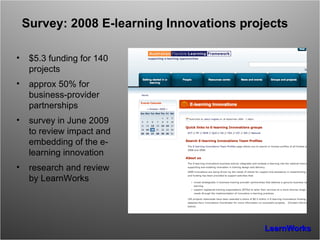
Survey: 2008 E-learning Innovations projects $5.3 funding for 140 projects approx 50% for business-provider partnerships survey in June 2009 to review impact and embedding of the e-learning innovation research and review by LearnWorks
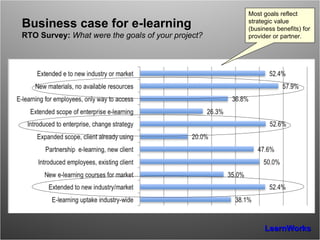
Business case for e-learning RTO Survey:  What were the goals of your project? Most goals reflect strategic value (business benefits) for provider or partner.
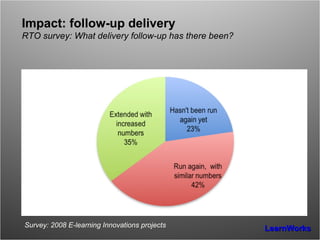
Impact: follow-up delivery RTO survey: What delivery follow-up has there been? Survey: 2008 E-learning Innovations projects
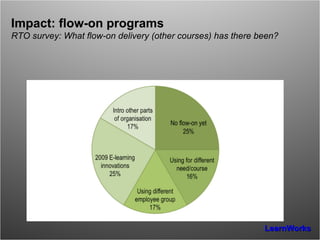
Impact: flow-on programs RTO survey: What flow-on delivery (other courses) has there been?
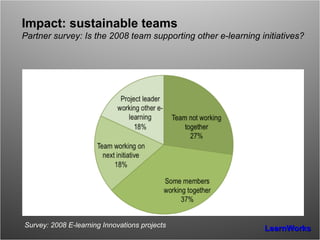
Impact: sustainable teams Partner survey: Is the 2008 team supporting other e-learning initiatives? Survey: 2008 E-learning Innovations projects
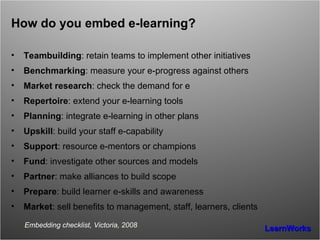
How do you embed e-learning? Teambuilding : retain teams to implement other initiatives Benchmarking : measure your e-progress against others Market research : check the demand for e Repertoire : extend your e-learning tools Planning : integrate e-learning in other plans Upskill : build your staff e-capability Support : resource e-mentors or champions Fund : investigate other sources and models Partner : make alliances to build scope Prepare : build learner e-skills and awareness Market : sell benefits to management, staff, learners, clients Embedding checklist, Victoria, 2008
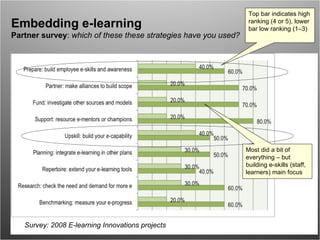
Embedding e-learning Partner survey :  which of these these strategies have you used? Survey: 2008 E-learning Innovations projects Top bar indicates high ranking (4 or 5), lower bar low ranking (1–3) Most did a bit of everything – but building e-skills (staff, learners) main focus
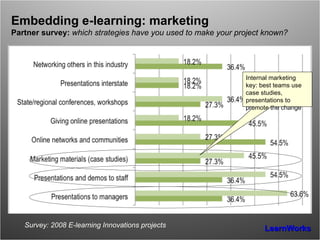
Embedding e-learning: marketing Partner survey:  which strategies have you used to make your project known? Survey: 2008 E-learning Innovations projects Internal marketing key: best teams use case studies, presentations to promote the change
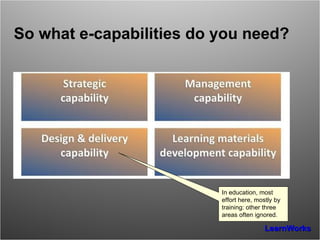
So what e-capabilities do you need? In education, most effort here, mostly by training: other three areas often ignored.
Strategic e-capabilities
Strategic e-capabilities Interpreting  trends in using web-based technologies for training  Analysing  business opportunities and threats from the technology trends Monitoring  e-learning development in competitors Identifying  types of e-learning relevant to the training business Picking  winners (e-learning initiatives for success and impact) Articulating  the role of e-learning in the business  ie business analysis Question: how do you build this stategic capability? More courses (PD)?
Strategic e-capabilities Interpreting  trends in using web-based technologies for training  Analysing  business opportunities and threats from the technology trends Monitoring  e-learning development in competitors Identifying  types of e-learning relevant to the training business Picking  winners (e-learning initiatives for success and impact) Articulating  the role of e-learning in the business  ie business analysis Get googling: who offers what you offer online? Who does it best?  Where  are they?
Strategic e-capabilities Interpreting  trends in using web-based technologies for training  Analysing  business opportunities and threats from the technology trends Monitoring  e-learning development in competitors Identifying  types of e-learning relevant to the training business Picking  winners (e-learning initiatives for success and impact) Articulating  the role of e-learning in the business  ie business analysis There are handy tools for this on the popular  Designing e-learning  site
…  and  more  strategic e-caps Developing an e-learning  game plan Marketing , supporting, monitoring and updating the game plan  Establishing clear leadership  goals and targets Identifying, developing and  supporting e-learning leaders Recruiting or developing appropriate  e-skills  for the business Designing and implementing e-learning  embedding strategies ie planning & leadership Recent  research  indicates a major shortage of these  e-caps in VET in Oz.
oh no! even more… Identifying business, learner and user technology  service needs Evaluating, selecting and implementing e-learning  systems and services Integrating e-learning needs in Web and  intranet services Developing user-friendly processes and interfaces ie systems development Technically, e-learning is mostly about good Web services. It’s not some exotic new beast.
Management e-capabilities When 2008 projects failed, the problems were mostly this area – project management. Question: how do you build this management capability? More courses (PD)?
Management e-capabilities Managing e-learning  projects , on time and on budget Establishing flexible  staffing  to support e-learning Establishing  team workflow processes  for e-learning initiatives Contracting and managing e-learning  specialists  for skill gaps Managing e-learning  content development  staffing and processes Managing  contracted  e-learning content development  ie project management Many education and training providers lack the flexibility to support project-based activity: their processes & structures are wrong.  So e-learning can be a major change management challenge.
and some more… Evaluating the  impact and value  of e-learning initiatives Providing e-learning  consultancy services  to business clients Marketing  e-learning internally, including to client employees Promoting  e-capability externally ie marketing There are free  benchmarking tools  available on the Framework site
Design and delivery capabilities Analysing client/learner needs and readiness for e-learning Selecting an appropriate e-learning mix (self-paced, facilitated, blended) Selecting appropriate delivery tools for an e-learning solution Designing e-learning sequences and activities Using e-learning tools, resources and systems for training delivery Using e-learning tools for assessing learning outcomes Providing client/learner/employee induction to e-learning Facilitating group learning online Providing support for e-learners  The  Designing e-learning   site has several handy tools to help with these tasks
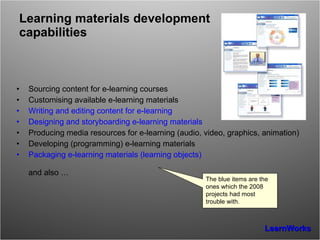
Learning materials development capabilities Sourcing content for e-learning courses Customising available e-learning materials Writing and editing content for e-learning Designing and storyboarding e-learning materials Producing media resources for e-learning (audio, video, graphics, animation) Developing (programming) e-learning materials Packaging e-learning materials (learning objects) and also … The blue items are the ones which the 2008 projects had most trouble with.
Learning materials development capabilities Sourcing content for e-learning courses Customising available e-learning materials Writing and editing content for e-learning Designing and storyboarding e-learning materials Producing media resources for e-learning (audio, video, graphics, animation) Developing (programming) e-learning materials Packaging e-learning materials (learning objects) Managing contracted development of e-learning materials Providing non-specialist (rapid) development tools for teachers Supporting and coordinating individual teacher development of materials These are options: a weakness in some project RTOs was being uncertain which tram (or trams) they were on.
So who do you spend your e-capability development budget on? Why? How? Director, Owner, Board Planners, business managers, finance officers Senior managers, education Senior managers, corporate/admin/IT Middle managers, project managers Industry consultants/sales/extension E-learning leaders/champions/innovators SO – just roll out more PD for this lot? Will that work? Why and why not?
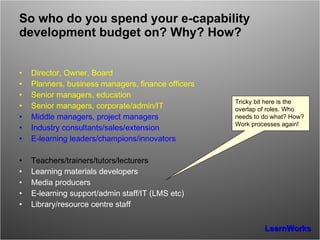
So who do you spend your e-capability development budget on? Why? How? Director, Owner, Board Planners, business managers, finance officers Senior managers, education Senior managers, corporate/admin/IT Middle managers, project managers Industry consultants/sales/extension E-learning leaders/champions/innovators Teachers/trainers/tutors/lecturers Learning materials developers Media producers E-learning support/admin staff/IT (LMS etc) Library/resource centre staff Tricky bit here is the overlap of roles. Who needs to do what? How? Work processes again!
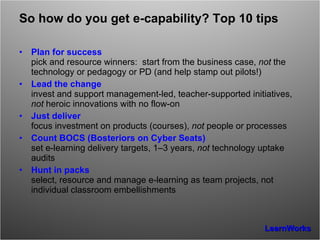
So how do you get e-capability? Top 10 tips Plan for success pick and resource winners:  start from the business case,  not  the technology or pedagogy or PD (and help stamp out pilots!) Lead the change invest and support management-led, teacher-supported initiatives,  not  heroic innovations with no flow-on Just deliver focus investment on products (courses),  not  people or processes Count BOCS (Bosteriors on Cyber Seats) set e-learning delivery targets, 1–3 years,  not  technology uptake audits Hunt in packs select, resource and manage e-learning as team projects, not individual classroom embellishments
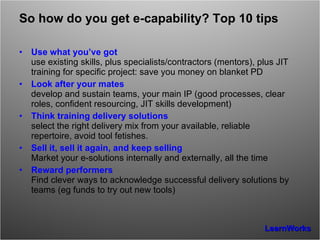
So how do you get e-capability? Top 10 tips Use what you’ve got use existing skills, plus specialists/contractors (mentors), plus JIT training for specific project: save you money on blanket PD Look after your mates develop and sustain teams, your main IP (good processes, clear roles, confident resourcing, JIT skills development) Think training delivery solutions select the right delivery mix from your available, reliable repertoire, avoid tool fetishes. Sell it, sell it again, and keep selling Market your e-solutions internally and externally, all the time Reward performers Find clever ways to acknowledge successful delivery solutions by teams (eg funds to try out new tools)
Clint Smith Director LearnWorks performance design services [email_address] 03 9528 5337 0410 569 386 skype  clintos2

E Capability What And How

  • 1.
    9 June 2010LearnCentral E-capability What is it? How do you get it? Clint Smith Director LearnWorks
  • 2.
    Survey: 2008 E-learningInnovations projects $5.3 funding for 140 projects approx 50% for business-provider partnerships survey in June 2009 to review impact and embedding of the e-learning innovation research and review by LearnWorks
  • 3.
    Business case fore-learning RTO Survey: What were the goals of your project? Most goals reflect strategic value (business benefits) for provider or partner.
  • 4.
    Impact: follow-up deliveryRTO survey: What delivery follow-up has there been? Survey: 2008 E-learning Innovations projects
  • 5.
    Impact: flow-on programsRTO survey: What flow-on delivery (other courses) has there been?
  • 6.
    Impact: sustainable teamsPartner survey: Is the 2008 team supporting other e-learning initiatives? Survey: 2008 E-learning Innovations projects
  • 7.
    How do youembed e-learning? Teambuilding : retain teams to implement other initiatives Benchmarking : measure your e-progress against others Market research : check the demand for e Repertoire : extend your e-learning tools Planning : integrate e-learning in other plans Upskill : build your staff e-capability Support : resource e-mentors or champions Fund : investigate other sources and models Partner : make alliances to build scope Prepare : build learner e-skills and awareness Market : sell benefits to management, staff, learners, clients Embedding checklist, Victoria, 2008
  • 8.
    Embedding e-learning Partnersurvey : which of these these strategies have you used? Survey: 2008 E-learning Innovations projects Top bar indicates high ranking (4 or 5), lower bar low ranking (1–3) Most did a bit of everything – but building e-skills (staff, learners) main focus
  • 9.
    Embedding e-learning: marketingPartner survey: which strategies have you used to make your project known? Survey: 2008 E-learning Innovations projects Internal marketing key: best teams use case studies, presentations to promote the change
  • 10.
    So what e-capabilitiesdo you need? In education, most effort here, mostly by training: other three areas often ignored.
  • 11.
  • 12.
    Strategic e-capabilities Interpreting trends in using web-based technologies for training Analysing business opportunities and threats from the technology trends Monitoring e-learning development in competitors Identifying types of e-learning relevant to the training business Picking winners (e-learning initiatives for success and impact) Articulating the role of e-learning in the business ie business analysis Question: how do you build this stategic capability? More courses (PD)?
  • 13.
    Strategic e-capabilities Interpreting trends in using web-based technologies for training Analysing business opportunities and threats from the technology trends Monitoring e-learning development in competitors Identifying types of e-learning relevant to the training business Picking winners (e-learning initiatives for success and impact) Articulating the role of e-learning in the business ie business analysis Get googling: who offers what you offer online? Who does it best? Where are they?
  • 14.
    Strategic e-capabilities Interpreting trends in using web-based technologies for training Analysing business opportunities and threats from the technology trends Monitoring e-learning development in competitors Identifying types of e-learning relevant to the training business Picking winners (e-learning initiatives for success and impact) Articulating the role of e-learning in the business ie business analysis There are handy tools for this on the popular Designing e-learning site
  • 15.
    … and more strategic e-caps Developing an e-learning game plan Marketing , supporting, monitoring and updating the game plan Establishing clear leadership goals and targets Identifying, developing and supporting e-learning leaders Recruiting or developing appropriate e-skills for the business Designing and implementing e-learning embedding strategies ie planning & leadership Recent research indicates a major shortage of these e-caps in VET in Oz.
  • 16.
    oh no! evenmore… Identifying business, learner and user technology service needs Evaluating, selecting and implementing e-learning systems and services Integrating e-learning needs in Web and intranet services Developing user-friendly processes and interfaces ie systems development Technically, e-learning is mostly about good Web services. It’s not some exotic new beast.
  • 17.
    Management e-capabilities When2008 projects failed, the problems were mostly this area – project management. Question: how do you build this management capability? More courses (PD)?
  • 18.
    Management e-capabilities Managinge-learning projects , on time and on budget Establishing flexible staffing to support e-learning Establishing team workflow processes for e-learning initiatives Contracting and managing e-learning specialists for skill gaps Managing e-learning content development staffing and processes Managing contracted e-learning content development ie project management Many education and training providers lack the flexibility to support project-based activity: their processes & structures are wrong. So e-learning can be a major change management challenge.
  • 19.
    and some more…Evaluating the impact and value of e-learning initiatives Providing e-learning consultancy services to business clients Marketing e-learning internally, including to client employees Promoting e-capability externally ie marketing There are free benchmarking tools available on the Framework site
  • 20.
    Design and deliverycapabilities Analysing client/learner needs and readiness for e-learning Selecting an appropriate e-learning mix (self-paced, facilitated, blended) Selecting appropriate delivery tools for an e-learning solution Designing e-learning sequences and activities Using e-learning tools, resources and systems for training delivery Using e-learning tools for assessing learning outcomes Providing client/learner/employee induction to e-learning Facilitating group learning online Providing support for e-learners The Designing e-learning site has several handy tools to help with these tasks
  • 21.
    Learning materials developmentcapabilities Sourcing content for e-learning courses Customising available e-learning materials Writing and editing content for e-learning Designing and storyboarding e-learning materials Producing media resources for e-learning (audio, video, graphics, animation) Developing (programming) e-learning materials Packaging e-learning materials (learning objects) and also … The blue items are the ones which the 2008 projects had most trouble with.
  • 22.
    Learning materials developmentcapabilities Sourcing content for e-learning courses Customising available e-learning materials Writing and editing content for e-learning Designing and storyboarding e-learning materials Producing media resources for e-learning (audio, video, graphics, animation) Developing (programming) e-learning materials Packaging e-learning materials (learning objects) Managing contracted development of e-learning materials Providing non-specialist (rapid) development tools for teachers Supporting and coordinating individual teacher development of materials These are options: a weakness in some project RTOs was being uncertain which tram (or trams) they were on.
  • 23.
    So who doyou spend your e-capability development budget on? Why? How? Director, Owner, Board Planners, business managers, finance officers Senior managers, education Senior managers, corporate/admin/IT Middle managers, project managers Industry consultants/sales/extension E-learning leaders/champions/innovators SO – just roll out more PD for this lot? Will that work? Why and why not?
  • 24.
    So who doyou spend your e-capability development budget on? Why? How? Director, Owner, Board Planners, business managers, finance officers Senior managers, education Senior managers, corporate/admin/IT Middle managers, project managers Industry consultants/sales/extension E-learning leaders/champions/innovators Teachers/trainers/tutors/lecturers Learning materials developers Media producers E-learning support/admin staff/IT (LMS etc) Library/resource centre staff Tricky bit here is the overlap of roles. Who needs to do what? How? Work processes again!
  • 25.
    So how doyou get e-capability? Top 10 tips Plan for success pick and resource winners: start from the business case, not the technology or pedagogy or PD (and help stamp out pilots!) Lead the change invest and support management-led, teacher-supported initiatives, not heroic innovations with no flow-on Just deliver focus investment on products (courses), not people or processes Count BOCS (Bosteriors on Cyber Seats) set e-learning delivery targets, 1–3 years, not technology uptake audits Hunt in packs select, resource and manage e-learning as team projects, not individual classroom embellishments
  • 26.
    So how doyou get e-capability? Top 10 tips Use what you’ve got use existing skills, plus specialists/contractors (mentors), plus JIT training for specific project: save you money on blanket PD Look after your mates develop and sustain teams, your main IP (good processes, clear roles, confident resourcing, JIT skills development) Think training delivery solutions select the right delivery mix from your available, reliable repertoire, avoid tool fetishes. Sell it, sell it again, and keep selling Market your e-solutions internally and externally, all the time Reward performers Find clever ways to acknowledge successful delivery solutions by teams (eg funds to try out new tools)
  • 27.
    Clint Smith DirectorLearnWorks performance design services [email_address] 03 9528 5337 0410 569 386 skype clintos2