Pressure Measurement Instruments
NAME : HANIF BAPARY
STUDENT ID : 1707030
INTRODUCTION
• Nearly all industrial processes use liquids, gases or both.
Controlling these process requires the measurement and control
of liquid and gas pressures.
• Thus, pressure measurement is one of the most important of all
process measurement.
Pressure and Its units of measurement
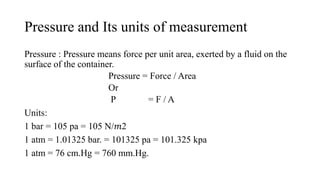
Pressure : Pressure means force per unit area, exerted by a fluid on the
surface of the container.
Pressure = Force / Area
Or
P = F / A
Units:
1 bar = 105 pa = 105 N/𝑚2
1 atm = 1.01325 bar. = 101325 pa = 101.325 kpa
1 atm = 76 cm.Hg = 760 mm.Hg.
Types of pressure
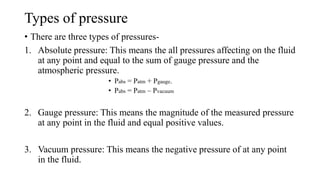
• There are three types of pressures-
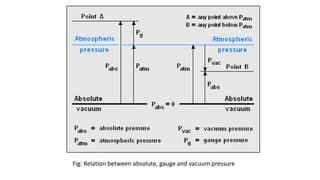
1. Absolute pressure: This means the all pressures affecting on the fluid
at any point and equal to the sum of gauge pressure and the
atmospheric pressure.
• Pabs = Patm + Pgauge.
• Pabs = Patm – Pvacuum
2. Gauge pressure: This means the magnitude of the measured pressure
at any point in the fluid and equal positive values.
3. Vacuum pressure: This means the negative pressure of at any point
in the fluid.
Fig: Relation between absolute, gauge and vacuum pressure
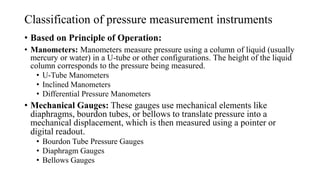
Classification of pressure measurement instruments
• Based on Principle of Operation:
• Manometers: Manometers measure pressure using a column of liquid (usually
mercury or water) in a U-tube or other configurations. The height of the liquid
column corresponds to the pressure being measured.
• U-Tube Manometers
• Inclined Manometers
• Differential Pressure Manometers
• Mechanical Gauges: These gauges use mechanical elements like
diaphragms, bourdon tubes, or bellows to translate pressure into a
mechanical displacement, which is then measured using a pointer or
digital readout.
• Bourdon Tube Pressure Gauges
• Diaphragm Gauges
• Bellows Gauges
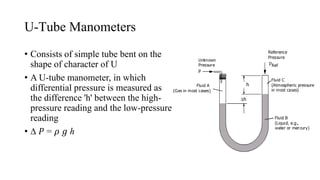
U-Tube Manometers
• Consists of simple tube bent on the
shape of character of U
• A U-tube manometer, in which
differential pressure is measured as
the difference 'h' between the high-
pressure reading and the low-pressure
reading
• ∆ 𝑃 = 𝜌 𝑔 ℎ
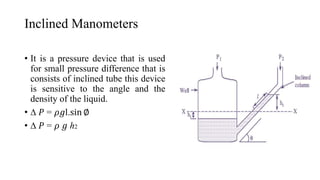
Inclined Manometers
• It is a pressure device that is used
for small pressure difference that is
consists of inclined tube this device
is sensitive to the angle and the
density of the liquid.
• ∆ 𝑃 = 𝜌𝑔l.sin ∅
• ∆ 𝑃 = 𝜌 𝑔 ℎ2
Application of Manometer
• Fluid Systems Monitoring
• Gas Distribution Networks
• HVAC Systems
• Steam Systems
• Boiler Systems
• Environmental Monitoring
• Automotive Industry
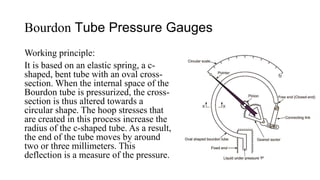
Bourdon Tube Pressure Gauges
Working principle:
It is based on an elastic spring, a c-
shaped, bent tube with an oval cross-
section. When the internal space of the
Bourdon tube is pressurized, the cross-
section is thus altered towards a
circular shape. The hoop stresses that
are created in this process increase the
radius of the c-shaped tube. As a result,
the end of the tube moves by around
two or three millimeters. This
deflection is a measure of the pressure.
Application of Bourdon Tube Pressure Gauges
• Pneumatics and hydraulics
• Water treatment
• Oil and gas production.
• Power generation
• HVAC systems
• Automotive and transportation
• Agriculture
• Medical
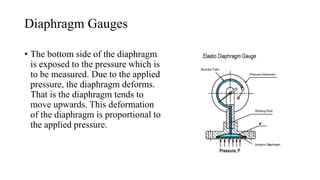
Diaphragm Gauges
• The bottom side of the diaphragm
is exposed to the pressure which is
to be measured. Due to the applied
pressure, the diaphragm deforms.
That is the diaphragm tends to
move upwards. This deformation
of the diaphragm is proportional to
the applied pressure.
Applications of Elastic diaphragm gauges
• They are used to measure medium pressure.
• They can also be used to measure low pressures including vacuum.
• They are used to measure draft in chimneys of boilers.
Advantages & Disadvantages
• Advantages
• Excellent load performance
• They have a linear scale for a wide range
• Suitable for measuring absolute and differential pressure
• Best advantage is they cost less
• Can be used to measure viscous and slurry materials
• Disadvantages
• Impact-resistant is not good
• Difficulty in maintenance
• Not suitable for very high pressure measurements
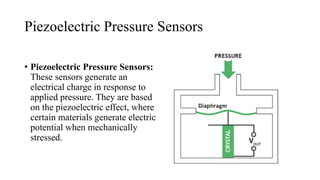
Piezoelectric Pressure Sensors
• Piezoelectric Pressure Sensors:
These sensors generate an
electrical charge in response to
applied pressure. They are based
on the piezoelectric effect, where
certain materials generate electric
potential when mechanically
stressed.
Application
• Vibration Monitoring: Used to monitor vibrations in machines, engines
and to detect potential faults or imbalances.
• Seismic Activity Monitoring: Used in seismographs to measure ground
motion during earthquakes.
• Aerospace Industry: To monitor vibration and acceleration for safety and
performance assessment.
• Health Monitoring: Used in wearable devices to track movement and
activity levels.
Others pressure measurement instruments
• Strain Gauge Pressure Sensors: These sensors use the principle that the
resistance of a wire changes when it's stretched or compressed. The
change in resistance is proportional to the applied pressure.
• Capacitive Pressure Sensors: These sensors measure the change in
capacitance between two plates as they move due to pressure changes.
The capacitance change is proportional to the pressure change.
• Optical Pressure Sensors: These sensors utilize the change in optical
properties of materials under pressure to measure pressure indirectly.
Thank You Everyone

Pressure Measurement Instruments 1.pptx

  • 1.
    Pressure Measurement Instruments NAME: HANIF BAPARY STUDENT ID : 1707030
  • 2.
    INTRODUCTION • Nearly allindustrial processes use liquids, gases or both. Controlling these process requires the measurement and control of liquid and gas pressures. • Thus, pressure measurement is one of the most important of all process measurement.
  • 3.
    Pressure and Itsunits of measurement Pressure : Pressure means force per unit area, exerted by a fluid on the surface of the container. Pressure = Force / Area Or P = F / A Units: 1 bar = 105 pa = 105 N/𝑚2 1 atm = 1.01325 bar. = 101325 pa = 101.325 kpa 1 atm = 76 cm.Hg = 760 mm.Hg.
  • 4.
    Types of pressure •There are three types of pressures- 1. Absolute pressure: This means the all pressures affecting on the fluid at any point and equal to the sum of gauge pressure and the atmospheric pressure. • Pabs = Patm + Pgauge. • Pabs = Patm – Pvacuum 2. Gauge pressure: This means the magnitude of the measured pressure at any point in the fluid and equal positive values. 3. Vacuum pressure: This means the negative pressure of at any point in the fluid.
  • 5.
    Fig: Relation betweenabsolute, gauge and vacuum pressure
  • 6.
    Classification of pressuremeasurement instruments • Based on Principle of Operation: • Manometers: Manometers measure pressure using a column of liquid (usually mercury or water) in a U-tube or other configurations. The height of the liquid column corresponds to the pressure being measured. • U-Tube Manometers • Inclined Manometers • Differential Pressure Manometers • Mechanical Gauges: These gauges use mechanical elements like diaphragms, bourdon tubes, or bellows to translate pressure into a mechanical displacement, which is then measured using a pointer or digital readout. • Bourdon Tube Pressure Gauges • Diaphragm Gauges • Bellows Gauges
  • 7.
    U-Tube Manometers • Consistsof simple tube bent on the shape of character of U • A U-tube manometer, in which differential pressure is measured as the difference 'h' between the high- pressure reading and the low-pressure reading • ∆ 𝑃 = 𝜌 𝑔 ℎ
  • 8.
    Inclined Manometers • Itis a pressure device that is used for small pressure difference that is consists of inclined tube this device is sensitive to the angle and the density of the liquid. • ∆ 𝑃 = 𝜌𝑔l.sin ∅ • ∆ 𝑃 = 𝜌 𝑔 ℎ2
  • 9.
    Application of Manometer •Fluid Systems Monitoring • Gas Distribution Networks • HVAC Systems • Steam Systems • Boiler Systems • Environmental Monitoring • Automotive Industry
  • 10.
    Bourdon Tube PressureGauges Working principle: It is based on an elastic spring, a c- shaped, bent tube with an oval cross- section. When the internal space of the Bourdon tube is pressurized, the cross- section is thus altered towards a circular shape. The hoop stresses that are created in this process increase the radius of the c-shaped tube. As a result, the end of the tube moves by around two or three millimeters. This deflection is a measure of the pressure.
  • 11.
    Application of BourdonTube Pressure Gauges • Pneumatics and hydraulics • Water treatment • Oil and gas production. • Power generation • HVAC systems • Automotive and transportation • Agriculture • Medical
  • 12.
    Diaphragm Gauges • Thebottom side of the diaphragm is exposed to the pressure which is to be measured. Due to the applied pressure, the diaphragm deforms. That is the diaphragm tends to move upwards. This deformation of the diaphragm is proportional to the applied pressure.
  • 13.
    Applications of Elasticdiaphragm gauges • They are used to measure medium pressure. • They can also be used to measure low pressures including vacuum. • They are used to measure draft in chimneys of boilers.
  • 14.
    Advantages & Disadvantages •Advantages • Excellent load performance • They have a linear scale for a wide range • Suitable for measuring absolute and differential pressure • Best advantage is they cost less • Can be used to measure viscous and slurry materials • Disadvantages • Impact-resistant is not good • Difficulty in maintenance • Not suitable for very high pressure measurements
  • 15.
    Piezoelectric Pressure Sensors •Piezoelectric Pressure Sensors: These sensors generate an electrical charge in response to applied pressure. They are based on the piezoelectric effect, where certain materials generate electric potential when mechanically stressed.
  • 16.
    Application • Vibration Monitoring:Used to monitor vibrations in machines, engines and to detect potential faults or imbalances. • Seismic Activity Monitoring: Used in seismographs to measure ground motion during earthquakes. • Aerospace Industry: To monitor vibration and acceleration for safety and performance assessment. • Health Monitoring: Used in wearable devices to track movement and activity levels.
  • 17.
    Others pressure measurementinstruments • Strain Gauge Pressure Sensors: These sensors use the principle that the resistance of a wire changes when it's stretched or compressed. The change in resistance is proportional to the applied pressure. • Capacitive Pressure Sensors: These sensors measure the change in capacitance between two plates as they move due to pressure changes. The capacitance change is proportional to the pressure change. • Optical Pressure Sensors: These sensors utilize the change in optical properties of materials under pressure to measure pressure indirectly.
  • 18.

Editor's Notes

  • #10 such as measuring fuel pressure, oil pressure, and tire pressure.