Pressure
Measurement
Devices
BY-
NIKITA A. GANGURDE-67 (11920145)
TEJAS K. AMBEKAR -68 (11920151)
AHMED B. SHAH -69 (11920152)
DURGESH CHANDANGOLE -70 (11920091)
Introduction
Need of Pressure Measurement
There are four common need
⇨ Safety
⇨ Process efficiency
⇨ Cost savings
⇨ Measurement of other process variables
Pressure
Pressure (P) Expresses The Magnitude Of Normal Force(f) Per Unit
Area(a) Applied On The Surface.
Units:
SI :- Pascal (N/m²)
Other units:- bar (=10⁵ pa), atm (=101.3kpa),mm of hg or (torr = 0.133322kpa)
Types of Pressure
STATIC PRESSURE- When the force in a system under pressure is
constant or static, the pressure is said to be static pressure.
DYNAMIC PRESSURE- When the force in a system is varying, the
pressure is said to be dynamic pressure.
A
F
P
or
A
F
P




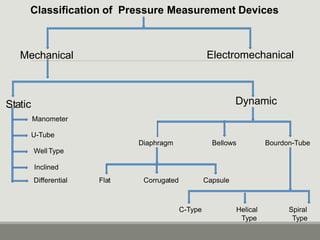
Mechanical Electromechanical
Static Dynamic
Manometer
U-Tube
Well Type
Inclined
Diaphragm Bellows Bourdon-Tube
Classification of Pressure Measurement Devices
Flat Corrugated Capsule
C-Type Helical
Type
Spiral
Type
Differential
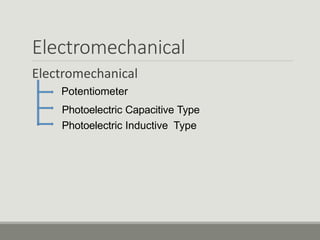
Electromechanical
Electromechanical
Potentiometer
Photoelectric Capacitive Type
Photoelectric Inductive Type
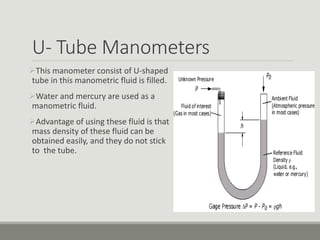
U- Tube Manometers
This manometer consist of U-shaped
tube in this manometric fluid is filled.
Water and mercury are used as a
manometric fluid.
Advantage of using these fluid is that
mass density of these fluid can be
obtained easily, and they do not stick
to the tube.
Well Type Manometer
The well type manometer is widely
used because of inconvenience;
the reading of only a single leg is
required in it.
It consist of a very large-diameter
vessel (well) connected on one side
to a very small-sized tube.
Thus the zero level moves very
little when pressure is applied.
Inclined Manometer
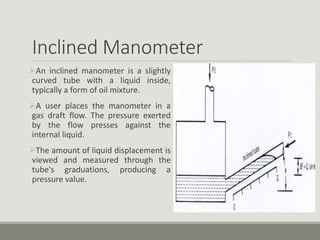
An inclined manometer is a slightly
curved tube with a liquid inside,
typically a form of oil mixture.
A user places the manometer in a
gas draft flow. The pressure exerted
by the flow presses against the
internal liquid.
The amount of liquid displacement is
viewed and measured through the
tube's graduations, producing a
pressure value.
Differential Manometer
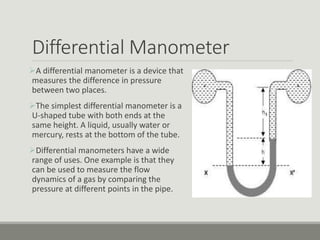
A differential manometer is a device that
measures the difference in pressure
between two places.
The simplest differential manometer is a
U-shaped tube with both ends at the
same height. A liquid, usually water or
mercury, rests at the bottom of the tube.
Differential manometers have a wide
range of uses. One example is that they
can be used to measure the flow
dynamics of a gas by comparing the
pressure at different points in the pipe.
Piezometer
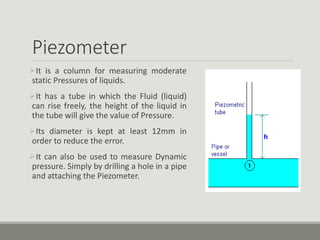
It is a column for measuring moderate
static Pressures of liquids.
It has a tube in which the Fluid (liquid)
can rise freely, the height of the liquid in
the tube will give the value of Pressure.
Its diameter is kept at least 12mm in
order to reduce the error.
It can also be used to measure Dynamic
pressure. Simply by drilling a hole in a pipe
and attaching the Piezometer.
Barometer
Barometer is used for measuring local
atmospheric Pressure. It is calibrated to read
zero when there is a complete vacuum; the
pressure indicated by the instrument is
therefore called absolute pressure.
A mercury barometer has a glass tube with a
height of at least 84 cm, closed at one end, with
an open mercury-filled reservoir at the base.
The weight of the mercury creates a vacuum in
the top of the tube. Mercury in the tube adjusts
until the weight of the mercury column
balances the atmospheric force exerted on the
reservoir
Diaphragm
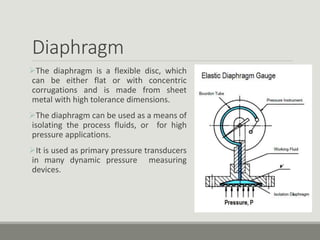
The diaphragm is a flexible disc, which
can be either flat or with concentric
corrugations and is made from sheet
metal with high tolerance dimensions.
The diaphragm can be used as a means of
isolating the process fluids, or for high
pressure applications.
It is used as primary pressure transducers
in many dynamic pressure measuring
devices.
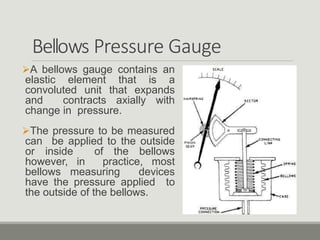
Bellows Pressure Gauge
A bellows gauge contains an
elastic element that is a
convoluted unit that expands
and contracts axially with
change in pressure.
The pressure to be measured
can be applied to the outside
or inside of the bellows
however, in practice, most
bellows measuring devices
have the pressure applied to
the outside of the bellows.
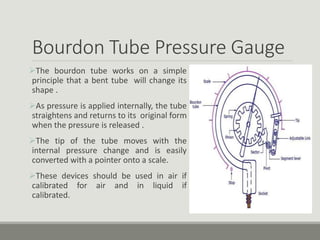
Bourdon Tube Pressure Gauge
The bourdon tube works on a simple
principle that a bent tube will change its
shape .
As pressure is applied internally, the tube
straightens and returns to its original form
when the pressure is released .
The tip of the tube moves with the
internal pressure change and is easily
converted with a pointer onto a scale.
These devices should be used in air if
calibrated for air and in liquid if
calibrated.
Bourdon Tube Pressure Gauge
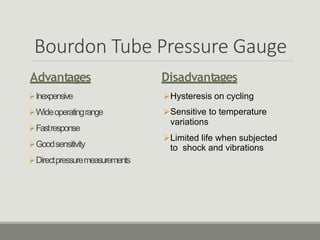
Advantages Disadvantages
Inexpensive
Wideoperatingrange
Fastresponse
Goodsensitivity
Directpressuremeasurements
Hysteresis on cycling
Sensitive to temperature
variations
Limited life when subjected
to shock and vibrations
Thank You!!!!

Pressure measurement devices

  • 1.
    Pressure Measurement Devices BY- NIKITA A. GANGURDE-67(11920145) TEJAS K. AMBEKAR -68 (11920151) AHMED B. SHAH -69 (11920152) DURGESH CHANDANGOLE -70 (11920091)
  • 2.
    Introduction Need of PressureMeasurement There are four common need ⇨ Safety ⇨ Process efficiency ⇨ Cost savings ⇨ Measurement of other process variables
  • 3.
    Pressure Pressure (P) ExpressesThe Magnitude Of Normal Force(f) Per Unit Area(a) Applied On The Surface. Units: SI :- Pascal (N/m²) Other units:- bar (=10⁵ pa), atm (=101.3kpa),mm of hg or (torr = 0.133322kpa) Types of Pressure STATIC PRESSURE- When the force in a system under pressure is constant or static, the pressure is said to be static pressure. DYNAMIC PRESSURE- When the force in a system is varying, the pressure is said to be dynamic pressure. A F P or A F P    
  • 4.
    Mechanical Electromechanical Static Dynamic Manometer U-Tube WellType Inclined Diaphragm Bellows Bourdon-Tube Classification of Pressure Measurement Devices Flat Corrugated Capsule C-Type Helical Type Spiral Type Differential
  • 5.
  • 6.
    U- Tube Manometers Thismanometer consist of U-shaped tube in this manometric fluid is filled. Water and mercury are used as a manometric fluid. Advantage of using these fluid is that mass density of these fluid can be obtained easily, and they do not stick to the tube.
  • 7.
    Well Type Manometer Thewell type manometer is widely used because of inconvenience; the reading of only a single leg is required in it. It consist of a very large-diameter vessel (well) connected on one side to a very small-sized tube. Thus the zero level moves very little when pressure is applied.
  • 8.
    Inclined Manometer An inclinedmanometer is a slightly curved tube with a liquid inside, typically a form of oil mixture. A user places the manometer in a gas draft flow. The pressure exerted by the flow presses against the internal liquid. The amount of liquid displacement is viewed and measured through the tube's graduations, producing a pressure value.
  • 9.
    Differential Manometer A differentialmanometer is a device that measures the difference in pressure between two places. The simplest differential manometer is a U-shaped tube with both ends at the same height. A liquid, usually water or mercury, rests at the bottom of the tube. Differential manometers have a wide range of uses. One example is that they can be used to measure the flow dynamics of a gas by comparing the pressure at different points in the pipe.
  • 10.
    Piezometer It is acolumn for measuring moderate static Pressures of liquids. It has a tube in which the Fluid (liquid) can rise freely, the height of the liquid in the tube will give the value of Pressure. Its diameter is kept at least 12mm in order to reduce the error. It can also be used to measure Dynamic pressure. Simply by drilling a hole in a pipe and attaching the Piezometer.
  • 11.
    Barometer Barometer is usedfor measuring local atmospheric Pressure. It is calibrated to read zero when there is a complete vacuum; the pressure indicated by the instrument is therefore called absolute pressure. A mercury barometer has a glass tube with a height of at least 84 cm, closed at one end, with an open mercury-filled reservoir at the base. The weight of the mercury creates a vacuum in the top of the tube. Mercury in the tube adjusts until the weight of the mercury column balances the atmospheric force exerted on the reservoir
  • 12.
    Diaphragm The diaphragm isa flexible disc, which can be either flat or with concentric corrugations and is made from sheet metal with high tolerance dimensions. The diaphragm can be used as a means of isolating the process fluids, or for high pressure applications. It is used as primary pressure transducers in many dynamic pressure measuring devices.
  • 13.
    Bellows Pressure Gauge Abellows gauge contains an elastic element that is a convoluted unit that expands and contracts axially with change in pressure. The pressure to be measured can be applied to the outside or inside of the bellows however, in practice, most bellows measuring devices have the pressure applied to the outside of the bellows.
  • 14.
    Bourdon Tube PressureGauge The bourdon tube works on a simple principle that a bent tube will change its shape . As pressure is applied internally, the tube straightens and returns to its original form when the pressure is released . The tip of the tube moves with the internal pressure change and is easily converted with a pointer onto a scale. These devices should be used in air if calibrated for air and in liquid if calibrated.
  • 15.
    Bourdon Tube PressureGauge Advantages Disadvantages Inexpensive Wideoperatingrange Fastresponse Goodsensitivity Directpressuremeasurements Hysteresis on cycling Sensitive to temperature variations Limited life when subjected to shock and vibrations
  • 16.