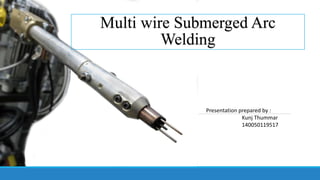
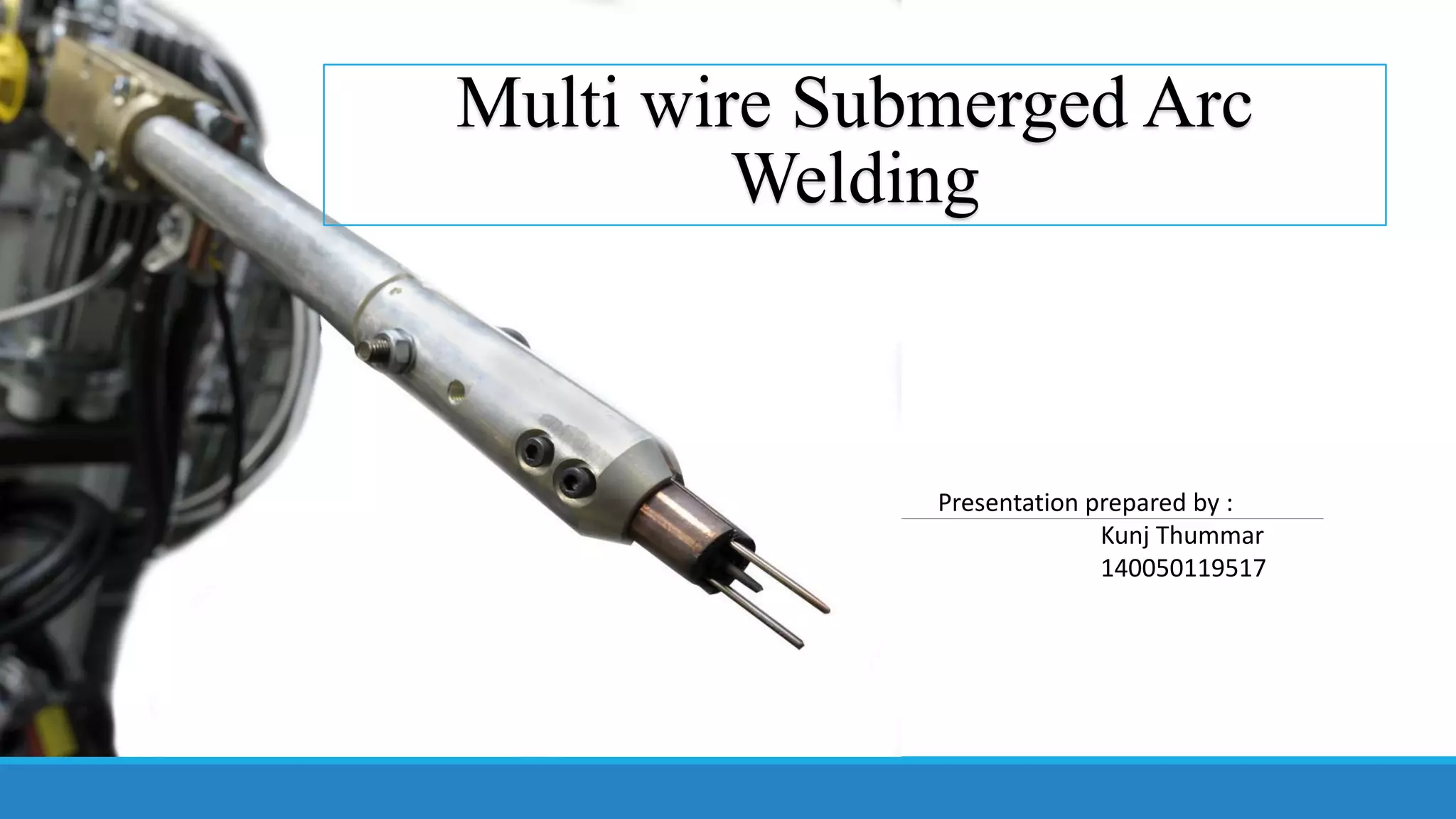
Multi wire Submerged Arc
Welding
Presentation prepared by :
Kunj Thummar
140050119517
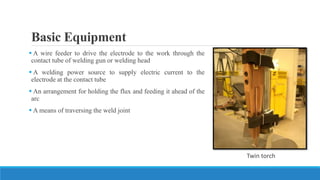
Basic Equipment
 A wire feeder to drive the electrode to the work through the
contact tube of welding gun or welding head
 A welding power source to supply electric current to the
electrode at the contact tube
 An arrangement for holding the flux and feeding it ahead of the
arc
 A means of traversing the weld joint
Twin torch
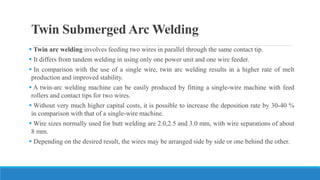
Twin Submerged Arc Welding
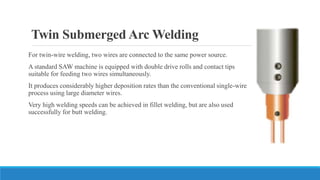
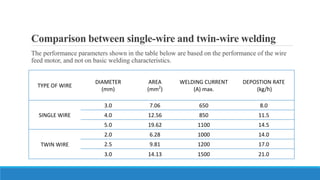
 Twin arc welding involves feeding two wires in parallel through the same contact tip.
 It differs from tandem welding in using only one power unit and one wire feeder.
 In comparison with the use of a single wire, twin arc welding results in a higher rate of melt
production and improved stability.
 A twin-arc welding machine can be easily produced by fitting a single-wire machine with feed
rollers and contact tips for two wires.
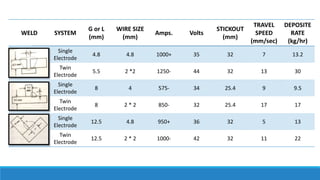
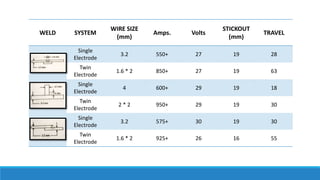
 Without very much higher capital costs, it is possible to increase the deposition rate by 30-40 %
in comparison with that of a single-wire machine.
 Wire sizes normally used for butt welding are 2.0,2.5 and 3.0 mm, with wire separations of about
8 mm.
 Depending on the desired result, the wires may be arranged side by side or one behind the other.
Twin Submerged Arc Welding
For twin-wire welding, two wires are connected to the same power source.
A standard SAW machine is equipped with double drive rolls and contact tips
suitable for feeding two wires simultaneously.
It produces considerably higher deposition rates than the conventional single-wire
process using large diameter wires.
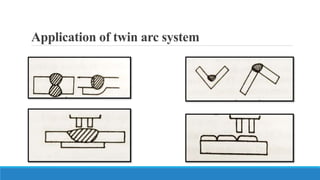
Very high welding speeds can be achieved in fillet welding, but are also used
successfully for butt welding.
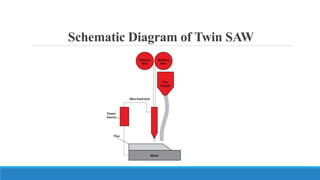
Schematic Diagram of Twin SAW
Tandem twin SAW
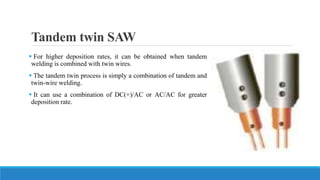
 For higher deposition rates, it can be obtained when tandem
welding is combined with twin wires.
 The tandem twin process is simply a combination of tandem and
twin-wire welding.
 It can use a combination of DC(+)/AC or AC/AC for greater
deposition rate.
 A tandem twin welding head is shown in Figure.
 With the use of 4x2.5 mm diameter, wires
deposition rates of up to 38 kg/h can be achieved.
 The process can be used in joints that allows
accessibility for the equipment, e.g.
circumferential welding in wind tower fabrication
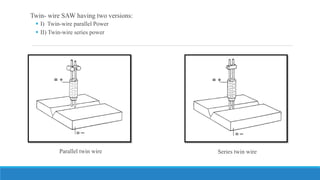
Parallel twin wire Series twin wire
Twin- wire SAW having two versions:
 I) Twin-wire parallel Power
 II) Twin-wire series power
Twin-wire parallel power
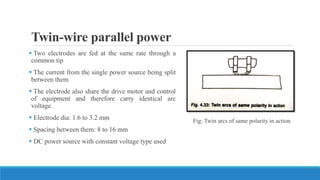
 Two electrodes are fed at the same rate through a
common tip
 The current from the single power source being split
between them
 The electrode also share the drive motor and control
of equipment and therefore carry identical arc
voltage.
 Electrode dia: 1.6 to 3.2 mm
 Spacing between them: 8 to 16 mm
 DC power source with constant voltage type used
Fig: Twin arcs of same polarity in action
Twin-wire series power
 Main advantage of this system is high deposition rate
and minimum dilution with base metal
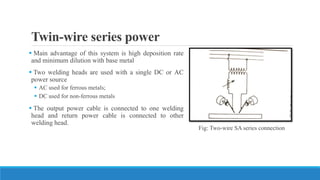
 Two welding heads are used with a single DC or AC
power source
 AC used for ferrous metals;
 DC used for non-ferrous metals
 The output power cable is connected to one welding
head and return power cable is connected to other
welding head.
Fig: Two-wire SA series connection
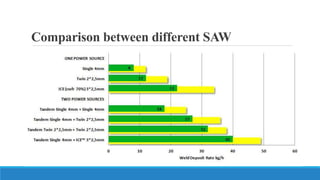
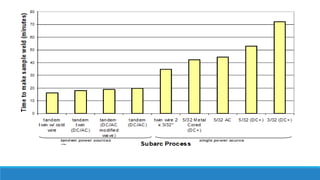
Comparison between different SAW
Comparison between single-wire and twin-wire welding
The performance parameters shown in the table below are based on the performance of the wire
feed motor, and not on basic welding characteristics.
TYPE OF WIRE
DIAMETER
(mm)
AREA
(mm2
)
WELDING CURRENT
(A) max.
DEPOSTION RATE
(kg/h)
SINGLE WIRE
3.0 7.06 650 8.0
4.0 12.56 850 11.5
5.0 19.62 1100 14.5
TWIN WIRE
2.0 6.28 1000 14.0
2.5 9.81 1200 17.0
3.0 14.13 1500 21.0
WELD SYSTEM
G or L
(mm)
WIRE SIZE
(mm)
Amps. Volts
STICKOUT
(mm)
TRAVEL
SPEED
(mm/sec)
DEPOSITE
RATE
(kg/hr)
Single
Electrode
4.8 4.8 1000+ 35 32 7 13.2
Twin
Electrode
5.5 2 *2 1250- 44 32 13 30
Single
Electrode
8 4 575- 34 25.4 9 9.5
Twin
Electrode
8 2 * 2 850- 32 25.4 17 17
Single
Electrode
12.5 4.8 950+ 36 32 5 13
Twin
Electrode
12.5 2 * 2 1000- 42 32 11 22
WELD SYSTEM
WIRE SIZE
(mm)
Amps. Volts
STICKOUT
(mm)
TRAVEL
Single
Electrode
3.2 550+ 27 19 28
Twin
Electrode
1.6 * 2 850+ 27 19 63
Single
Electrode
4 600+ 29 19 18
Twin
Electrode
2 * 2 950+ 29 19 30
Single
Electrode
3.2 575+ 30 19 30
Twin
Electrode
1.6 * 2 925+ 26 16 55
Application of twin arc system
BIBLIOGRAPHY
http://www.thefabricator.com/article/arcwelding/improving-productivity-with-submerged-arc-
welding

MULTIWIRE SUBMERGED ARC WELDING

  • 1.
    Multi wire SubmergedArc Welding Presentation prepared by : Kunj Thummar 140050119517
  • 2.
    Basic Equipment  Awire feeder to drive the electrode to the work through the contact tube of welding gun or welding head  A welding power source to supply electric current to the electrode at the contact tube  An arrangement for holding the flux and feeding it ahead of the arc  A means of traversing the weld joint Twin torch
  • 3.
    Twin Submerged ArcWelding  Twin arc welding involves feeding two wires in parallel through the same contact tip.  It differs from tandem welding in using only one power unit and one wire feeder.  In comparison with the use of a single wire, twin arc welding results in a higher rate of melt production and improved stability.  A twin-arc welding machine can be easily produced by fitting a single-wire machine with feed rollers and contact tips for two wires.  Without very much higher capital costs, it is possible to increase the deposition rate by 30-40 % in comparison with that of a single-wire machine.  Wire sizes normally used for butt welding are 2.0,2.5 and 3.0 mm, with wire separations of about 8 mm.  Depending on the desired result, the wires may be arranged side by side or one behind the other.
  • 4.
    Twin Submerged ArcWelding For twin-wire welding, two wires are connected to the same power source. A standard SAW machine is equipped with double drive rolls and contact tips suitable for feeding two wires simultaneously. It produces considerably higher deposition rates than the conventional single-wire process using large diameter wires. Very high welding speeds can be achieved in fillet welding, but are also used successfully for butt welding.
  • 5.
  • 6.
    Tandem twin SAW For higher deposition rates, it can be obtained when tandem welding is combined with twin wires.  The tandem twin process is simply a combination of tandem and twin-wire welding.  It can use a combination of DC(+)/AC or AC/AC for greater deposition rate.
  • 7.
     A tandemtwin welding head is shown in Figure.  With the use of 4x2.5 mm diameter, wires deposition rates of up to 38 kg/h can be achieved.  The process can be used in joints that allows accessibility for the equipment, e.g. circumferential welding in wind tower fabrication
  • 8.
    Parallel twin wireSeries twin wire Twin- wire SAW having two versions:  I) Twin-wire parallel Power  II) Twin-wire series power
  • 9.
    Twin-wire parallel power Two electrodes are fed at the same rate through a common tip  The current from the single power source being split between them  The electrode also share the drive motor and control of equipment and therefore carry identical arc voltage.  Electrode dia: 1.6 to 3.2 mm  Spacing between them: 8 to 16 mm  DC power source with constant voltage type used Fig: Twin arcs of same polarity in action
  • 10.
    Twin-wire series power Main advantage of this system is high deposition rate and minimum dilution with base metal  Two welding heads are used with a single DC or AC power source  AC used for ferrous metals;  DC used for non-ferrous metals  The output power cable is connected to one welding head and return power cable is connected to other welding head. Fig: Two-wire SA series connection
  • 11.
  • 13.
    Comparison between single-wireand twin-wire welding The performance parameters shown in the table below are based on the performance of the wire feed motor, and not on basic welding characteristics. TYPE OF WIRE DIAMETER (mm) AREA (mm2 ) WELDING CURRENT (A) max. DEPOSTION RATE (kg/h) SINGLE WIRE 3.0 7.06 650 8.0 4.0 12.56 850 11.5 5.0 19.62 1100 14.5 TWIN WIRE 2.0 6.28 1000 14.0 2.5 9.81 1200 17.0 3.0 14.13 1500 21.0
  • 14.
    WELD SYSTEM G orL (mm) WIRE SIZE (mm) Amps. Volts STICKOUT (mm) TRAVEL SPEED (mm/sec) DEPOSITE RATE (kg/hr) Single Electrode 4.8 4.8 1000+ 35 32 7 13.2 Twin Electrode 5.5 2 *2 1250- 44 32 13 30 Single Electrode 8 4 575- 34 25.4 9 9.5 Twin Electrode 8 2 * 2 850- 32 25.4 17 17 Single Electrode 12.5 4.8 950+ 36 32 5 13 Twin Electrode 12.5 2 * 2 1000- 42 32 11 22
  • 15.
    WELD SYSTEM WIRE SIZE (mm) Amps.Volts STICKOUT (mm) TRAVEL Single Electrode 3.2 550+ 27 19 28 Twin Electrode 1.6 * 2 850+ 27 19 63 Single Electrode 4 600+ 29 19 18 Twin Electrode 2 * 2 950+ 29 19 30 Single Electrode 3.2 575+ 30 19 30 Twin Electrode 1.6 * 2 925+ 26 16 55
  • 16.
  • 17.

Editor's Notes

  • #4 Submerged arc welding with two parallel wires differs more from twin-wire welding with separate welding heads than it does from conventional submerged arc welding having one wire and one welding head. An automatic twin-arc welding machine can be easily produced by fitting a single-wire machine with feed rollers and contact tips for two wires, together with an extra carrier for a second wire bobbin. Double wires have become increasingly common in the interests of higher productivity. Without very much higher capital costs, it is possible to increase the deposition rate by 30–40% in comparison with that of a single-wire machine, as a result of the higher current density that can be carried by two filler wires in parallel. As the equipment uses only a single wire feed unit, the welding current will be shared equally between the two wires.