June Hayden R. Sinson

Ramon Magsaysay High School - Espaǹa

Arturo A. Tolentino,

Caloocan City Science High School
 The

study of development has been
greatly aided by the use of the chick
embryo as an experimental model.
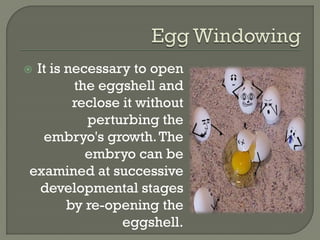
It is necessary to open
the eggshell and
reclose it without
perturbing the
embryo's growth. The
embryo can be
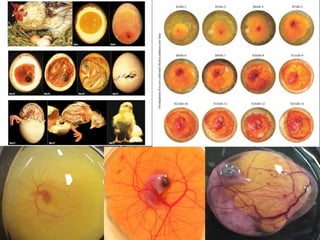
examined at successive
developmental stages
by re-opening the
eggshell.


Protocol
Maintain

at 37°C
with relative
humidity that
was set above
60%, remove the
eggs from the
incubator.
 Turn

eggs 90
degrees so that the
large base lies
horizontal where
your embryo is
located.
Saturate

a stack of nonsterile gauze with 70%
ethanol.

Use

two to three pieces
to swab up to 5 eggs.
Discard when the
gauze is soiled.
 Cut

and place a 1" x 1" piece of plastic
tape just left of the base to protect the
area where the albumen will be drawn
out.
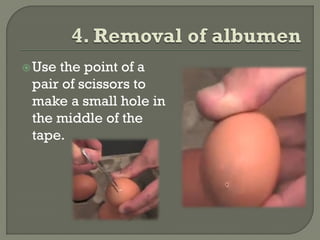
 Use

the point of a
pair of scissors to
make a small hole in
the middle of the
tape.
 Using

a 10 cc
syringe with an 18gauge, 1-inch
needle, slowly drill
the needle through
the hole made by the
scissors.
 Drive

the needle
down at a 45°C angle
towards the bottom
of the egg.
 Tilt the needle
towards the center
and draw up 3 to 4
mL of albumen.
 Cut

a 3" x 3" piece of plastic tape and
stretch it to fit on the top of the egg.
Extend the corners of the square around
the rounded ends of the horizontal
surface of the eggs, being careful not to
pull too hard.
Pull the tape so that it
is tight against the
surface of the eggs
with no folds.
 Using

a pair of sharpstraight 4" dissection
scissors, twist a hole
into the bottom
center of the area
where the tape was
placed.
 Slowly

guide the
lower blade of the
scissors into the egg
being sure to keep
the tips up against
the inside of the
shell. Direct
the
blade towards the
base and slowly
begin to cut the
shell.
 Remove

the
scissors and repeat
going
in
the
opposite direction
until only a small
bit of the egg
remains attached.
Check to be sure
the egg is fertilized.
Shut the window.
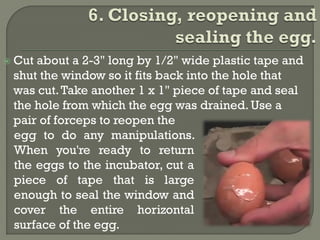
 Cut

about a 2-3" long by 1/2" wide plastic tape and
shut the window so it fits back into the hole that
was cut. Take another 1 x 1" piece of tape and seal
the hole from which the egg was drained. Use a
pair of forceps to reopen the
egg to do any manipulations.
When you're ready to return
the eggs to the incubator, cut a
piece of tape that is large
enough to seal the window and
cover the entire horizontal
surface of the egg.
 http://www.ncbi.nlm.nih.gov
 J Vis

Exp. 2007; (8): 306.
Published online 2007 October
1. doi: 10.3791/306
PMCID: PMC2562489
Matthew J. Korn and Karina S. Cramer
 http://www.youtube.com :
Windowing Chicken Eggs for
Developmental Studies
Avian egg is a useful animal model for
studies concerning early embryonic
development.
The model is particularly advantageous
of the ease by which the avian embryo
may be accessed and handled.

Numerous bioassays revolving around
avian embryos have been developed..
Avian eggs may be used for teratogenicity
studies.
Choriooallantoic membrane (CAM assay.

Egg windowing
• Process by which the egg is
opened and the embryo revealed
for manipulation.
1.Perform egg candling in order to
determine the position of the
embryo.
This can be done by holding the egg in
front of a light source.
(Source:http://www.pic2fly.com/Candling-Chicken-Egg-Pictures.html)

This step is necessary in order to ensure
that the windowing be performed
exactly on the top of the embryo
2. Using sandpaper, scrape the egg shell
directly on top of the embryo.
3. Once the shell is thin enough, cut a
small window (1 cm x 1 cm) into the
egg shell. Remove the egg shell first
before cutting through the shell
membrane. Once the window has
been cut,
it may be enlarged
depending on the need.
4. Observe the embryo.

5. Add 10 drops of the test reagent.
6. Cover the open window with
parafilm and return to the incubator.

References:
G. Speksnijder & R. Ivarie. 2000. A Modified Method of Shell Windowing for Producing Somatic or Germline
Chimeras in Fertilized Chicken Eggs. Poultry of Science 79:1430-1433.
UP seminar materials , acquired, April, 2013.
THANK YOU
FOR
LISTENING!!!

Egg Windowing

  • 1.
    June Hayden R.Sinson Ramon Magsaysay High School - Espaǹa Arturo A. Tolentino, Caloocan City Science High School
  • 2.
     The study ofdevelopment has been greatly aided by the use of the chick embryo as an experimental model.
  • 3.
    It is necessaryto open the eggshell and reclose it without perturbing the embryo's growth. The embryo can be examined at successive developmental stages by re-opening the eggshell. 
  • 4.
  • 5.
    Maintain at 37°C with relative humiditythat was set above 60%, remove the eggs from the incubator.
  • 6.
     Turn eggs 90 degreesso that the large base lies horizontal where your embryo is located.
  • 7.
    Saturate a stack ofnonsterile gauze with 70% ethanol. Use two to three pieces to swab up to 5 eggs. Discard when the gauze is soiled.
  • 8.
     Cut and placea 1" x 1" piece of plastic tape just left of the base to protect the area where the albumen will be drawn out.
  • 9.
     Use the pointof a pair of scissors to make a small hole in the middle of the tape.
  • 10.
     Using a 10cc syringe with an 18gauge, 1-inch needle, slowly drill the needle through the hole made by the scissors.
  • 11.
     Drive the needle downat a 45°C angle towards the bottom of the egg.  Tilt the needle towards the center and draw up 3 to 4 mL of albumen.
  • 12.
     Cut a 3"x 3" piece of plastic tape and stretch it to fit on the top of the egg. Extend the corners of the square around the rounded ends of the horizontal surface of the eggs, being careful not to pull too hard. Pull the tape so that it is tight against the surface of the eggs with no folds.
  • 13.
     Using a pairof sharpstraight 4" dissection scissors, twist a hole into the bottom center of the area where the tape was placed.
  • 14.
     Slowly guide the lowerblade of the scissors into the egg being sure to keep the tips up against the inside of the shell. Direct the blade towards the base and slowly begin to cut the shell.
  • 15.
     Remove the scissors andrepeat going in the opposite direction until only a small bit of the egg remains attached. Check to be sure the egg is fertilized. Shut the window.
  • 16.
     Cut about a2-3" long by 1/2" wide plastic tape and shut the window so it fits back into the hole that was cut. Take another 1 x 1" piece of tape and seal the hole from which the egg was drained. Use a pair of forceps to reopen the egg to do any manipulations. When you're ready to return the eggs to the incubator, cut a piece of tape that is large enough to seal the window and cover the entire horizontal surface of the egg.
  • 18.
     http://www.ncbi.nlm.nih.gov  JVis Exp. 2007; (8): 306. Published online 2007 October 1. doi: 10.3791/306 PMCID: PMC2562489 Matthew J. Korn and Karina S. Cramer  http://www.youtube.com : Windowing Chicken Eggs for Developmental Studies
  • 20.
    Avian egg isa useful animal model for studies concerning early embryonic development. The model is particularly advantageous of the ease by which the avian embryo may be accessed and handled. Numerous bioassays revolving around avian embryos have been developed..
  • 21.
    Avian eggs maybe used for teratogenicity studies. Choriooallantoic membrane (CAM assay. Egg windowing • Process by which the egg is opened and the embryo revealed for manipulation.
  • 22.
    1.Perform egg candlingin order to determine the position of the embryo. This can be done by holding the egg in front of a light source.
  • 23.
    (Source:http://www.pic2fly.com/Candling-Chicken-Egg-Pictures.html) This step isnecessary in order to ensure that the windowing be performed exactly on the top of the embryo
  • 24.
    2. Using sandpaper,scrape the egg shell directly on top of the embryo. 3. Once the shell is thin enough, cut a small window (1 cm x 1 cm) into the egg shell. Remove the egg shell first before cutting through the shell membrane. Once the window has been cut, it may be enlarged depending on the need.
  • 25.
    4. Observe theembryo. 5. Add 10 drops of the test reagent. 6. Cover the open window with parafilm and return to the incubator. References: G. Speksnijder & R. Ivarie. 2000. A Modified Method of Shell Windowing for Producing Somatic or Germline Chimeras in Fertilized Chicken Eggs. Poultry of Science 79:1430-1433. UP seminar materials , acquired, April, 2013.
  • 26.