INCUBATION AND HATCHERY
PRACTICES
INTRODUCTION
• Incubation is the management of fertilized eggs to ensure normal
development of embryo into normal chick. Incubation can be
achieved naturally (when the hen sits on the eggs for a period of time
and keeps the eggs warm until hatching) or artificially by using
machines known as incubators which provide the necessary heat
until hatching. Some essential requirements of incubation include
temperature, humidity, turning of the eggs, candling e.t.c.
Reproductive System of the hen
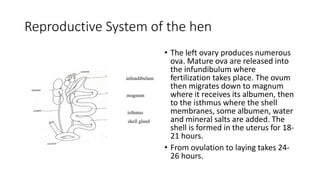
• The left ovary produces numerous
ova. Mature ova are released into
the infundibulum where
fertilization takes place. The ovum
then migrates down to magnum
where it receives its albumen, then
to the isthmus where the shell
membranes, some albumen, water
and mineral salts are added. The
shell is formed in the uterus for 18-
21 hours.
• From ovulation to laying takes 24-
26 hours.
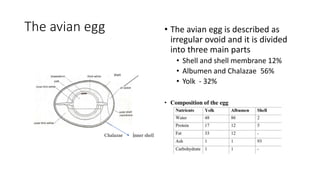
The avian egg • The avian egg is described as
irregular ovoid and it is divided
into three main parts
• Shell and shell membrane 12%
• Albumen and Chalazae 56%
• Yolk - 32%
• Composition of the egg
Shell
• Factors affecting Egg size
• 1) Genetic factors
• 2) Age of the birds
• 3) Protein level of the diet
• 4) Environmental factors
• 5) Size of the birds
• 6) Ovum size
• 7) Intensity of egg laying
Incubation
• Incubation is the process of aiding the development of a fertilized egg into a life chick by providing such
factors as adequate temperature, humidity, ventilation and turning. There are two methods of incubation.
1) Natural incubation
• That is getting the hen to sit on fertilize egg to incubate the egg.
2) Artificial incubation
• Artificial incubation is carried out with incubator using fuels such as kerosene, gas, coal etc.
Essential requirement of artificial incubation
• 1) Adequate ventilation- there should be sufficient oxygen to supply the respiratory need of the
embryo. Also carbon dioxide resulting from embryonic metabolism should not be allowed to accumulate.
• 2) Relative humidity of 60-65% should be provided to prevent excessive water loss by the egg.
• 3) Adequate temperature should be provided to ensure that life within the egg is maintained at the
optimum level. The temperature of 37.5◦C is ideal.
• 4) Turner: There should be a turner to prevent the embryo getting stucked shell. This should be done at
least three times daily.
• Operation of the incubator
• This is divided into two phases
• 1) Setting of the eggs 0-18 days.
• 2) Hatching of the eggs 19-21 days.
• Some incubators combine the two operations while others are
separate. The selected eggs are set on trays with the large ends up
and placed in the incubator.
• The temperature requirement during the first week is 38oC, 39oC for
the second week and 40oC for the third week.
• The relative humidity requirement is 60-65%. There should also be
free passage of air in the incubator. The egg should be turn at least
three times daily up to the 18th day. On the seventh and sixteenth
day of incubation the eggs are checked for infertile eggs and dead
embryo by candling. Candling is the process of testing incubated eggs
for fertility and development of the embryo. This is done by holding
the egg before a strong shaded light or placing a strong hand torch
under the tray.
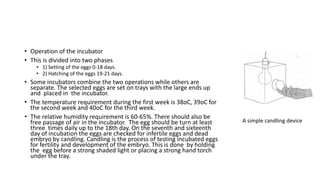
A simple candling device
• 3.4 Hatching
• The eggs are moved from the incubator to the hatching compartment
on the 18 day. The eggs are layed (Placed) flat in preparation for
hatching. The relative humidity should be higher (70%) in hatching
compartment.
• 3.4.1 Hatchability
• Hatchability refers to percentage of eggs that were hatched, it should
be about 80-90% from a good flock
• Hatch of fertile
• This refers to percentage of fertile eggs that were hatched.
• Hatch of total
• This refers to percentage of total eggs that were hatched.
• Example: supposing 500eggs were incubated, after 7 days. 450 were
found to be fertile. If 400 of the fertile eggs hatched into chicks.
Calculate hatch of fertile and hatch of total?
• Solution: Total eggs = 500
• Fertile eggs = 450
• Hatched eggs = 400
• %hatch of fertile = 400/450 x 100 = 88.89%
• % hatch total = 400/500 x 100 =80.0%
• Note:
1) Hatch of fertile is usually higher than hatch of total.
2) Hatch of fertile is more precise because fertility is
considered.
3) Hatch of fertile is of practical importance as it refers to
the performance of the breeder stock.
Factors affecting hatchability
• There are six factors affecting hatchability.
• 1) Fertility
• 2) Genetic
• 3) Nutrition
• 4) Diseases
• 5) Egg selection
• 6) Management practices
• Fertility
• Percentage fertility is the percentage of egg that
are fertile and should be about 90-95% for a good
flock.
• Fertility is affected by the following
a) Mating ratio: mating ratio of 10 : 1 is recommended.
If the ratio is higher the fertility of the egg will be lower.
b) Age of breeders: Fertility declines with age
c) Length of period between mating: A mated hen
stores sperm and uses it up to 2 weeks.
• Generally it requires 2 weeks after mating the flock
before satisfactory fertility is achieved. The
removal of the male from the flock is followed by
decline in fertility within 2 weeks and few if any
fertile eggs will be produced after 3 weeks.
• 3.4.4 Genetic factors
• Hatchability is an inherited trait so strains
(breeds) that possess high hatchability should
be selected.
i) In-breeding without selection for hatchability
has been shown to lower hatchability in poultry.
ii) Cross breeding usually result in increase
hatchability.
iii) Lethal or semi- Lethal genes may
affect either fertility, hatchability and livability
(life).
iv) Rate of egg production: Eggs layed by hen
producing at a high rate are more fertile than eggs
layed by low producers.
v) Age: Hatchability is maximum half way into
the second laying year for females.
While for male is one year after sexual maturity.
• Nutrition
• The egg must contain the entire nutrients
needed by the embryo for development.
Breeder hen must be fed ration which
supplies adequate quantities with the
nutrients needed for the embryo to develop.
• Disease
• Eggs for hatching should be collected from
healthy flocks. Disease causing organisms like
Salmonella and Mycoplasma are transmitted
from infected hen chiefly through the egg.
Breeding stocks should be tested regularly to
prevent infection.
• Egg selection
• Certain physical characteristics of eggs are related to hatchability among these are
size, weight (50-60g), shape, shell quality and internal quality.
• Management practices
• Eggs for hatching should be collected immediately and stored below 20oC to arrest
embryonic development. Fertile eggs deteriorate in quality after 4 days.
• Fertile eggs should be stored at a temperature around 10oC and humidity 80%. Eggs
should be stored with the broad end upward. Proper hygiene should be maintained
in the hatchery. Eggs should be collected at least 3 times daily. Soiled eggs should be
rejected or fumigated with formaline solution.
• 3.5 Sex Separation
• The early separation of the sex of young chicks is important economic factor. There are several ways of
sexing chicks.
• 1) By manual vent inspection at day old. At the center of the vent of a male chick is located a pin edge
size structure called the process. This can be easily seen with aid of the magnifying lens. A female vent
shows no such structure.
• 2) Sexing can also be done when the chicks are five to eight weeks old. Such a separation is based on
larger size combs and wattles, longer tail feathers, stouter shanks, with prominent scales and generally larger
body size in cockerels than in pullets.
• 3) Sex-linked colour differentiations: for example at day old, golden comet breed have dark gold
coloured pullets while the cockerels look white.
•
• 4.0 CONCLUSION
• The avian egg therefore, can be divided into three main parts as shell and shell membranes, albumen and
chalazae and the yolk. The egg can be incubated either naturally or artificially. Hatchability as well as
fertility is affected by genetic factors but again it is management which go above genetics in its effect.

5. INCUBATION AND HATCHERY PRACTICES.pptx

  • 1.
  • 2.
    INTRODUCTION • Incubation isthe management of fertilized eggs to ensure normal development of embryo into normal chick. Incubation can be achieved naturally (when the hen sits on the eggs for a period of time and keeps the eggs warm until hatching) or artificially by using machines known as incubators which provide the necessary heat until hatching. Some essential requirements of incubation include temperature, humidity, turning of the eggs, candling e.t.c.
  • 3.
    Reproductive System ofthe hen • The left ovary produces numerous ova. Mature ova are released into the infundibulum where fertilization takes place. The ovum then migrates down to magnum where it receives its albumen, then to the isthmus where the shell membranes, some albumen, water and mineral salts are added. The shell is formed in the uterus for 18- 21 hours. • From ovulation to laying takes 24- 26 hours.
  • 4.
    The avian egg• The avian egg is described as irregular ovoid and it is divided into three main parts • Shell and shell membrane 12% • Albumen and Chalazae 56% • Yolk - 32% • Composition of the egg Shell
  • 5.
    • Factors affectingEgg size • 1) Genetic factors • 2) Age of the birds • 3) Protein level of the diet • 4) Environmental factors • 5) Size of the birds • 6) Ovum size • 7) Intensity of egg laying
  • 6.
    Incubation • Incubation isthe process of aiding the development of a fertilized egg into a life chick by providing such factors as adequate temperature, humidity, ventilation and turning. There are two methods of incubation. 1) Natural incubation • That is getting the hen to sit on fertilize egg to incubate the egg. 2) Artificial incubation • Artificial incubation is carried out with incubator using fuels such as kerosene, gas, coal etc. Essential requirement of artificial incubation • 1) Adequate ventilation- there should be sufficient oxygen to supply the respiratory need of the embryo. Also carbon dioxide resulting from embryonic metabolism should not be allowed to accumulate. • 2) Relative humidity of 60-65% should be provided to prevent excessive water loss by the egg. • 3) Adequate temperature should be provided to ensure that life within the egg is maintained at the optimum level. The temperature of 37.5◦C is ideal. • 4) Turner: There should be a turner to prevent the embryo getting stucked shell. This should be done at least three times daily.
  • 7.
    • Operation ofthe incubator • This is divided into two phases • 1) Setting of the eggs 0-18 days. • 2) Hatching of the eggs 19-21 days. • Some incubators combine the two operations while others are separate. The selected eggs are set on trays with the large ends up and placed in the incubator. • The temperature requirement during the first week is 38oC, 39oC for the second week and 40oC for the third week. • The relative humidity requirement is 60-65%. There should also be free passage of air in the incubator. The egg should be turn at least three times daily up to the 18th day. On the seventh and sixteenth day of incubation the eggs are checked for infertile eggs and dead embryo by candling. Candling is the process of testing incubated eggs for fertility and development of the embryo. This is done by holding the egg before a strong shaded light or placing a strong hand torch under the tray. A simple candling device
  • 8.
    • 3.4 Hatching •The eggs are moved from the incubator to the hatching compartment on the 18 day. The eggs are layed (Placed) flat in preparation for hatching. The relative humidity should be higher (70%) in hatching compartment. • 3.4.1 Hatchability • Hatchability refers to percentage of eggs that were hatched, it should be about 80-90% from a good flock • Hatch of fertile • This refers to percentage of fertile eggs that were hatched. • Hatch of total • This refers to percentage of total eggs that were hatched. • Example: supposing 500eggs were incubated, after 7 days. 450 were found to be fertile. If 400 of the fertile eggs hatched into chicks. Calculate hatch of fertile and hatch of total? • Solution: Total eggs = 500 • Fertile eggs = 450 • Hatched eggs = 400 • %hatch of fertile = 400/450 x 100 = 88.89% • % hatch total = 400/500 x 100 =80.0% • Note: 1) Hatch of fertile is usually higher than hatch of total. 2) Hatch of fertile is more precise because fertility is considered. 3) Hatch of fertile is of practical importance as it refers to the performance of the breeder stock.
  • 9.
    Factors affecting hatchability •There are six factors affecting hatchability. • 1) Fertility • 2) Genetic • 3) Nutrition • 4) Diseases • 5) Egg selection • 6) Management practices • Fertility • Percentage fertility is the percentage of egg that are fertile and should be about 90-95% for a good flock. • Fertility is affected by the following a) Mating ratio: mating ratio of 10 : 1 is recommended. If the ratio is higher the fertility of the egg will be lower. b) Age of breeders: Fertility declines with age c) Length of period between mating: A mated hen stores sperm and uses it up to 2 weeks. • Generally it requires 2 weeks after mating the flock before satisfactory fertility is achieved. The removal of the male from the flock is followed by decline in fertility within 2 weeks and few if any fertile eggs will be produced after 3 weeks.
  • 10.
    • 3.4.4 Geneticfactors • Hatchability is an inherited trait so strains (breeds) that possess high hatchability should be selected. i) In-breeding without selection for hatchability has been shown to lower hatchability in poultry. ii) Cross breeding usually result in increase hatchability. iii) Lethal or semi- Lethal genes may affect either fertility, hatchability and livability (life). iv) Rate of egg production: Eggs layed by hen producing at a high rate are more fertile than eggs layed by low producers. v) Age: Hatchability is maximum half way into the second laying year for females. While for male is one year after sexual maturity. • Nutrition • The egg must contain the entire nutrients needed by the embryo for development. Breeder hen must be fed ration which supplies adequate quantities with the nutrients needed for the embryo to develop. • Disease • Eggs for hatching should be collected from healthy flocks. Disease causing organisms like Salmonella and Mycoplasma are transmitted from infected hen chiefly through the egg. Breeding stocks should be tested regularly to prevent infection.
  • 11.
    • Egg selection •Certain physical characteristics of eggs are related to hatchability among these are size, weight (50-60g), shape, shell quality and internal quality. • Management practices • Eggs for hatching should be collected immediately and stored below 20oC to arrest embryonic development. Fertile eggs deteriorate in quality after 4 days. • Fertile eggs should be stored at a temperature around 10oC and humidity 80%. Eggs should be stored with the broad end upward. Proper hygiene should be maintained in the hatchery. Eggs should be collected at least 3 times daily. Soiled eggs should be rejected or fumigated with formaline solution.
  • 12.
    • 3.5 SexSeparation • The early separation of the sex of young chicks is important economic factor. There are several ways of sexing chicks. • 1) By manual vent inspection at day old. At the center of the vent of a male chick is located a pin edge size structure called the process. This can be easily seen with aid of the magnifying lens. A female vent shows no such structure. • 2) Sexing can also be done when the chicks are five to eight weeks old. Such a separation is based on larger size combs and wattles, longer tail feathers, stouter shanks, with prominent scales and generally larger body size in cockerels than in pullets. • 3) Sex-linked colour differentiations: for example at day old, golden comet breed have dark gold coloured pullets while the cockerels look white. • • 4.0 CONCLUSION • The avian egg therefore, can be divided into three main parts as shell and shell membranes, albumen and chalazae and the yolk. The egg can be incubated either naturally or artificially. Hatchability as well as fertility is affected by genetic factors but again it is management which go above genetics in its effect.