HATCHING
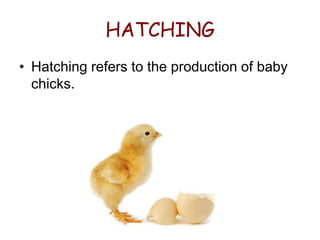
• Hatching refers to the production of baby
  chicks.
INTRO
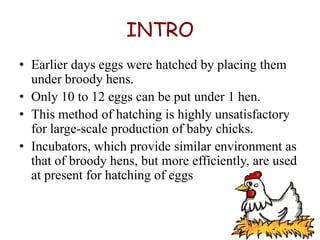
• Earlier days eggs were hatched by placing them
  under broody hens.
• Only 10 to 12 eggs can be put under 1 hen.
• This method of hatching is highly unsatisfactory
  for large-scale production of baby chicks.
• Incubators, which provide similar environment as
  that of broody hens, but more efficiently, are used
  at present for hatching of eggs
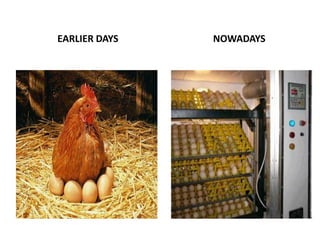
EARLIER DAYS   NOWADAYS
INCUBATORS
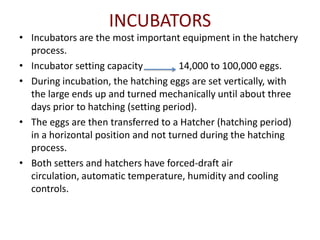
• Incubators are the most important equipment in the hatchery
  process.
• Incubator setting capacity          14,000 to 100,000 eggs.
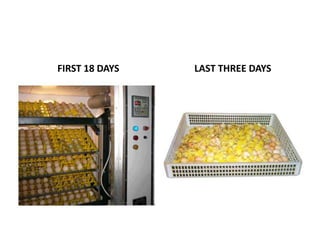
• During incubation, the hatching eggs are set vertically, with
  the large ends up and turned mechanically until about three
  days prior to hatching (setting period).
• The eggs are then transferred to a Hatcher (hatching period)
  in a horizontal position and not turned during the hatching
  process.
• Both setters and hatchers have forced-draft air
  circulation, automatic temperature, humidity and cooling
  controls.
FIRST 18 DAYS   LAST THREE DAYS
TEMPERATURE
• The normal development of the embryo is
  dependent on the heat being held within a
  very narrow range in the incubator.
• 37.2 TO 37.8 degree Centigrade.
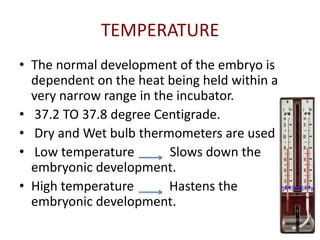
• Dry and Wet bulb thermometers are used.
• Low temperature         Slows down the
  embryonic development.
• High temperature       Hastens the
  embryonic development.
HUMIDITY
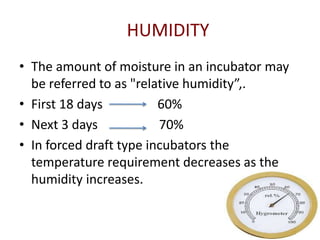
• The amount of moisture in an incubator may
  be referred to as "relative humidity”,.
• First 18 days          60%
• Next 3 days            70%
• In forced draft type incubators the
  temperature requirement decreases as the
  humidity increases.
VENTILATION
• The free movement of oxygen, carbon dioxide
  and water vapor through the pores of the
  shell is important, since the developing
  embryo must be able to take in a constant
  supply of oxygen and release carbon dioxide
  and moisture.
• Oxygen content             21%
• Carbon-di-oxide            not >0.5%
TURNING OF EGGS
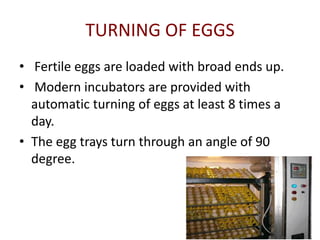
• Fertile eggs are loaded with broad ends up.
• Modern incubators are provided with
  automatic turning of eggs at least 8 times a
  day.
• The egg trays turn through an angle of 90
  degree.
OTHER FACTORS
EGG SELECTION
• Poor quality hatching eggs do not hatch as
  well as eggs of good quality.
• The term "quality" refers to the condition
  outside the shell, the condition of the shell
  itself and that of the contents.
• Eggs with inferior characteristics, as discussed
  in "Selection and Care of Hatching Eggs,"
  should not be set.
SANITATION
• Eggs used for hatching should be clean and
  stored in clean containers in a sanitary egg
  holding room.
• Eggs contaminated with bacterial organisms
  usually do not hatch well and this poor quality
  is reflected in the chicks that do hatch.
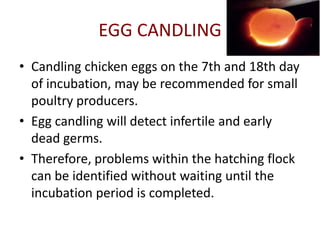
EGG CANDLING
• Candling chicken eggs on the 7th and 18th day
  of incubation, may be recommended for small
  poultry producers.
• Egg candling will detect infertile and early
  dead germs.
• Therefore, problems within the hatching flock
  can be identified without waiting until the
  incubation period is completed.
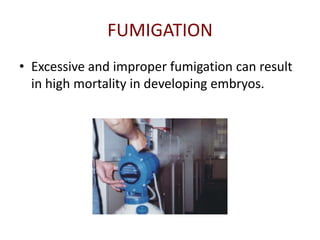
FUMIGATION
• Excessive and improper fumigation can result
  in high mortality in developing embryos.
INCUBATION PERIOD FOR AVIAN
          SPECIES
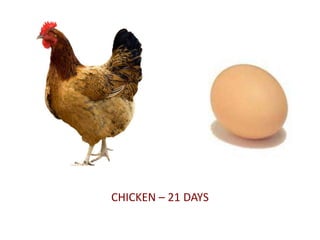
CHICKEN – 21 DAYS
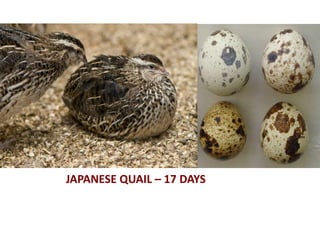
JAPANESE QUAIL – 17 DAYS
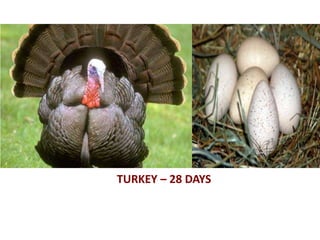
TURKEY – 28 DAYS
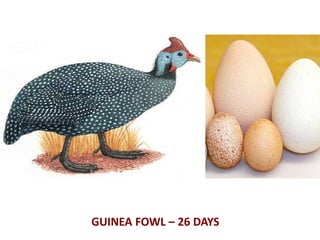
GUINEA FOWL – 26 DAYS
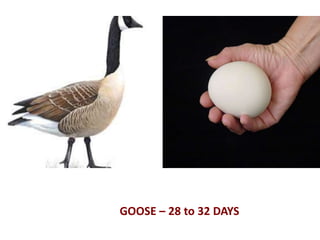
GOOSE – 28 to 32 DAYS
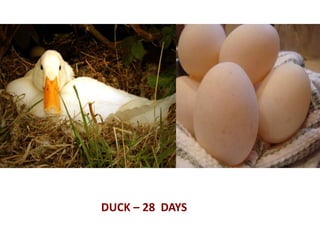
DUCK – 28 DAYS
THANK YOU

Factors affecting hatchability - Dairy

  • 2.
    HATCHING • Hatching refersto the production of baby chicks.
  • 3.
    INTRO • Earlier dayseggs were hatched by placing them under broody hens. • Only 10 to 12 eggs can be put under 1 hen. • This method of hatching is highly unsatisfactory for large-scale production of baby chicks. • Incubators, which provide similar environment as that of broody hens, but more efficiently, are used at present for hatching of eggs
  • 4.
    EARLIER DAYS NOWADAYS
  • 5.
    INCUBATORS • Incubators arethe most important equipment in the hatchery process. • Incubator setting capacity 14,000 to 100,000 eggs. • During incubation, the hatching eggs are set vertically, with the large ends up and turned mechanically until about three days prior to hatching (setting period). • The eggs are then transferred to a Hatcher (hatching period) in a horizontal position and not turned during the hatching process. • Both setters and hatchers have forced-draft air circulation, automatic temperature, humidity and cooling controls.
  • 6.
    FIRST 18 DAYS LAST THREE DAYS
  • 7.
    TEMPERATURE • The normaldevelopment of the embryo is dependent on the heat being held within a very narrow range in the incubator. • 37.2 TO 37.8 degree Centigrade. • Dry and Wet bulb thermometers are used. • Low temperature Slows down the embryonic development. • High temperature Hastens the embryonic development.
  • 8.
    HUMIDITY • The amountof moisture in an incubator may be referred to as "relative humidity”,. • First 18 days 60% • Next 3 days 70% • In forced draft type incubators the temperature requirement decreases as the humidity increases.
  • 9.
    VENTILATION • The freemovement of oxygen, carbon dioxide and water vapor through the pores of the shell is important, since the developing embryo must be able to take in a constant supply of oxygen and release carbon dioxide and moisture. • Oxygen content 21% • Carbon-di-oxide not >0.5%
  • 10.
    TURNING OF EGGS •Fertile eggs are loaded with broad ends up. • Modern incubators are provided with automatic turning of eggs at least 8 times a day. • The egg trays turn through an angle of 90 degree.
  • 11.
  • 12.
    EGG SELECTION • Poorquality hatching eggs do not hatch as well as eggs of good quality. • The term "quality" refers to the condition outside the shell, the condition of the shell itself and that of the contents. • Eggs with inferior characteristics, as discussed in "Selection and Care of Hatching Eggs," should not be set.
  • 13.
    SANITATION • Eggs usedfor hatching should be clean and stored in clean containers in a sanitary egg holding room. • Eggs contaminated with bacterial organisms usually do not hatch well and this poor quality is reflected in the chicks that do hatch.
  • 14.
    EGG CANDLING • Candlingchicken eggs on the 7th and 18th day of incubation, may be recommended for small poultry producers. • Egg candling will detect infertile and early dead germs. • Therefore, problems within the hatching flock can be identified without waiting until the incubation period is completed.
  • 15.
    FUMIGATION • Excessive andimproper fumigation can result in high mortality in developing embryos.
  • 16.
    INCUBATION PERIOD FORAVIAN SPECIES
  • 17.
  • 18.
  • 19.
  • 20.
  • 21.
    GOOSE – 28to 32 DAYS
  • 22.
  • 23.