

An autoclave is a device
used to sterilize equipment
and supplies by subjecting
them to high pressure
saturated steam at 121 °C
for around 15–20 minutes
depending on the size of the
load and the contents. It was
invented by Charles
Chamberland in 1879,
although a precursor known
as the steam digester was
created by Denis Papin in
1679.
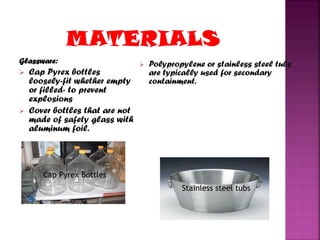
Glassware:




Cap Pyrex bottles
loosely-fit whether empty
or filled- to prevent
explosions
Cover bottles that are not
made of safety glass with
aluminum foil.



Polypropylene or stainless steel tubs
are typically used for secondary
containment.

Cap Pyrex Bottles

Stainless steel tubs
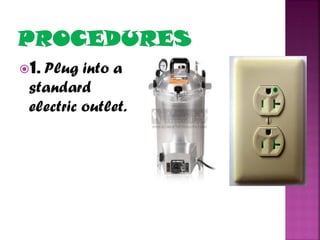
1. Plug

into a
standard
electric outlet.
2. Pour

water
(distilled water is
best) to the
chamber to flow
over its gap on the
bottom plate.
3.Turn

exhaust
knob on the
handle
clockwise
tightly and
close DOOR.
Cover it tightly.
4. Set

timer at 35
minutes
position and
make sure
STERILIZE
light is on.
(sterilization
will start)
5. Upon

completion of
sterilization power will be off
automatically.
 6. Release

EXHAUST
KNOB on the handle
by turning 4-5
revolution until
PRESSURE GAUGE, is
zero returned. Then you
can open DOOR COVER.
(after PRESSURE
GAUGE) is zero
returned, wait 5-10
minutes before opening.
(DOOR COVER for
better sterilization).
Caution
1. Do not open DOOR
COVER if PRESSURE
GAUGE is not yet zero
returned.
2. Do not release EXHAUST
KNOB on the handle
during sterilization. Place
Autoclave on a flat
position .
3. Use distilled water as the
sterilization water. (Do
not use any chemical
medication)

Disadvantages
1. It requires more
electricity and more
time to prepare and
finish.


Wear personal protection
equipment:
Lab coat
 Eye protection
 Closed-toe shoes
 Heat-resistant gloves to remove
items, especially hot glassware







Wait for the pressure gauge
to drop to zero with zero
time remaining before
opening the door.





Never open an autoclave set for
"slow exhaust" until the cycle is
complete. Superheated liquids
can boil over and damage the
autoclave and the operator.
Open the door cautiously. Stand
behind the door and slowly open
it. Allow all steam to escape
before reaching inside.
Let liquids stand another 10–20
minutes after the autoclave is
opened to avoid any movement
that could cause them to boil.
Remove items carefully.
Autoclave

Autoclave

  • 2.
     An autoclave isa device used to sterilize equipment and supplies by subjecting them to high pressure saturated steam at 121 °C for around 15–20 minutes depending on the size of the load and the contents. It was invented by Charles Chamberland in 1879, although a precursor known as the steam digester was created by Denis Papin in 1679.
  • 3.
    Glassware:   Cap Pyrex bottles loosely-fitwhether empty or filled- to prevent explosions Cover bottles that are not made of safety glass with aluminum foil.  Polypropylene or stainless steel tubs are typically used for secondary containment. Cap Pyrex Bottles Stainless steel tubs
  • 4.
  • 5.
    2. Pour water (distilled wateris best) to the chamber to flow over its gap on the bottom plate.
  • 6.
  • 7.
    4. Set timer at35 minutes position and make sure STERILIZE light is on. (sterilization will start)
  • 8.
    5. Upon completion of sterilizationpower will be off automatically.
  • 9.
     6. Release EXHAUST KNOBon the handle by turning 4-5 revolution until PRESSURE GAUGE, is zero returned. Then you can open DOOR COVER. (after PRESSURE GAUGE) is zero returned, wait 5-10 minutes before opening. (DOOR COVER for better sterilization).
  • 10.
    Caution 1. Do notopen DOOR COVER if PRESSURE GAUGE is not yet zero returned. 2. Do not release EXHAUST KNOB on the handle during sterilization. Place Autoclave on a flat position . 3. Use distilled water as the sterilization water. (Do not use any chemical medication) Disadvantages 1. It requires more electricity and more time to prepare and finish.
  • 11.
     Wear personal protection equipment: Labcoat  Eye protection  Closed-toe shoes  Heat-resistant gloves to remove items, especially hot glassware    Wait for the pressure gauge to drop to zero with zero time remaining before opening the door.   Never open an autoclave set for "slow exhaust" until the cycle is complete. Superheated liquids can boil over and damage the autoclave and the operator. Open the door cautiously. Stand behind the door and slowly open it. Allow all steam to escape before reaching inside. Let liquids stand another 10–20 minutes after the autoclave is opened to avoid any movement that could cause them to boil. Remove items carefully.