By the end of the session you will
be able to identify, understand
and implement principles of
effective teamwork.
Ice Breaker
Defining Teamwork
Principles of Effective Teamwork Activity
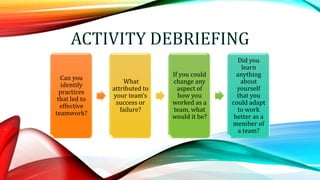
Activity Debriefing
Summary of the Principles of Effective Teamwork
Questions and Comments
Evaluation
The image below shows the number 9 in Roman numerals.
Drawing a single continuous line, turn the 9 into a 6.
IX
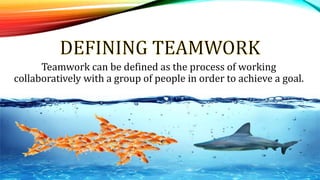
Teamwork can be defined as the process of working
collaboratively with a group of people in order to achieve a goal.
.
1. Using the
kit provided,
build the
tallest
freestanding
structure that
you can.
2. Use as much
or as little of
the kit as you
decide.
3. Teams are
free to break
the spaghetti
and cut up the
tape and string
as needed.
4. You will be
given 15
minutes:
Teams cannot
hold on to the
structure
when the time
runs out.
Can you
identify
practices
that led to
effective
teamwork?
What
attributed to
your team’s
success or
failure?
If you could
change any
aspect of
how you
worked as a
team, what
would it be?
Did you
learn
anything
about
yourself
that you
could adapt
to work
better as a
member of
a team?
Understanding
your role and your
co-workers’ roles
Clear mutual
objectives
Effective
communication
Effective group
processes
Appropriate
leadership
Support and trust
Openness and
conflict
management
Individual
development
Positive
interdependence
Individual
accountability
Regular review
• Hodder Education
• Know how nonprofit.org
• Mindtools.com
• Amanet.org
• Tom Wujec.com
• Leadershipchallenge.com

Effective Team Work

  • 3.
    By the endof the session you will be able to identify, understand and implement principles of effective teamwork.
  • 4.
    Ice Breaker Defining Teamwork Principlesof Effective Teamwork Activity Activity Debriefing Summary of the Principles of Effective Teamwork Questions and Comments Evaluation
  • 5.
    The image belowshows the number 9 in Roman numerals. Drawing a single continuous line, turn the 9 into a 6. IX
  • 6.
    Teamwork can bedefined as the process of working collaboratively with a group of people in order to achieve a goal. .
  • 8.
    1. Using the kitprovided, build the tallest freestanding structure that you can. 2. Use as much or as little of the kit as you decide. 3. Teams are free to break the spaghetti and cut up the tape and string as needed. 4. You will be given 15 minutes: Teams cannot hold on to the structure when the time runs out.
  • 9.
    Can you identify practices that ledto effective teamwork? What attributed to your team’s success or failure? If you could change any aspect of how you worked as a team, what would it be? Did you learn anything about yourself that you could adapt to work better as a member of a team?
  • 10.
    Understanding your role andyour co-workers’ roles Clear mutual objectives Effective communication Effective group processes Appropriate leadership Support and trust Openness and conflict management Individual development Positive interdependence Individual accountability Regular review
  • 14.
    • Hodder Education •Know how nonprofit.org • Mindtools.com • Amanet.org • Tom Wujec.com • Leadershipchallenge.com

Editor's Notes

  • #3 Welcome all the session. I trust that I will have your full attention and participation in the session.
  • #5 Explain the booklet at they have been given. Go through the agenda.
  • #6 There are 3 ways
  • #7 To build context.
  • #9 Explain instructions
  • #10 Use flip chart list to get response
  • #11 Adding some that I had. Understanding your role and co-workers’ roles Team members have a clear understanding of each individual’s role in achieving overall team objectives. There is a good balance of skills, abilities and aspirations. Clear mutual objectives There are mutually-agreed aims and objectives, and everyone has a clear understanding of these. Effective communication Meetings are productive and there is effective communication up, down and across the organisation. Effective processes There are good processes for making, communicating, implementing and reviewing decisions. There are effective information systems and co-ordination of resources. . Appropriate leadership The team trusts the team leader and feels that it is led in an appropriate way. Support and trust People help each other by listening, evaluating, offering ideas, encouraging experimentation and giving support. Openness and conflict management People express themselves openly and honestly. There is a willingness to work through difficult situations or conflict constructively. Individual development ‘Mistakes’ are faced openly and used as a vehicle for learning. Individuals are given opportunities to develop new skills and experience. Positive Interdependence: We instead of me There is a readiness to be involved and committed. Individuals’ abilities, knowledge and experience are pooled and used by the team. There is acceptance of each others’ strengths and weaknesses. Individual Accountability/ Personal Responsibility Each team member must be accountable for their role in the team, there must be an individual commitment to meeting your deadline, doing your fair share of tasks and taking responsibility if you fail to do so. Regular review The team regularly reviews its performance and goals and alters its priorities and practice in the light of review.