DR. MUKESH KUMAR KRISHANANI
PROGRAM REGISTRAR
SPFM-EP, MOH
Effective Reading and Note
Taking Skills
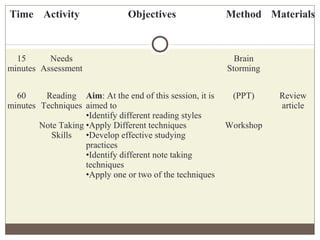
Time Activity Objectives Method Materials
15
minutes
Needs
Assessment
Brain
Storming
60
minutes
Reading
Techniques
Note Taking
Skills
Aim: At the end of this session, it is
aimed to
•Identify different reading styles
•Apply Different techniques
•Develop effective studying
practices
•Identify different note taking
techniques
•Apply one or two of the techniques
(PPT)
Workshop
Review
article
Why do you think we should have effective
reading skills?
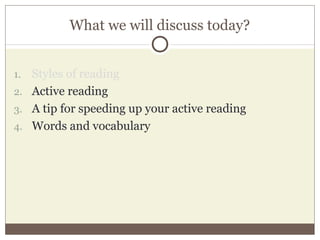
What we will discuss today?
1. Styles of reading
2. Active reading
3. A tip for speeding up your active reading
4. Key words and vocabulary
Reading Styles
Scanning: for a specific focus
Skim Through
Detailed reading for specific information
Reading Styles……………… Cont
Scanning
 Title of article
 Authors contribution
 The introduction or preface of a article
 The first or last paragraphs of articles
 The conclusion of article
Reading Styles……………… Cont
Skimming
 you read quickly to get the main points, and skip over the
detail
 Go through Sub headings
 to refresh your understand of a passage after you've read it
in detail
Reading Styles……………… Cont
Detailed reading to extract information
 You read every word from the text.
• Practical Tips
 Skim first and get a general idea
 Go back to read in detail
 Use a dictionary to make sure you understand all the words used
What we will discuss today?
1. Styles of reading
2. Active reading
3. A tip for speeding up your active reading
4. Words and vocabulary
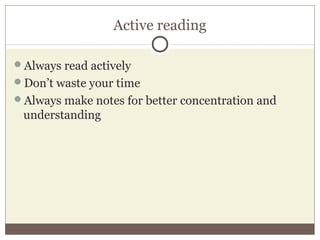
Active reading
Always read actively
Don’t waste your time
Always make notes for better concentration and
understanding
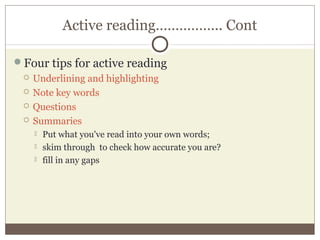
Active reading…………….. Cont
Four tips for active reading
 Underlining and highlighting
 Note key words
 Questions
 Summaries
 Put what you've read into your own words;
 skim through to check how accurate you are?
 fill in any gaps
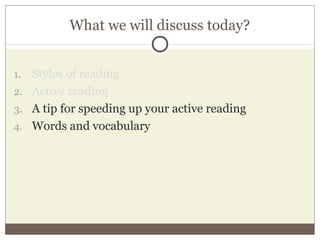
What we will discuss today?
1. Styles of reading
2. Active reading
3. A tip for speeding up your active reading
4. Words and vocabulary
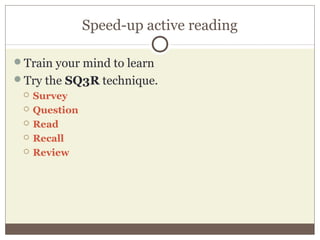
Speed-up active reading
Train your mind to learn
Try the SQ3R technique.
 Survey
 Question
 Read
 Recall
 Review
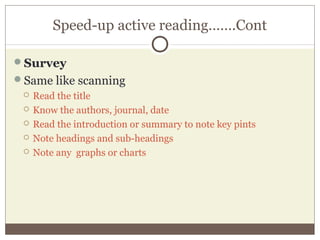
Speed-up active reading…….Cont
Survey
Same like scanning
 Read the title
 Know the authors, journal, date
 Read the introduction or summary to note key pints
 Note headings and sub-headings
 Note any graphs or charts
Speed-up active reading…….Cont
Question
 Engage your mind to learn by making questions
 Try turning the headings into questions:
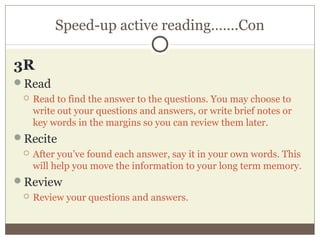
Speed-up active reading…….Con
3R
Read
 Read to find the answer to the questions. You may choose to
write out your questions and answers, or write brief notes or
key words in the margins so you can review them later.
Recite
 After you’ve found each answer, say it in your own words. This
will help you move the information to your long term memory.
Review
 Review your questions and answers.
(Gilstrap and Martin, 1975)
 "A lecture is a process in which information
passes from the notes of the lecturer into
the notes of the student without passing
through the minds of either."
Note Taking
How do you Take note during class activity?
Note Taking………………. Techniques
Different techniques
a) Mind Mapping
b) Cornell style
c) Informal paragraphs
d) Outlining
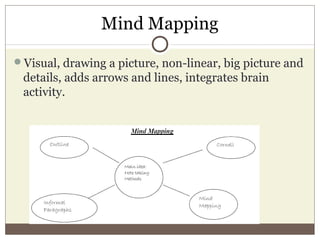
Mind Mapping
Visual, drawing a picture, non-linear, big picture and
details, adds arrows and lines, integrates brain
activity.
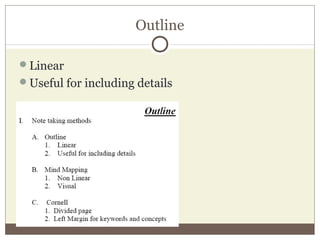
Outline
Linear
Useful for including details
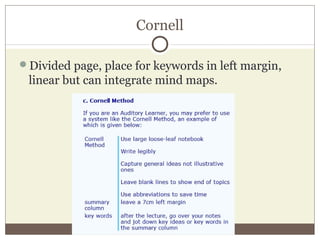
Cornell
Divided page, place for keywords in left margin,
linear but can integrate mind maps.
Workshop
You all are requested to take this article and spend
20 minutes by using SQ3R technique

Effective reading skills

  • 1.
    DR. MUKESH KUMARKRISHANANI PROGRAM REGISTRAR SPFM-EP, MOH Effective Reading and Note Taking Skills
  • 2.
    Time Activity ObjectivesMethod Materials 15 minutes Needs Assessment Brain Storming 60 minutes Reading Techniques Note Taking Skills Aim: At the end of this session, it is aimed to •Identify different reading styles •Apply Different techniques •Develop effective studying practices •Identify different note taking techniques •Apply one or two of the techniques (PPT) Workshop Review article
  • 3.
    Why do youthink we should have effective reading skills?
  • 4.
    What we willdiscuss today? 1. Styles of reading 2. Active reading 3. A tip for speeding up your active reading 4. Key words and vocabulary
  • 5.
    Reading Styles Scanning: fora specific focus Skim Through Detailed reading for specific information
  • 6.
    Reading Styles……………… Cont Scanning Title of article  Authors contribution  The introduction or preface of a article  The first or last paragraphs of articles  The conclusion of article
  • 7.
    Reading Styles……………… Cont Skimming you read quickly to get the main points, and skip over the detail  Go through Sub headings  to refresh your understand of a passage after you've read it in detail
  • 8.
    Reading Styles……………… Cont Detailedreading to extract information  You read every word from the text. • Practical Tips  Skim first and get a general idea  Go back to read in detail  Use a dictionary to make sure you understand all the words used
  • 9.
    What we willdiscuss today? 1. Styles of reading 2. Active reading 3. A tip for speeding up your active reading 4. Words and vocabulary
  • 10.
    Active reading Always readactively Don’t waste your time Always make notes for better concentration and understanding
  • 11.
    Active reading…………….. Cont Fourtips for active reading  Underlining and highlighting  Note key words  Questions  Summaries  Put what you've read into your own words;  skim through to check how accurate you are?  fill in any gaps
  • 12.
    What we willdiscuss today? 1. Styles of reading 2. Active reading 3. A tip for speeding up your active reading 4. Words and vocabulary
  • 13.
    Speed-up active reading Trainyour mind to learn Try the SQ3R technique.  Survey  Question  Read  Recall  Review
  • 14.
    Speed-up active reading…….Cont Survey Samelike scanning  Read the title  Know the authors, journal, date  Read the introduction or summary to note key pints  Note headings and sub-headings  Note any graphs or charts
  • 15.
    Speed-up active reading…….Cont Question Engage your mind to learn by making questions  Try turning the headings into questions:
  • 16.
    Speed-up active reading…….Con 3R Read Read to find the answer to the questions. You may choose to write out your questions and answers, or write brief notes or key words in the margins so you can review them later. Recite  After you’ve found each answer, say it in your own words. This will help you move the information to your long term memory. Review  Review your questions and answers.
  • 17.
    (Gilstrap and Martin,1975)  "A lecture is a process in which information passes from the notes of the lecturer into the notes of the student without passing through the minds of either."
  • 18.
    Note Taking How doyou Take note during class activity?
  • 19.
    Note Taking………………. Techniques Differenttechniques a) Mind Mapping b) Cornell style c) Informal paragraphs d) Outlining
  • 20.
    Mind Mapping Visual, drawinga picture, non-linear, big picture and details, adds arrows and lines, integrates brain activity.
  • 21.
  • 22.
    Cornell Divided page, placefor keywords in left margin, linear but can integrate mind maps.
  • 23.
    Workshop You all arerequested to take this article and spend 20 minutes by using SQ3R technique

Editor's Notes

  • #4 You are expected to read a lot throughout your training or even after your training as we all have eternal student syndrome; Here are five tips to help you improve your reading: Styles of reading Active reading A tip for speeding up your active reading Words and vocabulary
  • #8 The technique you use when you're going through a newspaper or magazine: you read quickly to get the main points, and skip over the detail. It's useful to skim: to preview a passage before you read it in detail to refresh your understand of a passage after you've read it in detail. Use skimming when you're trying to decide if a book in the library or bookshop is right for you
  • #9 The technique you use when you're going through a newspaper or magazine: you read quickly to get the main points, and skip over the detail. It's useful to skim: to preview a passage before you read it in detail to refresh your understand of a passage after you've read it in detail. Use skimming when you're trying to decide if a book in the library or bookshop is right for you
  • #24 15 minutes for