STUDY SKILLS Made easy
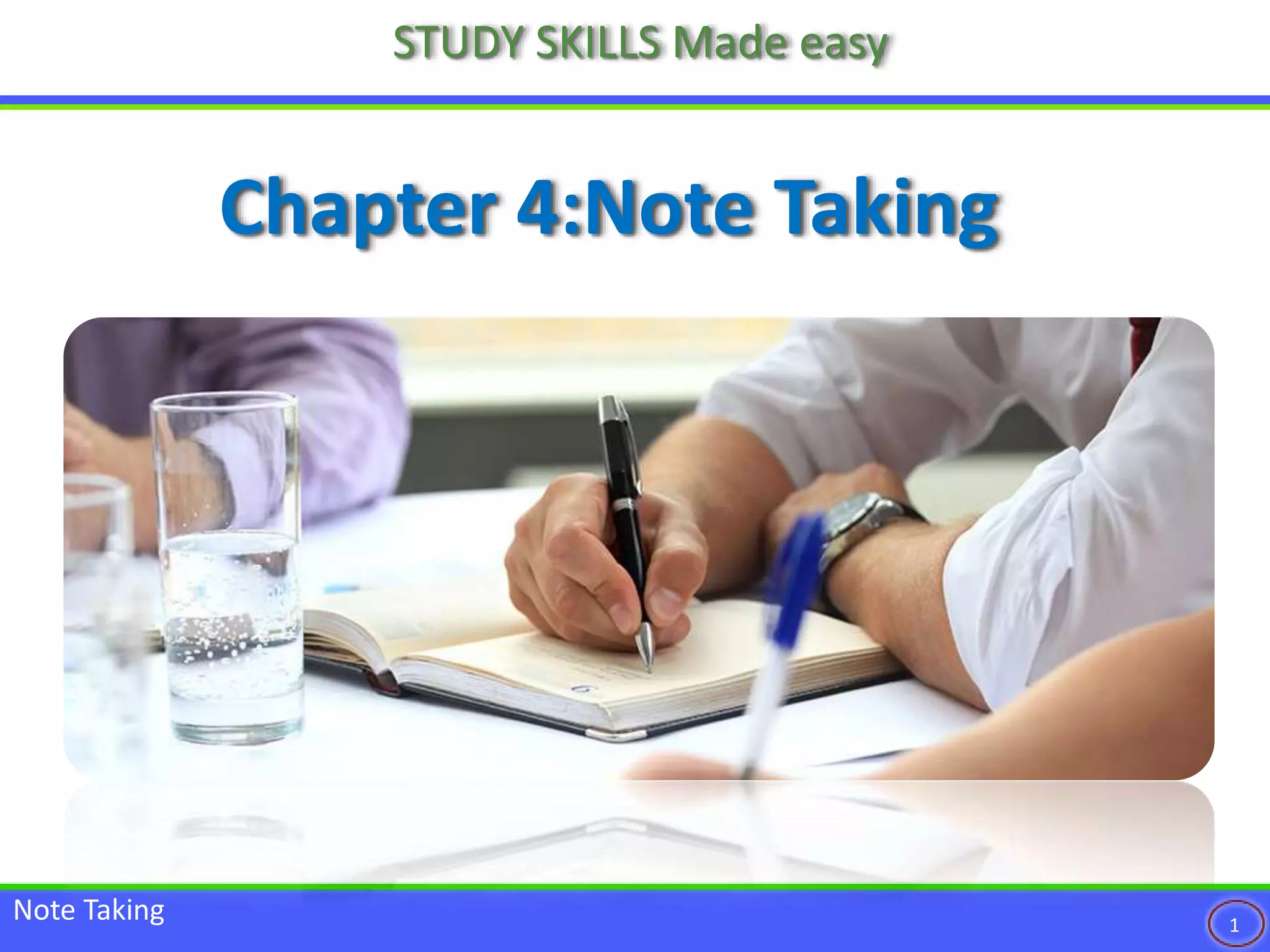
Chapter 4:Note Taking
1
Note Taking
Chapter outline
4.1 The Importance of NoteTaking
4.2 Listening Attentively
4.3 Effective NoteTaking Strategies
2
Learning Styles
Chapter outline
2
Learning Styles
Information presented in class often contains the central concepts of
the course and the material most likely to be included on exams. Yet,
students frequently do not realize the importance of note taking and
listening.
The following resources provide tips on how to recall more
information from your lectures through active listening and
purposeful note taking. In addition, lecture notes can be a critical tool
for preparing for exams.
Introduction
Effective note taking should have a purpose, should be well
organized, and can be a time saving skill. This information sheet
outlines the basic lecture and written source note taking skills.
Firstly, we will try to understand
why notes are an important part of studying.
How to take, organize and store notes.
Introduction
When you’ve finished this study skills package, you should be able
to:
Evaluate which information is useful and important and
which is not
Understand how to effectively store and review your notes
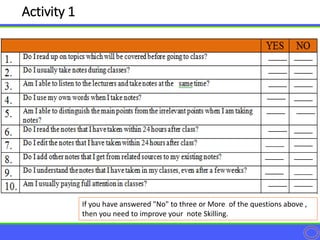
First, let‘s find out whether you have good note taking skills.
Read the following questions and Put a tick ( ) in the appropriate
column.
Activity 1
If you have answered "No" to three or More of the questions above ,
then you need to improve your note Skilling.
Activity 1
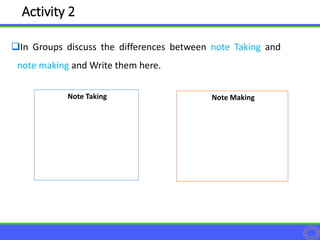
In Groups discuss the differences between note Taking and
note making and Write them here.
Note Taking Note Making
Activity 2
Based on your answer it can be seen that while there are some
differences between note taking and note making, they Actually
complement each other.
After you have taken some notes from your classes you make extra
notes through your reading of other literature to supplement your
existing notes so that your notes are comprehensive.
4.1 The Importance of Note Taking
Taking notes for each of your classes is important as it encourages
you to pay attention to your lecturers.
It helps you to concentrate, and will be able to understand the
lessons better as it will stimulate you to think about what the lecturer
have taught and to distinguish between the main and the supporting
points.
Why take notes (1)
In addition, most students often complain that their classes are
boring and that they feel tired and Sleepy listening to their lecturers
in class. Instead of wasting their time daydreaming or having an idle
conversation with their friends, they should take down some notes as
it would force them to be attentive and alert. While taking notes,
they are actually doing something.
Most importantly, the notes will be very useful to them later in
the semester as they will have something concrete to refer to
while revising for their final examinations.
Why take notes (2)
Those who do not take any notes will face much difficulty later as
they will have nothing to read before the examinations.
Hence instead of complaining and blaming the lecturers for being
boring, students should actively take notes to improve their learning
experience.
Why take notes (3)
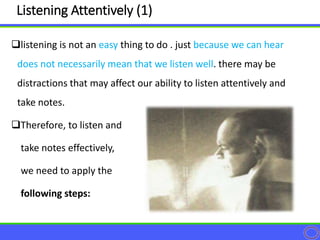
listening is not an easy thing to do . just because we can hear
does not necessarily mean that we listen well. there may be
distractions that may affect our ability to listen attentively and
take notes.
Therefore, to listen and
take notes effectively,
we need to apply the
following steps:
Listening Attentively (1)
1. Sit close to the front of the room
Listening Attentively (2)
Avoid sitting with your friends who are distracting. These friends
may tempt you with idle conversation. Thus, instead of listening
attentively to your lecturers and taking notes, you may end up
laughing away with your group of friends.
At the end of the class, you would have done nothing but
disturb your lecturers and others who are there to learn.
Is this your main objective of attending class?
2. Avoid distracting friends
Listening Attentively (3)
Pay attention to your lecturer’s style of delivery as they may
indicate important information by using some verbal signals such
as:
Pausing
Repeating the same point
Slowing down their rate of speaking
Increasing their volume of speech
Using certain words or phrases, e.g most importantly,; there are
three vital factors, etc.
3. Pay close attention to verbal signals
Listening Attentively (4)
Most students keep quiet in class, with their hands busy taking
notes whether they understand what they are writing or not.
If this is you. Take a moment to ask yourself, “Do I understand what I
have written so far?” if you are unsure of something, find an
appropriate time to stop your lecturers and ask them for further
clarifications.
Otherwise, mark that a particular point and do your own
background reading at home or ask the lecturers after classes. If you
do not ask, you will never know.
4. Ask, ask, and ask
Listening Attentively (5)
As a form of courtesy to your lecturers, it is advisable to inform
them about your use of a tape recorder in their classes.
5. Use a tape recorder for your classes
Listening Attentively (6)
There is no one best way to take notes. you need to try a few
ways and stick to those that work best for you.
listed below are a few useful strategies that will help you to take
notes effectively.
Effective note taking strategies (1)
1. Read and prepare advance
Effective note taking strategies (2)
2. Become an active listener
listen attentively to your lecturers and summarize the
information presented by writing in your own words.
keep your notes short and simple.
Always remember that you can always fill in the necessary
information from your own reading or research later.
Effective note taking strategies (3)
3. Write Down important points only
leave out examples and unnecessary details as you may not have
sufficient time to take everything down.
you must learn to be selective.
Effective note taking strategies (4)
4. Use headings and Subheadings to organize your ideas
Effective note taking strategies (5)
5. Use Symbols and Abbreviations to take notes Quickly
Do not use too many symbols and abbreviations as you will be
confused when you review your notes. ensure that one symbol or
one abbreviation stands for one word.
•& And
•> more than
•< Less than
•= Equal to
•W with
•W/o Without
Effective note taking strategies (6)
6. Number the pages
• Number each page of your notes. Alternatively, you may also put
the dates on your notes so that they can be systematically
arranged.
Effective note taking strategies (7)
7. Take notes on one side of the paper only
Write on one side of the paper. The other side can be used for
additional notes when you review your notes or do more
background reading.
Effective note taking strategies (8)
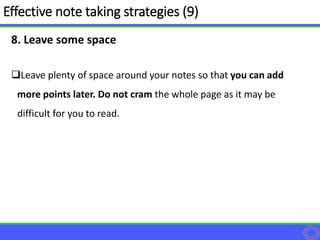
8. Leave some space
Leave plenty of space around your notes so that you can add
more points later. Do not cram the whole page as it may be
difficult for you to read.
Effective note taking strategies (9)
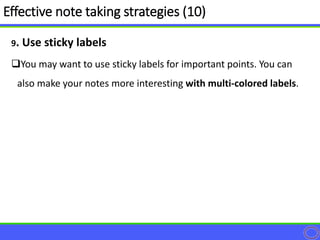
9. Use sticky labels
You may want to use sticky labels for important points. You can
also make your notes more interesting with multi-colored labels.
Effective note taking strategies (10)
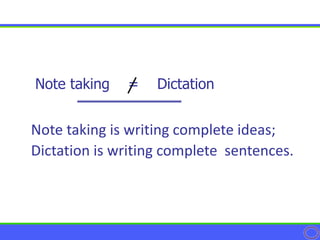
Note taking = Dictation
Note taking is writing complete ideas;
Dictation is writing complete sentences.
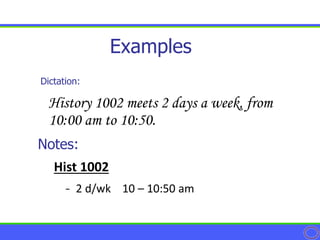
Dictation:
Examples
History 1002 meets 2 days a week, from
10:00 am to 10:50.
Hist 1002
- 2 d/wk 10 – 10:50 am
Notes:
32
Chapter 4: Taking Notes

Chapter 4 Note Taking.ppt

  • 1.
    STUDY SKILLS Madeeasy Chapter 4:Note Taking 1 Note Taking
  • 2.
    Chapter outline 4.1 TheImportance of NoteTaking 4.2 Listening Attentively 4.3 Effective NoteTaking Strategies 2 Learning Styles
  • 3.
  • 4.
    Information presented inclass often contains the central concepts of the course and the material most likely to be included on exams. Yet, students frequently do not realize the importance of note taking and listening. The following resources provide tips on how to recall more information from your lectures through active listening and purposeful note taking. In addition, lecture notes can be a critical tool for preparing for exams. Introduction
  • 5.
    Effective note takingshould have a purpose, should be well organized, and can be a time saving skill. This information sheet outlines the basic lecture and written source note taking skills. Firstly, we will try to understand why notes are an important part of studying. How to take, organize and store notes. Introduction
  • 6.
    When you’ve finishedthis study skills package, you should be able to: Evaluate which information is useful and important and which is not Understand how to effectively store and review your notes
  • 7.
    First, let‘s findout whether you have good note taking skills. Read the following questions and Put a tick ( ) in the appropriate column. Activity 1
  • 8.
    If you haveanswered "No" to three or More of the questions above , then you need to improve your note Skilling. Activity 1
  • 9.
    In Groups discussthe differences between note Taking and note making and Write them here. Note Taking Note Making Activity 2
  • 10.
    Based on youranswer it can be seen that while there are some differences between note taking and note making, they Actually complement each other. After you have taken some notes from your classes you make extra notes through your reading of other literature to supplement your existing notes so that your notes are comprehensive. 4.1 The Importance of Note Taking
  • 11.
    Taking notes foreach of your classes is important as it encourages you to pay attention to your lecturers. It helps you to concentrate, and will be able to understand the lessons better as it will stimulate you to think about what the lecturer have taught and to distinguish between the main and the supporting points. Why take notes (1)
  • 12.
    In addition, moststudents often complain that their classes are boring and that they feel tired and Sleepy listening to their lecturers in class. Instead of wasting their time daydreaming or having an idle conversation with their friends, they should take down some notes as it would force them to be attentive and alert. While taking notes, they are actually doing something. Most importantly, the notes will be very useful to them later in the semester as they will have something concrete to refer to while revising for their final examinations. Why take notes (2)
  • 13.
    Those who donot take any notes will face much difficulty later as they will have nothing to read before the examinations. Hence instead of complaining and blaming the lecturers for being boring, students should actively take notes to improve their learning experience. Why take notes (3)
  • 14.
    listening is notan easy thing to do . just because we can hear does not necessarily mean that we listen well. there may be distractions that may affect our ability to listen attentively and take notes. Therefore, to listen and take notes effectively, we need to apply the following steps: Listening Attentively (1)
  • 15.
    1. Sit closeto the front of the room Listening Attentively (2)
  • 16.
    Avoid sitting withyour friends who are distracting. These friends may tempt you with idle conversation. Thus, instead of listening attentively to your lecturers and taking notes, you may end up laughing away with your group of friends. At the end of the class, you would have done nothing but disturb your lecturers and others who are there to learn. Is this your main objective of attending class? 2. Avoid distracting friends Listening Attentively (3)
  • 17.
    Pay attention toyour lecturer’s style of delivery as they may indicate important information by using some verbal signals such as: Pausing Repeating the same point Slowing down their rate of speaking Increasing their volume of speech Using certain words or phrases, e.g most importantly,; there are three vital factors, etc. 3. Pay close attention to verbal signals Listening Attentively (4)
  • 18.
    Most students keepquiet in class, with their hands busy taking notes whether they understand what they are writing or not. If this is you. Take a moment to ask yourself, “Do I understand what I have written so far?” if you are unsure of something, find an appropriate time to stop your lecturers and ask them for further clarifications. Otherwise, mark that a particular point and do your own background reading at home or ask the lecturers after classes. If you do not ask, you will never know. 4. Ask, ask, and ask Listening Attentively (5)
  • 19.
    As a formof courtesy to your lecturers, it is advisable to inform them about your use of a tape recorder in their classes. 5. Use a tape recorder for your classes Listening Attentively (6)
  • 20.
    There is noone best way to take notes. you need to try a few ways and stick to those that work best for you. listed below are a few useful strategies that will help you to take notes effectively. Effective note taking strategies (1)
  • 21.
    1. Read andprepare advance Effective note taking strategies (2)
  • 22.
    2. Become anactive listener listen attentively to your lecturers and summarize the information presented by writing in your own words. keep your notes short and simple. Always remember that you can always fill in the necessary information from your own reading or research later. Effective note taking strategies (3)
  • 23.
    3. Write Downimportant points only leave out examples and unnecessary details as you may not have sufficient time to take everything down. you must learn to be selective. Effective note taking strategies (4)
  • 24.
    4. Use headingsand Subheadings to organize your ideas Effective note taking strategies (5)
  • 25.
    5. Use Symbolsand Abbreviations to take notes Quickly Do not use too many symbols and abbreviations as you will be confused when you review your notes. ensure that one symbol or one abbreviation stands for one word. •& And •> more than •< Less than •= Equal to •W with •W/o Without Effective note taking strategies (6)
  • 26.
    6. Number thepages • Number each page of your notes. Alternatively, you may also put the dates on your notes so that they can be systematically arranged. Effective note taking strategies (7)
  • 27.
    7. Take noteson one side of the paper only Write on one side of the paper. The other side can be used for additional notes when you review your notes or do more background reading. Effective note taking strategies (8)
  • 28.
    8. Leave somespace Leave plenty of space around your notes so that you can add more points later. Do not cram the whole page as it may be difficult for you to read. Effective note taking strategies (9)
  • 29.
    9. Use stickylabels You may want to use sticky labels for important points. You can also make your notes more interesting with multi-colored labels. Effective note taking strategies (10)
  • 30.
    Note taking =Dictation Note taking is writing complete ideas; Dictation is writing complete sentences.
  • 31.
    Dictation: Examples History 1002 meets2 days a week, from 10:00 am to 10:50. Hist 1002 - 2 d/wk 10 – 10:50 am Notes:
  • 32.