“We know more about the world than we
used to, but knowledge is not really a
prerequisite to understanding, we do not
have to know everything in order to
understand it. Too much can be a larger
obstacle than too few!”
Is this true? Take 5 minutes and write down if you agree or
disagree and why?
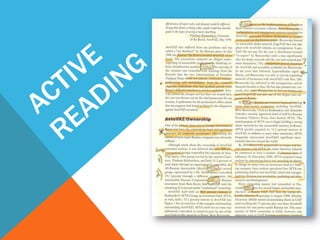
ACTIVE
NOT ACTIVE
THE ESSENCE OF ACTIVE READING
The FOUR Basic QUESTIONS a Reader asks. It is important to ask questions
   while you read, questions you want to answer in the course of your reading.


WHAT IS THE BOOK ABOUT AS A WHOLE? You must try to discover the
  leading theme of the book, and how the author develops this theme in an
  orderly way by subdividing it into its essential subordinate themes or topics.
WHAT IS BEING SAID IN DETAIL, AND HOW? Discover the main ideas,
  assertions, and arguments that constitute the author’s particular message.
IS THE BOOK TRUE, IN WHOLE OR PART? Only answer after you answer the
    first two. As a reader you are obligated to make up your own mind, knowing
    the author’s mind is not enough.
WHAT OF IT? What is the significance? Why does the author think it important to
  know these things? What is further implied or suggested?
HOW I MARK IN A BOOK: MY VERSION OF
       ANNOTATION
1) Underlining- of major points, or important statements.
2) Vertical Lines at the Margin- To emphasize a statement already underlined or to point to a passage
   too long to be underlined.
3) Star, ASTERIK, Doodad- to emphasize important passages in the book
4) NUMBER or LETTERS in the Margin- to indicate a sequence of points made by the author.
5) NUMBERS of OTHER PAGES- to indicate places where the author made similar points, or
   contradictions, to tie up ideas in the book.
6) CIRCLE- key words or phrases
7) WRITING in the MARGIN- to ask questions (?) to indicate a note to yourself.

Three TYPES of Note MAKING
Structural NOTES: What kind of book is it? What is it about as a whole? How is it arranged?
   STRUCTURE OF THE BOOK.
Conceptual NOTES: Concern the author’s concepts and also your own as they develop through reading.
Dialectical NOTES: shape of the discussion from several different books it involves a structure of
   concepts an order of statements and questions about a single subject matter.
Enough Said
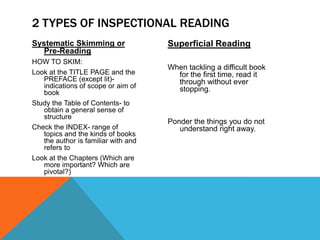
2 TYPES OF INSPECTIONAL READING
Systematic Skimming or               Superficial Reading
   Pre-Reading
HOW TO SKIM:
                                     When tackling a difficult book
Look at the TITLE PAGE and the         for the first time, read it
   PREFACE (except lit)-               through without ever
   indications of scope or aim of      stopping.
   book
Study the Table of Contents- to
   obtain a general sense of
   structure
                                     Ponder the things you do not
Check the INDEX- range of               understand right away.
   topics and the kinds of books
   the author is familiar with and
   refers to
Look at the Chapters (Which are
   more important? Which are
   pivotal?)
ENOUGH SAID
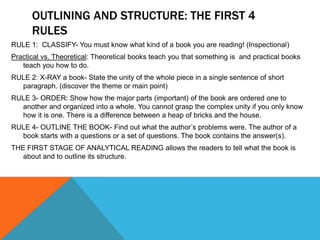
OUTLINING AND STRUCTURE: THE FIRST 4
      RULES
RULE 1: CLASSIFY- You must know what kind of a book you are reading! (Inspectional)
Practical vs. Theoretical: Theoretical books teach you that something is and practical books
   teach you how to do.
RULE 2: X-RAY a book- State the unity of the whole piece in a single sentence of short
  paragraph. (discover the theme or main point)
RULE 3- ORDER: Show how the major parts (important) of the book are ordered one to
  another and organized into a whole. You cannot grasp the complex unity if you only know
  how it is one. There is a difference between a heap of bricks and the house.
RULE 4- OUTLINE THE BOOK- Find out what the author’s problems were. The author of a
  book starts with a questions or a set of questions. The book contains the answer(s).
THE FIRST STAGE OF ANALYTICAL READING allows the readers to tell what the book is
   about and to outline its structure.
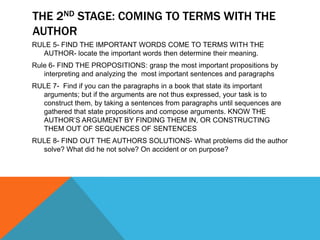
THE 2ND STAGE: COMING TO TERMS WITH THE
AUTHOR
RULE 5- FIND THE IMPORTANT WORDS COME TO TERMS WITH THE
  AUTHOR- locate the important words then determine their meaning.
Rule 6- FIND THE PROPOSITIONS: grasp the most important propositions by
   interpreting and analyzing the most important sentences and paragraphs
RULE 7- Find if you can the paragraphs in a book that state its important
  arguments; but if the arguments are not thus expressed, your task is to
  construct them, by taking a sentences from paragraphs until sequences are
  gathered that state propositions and compose arguments. KNOW THE
  AUTHOR’S ARGUMENT BY FINDING THEM IN, OR CONSTRUCTING
  THEM OUT OF SEQUENCES OF SENTENCES
RULE 8- FIND OUT THE AUTHORS SOLUTIONS- What problems did the author
  solve? What did he not solve? On accident or on purpose?
Reading a book is a kind of conversation. Some say the
author is doing all the talking but if you find that to be true
you are not grasping your opportunities.

The reader has the last word.

Ordinary Conversations between persons who confront each
other are good only when carried on civilly.
In reading there is an intellectual etiquette to be observed
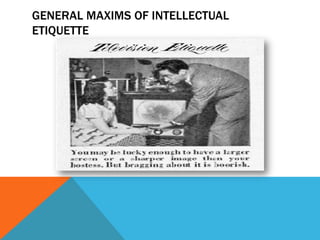
GENERAL MAXIMS OF INTELLECTUAL
ETIQUETTE
GENERAL MAXIMS OF INTELLECTUAL
ETIQUETTE

RULE 9- You must be able to say “I UNDERSTAND” before saying “I
JUDGE”

RULE 10- When YOU disagree do so reasonably, and not disputatiously
or contentiously.

There is no point winning an argument if you know you are wrong. When
we regard conversation as a battle you can only win by antagonism, not
with truth.

RULE 11- Respect the difference between knowledge and mere personal
opinion, by giving reasons for any critical judgment you make.

Knowledge- supported opinions that can be defended
Opinions-unsupported judgment
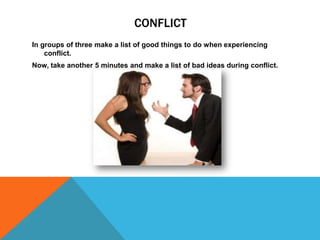
CONFLICT
In groups of three make a list of good things to do when experiencing
    conflict.
Now, take another 5 minutes and make a list of bad ideas during conflict.
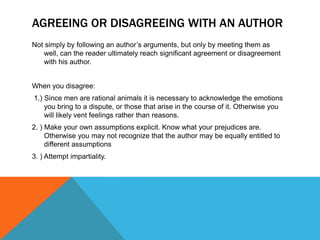
AGREEING OR DISAGREEING WITH AN AUTHOR
Not simply by following an author’s arguments, but only by meeting them as
   well, can the reader ultimately reach significant agreement or disagreement
   with his author.


When you disagree:
1.) Since men are rational animals it is necessary to acknowledge the emotions
    you bring to a dispute, or those that arise in the course of it. Otherwise you
    will likely vent feelings rather than reasons.
2. ) Make your own assumptions explicit. Know what your prejudices are.
     Otherwise you may not recognize that the author may be equally entitled to
     different assumptions
3. ) Attempt impartiality.
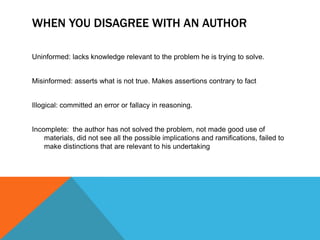
WHEN YOU DISAGREE WITH AN AUTHOR

Uninformed: lacks knowledge relevant to the problem he is trying to solve.


Misinformed: asserts what is not true. Makes assertions contrary to fact


Illogical: committed an error or fallacy in reasoning.


Incomplete: the author has not solved the problem, not made good use of
    materials, did not see all the possible implications and ramifications, failed to
    make distinctions that are relevant to his undertaking
ENOUGH SAID
REQUIREMENTS OF SYNTOPICAL READING
1.) Knowing that more than one books is relevant to a
   particular topic or subject


2.) Knowing which books should be read
5 STEPS IN SYNTOPICAL READING
1. ) Finding the Relevant Passage-: it is you and your concerns that are to be
     primarily served, not the books you read. You must identify relevant books
     before relevant passages. Your task is not to understand the book thoroughly
     but to discover how it is useful to your purposes, which may be very far from
     the author’s purpose(s).


2.)Bring the Authors to Terms: Force an author to use your language rather than
    using his/hers.


3. ) Get the Questions Clear: Since we are establishing a set of
     propositions, frame questions that shed light on the problem, and to which the
     authors answer. Questions must be put in an order that is helpful to us
     depending on the subject… Good starting order:
5 STEPS OF SYNTOPICAL READING (CONT)
4.) Define the Issues: If authors answer in different way we discover issues and
    they must be defined. Usually differences in answers must be ascribed to
    different conceptions of the question as often as different views of the subject.


5.) Analyze the Discussion: To present truth we must do more than ask and
    answer questions, we must ask them in a certain order, defend the order,
    answer how questions are answered differently, and suggest WHY. Look at all
    sides without trying to take sides
ENOUGH SAID
READING AND THE GROWTH OF THE MIND

Activity is the essence of good reading, the more active reading is, the
   better.
You will improve your reading, comprehension, etc.
You will learn about the world and about yourself.
There are problems with no solutions or final understanding and the greatest
   books help you think better about these problems
You know when you read great books they are stretching your mind and the
   book seems to grow with you. There is new understanding each time you
   read.
These books continue your learning and help grow the mind. The mind is not
  limited like the body, it can continue growing way beyond normal adult
  development. It can also atrophy just like muscles so it must “work out” as
  well.

How to read a book

  • 2.
    “We know moreabout the world than we used to, but knowledge is not really a prerequisite to understanding, we do not have to know everything in order to understand it. Too much can be a larger obstacle than too few!” Is this true? Take 5 minutes and write down if you agree or disagree and why?
  • 4.
  • 5.
  • 8.
    THE ESSENCE OFACTIVE READING The FOUR Basic QUESTIONS a Reader asks. It is important to ask questions while you read, questions you want to answer in the course of your reading. WHAT IS THE BOOK ABOUT AS A WHOLE? You must try to discover the leading theme of the book, and how the author develops this theme in an orderly way by subdividing it into its essential subordinate themes or topics. WHAT IS BEING SAID IN DETAIL, AND HOW? Discover the main ideas, assertions, and arguments that constitute the author’s particular message. IS THE BOOK TRUE, IN WHOLE OR PART? Only answer after you answer the first two. As a reader you are obligated to make up your own mind, knowing the author’s mind is not enough. WHAT OF IT? What is the significance? Why does the author think it important to know these things? What is further implied or suggested?
  • 10.
    HOW I MARKIN A BOOK: MY VERSION OF ANNOTATION 1) Underlining- of major points, or important statements. 2) Vertical Lines at the Margin- To emphasize a statement already underlined or to point to a passage too long to be underlined. 3) Star, ASTERIK, Doodad- to emphasize important passages in the book 4) NUMBER or LETTERS in the Margin- to indicate a sequence of points made by the author. 5) NUMBERS of OTHER PAGES- to indicate places where the author made similar points, or contradictions, to tie up ideas in the book. 6) CIRCLE- key words or phrases 7) WRITING in the MARGIN- to ask questions (?) to indicate a note to yourself. Three TYPES of Note MAKING Structural NOTES: What kind of book is it? What is it about as a whole? How is it arranged? STRUCTURE OF THE BOOK. Conceptual NOTES: Concern the author’s concepts and also your own as they develop through reading. Dialectical NOTES: shape of the discussion from several different books it involves a structure of concepts an order of statements and questions about a single subject matter.
  • 13.
  • 15.
    2 TYPES OFINSPECTIONAL READING Systematic Skimming or Superficial Reading Pre-Reading HOW TO SKIM: When tackling a difficult book Look at the TITLE PAGE and the for the first time, read it PREFACE (except lit)- through without ever indications of scope or aim of stopping. book Study the Table of Contents- to obtain a general sense of structure Ponder the things you do not Check the INDEX- range of understand right away. topics and the kinds of books the author is familiar with and refers to Look at the Chapters (Which are more important? Which are pivotal?)
  • 16.
  • 19.
    OUTLINING AND STRUCTURE:THE FIRST 4 RULES RULE 1: CLASSIFY- You must know what kind of a book you are reading! (Inspectional) Practical vs. Theoretical: Theoretical books teach you that something is and practical books teach you how to do. RULE 2: X-RAY a book- State the unity of the whole piece in a single sentence of short paragraph. (discover the theme or main point) RULE 3- ORDER: Show how the major parts (important) of the book are ordered one to another and organized into a whole. You cannot grasp the complex unity if you only know how it is one. There is a difference between a heap of bricks and the house. RULE 4- OUTLINE THE BOOK- Find out what the author’s problems were. The author of a book starts with a questions or a set of questions. The book contains the answer(s). THE FIRST STAGE OF ANALYTICAL READING allows the readers to tell what the book is about and to outline its structure.
  • 21.
    THE 2ND STAGE:COMING TO TERMS WITH THE AUTHOR RULE 5- FIND THE IMPORTANT WORDS COME TO TERMS WITH THE AUTHOR- locate the important words then determine their meaning. Rule 6- FIND THE PROPOSITIONS: grasp the most important propositions by interpreting and analyzing the most important sentences and paragraphs RULE 7- Find if you can the paragraphs in a book that state its important arguments; but if the arguments are not thus expressed, your task is to construct them, by taking a sentences from paragraphs until sequences are gathered that state propositions and compose arguments. KNOW THE AUTHOR’S ARGUMENT BY FINDING THEM IN, OR CONSTRUCTING THEM OUT OF SEQUENCES OF SENTENCES RULE 8- FIND OUT THE AUTHORS SOLUTIONS- What problems did the author solve? What did he not solve? On accident or on purpose?
  • 23.
    Reading a bookis a kind of conversation. Some say the author is doing all the talking but if you find that to be true you are not grasping your opportunities. The reader has the last word. Ordinary Conversations between persons who confront each other are good only when carried on civilly. In reading there is an intellectual etiquette to be observed
  • 24.
    GENERAL MAXIMS OFINTELLECTUAL ETIQUETTE
  • 25.
    GENERAL MAXIMS OFINTELLECTUAL ETIQUETTE RULE 9- You must be able to say “I UNDERSTAND” before saying “I JUDGE” RULE 10- When YOU disagree do so reasonably, and not disputatiously or contentiously. There is no point winning an argument if you know you are wrong. When we regard conversation as a battle you can only win by antagonism, not with truth. RULE 11- Respect the difference between knowledge and mere personal opinion, by giving reasons for any critical judgment you make. Knowledge- supported opinions that can be defended Opinions-unsupported judgment
  • 26.
    CONFLICT In groups ofthree make a list of good things to do when experiencing conflict. Now, take another 5 minutes and make a list of bad ideas during conflict.
  • 27.
    AGREEING OR DISAGREEINGWITH AN AUTHOR Not simply by following an author’s arguments, but only by meeting them as well, can the reader ultimately reach significant agreement or disagreement with his author. When you disagree: 1.) Since men are rational animals it is necessary to acknowledge the emotions you bring to a dispute, or those that arise in the course of it. Otherwise you will likely vent feelings rather than reasons. 2. ) Make your own assumptions explicit. Know what your prejudices are. Otherwise you may not recognize that the author may be equally entitled to different assumptions 3. ) Attempt impartiality.
  • 28.
    WHEN YOU DISAGREEWITH AN AUTHOR Uninformed: lacks knowledge relevant to the problem he is trying to solve. Misinformed: asserts what is not true. Makes assertions contrary to fact Illogical: committed an error or fallacy in reasoning. Incomplete: the author has not solved the problem, not made good use of materials, did not see all the possible implications and ramifications, failed to make distinctions that are relevant to his undertaking
  • 29.
  • 31.
    REQUIREMENTS OF SYNTOPICALREADING 1.) Knowing that more than one books is relevant to a particular topic or subject 2.) Knowing which books should be read
  • 32.
    5 STEPS INSYNTOPICAL READING 1. ) Finding the Relevant Passage-: it is you and your concerns that are to be primarily served, not the books you read. You must identify relevant books before relevant passages. Your task is not to understand the book thoroughly but to discover how it is useful to your purposes, which may be very far from the author’s purpose(s). 2.)Bring the Authors to Terms: Force an author to use your language rather than using his/hers. 3. ) Get the Questions Clear: Since we are establishing a set of propositions, frame questions that shed light on the problem, and to which the authors answer. Questions must be put in an order that is helpful to us depending on the subject… Good starting order:
  • 33.
    5 STEPS OFSYNTOPICAL READING (CONT) 4.) Define the Issues: If authors answer in different way we discover issues and they must be defined. Usually differences in answers must be ascribed to different conceptions of the question as often as different views of the subject. 5.) Analyze the Discussion: To present truth we must do more than ask and answer questions, we must ask them in a certain order, defend the order, answer how questions are answered differently, and suggest WHY. Look at all sides without trying to take sides
  • 34.
  • 35.
    READING AND THEGROWTH OF THE MIND Activity is the essence of good reading, the more active reading is, the better. You will improve your reading, comprehension, etc. You will learn about the world and about yourself. There are problems with no solutions or final understanding and the greatest books help you think better about these problems You know when you read great books they are stretching your mind and the book seems to grow with you. There is new understanding each time you read. These books continue your learning and help grow the mind. The mind is not limited like the body, it can continue growing way beyond normal adult development. It can also atrophy just like muscles so it must “work out” as well.