Literary Analysis:
A Short List of Fictional Elements
Setting, Point of View, Character, and Plot
Setting: Locale & Time
• Setting = locale and time
• Short Stories usually focus on a single setting
• Novels can focus on two or more settings: a second setting is used as
counterpoint (The technique of combining two or more melodic lines in such a
way that they establish a harmonic relationship while retaining their linear
individuality. For example, )
• Imply historical and political contexts, customs and conventions and values of
the community, and the dominant issues and conflicts of the society as a whole.
• Benefits the reader by enlarging his/her world-view.
Examples
District 12 in the country of Panem, post-apocalyptic (Hunger
Games)
Forks, Washington, 2005 (Twilight)
Point of View
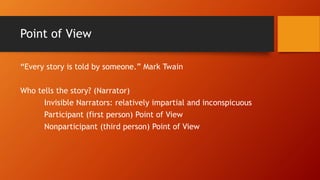
“Every story is told by someone.” Mark Twain
Who tells the story? (Narrator)
Invisible Narrators: relatively impartial and inconspicuous
Participant (first person) Point of View
Nonparticipant (third person) Point of View
Point of View
• Example of First Person Point of View
• “You don’t know about me without you have read a book by the name of The
Adventures of Tom Sawyer, but that ain’t no matter. That book was made by Mr.
Mark Twain, and he told the truth, mainly. There was things which he stretched,
but mainly he told the truth.”
Mark Twain’s Adventures of Huckleberry Finn
• Example of Nonparticipant (or Third Person) Point of View
• “Young Goodman brown came forth, at sunset, into the street at Salem village;
but put his head back, after crossing the threshold, to exchange a parting kiss
with his young wife. And Faith, as the wife was aptly names, thrust her own
pretty head into the street, letting the wind play with the pink ribbons of her
cap while she called to Goodman Brown.”
Nathaniel Hawthorne’s “Young Goodman Brown”
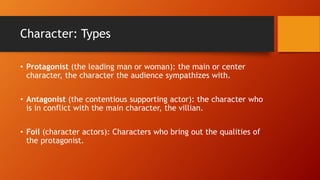
Character: Types
• Protagonist (the leading man or woman): the main or center
character, the character the audience sympathizes with.
• Antagonist (the contentious supporting actor): the character who
is in conflict with the main character, the villian.
• Foil (character actors): Characters who bring out the qualities of
the protagonist.
Kinds of Characters
• Characters are presented through:
• What the character says (dialogue)
• What the character does (actions)
• What the author explicitly tells us about the character (authorial comment)
• What the author tells us about where the character lives (setting)
Character: What to look at. (iFAAD)
• Internal Feelings (thoughts): What does the character think and
feel? (His/her inner life)
• Appearance: What does the character look like?
• Action: What does the character do?
• Dialogue: What does the character say? And to whom? (Dialogue is
an action)
Character: Other Considerations
• Setting: How does the locale and time shape the character?
• Point of View: Does the author show or tell?
• Making Connections: How is this character in this story similar to
and different from characters in other literary works?
Questions to Ask
• What is the setting when the story begins?
• How does the white room of your mind fill in?
• Does the action remain in one setting? Or does it change? If it changes,
compare how they are similar and different.
• Through action, what does the author show by action? Through telling,
what does the author describe?
• How detailed is the author? What does the author draw the reader’s
attention to through description?
• Does the setting become symbolic?
• How is the main character shaped by the setting?
Plot (Character in Action)
• Story & Plot are not the same.
• Story implies history; a narrative of events arranged in their time-sequence.
• The king died and then the queen died.
• The king died in December. Then, in January, the queen was hit by a drunk drive and
died.
• Plot implies imposed structure: a narrative of events, with the emphasis falling
on causality.
• The king died and then the queen died of grief.
• Plot is the arrangement of episodes or doings or incidencts or actions or
happenings or whatever we wish to call them. The plot, again, is the cunning
contrivance that is an organized whole.
• The literary use of the term is closer to a secret plan or scheme.
Plot
• Chronological structure, usually.
• Foreshadowing, maybe. The author hints at what will come.
• Flashbacks: the author goes back to another time.
• In medias res (in the middle) like the movie Forrest Gump.
• Sifting (repeatedly going back and forth) like a miner sifting
through sand in order to find gold.
• A good plot should evoke surprise but also the sense “Oh, that’s all
right.”
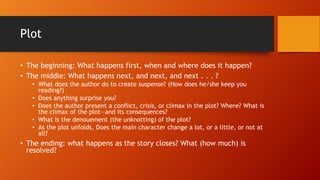
Plot
• The beginning: What happens first, when and where does it happen?
• The middle: What happens next, and next, and next . . . ?
• What does the author do to create suspense? (How does he/she keep you
reading?)
• Does anything surprise you?
• Does the author present a conflict, crisis, or climax in the plot? Where? What is
the climax of the plot—and its consequences?
• What is the denouement (the unknotting) of the plot?
• As the plot unfolds, Does the main character change a lot, or a little, or not at
all?
• The ending: what happens as the story closes? What (how much) is
resolved?

Literary analysis fictional elements

  • 1.
    Literary Analysis: A ShortList of Fictional Elements Setting, Point of View, Character, and Plot
  • 2.
    Setting: Locale &Time • Setting = locale and time • Short Stories usually focus on a single setting • Novels can focus on two or more settings: a second setting is used as counterpoint (The technique of combining two or more melodic lines in such a way that they establish a harmonic relationship while retaining their linear individuality. For example, ) • Imply historical and political contexts, customs and conventions and values of the community, and the dominant issues and conflicts of the society as a whole. • Benefits the reader by enlarging his/her world-view. Examples District 12 in the country of Panem, post-apocalyptic (Hunger Games) Forks, Washington, 2005 (Twilight)
  • 3.
    Point of View “Everystory is told by someone.” Mark Twain Who tells the story? (Narrator) Invisible Narrators: relatively impartial and inconspicuous Participant (first person) Point of View Nonparticipant (third person) Point of View
  • 4.
    Point of View •Example of First Person Point of View • “You don’t know about me without you have read a book by the name of The Adventures of Tom Sawyer, but that ain’t no matter. That book was made by Mr. Mark Twain, and he told the truth, mainly. There was things which he stretched, but mainly he told the truth.” Mark Twain’s Adventures of Huckleberry Finn • Example of Nonparticipant (or Third Person) Point of View • “Young Goodman brown came forth, at sunset, into the street at Salem village; but put his head back, after crossing the threshold, to exchange a parting kiss with his young wife. And Faith, as the wife was aptly names, thrust her own pretty head into the street, letting the wind play with the pink ribbons of her cap while she called to Goodman Brown.” Nathaniel Hawthorne’s “Young Goodman Brown”
  • 5.
    Character: Types • Protagonist(the leading man or woman): the main or center character, the character the audience sympathizes with. • Antagonist (the contentious supporting actor): the character who is in conflict with the main character, the villian. • Foil (character actors): Characters who bring out the qualities of the protagonist.
  • 6.
    Kinds of Characters •Characters are presented through: • What the character says (dialogue) • What the character does (actions) • What the author explicitly tells us about the character (authorial comment) • What the author tells us about where the character lives (setting)
  • 7.
    Character: What tolook at. (iFAAD) • Internal Feelings (thoughts): What does the character think and feel? (His/her inner life) • Appearance: What does the character look like? • Action: What does the character do? • Dialogue: What does the character say? And to whom? (Dialogue is an action)
  • 8.
    Character: Other Considerations •Setting: How does the locale and time shape the character? • Point of View: Does the author show or tell? • Making Connections: How is this character in this story similar to and different from characters in other literary works?
  • 9.
    Questions to Ask •What is the setting when the story begins? • How does the white room of your mind fill in? • Does the action remain in one setting? Or does it change? If it changes, compare how they are similar and different. • Through action, what does the author show by action? Through telling, what does the author describe? • How detailed is the author? What does the author draw the reader’s attention to through description? • Does the setting become symbolic? • How is the main character shaped by the setting?
  • 10.
    Plot (Character inAction) • Story & Plot are not the same. • Story implies history; a narrative of events arranged in their time-sequence. • The king died and then the queen died. • The king died in December. Then, in January, the queen was hit by a drunk drive and died. • Plot implies imposed structure: a narrative of events, with the emphasis falling on causality. • The king died and then the queen died of grief. • Plot is the arrangement of episodes or doings or incidencts or actions or happenings or whatever we wish to call them. The plot, again, is the cunning contrivance that is an organized whole. • The literary use of the term is closer to a secret plan or scheme.
  • 11.
    Plot • Chronological structure,usually. • Foreshadowing, maybe. The author hints at what will come. • Flashbacks: the author goes back to another time. • In medias res (in the middle) like the movie Forrest Gump. • Sifting (repeatedly going back and forth) like a miner sifting through sand in order to find gold. • A good plot should evoke surprise but also the sense “Oh, that’s all right.”
  • 12.
    Plot • The beginning:What happens first, when and where does it happen? • The middle: What happens next, and next, and next . . . ? • What does the author do to create suspense? (How does he/she keep you reading?) • Does anything surprise you? • Does the author present a conflict, crisis, or climax in the plot? Where? What is the climax of the plot—and its consequences? • What is the denouement (the unknotting) of the plot? • As the plot unfolds, Does the main character change a lot, or a little, or not at all? • The ending: what happens as the story closes? What (how much) is resolved?