Note Making


  Not   Note Taking
Objectives for this topic


a. Stimulate your thoughts about what
   you do in this area.
b. Help to make you aware of strengths
   and weaknesses
c. Encourage an ‘active learning’
   approach
Definition
   we use the words 'note-making' rather than 'note-
    taking' as it more accurately reflects a process where
    you are actively involved, rather than the idea of
    passively copying the words of others word-for-word
    without thought or discrimination.

   Note-making from written sources involves reading,
    questioning, evaluating, summarising and
    paraphrasing. Whether you are at university or at
    work you will need to make notes to help you
    remember and understand complex issues. By
    actively engaging in the process you will find that
    note-making is not a painful or boring process, but is
    one of the steps on the road to understanding.
Where do we take notes from?
   From written sources:
       books, articles.
   From lectures.
   From audio devices:
       Radio, TV, telephone.
Why do we need to make notes?
   To record and store information
       Permanent record of lecture
       Relevant information from book
   To organise information - revision
   To act as memory hooks - retention
   To aid understanding, process ideas
   Efficient note-making is absolutely
    essential to effective learning.
Importance of Notes
   Purpose is crucial – have questions to answer
       Variety of styles for varying needs
   active learning – helps concentration
   Creates material for later use in exams or
    essays/projects – aids retention
   Personal record of understanding
        (cf using somebody else’s notes).
   Own words – avoids plagiarism
   Make bibliographic record - at this stage!
Notes from lectures
Active or Passive?
   Copying down what you see on a screen or black board.
    A or P?
   Writing down things the lecturer says.    A or P?
   Writing down your own thoughts and ideas.         A or P?
   Asking the lecturer questions.    A or P?
   Asking yourself questions-jotting them down to research
    later.     A or P?
   Answering questions posed by the lecturer
   Doing calculations, solving problems, evolving a personal
    response
   Yawning, shuffling, fidgeting, watching fellow students
   Thinking about other things
   Looking at the lecturer, blackboard or the screen
   Discussing things with students near you, when directed to
    do so by the lecturer.
Using SQ3R
   Survey.
   Question.
   Read / Listen
   Recall,
   Review

   See “Efficient Reading” on S4L or
    attend the workshop
Survey - Lectures
   Are the lecture notes available in advance
       (e.g. on WebCT)?
   You can however still prepare for the lecture in
    advance.
       What is the lecture going to be about? Title?
       Where does this fit in to the subject area/module?
       What do you know about this topic already?
       Can you read a book chapter or an article
        beforehand? General background?
   This will give you an overall map or framework in
    your mind; can fit the new information into this.
Question - Lectures
   Pose questions in your mind or on
    paper - before the lecture.
       What do you expect to learn?
   Amend the list as lecture progresses
       what is not clear?
       further reading suggests itself
   You may even get the opportunity to
    pose the questions directly.
Listen
   Attend
   Listen
   Participate
   Make notes
   Ask questions if opportunity
   Talk to other people (when appropriate!)
   Remember, listening is an active
    learning process not a passive process of
    mere recording of information
Listening Skills

  Many people admit to being a bit
  “hard of hearing”, but fewer admit to
  the much more common condition of
  being “hard of listening”.
                                                Phil Race
                    Professor of Education Development
                                 University of Glamorgan
Making Notes - Lectures
   Don’t try to write everything down
   Listen for ‘sign-posts’ “Secondly,…”
   What is the main point of this bit?
   Summarise in own words
   Flag topics you want to re-visit
       further reading, alternative view
   Leave room for re-visiting
       wide margin; double spacing
Survey – Printed Material
   Read the ‘blurb’ or preface (book)
   Read the abstract (journal article)
   Look at the table of contents
       of relevant chapter or section
       Are there sub-headings?
   What do I know already? (e.g. lectures)
   Any summaries?
       Bullet points? List of learning outcomes?
       Tables?     Charts?       Diagrams?
   Identify what needed – NOT whole book!
Question – Printed Material
   Have in mind the questions you want
    answered by your reading
       Will give purpose and focus
       brainstorm on the essay topic
       For research proposal I need….
       Write a list of questions
   Continue to question…
       How does this fit with prior knowledge?
       Is this information useful to my purpose?
       What further questions have arisen?
Read
   “Pre –read”
       Title, date, abstract, conclusion (article)
       List of objectives, introduction, any
        “boxes”, summary at end of section
   Skim-read or scan for relevance
   Read only relevant text
   Tables, charts are information-rich
   Read actively – critically, evaluate.
   Make notes in next stage
Making Notes – Printed Material
   This assists in Recall
   Write down key-words from each
    paragraph/section
   Express the main ideas in your own
    words – counters plagiarism
   Full bibliographic ref. for that source
       See “Quote, Unquote” for details
   Direct quotation – copy exactly
       Remember page number if from a book
Ways to make notes from written
sources.
   1.Key word outlines.
   2.Prose summaries.
   3.Diagrammatic notes.
    (spider diagrams, mind maps)
   Leave room to add comments later
       Half width of page; well spaced
   Write critically – question arguments
       Author’s perspective? Alternative views?
       relate to own existing knowledge
   Everything needed from that source
       Should not need that book, article again!
Review
   Re-read lecture notes within 24 hours
       Great aid to long-term memory
       Handwriting, spelling, abbreviations!
   Critically review your notes:
       Are the original questions answered?
       More information needed? What sources?
       Relate to previous learning; look back at
        earlier lecture, or other, relevant notes
       Do you need to expand on your notes so
        that you can use them better later?
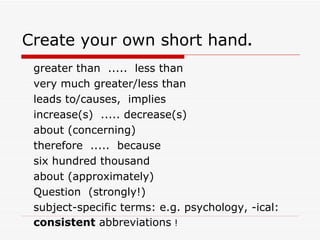
Create your own short hand.
 greater than ..... less than
 very much greater/less than
 leads to/causes, implies
 increase(s) ..... decrease(s)
 about (concerning)
 therefore ..... because
 six hundred thousand
 about (approximately)
 Question (strongly!)
 subject-specific terms: e.g. psychology, -ical:
 consistent abbreviations !
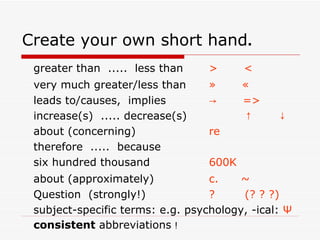
Create your own short hand.
 greater than ..... less than     >      <
 very much greater/less than      »      «
 leads to/causes, implies         →      =>
 increase(s) ..... decrease(s)           ↑     ↓
 about (concerning)               re
 therefore ..... because
 six hundred thousand             600K
 about (approximately)            c.    ~
 Question (strongly!)             ?     (? ? ?)
 subject-specific terms: e.g. psychology, -ical: Ψ
 consistent abbreviations !

Notemaking

  • 1.
    Note Making Not Note Taking
  • 2.
    Objectives for thistopic a. Stimulate your thoughts about what you do in this area. b. Help to make you aware of strengths and weaknesses c. Encourage an ‘active learning’ approach
  • 3.
    Definition  we use the words 'note-making' rather than 'note- taking' as it more accurately reflects a process where you are actively involved, rather than the idea of passively copying the words of others word-for-word without thought or discrimination.  Note-making from written sources involves reading, questioning, evaluating, summarising and paraphrasing. Whether you are at university or at work you will need to make notes to help you remember and understand complex issues. By actively engaging in the process you will find that note-making is not a painful or boring process, but is one of the steps on the road to understanding.
  • 4.
    Where do wetake notes from?  From written sources:  books, articles.  From lectures.  From audio devices:  Radio, TV, telephone.
  • 5.
    Why do weneed to make notes?  To record and store information  Permanent record of lecture  Relevant information from book  To organise information - revision  To act as memory hooks - retention  To aid understanding, process ideas  Efficient note-making is absolutely essential to effective learning.
  • 6.
    Importance of Notes  Purpose is crucial – have questions to answer  Variety of styles for varying needs  active learning – helps concentration  Creates material for later use in exams or essays/projects – aids retention  Personal record of understanding (cf using somebody else’s notes).  Own words – avoids plagiarism  Make bibliographic record - at this stage!
  • 7.
    Notes from lectures Activeor Passive?  Copying down what you see on a screen or black board. A or P?  Writing down things the lecturer says. A or P?  Writing down your own thoughts and ideas. A or P?  Asking the lecturer questions. A or P?  Asking yourself questions-jotting them down to research later. A or P?  Answering questions posed by the lecturer  Doing calculations, solving problems, evolving a personal response  Yawning, shuffling, fidgeting, watching fellow students  Thinking about other things  Looking at the lecturer, blackboard or the screen  Discussing things with students near you, when directed to do so by the lecturer.
  • 8.
    Using SQ3R  Survey.  Question.  Read / Listen  Recall,  Review  See “Efficient Reading” on S4L or attend the workshop
  • 9.
    Survey - Lectures  Are the lecture notes available in advance (e.g. on WebCT)?  You can however still prepare for the lecture in advance.  What is the lecture going to be about? Title?  Where does this fit in to the subject area/module?  What do you know about this topic already?  Can you read a book chapter or an article beforehand? General background?  This will give you an overall map or framework in your mind; can fit the new information into this.
  • 10.
    Question - Lectures  Pose questions in your mind or on paper - before the lecture.  What do you expect to learn?  Amend the list as lecture progresses  what is not clear?  further reading suggests itself  You may even get the opportunity to pose the questions directly.
  • 11.
    Listen  Attend  Listen  Participate  Make notes  Ask questions if opportunity  Talk to other people (when appropriate!)  Remember, listening is an active learning process not a passive process of mere recording of information
  • 12.
    Listening Skills Many people admit to being a bit “hard of hearing”, but fewer admit to the much more common condition of being “hard of listening”. Phil Race Professor of Education Development University of Glamorgan
  • 13.
    Making Notes -Lectures  Don’t try to write everything down  Listen for ‘sign-posts’ “Secondly,…”  What is the main point of this bit?  Summarise in own words  Flag topics you want to re-visit  further reading, alternative view  Leave room for re-visiting  wide margin; double spacing
  • 14.
    Survey – PrintedMaterial  Read the ‘blurb’ or preface (book)  Read the abstract (journal article)  Look at the table of contents  of relevant chapter or section  Are there sub-headings?  What do I know already? (e.g. lectures)  Any summaries?  Bullet points? List of learning outcomes?  Tables? Charts? Diagrams?  Identify what needed – NOT whole book!
  • 15.
    Question – PrintedMaterial  Have in mind the questions you want answered by your reading  Will give purpose and focus  brainstorm on the essay topic  For research proposal I need….  Write a list of questions  Continue to question…  How does this fit with prior knowledge?  Is this information useful to my purpose?  What further questions have arisen?
  • 16.
    Read  “Pre –read”  Title, date, abstract, conclusion (article)  List of objectives, introduction, any “boxes”, summary at end of section  Skim-read or scan for relevance  Read only relevant text  Tables, charts are information-rich  Read actively – critically, evaluate.  Make notes in next stage
  • 17.
    Making Notes –Printed Material  This assists in Recall  Write down key-words from each paragraph/section  Express the main ideas in your own words – counters plagiarism  Full bibliographic ref. for that source  See “Quote, Unquote” for details  Direct quotation – copy exactly  Remember page number if from a book
  • 18.
    Ways to makenotes from written sources.  1.Key word outlines.  2.Prose summaries.  3.Diagrammatic notes. (spider diagrams, mind maps)  Leave room to add comments later  Half width of page; well spaced  Write critically – question arguments  Author’s perspective? Alternative views?  relate to own existing knowledge  Everything needed from that source  Should not need that book, article again!
  • 19.
    Review  Re-read lecture notes within 24 hours  Great aid to long-term memory  Handwriting, spelling, abbreviations!  Critically review your notes:  Are the original questions answered?  More information needed? What sources?  Relate to previous learning; look back at earlier lecture, or other, relevant notes  Do you need to expand on your notes so that you can use them better later?
  • 20.
    Create your ownshort hand. greater than ..... less than very much greater/less than leads to/causes, implies increase(s) ..... decrease(s) about (concerning) therefore ..... because six hundred thousand about (approximately) Question (strongly!) subject-specific terms: e.g. psychology, -ical: consistent abbreviations !
  • 21.
    Create your ownshort hand. greater than ..... less than > < very much greater/less than » « leads to/causes, implies → => increase(s) ..... decrease(s) ↑ ↓ about (concerning) re therefore ..... because six hundred thousand 600K about (approximately) c. ~ Question (strongly!) ? (? ? ?) subject-specific terms: e.g. psychology, -ical: Ψ consistent abbreviations !