

Notes 
CEP
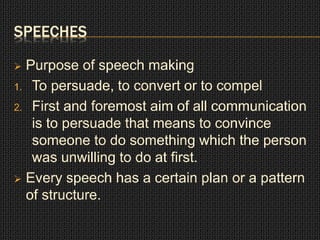
SPEECHES 
 Purpose of speech making 
1. To persuade, to convert or to compel 
2. First and foremost aim of all communication 
is to persuade that means to convince 
someone to do something which the person 
was unwilling to do at first. 
 Every speech has a certain plan or a pattern 
of structure.
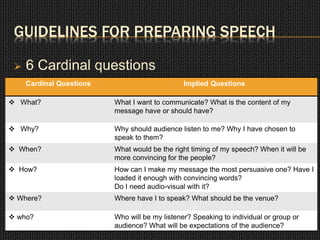
GUIDELINES FOR PREPARING SPEECH 
 6 Cardinal questions 
Cardinal Questions Implied Questions 
 What? What I want to communicate? What is the content of my 
message have or should have? 
 Why? Why should audience listen to me? Why I have chosen to 
speak to them? 
 When? What would be the right timing of my speech? When it will be 
more convincing for the people? 
 How? How can I make my message the most persuasive one? Have I 
loaded it enough with convincing words? 
Do I need audio-visual with it? 
 Where? Where have I to speak? What should be the venue? 
 who? Who will be my listener? Speaking to individual or group or 
audience? What will be expectations of the audience?
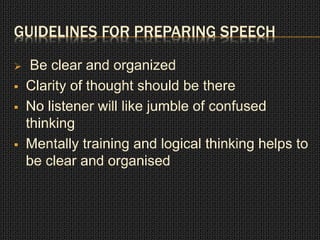
GUIDELINES FOR PREPARING SPEECH 
 Be clear and organized 
 Clarity of thought should be there 
 No listener will like jumble of confused 
thinking 
 Mentally training and logical thinking helps to 
be clear and organised
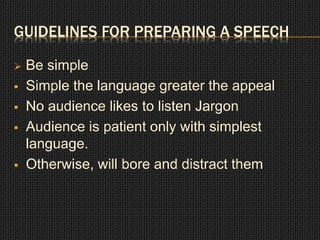
GUIDELINES FOR PREPARING A SPEECH 
 Be simple 
 Simple the language greater the appeal 
 No audience likes to listen Jargon 
 Audience is patient only with simplest 
language. 
 Otherwise, will bore and distract them
GUIDELINES FOR PREPARING A SPEECH 
 Furnish Concrete Details 
 Make your speech vivid by furnishing details 
and actual experiences which will capture 
attention of the audience 
 Use eye catching details, humorous 
anecdotes, relevant examples and 
enthusiastic eye contact should be used.
GUIDELINES FOR PREPARING A SPEECH 
 Cultivate effortless grace and naturalness 
 Cultured persons move and speaks with grace 
and sounds natural 
 Facing large audience can make you over-conscious. 
 Devise your own ways to move ,walk and talk 
smoothly and gracefully. 
 Practice – in front of mirror, friends or social 
groups 
 Emulate your fav. Anchor may also prove 
helpful.
GUIDELINES FOR PREPARING A SPEECH 
 Enrich Your Mental Equipment 
 Having the right kind of information for the 
right moment is an essential condition of 
speaking effectively. 
 Be learned 
 Read! Read! Read!
GUIDELINES FOR PREPARING A SPEECH 
 Be brief 
 Take care of quantity of information and 
quality of speech 
 Time is money… be brief and stick to time 
 Every word is valuable
GUIDELINES FOR PREPARING A SPEECH 
 Be informal 
 Give a personal touch to your speech 
 Build a rapport with the audience 
 Informality creates nearness
GUIDELINES FOR PREPARING A SPEECH 
 Be Enthusiastic 
 Enthusiasm is contagious 
 Be in the spirit of the occasion with 
enthusiasm 
 Being enthusiastic gets immediate response 
 It will help speaker and audience to 
empathize with each other.
GUIDELINES FOR PREPARING A SPEECH 
 Mind your non-verbal language 
 Take care of your gestures 
 Make eye contact 
 Practice voice modulation, stressing in right 
words etc.
GUIDELINES FOR PREPARING A SPEECH 
 Remember that facts and figures are not 
enough 
 Facts and figures are dry bones 
 They are just skeleton 
 Imaginative and effective use of language 
add flesh and bones
GUIDELINES FOR PREPARING A SPEECH 
 Control your emotions, but make an 
emotional speech 
 Cannot afford getting carried away by his 
emotions 
 Be convincing and influencing towards his 
audience .
GUIDELINES FOR PREPARING A SPEECH 
 Share your significant experiences/expertise 
with your listeners 
 Give a personal touch 
 Give confidence to the speaker and comfort 
to the listeners 
 Audience feel important
VARIOUS PARTS OF A SPEECH 
 3 Parts – 
 Beginning 
 Middle 
 End 
 Any listener will identify the three parts easily 
if you will stick to the principle ‘Be Clear!’
PARTS OF SPEECH 
 Beginning 
 Welcome invitees/guest to whom the speech 
is to be delivered. 
 Do not take much time nor use more words 
• But- Choose your own style 
 Keep it warm / nearer to the listener and 
conversational in nature.
PARTS OF SPEECH 
 Middle – Main Body 
 An overview about the theme of the topic of 
speech 
 A brief history 
 Problems or challenges faced 
 Change in the scenario 
 Additional details 
 Look to towards the future
PARTS OF SPEECH 
 End – Conclusion 
 Provide a conclusion 
 Give a good hope 
 Primary function is to thank all the guest and 
listeners.
MAKING IMPROMPTU SPEECH 
 Impromptu – unprepared / unrehearsed 
 Key points for making impromptu speech 
1. Practice it 
2. Structure it properly in your mind … it depends on 
the amount of practice you have done earlier 
3. Be mentally prepared to speak impromptu…. keep 
visualizing what would you say on something (if 
asked to)…keep gathering information about 
different areas and keep on developing new interest 
4. Give examples from your own experiences.
MAKING IMPROMPTU SPEECH 
5. Genuine interest in the audience ….find out what the 
audience ants to hear… think about their interest and 
inclinations and then speak 
6. Use quotations/proverbs/maxims 
7. Remember jokes /humorous anecdotes etc. 
8. Use incidents of the lives of great men in your speech…. 
But don’t use much repetitive stories 
9. Size up the patience level of the audience… keep an 
eye on their mood 
10. Get involved….don’t ‘tell’ audience …. Communicate 
with them 
11. Keep it BRIEF
How to create an effective Speech

How to create an effective Speech

  • 1.
  • 2.
    SPEECHES  Purposeof speech making 1. To persuade, to convert or to compel 2. First and foremost aim of all communication is to persuade that means to convince someone to do something which the person was unwilling to do at first.  Every speech has a certain plan or a pattern of structure.
  • 3.
    GUIDELINES FOR PREPARINGSPEECH  6 Cardinal questions Cardinal Questions Implied Questions  What? What I want to communicate? What is the content of my message have or should have?  Why? Why should audience listen to me? Why I have chosen to speak to them?  When? What would be the right timing of my speech? When it will be more convincing for the people?  How? How can I make my message the most persuasive one? Have I loaded it enough with convincing words? Do I need audio-visual with it?  Where? Where have I to speak? What should be the venue?  who? Who will be my listener? Speaking to individual or group or audience? What will be expectations of the audience?
  • 4.
    GUIDELINES FOR PREPARINGSPEECH  Be clear and organized  Clarity of thought should be there  No listener will like jumble of confused thinking  Mentally training and logical thinking helps to be clear and organised
  • 5.
    GUIDELINES FOR PREPARINGA SPEECH  Be simple  Simple the language greater the appeal  No audience likes to listen Jargon  Audience is patient only with simplest language.  Otherwise, will bore and distract them
  • 6.
    GUIDELINES FOR PREPARINGA SPEECH  Furnish Concrete Details  Make your speech vivid by furnishing details and actual experiences which will capture attention of the audience  Use eye catching details, humorous anecdotes, relevant examples and enthusiastic eye contact should be used.
  • 7.
    GUIDELINES FOR PREPARINGA SPEECH  Cultivate effortless grace and naturalness  Cultured persons move and speaks with grace and sounds natural  Facing large audience can make you over-conscious.  Devise your own ways to move ,walk and talk smoothly and gracefully.  Practice – in front of mirror, friends or social groups  Emulate your fav. Anchor may also prove helpful.
  • 8.
    GUIDELINES FOR PREPARINGA SPEECH  Enrich Your Mental Equipment  Having the right kind of information for the right moment is an essential condition of speaking effectively.  Be learned  Read! Read! Read!
  • 9.
    GUIDELINES FOR PREPARINGA SPEECH  Be brief  Take care of quantity of information and quality of speech  Time is money… be brief and stick to time  Every word is valuable
  • 10.
    GUIDELINES FOR PREPARINGA SPEECH  Be informal  Give a personal touch to your speech  Build a rapport with the audience  Informality creates nearness
  • 11.
    GUIDELINES FOR PREPARINGA SPEECH  Be Enthusiastic  Enthusiasm is contagious  Be in the spirit of the occasion with enthusiasm  Being enthusiastic gets immediate response  It will help speaker and audience to empathize with each other.
  • 12.
    GUIDELINES FOR PREPARINGA SPEECH  Mind your non-verbal language  Take care of your gestures  Make eye contact  Practice voice modulation, stressing in right words etc.
  • 13.
    GUIDELINES FOR PREPARINGA SPEECH  Remember that facts and figures are not enough  Facts and figures are dry bones  They are just skeleton  Imaginative and effective use of language add flesh and bones
  • 14.
    GUIDELINES FOR PREPARINGA SPEECH  Control your emotions, but make an emotional speech  Cannot afford getting carried away by his emotions  Be convincing and influencing towards his audience .
  • 15.
    GUIDELINES FOR PREPARINGA SPEECH  Share your significant experiences/expertise with your listeners  Give a personal touch  Give confidence to the speaker and comfort to the listeners  Audience feel important
  • 16.
    VARIOUS PARTS OFA SPEECH  3 Parts –  Beginning  Middle  End  Any listener will identify the three parts easily if you will stick to the principle ‘Be Clear!’
  • 17.
    PARTS OF SPEECH  Beginning  Welcome invitees/guest to whom the speech is to be delivered.  Do not take much time nor use more words • But- Choose your own style  Keep it warm / nearer to the listener and conversational in nature.
  • 18.
    PARTS OF SPEECH  Middle – Main Body  An overview about the theme of the topic of speech  A brief history  Problems or challenges faced  Change in the scenario  Additional details  Look to towards the future
  • 19.
    PARTS OF SPEECH  End – Conclusion  Provide a conclusion  Give a good hope  Primary function is to thank all the guest and listeners.
  • 20.
    MAKING IMPROMPTU SPEECH  Impromptu – unprepared / unrehearsed  Key points for making impromptu speech 1. Practice it 2. Structure it properly in your mind … it depends on the amount of practice you have done earlier 3. Be mentally prepared to speak impromptu…. keep visualizing what would you say on something (if asked to)…keep gathering information about different areas and keep on developing new interest 4. Give examples from your own experiences.
  • 21.
    MAKING IMPROMPTU SPEECH 5. Genuine interest in the audience ….find out what the audience ants to hear… think about their interest and inclinations and then speak 6. Use quotations/proverbs/maxims 7. Remember jokes /humorous anecdotes etc. 8. Use incidents of the lives of great men in your speech…. But don’t use much repetitive stories 9. Size up the patience level of the audience… keep an eye on their mood 10. Get involved….don’t ‘tell’ audience …. Communicate with them 11. Keep it BRIEF