Public Speaking
(Keys to Success)
Developed by
Narelle Stoll
May 2013
Overview of Session
 For most of us the thought of public speaking
rates up there with some of our greatest fears
in life.
 However once the fear is overcome the
benefits are enormous in terms of personal
confidence and even career development.
 What this course aims to do is to provide you
with tools in order for you to gain confidence
in public speaking
Our Fear of Public Speaking
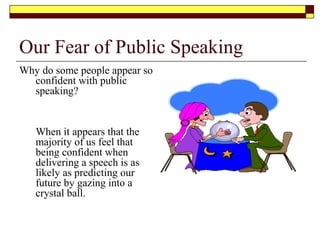
Why do some people appear so
confident with public
speaking?
When it appears that the
majority of us feel that
being confident when
delivering a speech is as
likely as predicting our
future by gazing into a
crystal ball.
Ask the right questions
The reality is that many confident speakers have taken the
time in preparing and practising their speeches. Before even
writing a speech they have addressed and found answers to
the following key questions
 Why they are giving the speech( The Purpose)
 Who they are giving the speech to ( The Audience)
 What they are going to prepare ( Mind to memory)
 Where they are giving the speech.( The physical environment)
 When they are giving the speech
 How they are going to deliver the speech ( Pronunciation and
Protocol)
Get to know your Audience
It is important that you know who is is you are speaking to .
Therefore as part of preparation you must spend time researching and getting to know your audience.
 Background of your audience
 Social/ Economic Background
 Education
 Family/culture
 Work
 Hobbies and Interests
 Age
 Health
 People like to hear
 Simple English
 Simple phrases
 One idea at a time
 Details and facts that are interesting
Our Audience
 People like People who
 Have knowledge of the subject
 Are enthusiastic
 Sincere
 Keep to the specified time
 People dislike people who
 Are late getting started
 Talks to much
 Present too many points and is uninteresting
 Embarrass or offends them
 Has a displeasing voice
 Avoids involving the audience
 Speaks on a topic that the audience cannot relate to
Activity: Know your audience
Watch the following video
“Public Speaking- From Speaking zero to
speaking hero”
Jot down some key points regarding knowing
your audience
Generating your ideas

Think of your audience
 What should they know ?
 What they could know?
 What would they find new and interesting?
 What is the time allowed to complete the presentation?
 What can I credibly handle?
 What resources can I use to prepare my speech?
Generating your ideas (cont)

Resources
 Libraries
 Bibliographies
 Microfilms
 Newspapers
 Books, Dictionaries, Speeches
 Tourist guides
 Television/ radio
 Internet
Generating your ideas (cont)
 Personal
 Own experiences and observations
 Others experiences
 Quotations
 Statistics e.g. "33% of workers pay goes into tax".
 Definitions
 Phrases or advertising jingles that set images
Hint: Carry a note book to jot down any useful words and phrases
Use a mind map as a method to jot down and brainstorm your ideas. PLease refer to the following video link
for a guide as to how to develop a mind map
Structure your speech- Introduction
 Format for a 20 minute speech
 Introduction (tell the audience what you are to tell them) (minutes
 Attention getter
 Establish relevance
 Preview of main points
Structure your speech- Discussion
 Format for a 20 minute speech
 Discussion/body (tell them) (15 minutes)
 Arranged logically( using roman numerals) and supported with data
 I first point- supporting data
 II second point- supporting data
 III Third point-supporting data
Structure your speech- Conclusion
 Format for a 20 minute speech
 Conclusion (tell them what you told them) (minutes
 Review of key points
 End with finality
 Memorial statement to denote power in the last sentence
 Go back to attention getter
 If you transfer only the main headings onto your palm cards with no more than
2-3 brief points under each one they will be easier to read and follow
 Refer to the following video on writing and structuring your speech
Introduction -Ways to commence your speech
 State a startling fact
 Ask a question
 Tell a joke
 Present a quotation
 Give an example,
illustration, story
 Refer to the occasion
 Point to an historic event
 Complement the audience;
sincerely
 Use a gimmick
 Emphasise an important part
of the subject
 Be silent
Conclusion
 Preparing a conclusion
 Ensure the speech ends on time
 End with conviction
 End on target.
 Ways to end a speech
 Use one of the attention getting techniques
 Return to the theme of your attention getter
 Point to the future
 Call for action
 Tie in with whatever may follow your speech
Ways to improve clarity in your speech
 Keep sentence length short. Maximum 8 -10 words
 Put one major idea into a sentence
 Avoid unrelated statements
 Avoid complex words
 Check for reliability and relevance
 Keep in the same tense
 Acknowledge sources
Ways to improve clarity in your speech
 Substitute ACTIVE voice for PASSIVE voice
 Avoid unnecessary words and phrases
 Keep writing in the formal tone
 Avoid judgement statements . Remain factual and
objective
 Avoid being subjective or emotive
 Avoid language that may offend
Tips when using note cards
 Points on cards should be specific
 Write on just one side
 Write your notes so that you wont have trouble seeing them
 Number the cards
 Write on the card the first sentence of the introduction
 Careful when you use old business cards. Can be distracting
Practise, Practise, Practise
 Read the material aloud.
Checking on word
pronunciation
 Remember ideas not words
 Practise mentally so that a
visual picture is formed
 Rehearse from note cards many
times. With all key ideas on
cards
 Go through entire speech every
time you practice including
rough spots
 Practice with audiovisual aids
 Practice with gestures 1 -2
times
When practising be mindful of your
body language and gestures.
 Rehearse your beginning
 Rehearse your ending in front of
mirror so you can determine what
kind of impact you are making.
 Stand and say your speech in the
corner of a room. You can then hear
the sound of your voice as it is
heard by your audience.
 Tape record yourself and make
changes to timing, tone and
modulation
 Time your speech
 Evaluate yourself or rehearse in
front of family and friends and ask
them to evaluate you.
 Say entire speech at bedtime the
night before
Ways to remember your speech
 Concentrate
 Observe closely
 Get your impressions and ideas through as many
sense as possible
 Use Repetition and rehearsal for optimum impact.
 Link persons name with facial features
 Dates - associate them with prominent events
 Use of mnemonics
 Link last words of last sentence to first words of new
one
Appearance on the Day
It is always important that you "Dress
to impress your audience" Here are
some tips on dress code and
appearance
Attire
Business attire
Glasses
 Make sure they fit snugly
 If using bifocals considering
substituting to full frame as
creates a impression looking
down
Jewellery Avoid
 Dangling earrings
 Dangling bracelets
 Remove all jewellery for TV
appearances
Avoid Distracting Clothing
 Bright colours near the neck
 Scarves that obscure part of
the face
Avoid Distracting Gestures
 Looking at the ceiling
 Scowling
 Obsessive preening
 Shifting feet side to
side
 Toe Tapping
 Drumming fingers
 Shuffling notes
 Frequent touching of
face
 Pacing back and
forward
 Playing with jewellery
 Removing and
replacing glasses
 Jangling change in
pockets
Overcoming nerves
Everyone gets nervous when speaking. Accept nervous energy as normal response
and that you will make a better performance than not being in that state. The day
you are not nervous when giving the speech is the day that your speech will
decline. Remember your audience is there to support you and is not there to see
you fail. Here are some tips for overcoming nervous tension
 Clench and release your hands
 Take deep breaths
 Drink water
 Avoid coffee and milk
 run lounge over teeth to prevent dry mouth
 When standing stand with your legs slightly bent and one foot in
front of the other for a balanced posture
Eye contact
“Inspiration is neither in the skies above or the depths below"
 1. Look at your notes
 2. Absorb one idea
 3. Look at the audience and engage the eyes of a person.
 4. Speak to that person then to his neighbour for 5 seconds
 5. Then swing your eyes across the group
 6. Look down at notes
 7. Speak to another person
 8. Vary your eye contact
Managing Questions
Answering a question
 Look directly at the questioner while they are asking the question
 Then direct answer to the whole audience
 Don't forget the persons name that asked the question
 Don't Interrupt a person before they are finished
 Don't fail to pay attention to the purpose of the question
 Don't use the old cliche " That is a good question"
 Don't get distracted in your answer
Dealing with difficult questions
 Be courteous
 Never get into an argument
 Always take control of the situation
Managing Questions
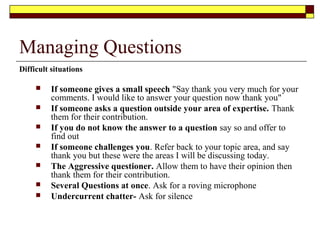
Difficult situations
 If someone gives a small speech "Say thank you very much for your
comments. I would like to answer your question now thank you"
 If someone asks a question outside your area of expertise. Thank
them for their contribution.
 If you do not know the answer to a question say so and offer to
find out
 If someone challenges you. Refer back to your topic area, and say
thank you but these were the areas I will be discussing today.
 The Aggressive questioner. Allow them to have their opinion then
thank them for their contribution.
 Several Questions at once. Ask for a roving microphone
 Undercurrent chatter- Ask for silence
Other difficult situations
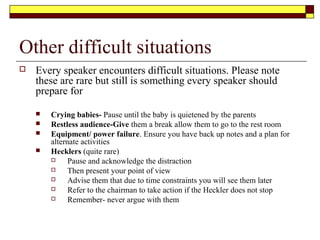
 Every speaker encounters difficult situations. Please note
these are rare but still is something every speaker should
prepare for
 Crying babies- Pause until the baby is quietened by the parents
 Restless audience-Give them a break allow them to go to the rest room
 Equipment/ power failure. Ensure you have back up notes and a plan for
alternate activities
 Hecklers (quite rare)
 Pause and acknowledge the distraction
 Then present your point of view
 Advise them that due to time constraints you will see them later
 Refer to the chairman to take action if the Heckler does not stop
 Remember- never argue with them
Tips for using power point
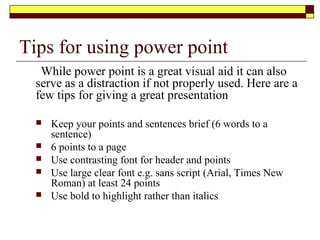
While power point is a great visual aid it can also
serve as a distraction if not properly used. Here are a
few tips for giving a great presentation
 Keep your points and sentences brief (6 words to a
sentence)
 6 points to a page
 Use contrasting font for header and points
 Use large clear font e.g. sans script (Arial, Times New
Roman) at least 24 points
 Use bold to highlight rather than italics
Tips for using power point (cont)
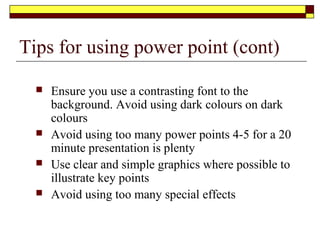
 Ensure you use a contrasting font to the
background. Avoid using dark colours on dark
colours
 Avoid using too many power points 4-5 for a 20
minute presentation is plenty
 Use clear and simple graphics where possible to
illustrate key points
 Avoid using too many special effects
In the Future
Remember Public Speaking is a ongoing
journey of development and discovery and an
area you can never stop learning in.
Here is a collection of resources to further
develop your skills and knowledge.
All the best with your career.
Resources
 Public Speaking and resources
https://www.box.com/shared/t75bz0634r
Link to the following
http://nfphub.wordpress.com/2013/05/27/public-speaking-resources/
 American Rhetoric
 Various articles on public speaking
 History place -speeches
Resources videos and downloads
(cont)
Videos
copy and paste if link is broken
(http://www.flickr.com/photos/communityleasership/sets/7215
7633734036232/
Body language
Gestures
Presentation skills
ABC Speeches
Guide to using power point
Guide to giving presentations
Inspiring speeches of 20th
Century
Martin Luther I have a dream
How to write a speech
Example of a speech for Practise
J.F Kennedy's Inaugural
 We observe today not a victory of party but a celebration of freedom, symbolising an end as well as a
beginning, signifying renewal as well as change. For I have sworn before you and Almighty God the
same solemn oath our forebears prescribed nearly a century and three quarters ago.
 So, let us begin anew, remembering on both sides that civility is not a sign of weakness, and sincerity is
always subject to proof- Let us never negotiate out of fear, but let us never fear to negotiate.
 Let both sides explore what problems unite use instead of belabouring those problems which divide us
 Let both sides, for the first time, formulate serious and precise proposals for the inspection and control of
arms, and bring the absolute power to destroy other nations under the absolute control of all nations.
 Let both sides seek to invoke the wonders of science instead of its terrors. Together let us explore the
stars, conquer the deserts, eradicate disease, tap the ocean depths and encourage the arts and commerce.
 Let both sides unite to heed in all corners of the earth the command if Isaiah to “Undo the heavy burdens
let the oppressed go free.
 And if a benchmark of co-operation may push back the jungle of suspicion, let both sides join in creating
a new endeavour , not a new balance of power, but a new world of law, where the strong are just and the
weak secure and the peace preserved.

Public speaking

  • 1.
    Public Speaking (Keys toSuccess) Developed by Narelle Stoll May 2013
  • 2.
    Overview of Session For most of us the thought of public speaking rates up there with some of our greatest fears in life.  However once the fear is overcome the benefits are enormous in terms of personal confidence and even career development.  What this course aims to do is to provide you with tools in order for you to gain confidence in public speaking
  • 3.
    Our Fear ofPublic Speaking Why do some people appear so confident with public speaking? When it appears that the majority of us feel that being confident when delivering a speech is as likely as predicting our future by gazing into a crystal ball.
  • 4.
    Ask the rightquestions The reality is that many confident speakers have taken the time in preparing and practising their speeches. Before even writing a speech they have addressed and found answers to the following key questions  Why they are giving the speech( The Purpose)  Who they are giving the speech to ( The Audience)  What they are going to prepare ( Mind to memory)  Where they are giving the speech.( The physical environment)  When they are giving the speech  How they are going to deliver the speech ( Pronunciation and Protocol)
  • 5.
    Get to knowyour Audience It is important that you know who is is you are speaking to . Therefore as part of preparation you must spend time researching and getting to know your audience.  Background of your audience  Social/ Economic Background  Education  Family/culture  Work  Hobbies and Interests  Age  Health  People like to hear  Simple English  Simple phrases  One idea at a time  Details and facts that are interesting
  • 6.
    Our Audience  Peoplelike People who  Have knowledge of the subject  Are enthusiastic  Sincere  Keep to the specified time  People dislike people who  Are late getting started  Talks to much  Present too many points and is uninteresting  Embarrass or offends them  Has a displeasing voice  Avoids involving the audience  Speaks on a topic that the audience cannot relate to
  • 7.
    Activity: Know youraudience Watch the following video “Public Speaking- From Speaking zero to speaking hero” Jot down some key points regarding knowing your audience
  • 8.
    Generating your ideas  Thinkof your audience  What should they know ?  What they could know?  What would they find new and interesting?  What is the time allowed to complete the presentation?  What can I credibly handle?  What resources can I use to prepare my speech?
  • 9.
    Generating your ideas(cont)  Resources  Libraries  Bibliographies  Microfilms  Newspapers  Books, Dictionaries, Speeches  Tourist guides  Television/ radio  Internet
  • 10.
    Generating your ideas(cont)  Personal  Own experiences and observations  Others experiences  Quotations  Statistics e.g. "33% of workers pay goes into tax".  Definitions  Phrases or advertising jingles that set images Hint: Carry a note book to jot down any useful words and phrases Use a mind map as a method to jot down and brainstorm your ideas. PLease refer to the following video link for a guide as to how to develop a mind map
  • 11.
    Structure your speech-Introduction  Format for a 20 minute speech  Introduction (tell the audience what you are to tell them) (minutes  Attention getter  Establish relevance  Preview of main points
  • 12.
    Structure your speech-Discussion  Format for a 20 minute speech  Discussion/body (tell them) (15 minutes)  Arranged logically( using roman numerals) and supported with data  I first point- supporting data  II second point- supporting data  III Third point-supporting data
  • 13.
    Structure your speech-Conclusion  Format for a 20 minute speech  Conclusion (tell them what you told them) (minutes  Review of key points  End with finality  Memorial statement to denote power in the last sentence  Go back to attention getter  If you transfer only the main headings onto your palm cards with no more than 2-3 brief points under each one they will be easier to read and follow  Refer to the following video on writing and structuring your speech
  • 14.
    Introduction -Ways tocommence your speech  State a startling fact  Ask a question  Tell a joke  Present a quotation  Give an example, illustration, story  Refer to the occasion  Point to an historic event  Complement the audience; sincerely  Use a gimmick  Emphasise an important part of the subject  Be silent
  • 15.
    Conclusion  Preparing aconclusion  Ensure the speech ends on time  End with conviction  End on target.  Ways to end a speech  Use one of the attention getting techniques  Return to the theme of your attention getter  Point to the future  Call for action  Tie in with whatever may follow your speech
  • 16.
    Ways to improveclarity in your speech  Keep sentence length short. Maximum 8 -10 words  Put one major idea into a sentence  Avoid unrelated statements  Avoid complex words  Check for reliability and relevance  Keep in the same tense  Acknowledge sources
  • 17.
    Ways to improveclarity in your speech  Substitute ACTIVE voice for PASSIVE voice  Avoid unnecessary words and phrases  Keep writing in the formal tone  Avoid judgement statements . Remain factual and objective  Avoid being subjective or emotive  Avoid language that may offend
  • 18.
    Tips when usingnote cards  Points on cards should be specific  Write on just one side  Write your notes so that you wont have trouble seeing them  Number the cards  Write on the card the first sentence of the introduction  Careful when you use old business cards. Can be distracting
  • 19.
    Practise, Practise, Practise Read the material aloud. Checking on word pronunciation  Remember ideas not words  Practise mentally so that a visual picture is formed  Rehearse from note cards many times. With all key ideas on cards  Go through entire speech every time you practice including rough spots  Practice with audiovisual aids  Practice with gestures 1 -2 times When practising be mindful of your body language and gestures.  Rehearse your beginning  Rehearse your ending in front of mirror so you can determine what kind of impact you are making.  Stand and say your speech in the corner of a room. You can then hear the sound of your voice as it is heard by your audience.  Tape record yourself and make changes to timing, tone and modulation  Time your speech  Evaluate yourself or rehearse in front of family and friends and ask them to evaluate you.  Say entire speech at bedtime the night before
  • 20.
    Ways to rememberyour speech  Concentrate  Observe closely  Get your impressions and ideas through as many sense as possible  Use Repetition and rehearsal for optimum impact.  Link persons name with facial features  Dates - associate them with prominent events  Use of mnemonics  Link last words of last sentence to first words of new one
  • 21.
    Appearance on theDay It is always important that you "Dress to impress your audience" Here are some tips on dress code and appearance Attire Business attire Glasses  Make sure they fit snugly  If using bifocals considering substituting to full frame as creates a impression looking down Jewellery Avoid  Dangling earrings  Dangling bracelets  Remove all jewellery for TV appearances Avoid Distracting Clothing  Bright colours near the neck  Scarves that obscure part of the face
  • 22.
    Avoid Distracting Gestures Looking at the ceiling  Scowling  Obsessive preening  Shifting feet side to side  Toe Tapping  Drumming fingers  Shuffling notes  Frequent touching of face  Pacing back and forward  Playing with jewellery  Removing and replacing glasses  Jangling change in pockets
  • 23.
    Overcoming nerves Everyone getsnervous when speaking. Accept nervous energy as normal response and that you will make a better performance than not being in that state. The day you are not nervous when giving the speech is the day that your speech will decline. Remember your audience is there to support you and is not there to see you fail. Here are some tips for overcoming nervous tension  Clench and release your hands  Take deep breaths  Drink water  Avoid coffee and milk  run lounge over teeth to prevent dry mouth  When standing stand with your legs slightly bent and one foot in front of the other for a balanced posture
  • 24.
    Eye contact “Inspiration isneither in the skies above or the depths below"  1. Look at your notes  2. Absorb one idea  3. Look at the audience and engage the eyes of a person.  4. Speak to that person then to his neighbour for 5 seconds  5. Then swing your eyes across the group  6. Look down at notes  7. Speak to another person  8. Vary your eye contact
  • 25.
    Managing Questions Answering aquestion  Look directly at the questioner while they are asking the question  Then direct answer to the whole audience  Don't forget the persons name that asked the question  Don't Interrupt a person before they are finished  Don't fail to pay attention to the purpose of the question  Don't use the old cliche " That is a good question"  Don't get distracted in your answer Dealing with difficult questions  Be courteous  Never get into an argument  Always take control of the situation
  • 26.
    Managing Questions Difficult situations If someone gives a small speech "Say thank you very much for your comments. I would like to answer your question now thank you"  If someone asks a question outside your area of expertise. Thank them for their contribution.  If you do not know the answer to a question say so and offer to find out  If someone challenges you. Refer back to your topic area, and say thank you but these were the areas I will be discussing today.  The Aggressive questioner. Allow them to have their opinion then thank them for their contribution.  Several Questions at once. Ask for a roving microphone  Undercurrent chatter- Ask for silence
  • 27.
    Other difficult situations Every speaker encounters difficult situations. Please note these are rare but still is something every speaker should prepare for  Crying babies- Pause until the baby is quietened by the parents  Restless audience-Give them a break allow them to go to the rest room  Equipment/ power failure. Ensure you have back up notes and a plan for alternate activities  Hecklers (quite rare)  Pause and acknowledge the distraction  Then present your point of view  Advise them that due to time constraints you will see them later  Refer to the chairman to take action if the Heckler does not stop  Remember- never argue with them
  • 28.
    Tips for usingpower point While power point is a great visual aid it can also serve as a distraction if not properly used. Here are a few tips for giving a great presentation  Keep your points and sentences brief (6 words to a sentence)  6 points to a page  Use contrasting font for header and points  Use large clear font e.g. sans script (Arial, Times New Roman) at least 24 points  Use bold to highlight rather than italics
  • 29.
    Tips for usingpower point (cont)  Ensure you use a contrasting font to the background. Avoid using dark colours on dark colours  Avoid using too many power points 4-5 for a 20 minute presentation is plenty  Use clear and simple graphics where possible to illustrate key points  Avoid using too many special effects
  • 30.
    In the Future RememberPublic Speaking is a ongoing journey of development and discovery and an area you can never stop learning in. Here is a collection of resources to further develop your skills and knowledge. All the best with your career.
  • 31.
    Resources  Public Speakingand resources https://www.box.com/shared/t75bz0634r Link to the following http://nfphub.wordpress.com/2013/05/27/public-speaking-resources/  American Rhetoric  Various articles on public speaking  History place -speeches
  • 32.
    Resources videos anddownloads (cont) Videos copy and paste if link is broken (http://www.flickr.com/photos/communityleasership/sets/7215 7633734036232/ Body language Gestures Presentation skills ABC Speeches Guide to using power point Guide to giving presentations Inspiring speeches of 20th Century Martin Luther I have a dream How to write a speech
  • 33.
    Example of aspeech for Practise J.F Kennedy's Inaugural  We observe today not a victory of party but a celebration of freedom, symbolising an end as well as a beginning, signifying renewal as well as change. For I have sworn before you and Almighty God the same solemn oath our forebears prescribed nearly a century and three quarters ago.  So, let us begin anew, remembering on both sides that civility is not a sign of weakness, and sincerity is always subject to proof- Let us never negotiate out of fear, but let us never fear to negotiate.  Let both sides explore what problems unite use instead of belabouring those problems which divide us  Let both sides, for the first time, formulate serious and precise proposals for the inspection and control of arms, and bring the absolute power to destroy other nations under the absolute control of all nations.  Let both sides seek to invoke the wonders of science instead of its terrors. Together let us explore the stars, conquer the deserts, eradicate disease, tap the ocean depths and encourage the arts and commerce.  Let both sides unite to heed in all corners of the earth the command if Isaiah to “Undo the heavy burdens let the oppressed go free.  And if a benchmark of co-operation may push back the jungle of suspicion, let both sides join in creating a new endeavour , not a new balance of power, but a new world of law, where the strong are just and the weak secure and the peace preserved.