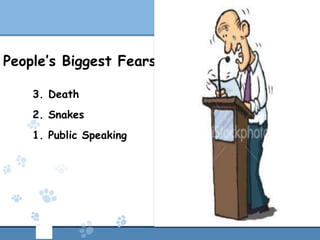
People’s Biggest Fears

    3. Death
    2. Snakes
    1. Public Speaking
•About 10 percent of the
population loves public
speaking.

•Another 10 percent are
genuinely terrified.

•The rest of us – roughly the
80 percent in the middle –
get butterflies, get anxious,
don’t sleep much the night
before – but we know that
we’re going to live through
it. It’s just not much fun.
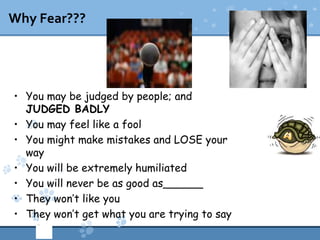
Why Fear???


• You may be judged by people; and
  JUDGED BADLY
• You may feel like a fool
• You might make mistakes and LOSE your
  way
• You will be extremely humiliated
• You will never be as good as______
• They won’t like you
• They won’t get what you are trying to say
Here’s the Good    news: with a little work,
we can turn those butterflies to our advantage.
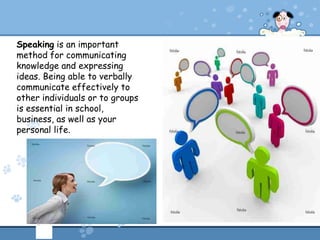
Speaking is an important
method for communicating
knowledge and expressing
ideas. Being able to verbally
communicate effectively to
other individuals or to groups
is essential in school,
business, as well as your
personal life.
Public speaking
opportunities stem
right from the play
school of a child and
the quality gets high as
we mount the ladder of
professional success.
Public speaking skills help you meet
new challenges. Effective public
speakers are able to:


     Speak confidently with new people.
     Choose interesting subjects.
     Organize a speech that captures the
      audience's attention.
     Participate in serious discussions about
      school and community issues.
     Use language properly.
     Be more sensitive to the opinions of
      others.
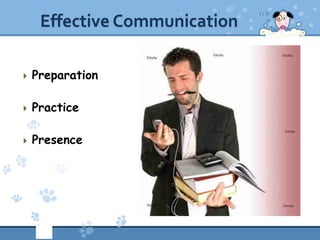
Effective Communication

   Preparation

   Practice

   Presence
Control the “Butterflies”
Relax
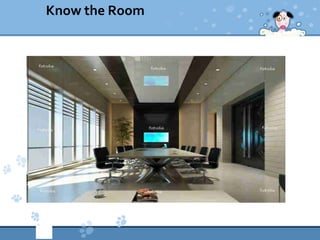
Know the Room
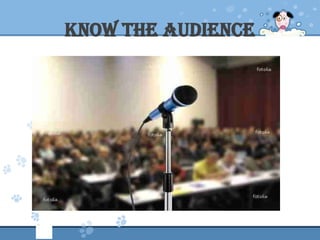
Know the audience
Know your material
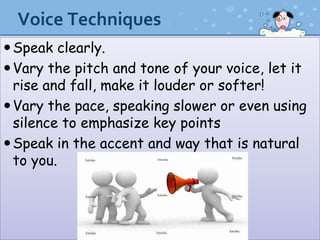
Voice Techniques
 Speak clearly.
 Vary the pitch and tone of your voice, let it
  rise and fall, make it louder or softer!
 Vary the pace, speaking slower or even using
  silence to emphasize key points
 Speak in the accent and way that is natural
  to you.
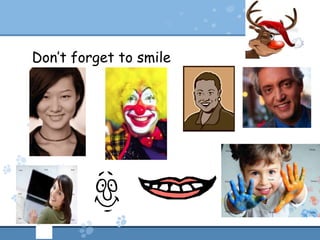
Don’t forget to smile
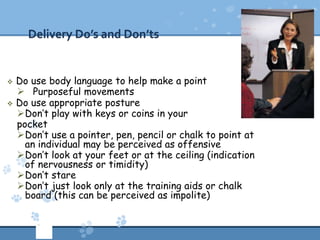
Delivery Do’s and Don’ts


   Do use body language to help make a point
     Purposeful movements
   Do use appropriate posture
    Don’t play with keys or coins in your
    pocket
    Don’t use a pointer, pen, pencil or chalk to point at
      an individual may be perceived as offensive
    Don’t look at your feet or at the ceiling (indication
      of nervousness or timidity)
    Don’t stare
    Don’t just look only at the training aids or chalk
      board (this can be perceived as impolite)
THE 6 “BEs”
OF
EFFECTIVE
PUBLIC SPEAKING:
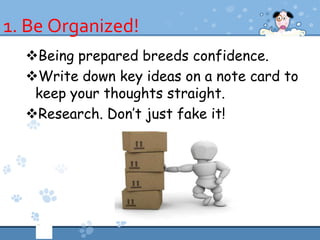
1. Be Organized!
  Being prepared breeds confidence.

  Write down key ideas on a note card to
   keep your thoughts straight.
  Research. Don’t just fake it!
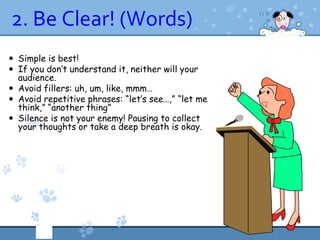
2. Be Clear! (Words)
 Simple is best!
 If you don’t understand it, neither will your
  audience.
 Avoid fillers: uh, um, like, mmm…
 Avoid repetitive phrases: “let’s see…,” “let me
  think,” “another thing”
 Silence is not your enemy! Pausing to collect
  your thoughts or take a deep breath is okay.
3. Be Direct! (Eyes)
 • Make eye contact.
 • Don’t be afraid to look down to collect
   your thoughts but be confident. You know
   the material
 • Make your audience believe!
4. Be Open! (Body Language)
• Posture. Standing up straight makes you
  look like you are in control.
• Open arms.
• Using your hands can be very effective!
• Chin up!
5. Be Vocal! (Voice)
    Volume… VOLUME… VOLUME
    Enunciate
   Speak TO your audience!
   No mumbling!
    Slow down!
6. Be Yourself!

Your audience will forgive your
 nervousness, but they will be
 turned off by fake modesty or
 bravado(BOLDNESS /
 COURAGE).
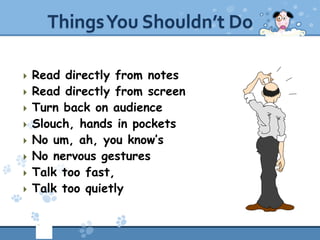
Things You Shouldn’t Do

   Read directly from notes
   Read directly from screen
   Turn back on audience
   Slouch, hands in pockets
   No um, ah, you know’s
   No nervous gestures
   Talk too fast,
   Talk too quietly
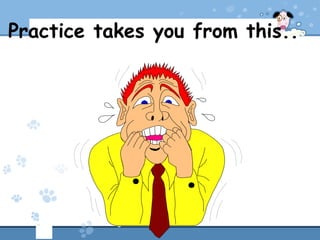
Practice takes you from this..
To this….
Now you will always love PUBLIC SPEAKING !
Best of Luck!
 public speaking

public speaking

  • 1.
    People’s Biggest Fears 3. Death 2. Snakes 1. Public Speaking
  • 2.
    •About 10 percentof the population loves public speaking. •Another 10 percent are genuinely terrified. •The rest of us – roughly the 80 percent in the middle – get butterflies, get anxious, don’t sleep much the night before – but we know that we’re going to live through it. It’s just not much fun.
  • 3.
    Why Fear??? • Youmay be judged by people; and JUDGED BADLY • You may feel like a fool • You might make mistakes and LOSE your way • You will be extremely humiliated • You will never be as good as______ • They won’t like you • They won’t get what you are trying to say
  • 4.
    Here’s the Good news: with a little work, we can turn those butterflies to our advantage.
  • 5.
    Speaking is animportant method for communicating knowledge and expressing ideas. Being able to verbally communicate effectively to other individuals or to groups is essential in school, business, as well as your personal life.
  • 6.
    Public speaking opportunities stem rightfrom the play school of a child and the quality gets high as we mount the ladder of professional success.
  • 7.
    Public speaking skillshelp you meet new challenges. Effective public speakers are able to:  Speak confidently with new people.  Choose interesting subjects.  Organize a speech that captures the audience's attention.  Participate in serious discussions about school and community issues.  Use language properly.  Be more sensitive to the opinions of others.
  • 8.
    Effective Communication  Preparation  Practice  Presence
  • 9.
  • 10.
  • 11.
  • 12.
  • 13.
  • 14.
    Voice Techniques  Speakclearly.  Vary the pitch and tone of your voice, let it rise and fall, make it louder or softer!  Vary the pace, speaking slower or even using silence to emphasize key points  Speak in the accent and way that is natural to you.
  • 15.
  • 16.
    Delivery Do’s andDon’ts  Do use body language to help make a point  Purposeful movements  Do use appropriate posture Don’t play with keys or coins in your pocket Don’t use a pointer, pen, pencil or chalk to point at an individual may be perceived as offensive Don’t look at your feet or at the ceiling (indication of nervousness or timidity) Don’t stare Don’t just look only at the training aids or chalk board (this can be perceived as impolite)
  • 17.
  • 18.
    1. Be Organized! Being prepared breeds confidence. Write down key ideas on a note card to keep your thoughts straight. Research. Don’t just fake it!
  • 19.
    2. Be Clear!(Words)  Simple is best!  If you don’t understand it, neither will your audience.  Avoid fillers: uh, um, like, mmm…  Avoid repetitive phrases: “let’s see…,” “let me think,” “another thing”  Silence is not your enemy! Pausing to collect your thoughts or take a deep breath is okay.
  • 20.
    3. Be Direct!(Eyes) • Make eye contact. • Don’t be afraid to look down to collect your thoughts but be confident. You know the material • Make your audience believe!
  • 21.
    4. Be Open!(Body Language) • Posture. Standing up straight makes you look like you are in control. • Open arms. • Using your hands can be very effective! • Chin up!
  • 22.
    5. Be Vocal!(Voice) Volume… VOLUME… VOLUME Enunciate Speak TO your audience! No mumbling! Slow down!
  • 23.
    6. Be Yourself! Youraudience will forgive your nervousness, but they will be turned off by fake modesty or bravado(BOLDNESS / COURAGE).
  • 24.
    Things You Shouldn’tDo  Read directly from notes  Read directly from screen  Turn back on audience  Slouch, hands in pockets  No um, ah, you know’s  No nervous gestures  Talk too fast,  Talk too quietly
  • 25.
    Practice takes youfrom this..
  • 26.
  • 27.
    Now you willalways love PUBLIC SPEAKING ! Best of Luck!