

21 Secrets
to Becoming A Good Speaker
Dr. Shanker Singh Solanki
Lecturer Deptt. Of English
D.A-V. College, KAnpur
We Present Every Day!
• Not just conference talks….
– Product group meetings
– BillG / TAB meetings
– Preamble to a demo
– Convince a product group to be interested
– Present patent to a lawyer
– Present a group result at offsite
– “Elevator” talks
But I’m not good at it….
• Presentation skills can be acquired.
• Examples:
– Bill Gates
– Kai-Fu Lee
What You’ll Learn Today:
• Communication skills
• Preparing the Talk
• Delivering the Talk
• Handling Q&A
• 21 secrets to becoming a good speaker.
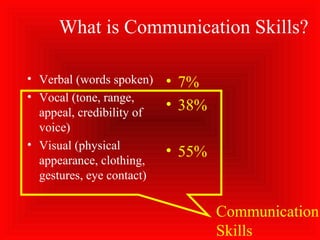
What is Communication Skills?
• Verbal (words spoken)
• Vocal (tone, range,
appeal, credibility of
voice)
• Visual (physical
appearance, clothing,
gestures, eye contact)
• 7%
• 38%
• 55%
Communication
Skills
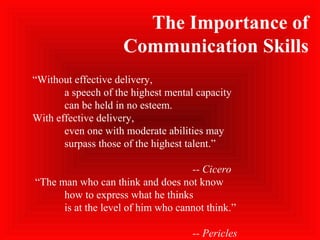
“Without effective delivery,
a speech of the highest mental capacity
can be held in no esteem.
With effective delivery,
even one with moderate abilities may
surpass those of the highest talent.”
-- Cicero
“The man who can think and does not know
how to express what he thinks
is at the level of him who cannot think.”
-- Pericles
The Importance of
Communication Skills
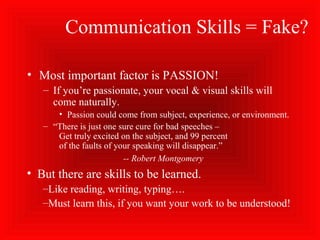
Communication Skills = Fake?
• Most important factor is PASSION!
– If you’re passionate, your vocal & visual skills will
come naturally.
• Passion could come from subject, experience, or environment.
– “There is just one sure cure for bad speeches –
Get truly excited on the subject, and 99 percent
of the faults of your speaking will disappear.”
-- Robert Montgomery
• But there are skills to be learned.
–Like reading, writing, typing….
–Must learn this, if you want your work to be understood!
Verbal Skills
• Be simple and clear!
– Don’t ramble.
– Stop to think if you need to.
– Example one: Dan Quayle celebrates
democracy:
– Example two: Dan Quayle trying to say
“A mind is a terrible thing to waste”
Verbal Skills
• Speaking is not like writing!!!
– Use simple words.
– Don’t use complex sentences.
– Can you understand this:
• Don’t use ambiguous words in speech.
Vocal Skills
• Project & resonate your voice.
• No “UM”s and “ER”s. (Pause instead).
• Silence is a tool (To draw attention).
Vocal Skills
• Play your voice with pitch and tempo.
• To amplify a point, slow down, speak loudly,
exaggerate inotation, pause in the right places.
– “You are right. I am wrong”
– Stalin to Trotsky
– “Ask not what your country can do for you; ask what
you can do for your country”
-- John F. Kennedy
– BAD EXAMPLE : “I welcome this kind of
examination, because people have to know whether
their president is a crook. Well, I’m not a crook.”
-- Richard M. Nixon
• Don’t use it everywhere!
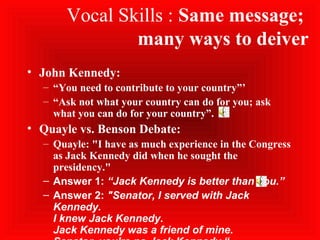
Vocal Skills : Same message;
many ways to deiver
• John Kennedy:
– “You need to contribute to your country”’
– “Ask not what your country can do for you; ask
what you can do for your country”.
• Quayle vs. Benson Debate:
– Quayle: "I have as much experience in the Congress
as Jack Kennedy did when he sought the
presidency."
– Answer 1: “Jack Kennedy is better than you.”
– Answer 2: "Senator, I served with Jack
Kennedy.
I knew Jack Kennedy.
Jack Kennedy was a friend of mine.
Vocal Skills : Enthusiasm
• Passion & Enthusiasm!
– If you’re not passionate, why should we care?
• Example: Martin Luther King
– I have a dream.
That one day
This nation will rise up
Live up to the true meaning to its creed:
We hold these truths to be self-evident
That all men are created equal.
Visual Skills
• Visual Skills – THE most important
– Appear trustworthy & respectful.
– US Election 1960 was won on visual skills.
• Components of Visual Skills
– Eyes
– Body
– Hands
– Face
Visual Skills – Eyes
• Look forward at audience (trust)
– Don’t shift eyeballs; don’t look in corner.
– Don’t look too much at computer screen or
your notes.
• Look at people’s faces (not eyes)
– 3-6 seconds per person.
– Shift randomly.
– Nod, smile, use facial expression.
Visual Skills – Body
• Stand up when talking.
• Walk around = informal.
• Don’t:
– Rock, shake, lean too much.
Visual Skills – Hands
• Gesture complements talk.
– Should come naturally, without thinking.
– Make sure they match!
• Need to exaggerate a little
– Especially with large audience.
• Don’t fidget or put in pocket.
• Videotape whole talk & watch.
Visual Skills – Face
• Show emotion!
• Most of the time:
– “I care a lot about this.”
– “I really believe in this.”
– “I love my work.”
• Sometimes (in response to questions).
– “This is the most outrageous thing I’ve ever heard.”
– “I will have nothing to do with this.”
What You’ll Learn Today:
• Communication skills
• Preparing the Talk
• Delivering the Talk
• Handling Q&A
• 21 secrets to becoming a good speaker.
Preparing the Talk
• Always OVERPREPARE!!!!!
• Preparation includes:
– Researching the background.
– Organizing the talk.
– Writing the slides.
– Rehearsing the talk.
– Last minute things….
Researching the Background
• When you’re invited, find out:
– How long is the talk?
– What’s the topic?
• (Say no if you don’t care about the topic).
– Who’s the audience.
• Once you say yes, you are COMMITTED
to do a great job.
Organizing the Talk
• You’re the salesman.
• First lesson for salesmen:
– “Tell them what you’re going to say.
– Say it.
– Tell them what you said”
• Very similar to your paper!
The Central Message (it)
• People will not remember everything.
• Have ONE clear walk-away message.
– What do you want people to remember in 3
months?
– The answer to the question:
“How was the talk?”
• Repeat it!
The Opening
• Say something provoking!
• Give a (very short) outline/overview.
The Substance
• Logical.
• Convincing.
– Help them remember the message!
– Anticipate doubts & remove them.
• Smooth transitions
– Don’t lose the audience
– OK to re-order the sub-topics.
• Keep repeating the message!
The Ending
• End with a BANG!
• Repeat the message.
• Say thank you.
Writing the Visuals (PowerPoint)
• Prepation (80% time)
– First prepare outline (recommend : Word).
– Then modify outline for:
• Logic onvincing, flow, transitions….
• Actual Slide Writing (20% time)
– Should come almost directly from the outline.
Use of Visuals (PowerPoint)
• Visuals only support your talk.
– Spend more time on your talk!
• Simple and clear
– 1 idea; 3 sub-concepts; <= 6 lines.
– Readable – Big & color-coordinated.
• Don’t read from the slides!
What if Talk is Complex
• Don’t lose people.
– Use grayed out outline.
• If idea is complex:
– Try really hard to avoid complex slides, but…
– If you must use it, use layers (prevent read-
ahead & lack of focus).
• Remember to change slides for printing.
• Example….
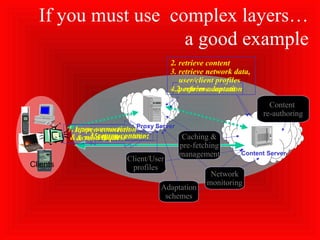
If you must use complex layers…
a good example
Content Server
Proxy Server
Clients
3. return content
1. open connection
& send request
Content
re-authoring
Client/User
profiles
Adaptation
schemes
Network
monitoring
Caching &
pre-fetching
management
2. retrieve content
2. retrieve content
3. retrieve network data,
user/client profiles
4. perform adaptation
5. return content
1. open connection
& send request
Use of Demos / Multimedia
• Keeps the talk interesting.
• Don’t overdo it.
– Should be tied to content.
• Ordering :
– 2,N, N-1, N-2,….3, 1
Rehearsing Your Talk
• Record & listen to every talk at least twice!
• Record:
– Best : PowerPoint features.
– OK : Tape recorder.
– Must do sometime :
• Video
• Ask experienced speaker to critique.
• Improve:
– Style, logic, timing per slide.
Get the Timing Right!
• Running out of time is a disaster.
• Write how much time should remain on
each slide.
After you’re more
experienced….
• No longer necessary to record.
• Every new talk still must be rehearsed.
• Bring notes if you aren’t confident.
Just Before the Talk….
• Prepare something matching the occasion.
• Make sure you’re not too tired:
– Get enough sleep the previous night.
– Drink 3 cups of coffee!
What You’ll Learn Today:
• Communication skills
• Preparing the Talk
• Delivering the Talk
• Handling Q&A
• 21 secrets to becoming a good speaker.
Delivering the Talk
• Overcoming language barrier.
• Overcoming nervousness.
• Art of Good Opening & ending.
• Humor
• Audience participation
Overcoming Language Barrier
• Perfect English not necessary.
• Know your limitations.
– Don’t use fancy words, complex sentences.
– Don’t take any chance of looking silly.
• OK to bring cheat notes!
Outline & Script
• Always make an outline.
– PowerPoint notes; Word Outline.
– Don’t have to use it.
• It may be best to READ a speech.
– No excuse not to be fluent! (practice!)
– Don’t stare at paper.
– (Memorize it if you’re prefer).
Overcoming Nervousness
“Do the thing you fear
and the death of fear is certain.”
-- Ralph Waldo Emerson
Hiding Nervousness
• It is possible to hide nervousness!
• Don’t let the shaking show!
– Make a fist; hold the lectern.
– Speak loudly.
– Take a deep breath.
• Look at a friendly face.
• Look above people’s heads.
Art of Good Opening & Ending
• Opening
– Say something relevant to the occasion.
– Need to research background before the talk.
• Ending
– “If you remember only one thing from this talk,
then you should remember XXX”.
Humor
• Good humor:
– Respectful.
– Relevant (better yet: original).
– Short.
• Plan your jokes:
– Remember what worked.
– Use it again!
Humor
• How to tell a joke?
– Set up (people should know a joke is coming
up).
– Pause after climax (punch line).
• Move on naturally if no reaction!
Audience Participation
• Best way for people to remember!
• Ask audience a question
– Anticipate their answer(s)!
– Respond with something interesting AND
relevant.
Be Yourself
• Learn the skills; don’t copy the styles.
• You must be yourself to be credible.
• Many styles could be effective:
– Bill Gates – Brilliant technologist
– Steve Ballmer – Powerful salesman
– Steve Jobs – Passionate evangelist
What You’ll Learn Today:
• Communication skills
• Preparing the Talk
• Delivering the Talk
• Handling Q&A
• 21 secrets to becoming a good speaker.
Q&A
• Q&A is your chance to:
– Amplify your points.
– Increase your credibility.
Dealing with Questions
• Easy Questions
– Amplify your points!
• Hard Questions
– No need to answer directly.
– But don’t hide!
• Narrow Questions
– Take offline.
Q&A – Giving A Good Answer
• Respect the listener
• Right body language
• Repeat the question
– Complete if people cannot hear.
– Paraphrase to help amplify your point.
• If people are too shy, you start!
• Don’t argue or dismiss a question.
21 Secrets
#1 Anybody can learn to give a good talk.
21 Secrets
#2 Don’t give a talk unless
you’re passionate.
21 Secrets
#3 Use simple and clear words.
21 Secrets
#4 Play your voice to focus on key points.
21 Secrets
#5 Silence is a great tool.
21 Secrets
#6 Overprepare every talk.
21 Secrets
#7 Tell them what you’re going to say.
Say it.
Tell them what you said.
21 Secrets
#8 Have ONE clear central message for:
the question “How was the talk”
21 Secrets
#9 Open your talk with
something thought-provoking
21 Secrets
#10 Slides should be simple & clear.
21 Secrets
#11 Don’t read from your slides.
21 Secrets
#12 Order your demos.
21 Secrets
#13 Rehearse & listen to each talk
at least twice!
21 Secrets
#14 Time your talk on every slide.
21 Secrets
#15 It may be OK to read from a script.
21 Secrets
#16 Stay awake!
Drink 3 cups of coffee before your talk.
21 Secrets
#17 It is possible to hide nervousness.
21 Secrets
#18 Tailor your opening remarks
to the occasion.
21 Secrets
#19 “If you only remember one thing from
this talk, you should remember XXX”
21 Secrets
#20 Humor & Interactivity must be
relevant and well-planned.
21 Secrets
#21 Q&A can help you
more than the audience.
Conclusion
• Giving a talk is easy
• It just takes:
–A little passion
–A lot of practice!
»Thank U 4
»Watching
»Designed & Presented By
»Dr. Shanker Singh Solanki
Lecturer Deptt. Of English
D. A-V. College, Kanpur

21tips of good speaker

  • 1.
    21 Secrets to BecomingA Good Speaker Dr. Shanker Singh Solanki Lecturer Deptt. Of English D.A-V. College, KAnpur
  • 2.
    We Present EveryDay! • Not just conference talks…. – Product group meetings – BillG / TAB meetings – Preamble to a demo – Convince a product group to be interested – Present patent to a lawyer – Present a group result at offsite – “Elevator” talks
  • 3.
    But I’m notgood at it…. • Presentation skills can be acquired. • Examples: – Bill Gates – Kai-Fu Lee
  • 4.
    What You’ll LearnToday: • Communication skills • Preparing the Talk • Delivering the Talk • Handling Q&A • 21 secrets to becoming a good speaker.
  • 5.
    What is CommunicationSkills? • Verbal (words spoken) • Vocal (tone, range, appeal, credibility of voice) • Visual (physical appearance, clothing, gestures, eye contact) • 7% • 38% • 55% Communication Skills
  • 6.
    “Without effective delivery, aspeech of the highest mental capacity can be held in no esteem. With effective delivery, even one with moderate abilities may surpass those of the highest talent.” -- Cicero “The man who can think and does not know how to express what he thinks is at the level of him who cannot think.” -- Pericles The Importance of Communication Skills
  • 7.
    Communication Skills =Fake? • Most important factor is PASSION! – If you’re passionate, your vocal & visual skills will come naturally. • Passion could come from subject, experience, or environment. – “There is just one sure cure for bad speeches – Get truly excited on the subject, and 99 percent of the faults of your speaking will disappear.” -- Robert Montgomery • But there are skills to be learned. –Like reading, writing, typing…. –Must learn this, if you want your work to be understood!
  • 8.
    Verbal Skills • Besimple and clear! – Don’t ramble. – Stop to think if you need to. – Example one: Dan Quayle celebrates democracy: – Example two: Dan Quayle trying to say “A mind is a terrible thing to waste”
  • 9.
    Verbal Skills • Speakingis not like writing!!! – Use simple words. – Don’t use complex sentences. – Can you understand this: • Don’t use ambiguous words in speech.
  • 10.
    Vocal Skills • Project& resonate your voice. • No “UM”s and “ER”s. (Pause instead). • Silence is a tool (To draw attention).
  • 11.
    Vocal Skills • Playyour voice with pitch and tempo. • To amplify a point, slow down, speak loudly, exaggerate inotation, pause in the right places. – “You are right. I am wrong” – Stalin to Trotsky – “Ask not what your country can do for you; ask what you can do for your country” -- John F. Kennedy – BAD EXAMPLE : “I welcome this kind of examination, because people have to know whether their president is a crook. Well, I’m not a crook.” -- Richard M. Nixon • Don’t use it everywhere!
  • 12.
    Vocal Skills :Same message; many ways to deiver • John Kennedy: – “You need to contribute to your country”’ – “Ask not what your country can do for you; ask what you can do for your country”. • Quayle vs. Benson Debate: – Quayle: "I have as much experience in the Congress as Jack Kennedy did when he sought the presidency." – Answer 1: “Jack Kennedy is better than you.” – Answer 2: "Senator, I served with Jack Kennedy. I knew Jack Kennedy. Jack Kennedy was a friend of mine.
  • 13.
    Vocal Skills :Enthusiasm • Passion & Enthusiasm! – If you’re not passionate, why should we care? • Example: Martin Luther King – I have a dream. That one day This nation will rise up Live up to the true meaning to its creed: We hold these truths to be self-evident That all men are created equal.
  • 14.
    Visual Skills • VisualSkills – THE most important – Appear trustworthy & respectful. – US Election 1960 was won on visual skills. • Components of Visual Skills – Eyes – Body – Hands – Face
  • 15.
    Visual Skills –Eyes • Look forward at audience (trust) – Don’t shift eyeballs; don’t look in corner. – Don’t look too much at computer screen or your notes. • Look at people’s faces (not eyes) – 3-6 seconds per person. – Shift randomly. – Nod, smile, use facial expression.
  • 16.
    Visual Skills –Body • Stand up when talking. • Walk around = informal. • Don’t: – Rock, shake, lean too much.
  • 17.
    Visual Skills –Hands • Gesture complements talk. – Should come naturally, without thinking. – Make sure they match! • Need to exaggerate a little – Especially with large audience. • Don’t fidget or put in pocket. • Videotape whole talk & watch.
  • 18.
    Visual Skills –Face • Show emotion! • Most of the time: – “I care a lot about this.” – “I really believe in this.” – “I love my work.” • Sometimes (in response to questions). – “This is the most outrageous thing I’ve ever heard.” – “I will have nothing to do with this.”
  • 19.
    What You’ll LearnToday: • Communication skills • Preparing the Talk • Delivering the Talk • Handling Q&A • 21 secrets to becoming a good speaker.
  • 20.
    Preparing the Talk •Always OVERPREPARE!!!!! • Preparation includes: – Researching the background. – Organizing the talk. – Writing the slides. – Rehearsing the talk. – Last minute things….
  • 21.
    Researching the Background •When you’re invited, find out: – How long is the talk? – What’s the topic? • (Say no if you don’t care about the topic). – Who’s the audience. • Once you say yes, you are COMMITTED to do a great job.
  • 22.
    Organizing the Talk •You’re the salesman. • First lesson for salesmen: – “Tell them what you’re going to say. – Say it. – Tell them what you said” • Very similar to your paper!
  • 23.
    The Central Message(it) • People will not remember everything. • Have ONE clear walk-away message. – What do you want people to remember in 3 months? – The answer to the question: “How was the talk?” • Repeat it!
  • 24.
    The Opening • Saysomething provoking! • Give a (very short) outline/overview.
  • 25.
    The Substance • Logical. •Convincing. – Help them remember the message! – Anticipate doubts & remove them. • Smooth transitions – Don’t lose the audience – OK to re-order the sub-topics. • Keep repeating the message!
  • 26.
    The Ending • Endwith a BANG! • Repeat the message. • Say thank you.
  • 27.
    Writing the Visuals(PowerPoint) • Prepation (80% time) – First prepare outline (recommend : Word). – Then modify outline for: • Logic onvincing, flow, transitions…. • Actual Slide Writing (20% time) – Should come almost directly from the outline.
  • 28.
    Use of Visuals(PowerPoint) • Visuals only support your talk. – Spend more time on your talk! • Simple and clear – 1 idea; 3 sub-concepts; <= 6 lines. – Readable – Big & color-coordinated. • Don’t read from the slides!
  • 29.
    What if Talkis Complex • Don’t lose people. – Use grayed out outline. • If idea is complex: – Try really hard to avoid complex slides, but… – If you must use it, use layers (prevent read- ahead & lack of focus). • Remember to change slides for printing. • Example….
  • 30.
    If you mustuse complex layers… a good example Content Server Proxy Server Clients 3. return content 1. open connection & send request Content re-authoring Client/User profiles Adaptation schemes Network monitoring Caching & pre-fetching management 2. retrieve content 2. retrieve content 3. retrieve network data, user/client profiles 4. perform adaptation 5. return content 1. open connection & send request
  • 31.
    Use of Demos/ Multimedia • Keeps the talk interesting. • Don’t overdo it. – Should be tied to content. • Ordering : – 2,N, N-1, N-2,….3, 1
  • 32.
    Rehearsing Your Talk •Record & listen to every talk at least twice! • Record: – Best : PowerPoint features. – OK : Tape recorder. – Must do sometime : • Video • Ask experienced speaker to critique. • Improve: – Style, logic, timing per slide.
  • 33.
    Get the TimingRight! • Running out of time is a disaster. • Write how much time should remain on each slide.
  • 34.
    After you’re more experienced…. •No longer necessary to record. • Every new talk still must be rehearsed. • Bring notes if you aren’t confident.
  • 35.
    Just Before theTalk…. • Prepare something matching the occasion. • Make sure you’re not too tired: – Get enough sleep the previous night. – Drink 3 cups of coffee!
  • 36.
    What You’ll LearnToday: • Communication skills • Preparing the Talk • Delivering the Talk • Handling Q&A • 21 secrets to becoming a good speaker.
  • 37.
    Delivering the Talk •Overcoming language barrier. • Overcoming nervousness. • Art of Good Opening & ending. • Humor • Audience participation
  • 38.
    Overcoming Language Barrier •Perfect English not necessary. • Know your limitations. – Don’t use fancy words, complex sentences. – Don’t take any chance of looking silly. • OK to bring cheat notes!
  • 39.
    Outline & Script •Always make an outline. – PowerPoint notes; Word Outline. – Don’t have to use it. • It may be best to READ a speech. – No excuse not to be fluent! (practice!) – Don’t stare at paper. – (Memorize it if you’re prefer).
  • 40.
    Overcoming Nervousness “Do thething you fear and the death of fear is certain.” -- Ralph Waldo Emerson
  • 41.
    Hiding Nervousness • Itis possible to hide nervousness! • Don’t let the shaking show! – Make a fist; hold the lectern. – Speak loudly. – Take a deep breath. • Look at a friendly face. • Look above people’s heads.
  • 42.
    Art of GoodOpening & Ending • Opening – Say something relevant to the occasion. – Need to research background before the talk. • Ending – “If you remember only one thing from this talk, then you should remember XXX”.
  • 43.
    Humor • Good humor: –Respectful. – Relevant (better yet: original). – Short. • Plan your jokes: – Remember what worked. – Use it again!
  • 44.
    Humor • How totell a joke? – Set up (people should know a joke is coming up). – Pause after climax (punch line). • Move on naturally if no reaction!
  • 45.
    Audience Participation • Bestway for people to remember! • Ask audience a question – Anticipate their answer(s)! – Respond with something interesting AND relevant.
  • 46.
    Be Yourself • Learnthe skills; don’t copy the styles. • You must be yourself to be credible. • Many styles could be effective: – Bill Gates – Brilliant technologist – Steve Ballmer – Powerful salesman – Steve Jobs – Passionate evangelist
  • 47.
    What You’ll LearnToday: • Communication skills • Preparing the Talk • Delivering the Talk • Handling Q&A • 21 secrets to becoming a good speaker.
  • 48.
    Q&A • Q&A isyour chance to: – Amplify your points. – Increase your credibility.
  • 49.
    Dealing with Questions •Easy Questions – Amplify your points! • Hard Questions – No need to answer directly. – But don’t hide! • Narrow Questions – Take offline.
  • 50.
    Q&A – GivingA Good Answer • Respect the listener • Right body language • Repeat the question – Complete if people cannot hear. – Paraphrase to help amplify your point. • If people are too shy, you start! • Don’t argue or dismiss a question.
  • 51.
    21 Secrets #1 Anybodycan learn to give a good talk.
  • 52.
    21 Secrets #2 Don’tgive a talk unless you’re passionate.
  • 53.
    21 Secrets #3 Usesimple and clear words.
  • 54.
    21 Secrets #4 Playyour voice to focus on key points.
  • 55.
    21 Secrets #5 Silenceis a great tool.
  • 56.
  • 57.
    21 Secrets #7 Tellthem what you’re going to say. Say it. Tell them what you said.
  • 58.
    21 Secrets #8 HaveONE clear central message for: the question “How was the talk”
  • 59.
    21 Secrets #9 Openyour talk with something thought-provoking
  • 60.
    21 Secrets #10 Slidesshould be simple & clear.
  • 61.
    21 Secrets #11 Don’tread from your slides.
  • 62.
  • 63.
    21 Secrets #13 Rehearse& listen to each talk at least twice!
  • 64.
    21 Secrets #14 Timeyour talk on every slide.
  • 65.
    21 Secrets #15 Itmay be OK to read from a script.
  • 66.
    21 Secrets #16 Stayawake! Drink 3 cups of coffee before your talk.
  • 67.
    21 Secrets #17 Itis possible to hide nervousness.
  • 68.
    21 Secrets #18 Tailoryour opening remarks to the occasion.
  • 69.
    21 Secrets #19 “Ifyou only remember one thing from this talk, you should remember XXX”
  • 70.
    21 Secrets #20 Humor& Interactivity must be relevant and well-planned.
  • 71.
    21 Secrets #21 Q&Acan help you more than the audience.
  • 72.
    Conclusion • Giving atalk is easy • It just takes: –A little passion –A lot of practice!
  • 73.
    »Thank U 4 »Watching »Designed& Presented By »Dr. Shanker Singh Solanki Lecturer Deptt. Of English D. A-V. College, Kanpur

Editor's Notes

  • #2 This talk is about the vision of the future computing at Microsoft. In this talk, I will introduce the history of MSR talk about our vision, and why we believe in it talk about a few of our many projects show you some demonstrations and conclude by telling you about the new lab we opened in China Since in China, not as many people know about MSR, let me start with an introduction….
  • #43 Intonation -- Stalin vs. Trotsky “You are right. I am wrong”.