Public Speaking
-Anand Kumar
What is Public Speaking ?
• Public speaking is an act of performing a speech in front of live audience.
• “The process of speaking to a group of people in a structured deliberate
manner intended to inform, influence or entertain the
listeners.”_Wikipedia.
• “A speech is a formal address or discourse delivered to an
audience.”_Oxford English Dictionary.
• “A speech is a talk or address delivered to an audience.”_ The Collins
English Dictionary.
Speaker or Trainer ??
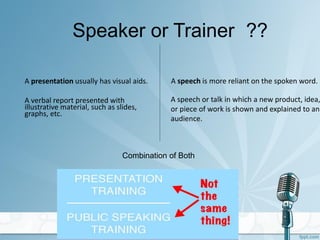
A presentation usually has visual aids. A speech is more reliant on the spoken word.
A speech or talk in which a new product, idea,
or piece of work is shown and explained to an
audience.
A verbal report presented with
illustrative material, such as slides,
graphs, etc.
Combination of Both
Evolution of public speaking
• Our current knowledge and practice of public speaking draws upon
ancient Greek, Roman, and Western thought.
• The Classical Period – 500 - 300 BC
• The ancient Greeks – Effective speeches as part of their citizen duties. No
Lawyers.
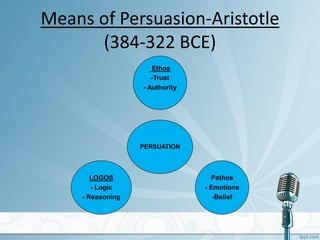
• Aristotle (384-322 BCE), the most famous Greek Scholar, defined rhetoric
as the “faculty of discovering the possible means of persuasion in
reference to any subject whatever.” He divided the “means of persuasion”
into three parts—
logical reason (Logos),
human character (Ethos),
and emotional (Pathos)
Means of Persuasion-Aristotle
(384-322 BCE)
PERSUATION
Ethos
-Trust
- Authority
Pathos
- Emotions
-Belief
LOGOS
- Logic
- Reasoning
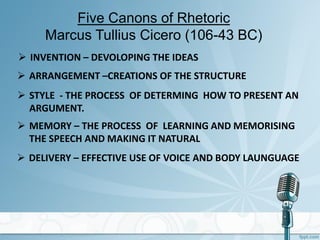
Five Canons of Rhetoric
Marcus Tullius Cicero (106-43 BC)
 INVENTION – DEVOLOPING THE IDEAS
 ARRANGEMENT –CREATIONS OF THE STRUCTURE
 STYLE - THE PROCESS OF DETERMING HOW TO PRESENT AN
ARGUMENT.
 MEMORY – THE PROCESS OF LEARNING AND MEMORISING
THE SPEECH AND MAKING IT NATURAL
 DELIVERY – EFFECTIVE USE OF VOICE AND BODY LAUNGUAGE
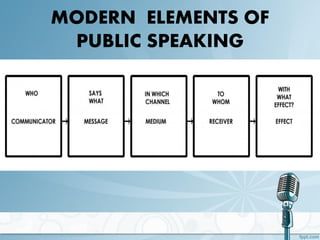
MODERN ELEMENTS OF
PUBLIC SPEAKING
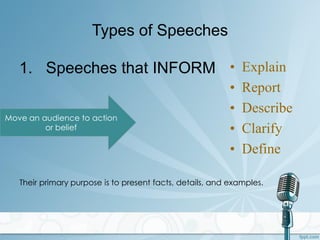
Types of Speeches
1. Speeches that INFORM • Explain
• Report
• Describe
• Clarify
• Define
Their primary purpose is to present facts, details, and examples.
Move an audience to action
or belief
Types of Speeches
2. Speeches that persuade
Designed to convince
or influence beliefs
or attitudes
Designed to convince and
influence the audience’s
beliefs or attitudes
Speaker uses his credibility or appeal to audience emotions
or sense of right or wrong.
Types of Speeches
3. Speeches that entertain.
Use humour to
influence an
audience.
Great ease and elegance and depends to a large
degree on the charisma of the speaker.
Once the audience is
warmed up, one main idea is
presented
Types of Speaker
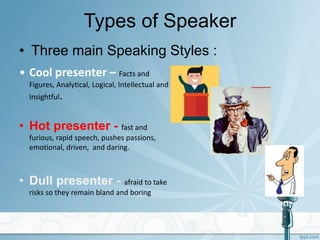
• Three main Speaking Styles :
• Hot presenter - fast and
furious, rapid speech, pushes passions,
emotional, driven, and daring.
• Cool presenter – Facts and
Figures, Analytical, Logical, Intellectual and
Insightful.
• Dull presenter - afraid to take
risks so they remain bland and boring .
How to prepare a public speech
1. MEDITATE UPON THE TOPIC
2. RESEARCH VARIOUS DIMENSIONS OF THE TOPIC THROUGH.
• OUR OWN EXPERIENCE
• FAMOUS SCHOLARS AND BOOKS
• DISSCUSSIONS
• WEBSITES
3. KNOW YOUR AUDIENCE
• Size of the Group.
• Mix of the Group
4. FRAME THE SPEECH
4. PRACTICE – START TO END & END TO SART
Framing The Speech
• INTRODUCTION
• BODY
• CONCLUSION
Introduction
• GAIN ATTENTION IN THE OPENING
• IT CAN BE DONE BY:
• QUOTAIONS
• QUESTIONS
• HUMOR
• INTRODUCTION SHOULD INDICATE YOUR TOPIC
• WIIFM
Body
• ELABORATE THE SUBJECT.
• DIVISION THE SUBJECT.
• PUT RELAVENT EXAMPLES TO SUPPORT YOUR STAND.
• DEVELOP POINTS
• ADD SUPERLATIVES
CONCLUSION
• RESTATE THE SUBJECT
• SUMMARISE THE KEY POINTS
• TAKE COMMITMENT
• GIVE A STATEMENT OF THE CONCLUSION – MAIN MESSAGE
During the Speech
• Body Language.
• Eye Contact.
• Lag Time.
Must Do’s in a public speaking
1. Smile and have fun
2. Speak loud
3. Relax
4. Be yourself
5. Know your Audience
6. Be confident
7. Claim Attention
8. Wrap up your speech on time
9. Be flexible
10.Connect with your people during the presentation
11.Face your Audience
12.Use more gestures
13.Use simple and understandable language
Don'ts in a public speaking
1. Do not fear
2. Do not rush through your presentation
3. Do not stick your hands in your pockets
4. Do not underestimate your Audience
5. Do not point fingers
6. Do not hurt people feelings
7. Do not dictate
8. Avoid unbecoming language
9. Avoid repetition of the works or phrase
10.Do not put-up an aggressive face
11.Don’t make things which you are not sure about
• Warm ups.
– Breathing.
– Lips. …FA
– Tounge
– Lips----Frrrr
– Whooozzz
– Tounge Clean.
Tips for overcoming fear
Public speaking anand kumar

Public speaking anand kumar

  • 1.
  • 2.
    What is PublicSpeaking ? • Public speaking is an act of performing a speech in front of live audience. • “The process of speaking to a group of people in a structured deliberate manner intended to inform, influence or entertain the listeners.”_Wikipedia. • “A speech is a formal address or discourse delivered to an audience.”_Oxford English Dictionary. • “A speech is a talk or address delivered to an audience.”_ The Collins English Dictionary.
  • 3.
    Speaker or Trainer?? A presentation usually has visual aids. A speech is more reliant on the spoken word. A speech or talk in which a new product, idea, or piece of work is shown and explained to an audience. A verbal report presented with illustrative material, such as slides, graphs, etc. Combination of Both
  • 4.
    Evolution of publicspeaking • Our current knowledge and practice of public speaking draws upon ancient Greek, Roman, and Western thought. • The Classical Period – 500 - 300 BC • The ancient Greeks – Effective speeches as part of their citizen duties. No Lawyers. • Aristotle (384-322 BCE), the most famous Greek Scholar, defined rhetoric as the “faculty of discovering the possible means of persuasion in reference to any subject whatever.” He divided the “means of persuasion” into three parts— logical reason (Logos), human character (Ethos), and emotional (Pathos)
  • 5.
    Means of Persuasion-Aristotle (384-322BCE) PERSUATION Ethos -Trust - Authority Pathos - Emotions -Belief LOGOS - Logic - Reasoning
  • 6.
    Five Canons ofRhetoric Marcus Tullius Cicero (106-43 BC)  INVENTION – DEVOLOPING THE IDEAS  ARRANGEMENT –CREATIONS OF THE STRUCTURE  STYLE - THE PROCESS OF DETERMING HOW TO PRESENT AN ARGUMENT.  MEMORY – THE PROCESS OF LEARNING AND MEMORISING THE SPEECH AND MAKING IT NATURAL  DELIVERY – EFFECTIVE USE OF VOICE AND BODY LAUNGUAGE
  • 7.
  • 8.
    Types of Speeches 1.Speeches that INFORM • Explain • Report • Describe • Clarify • Define Their primary purpose is to present facts, details, and examples. Move an audience to action or belief
  • 9.
    Types of Speeches 2.Speeches that persuade Designed to convince or influence beliefs or attitudes Designed to convince and influence the audience’s beliefs or attitudes Speaker uses his credibility or appeal to audience emotions or sense of right or wrong.
  • 10.
    Types of Speeches 3.Speeches that entertain. Use humour to influence an audience. Great ease and elegance and depends to a large degree on the charisma of the speaker. Once the audience is warmed up, one main idea is presented
  • 11.
    Types of Speaker •Three main Speaking Styles : • Hot presenter - fast and furious, rapid speech, pushes passions, emotional, driven, and daring. • Cool presenter – Facts and Figures, Analytical, Logical, Intellectual and Insightful. • Dull presenter - afraid to take risks so they remain bland and boring .
  • 12.
    How to preparea public speech 1. MEDITATE UPON THE TOPIC 2. RESEARCH VARIOUS DIMENSIONS OF THE TOPIC THROUGH. • OUR OWN EXPERIENCE • FAMOUS SCHOLARS AND BOOKS • DISSCUSSIONS • WEBSITES 3. KNOW YOUR AUDIENCE • Size of the Group. • Mix of the Group 4. FRAME THE SPEECH 4. PRACTICE – START TO END & END TO SART
  • 13.
    Framing The Speech •INTRODUCTION • BODY • CONCLUSION
  • 14.
    Introduction • GAIN ATTENTIONIN THE OPENING • IT CAN BE DONE BY: • QUOTAIONS • QUESTIONS • HUMOR • INTRODUCTION SHOULD INDICATE YOUR TOPIC • WIIFM
  • 15.
    Body • ELABORATE THESUBJECT. • DIVISION THE SUBJECT. • PUT RELAVENT EXAMPLES TO SUPPORT YOUR STAND. • DEVELOP POINTS • ADD SUPERLATIVES
  • 16.
    CONCLUSION • RESTATE THESUBJECT • SUMMARISE THE KEY POINTS • TAKE COMMITMENT • GIVE A STATEMENT OF THE CONCLUSION – MAIN MESSAGE
  • 17.
    During the Speech •Body Language. • Eye Contact. • Lag Time.
  • 18.
    Must Do’s ina public speaking 1. Smile and have fun 2. Speak loud 3. Relax 4. Be yourself 5. Know your Audience 6. Be confident 7. Claim Attention 8. Wrap up your speech on time 9. Be flexible 10.Connect with your people during the presentation 11.Face your Audience 12.Use more gestures 13.Use simple and understandable language
  • 19.
    Don'ts in apublic speaking 1. Do not fear 2. Do not rush through your presentation 3. Do not stick your hands in your pockets 4. Do not underestimate your Audience 5. Do not point fingers 6. Do not hurt people feelings 7. Do not dictate 8. Avoid unbecoming language 9. Avoid repetition of the works or phrase 10.Do not put-up an aggressive face 11.Don’t make things which you are not sure about
  • 20.
    • Warm ups. –Breathing. – Lips. …FA – Tounge – Lips----Frrrr – Whooozzz – Tounge Clean. Tips for overcoming fear