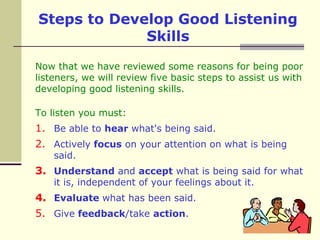
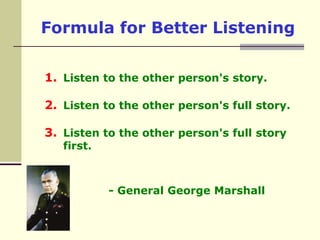
Do You Hear What I Hear?Clear communication is vital for good business and the first step to clear communication is listening with understanding.Pretend the speaker’s words contain the most important message you’ll ever receive. Stick to what he or she is actually saying, not what you think he or she is saying.
Listen with UnderstandingListening is a difficult skill that few people ever learn. Experts say the average person has 25% listening efficiency.Listening with understanding, is more than just sitting back and letting words flow into your ears.Listening is an active skill that is at least as hard as talking, maybe harder. There is no real communication unless the listener understands, accepts, and will take action based on what was said. The person who develops good listening skills has a head start on providing the best solutions based on information obtained during conversations.
The Three Basic Listening ModesCompetitive or Combative Listening happens when we are more interested in promoting our own point of view than in understanding or exploring someone else’s view. We either listen for openings to take the floor, or for flaws or weak points we can attack. As we pretend to pay attention we are impatiently waiting for an opening, or internally formulating our rebuttal and planning our devastating comeback that will destroy their argument and make us the victor.
The Three Basic Listening ModesIn Passive or Attentive Listening we are genuinely interested in hearing and understanding the other person’s point of view. We are attentive and passively listen. We assume that we heard and understand correctly, but stay passive and do not verify it.
The Three Basic Listening ModesActive or Reflective Listening is the single most useful and important listening skill. We are genuinely interested in understanding what the other person is thinking, feeling, wanting or what the message means, and we are active in checking out our understanding before we respond with our own new message. We restate or paraphrase our understanding of their message and reflect it back to the sender for verification. This verification or feedback process is what distinguishes active listening and makes it effective.
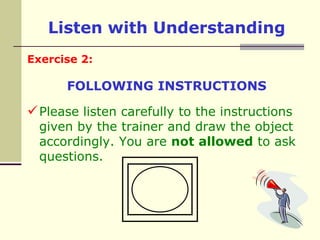
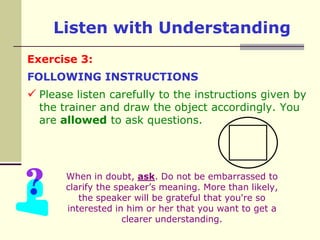
Listen with UnderstandingExercise 1:REPEATING A MESSAGE CORRECTLYOne person will be told a message. Please listen carefully to the message and repeat it quietly to the person next to you.The last person to hear the message will repeat it back to the trainer.Listen with UnderstandingExercise 2:FOLLOWING INSTRUCTIONSPlease listen carefully to the instructions given by the trainer and draw the object accordingly. You are not allowed to ask questions.Listen with UnderstandingExercise 3:FOLLOWING INSTRUCTIONSPlease listen carefully to the instructions given by the trainer and draw the object accordingly. You are allowed to ask questions.When in doubt, ask. Do not be embarrassed toclarify the speaker’s meaning. More than likely,the speaker will be grateful that you're sointerested in him or her that you want to get aclearer understanding.
Reasons Why We are Poor ListenersDo you have any of these difficulties?  Chances are you do.Place a check mark beside the listening difficulties that you experiencethe most.You think ten times faster than you speak.
You have several things on your mind at once.
You were not trained to listen.
While someone is talking, you are mentally rehearsing your response.
You get busy thinking about why the speaker's ideas won't work.
You may not be sure what the speaker is talking about, due to an inability to get the point across or unfamiliar vocabulary.
Personal prejudices to the speaker's age, sex, cultural background or disbelief of what is being said.
Jumping to conclusions; reading into the speaker's words.
The person may not be speaking loudly enough, there's too much environmental noise, or you have a physical hearing problem.Understand & ImproveThere are ways you can improve your listening. Just understandingthat you may have a listening problem is a big step toward improving your listening skills!
Helpful Hints on Listening More EffectivelyIf the speaker is speaking softly, ask him to speak louder. Block out any and all distractions around you, and focus on what the speaker is saying.Allow the speaker time to talk without you interrupting. Be patient and do not speak, even if you do not agree with what is being said.Do not mentally rehearse your response while the speaker is talking; rehearsing causes more lost listening than anything else. If you think you will forget, jot down highlights of the conversation to help you evaluate the situation.Ask clarifying questions if you don't understand what is being said.Listen for hidden messages. Paraphrase what you think you heard, and get agreement from the speaker.
Helpful Hints on Listening More Effectively (cont’d)Listen for the main message. Do not get distracted by side issues that are brought up by the speaker.Do not allow the speaker's language selection and usage to keep you from making a good decision.Evaluate the good points before you evaluate the bad ones. Weigh all the evidence presented. Was it logical, did it make sense and was it complete?After paraphrasing, give your interpretation and opinions to the speaker.Decide exactly what you and the speaker agreed on and tell the speaker what actions you can or cannot take, and why.

Listening Skills

  • 2.
    Do You HearWhat I Hear?Clear communication is vital for good business and the first step to clear communication is listening with understanding.Pretend the speaker’s words contain the most important message you’ll ever receive. Stick to what he or she is actually saying, not what you think he or she is saying.
  • 3.
    Listen with UnderstandingListeningis a difficult skill that few people ever learn. Experts say the average person has 25% listening efficiency.Listening with understanding, is more than just sitting back and letting words flow into your ears.Listening is an active skill that is at least as hard as talking, maybe harder. There is no real communication unless the listener understands, accepts, and will take action based on what was said. The person who develops good listening skills has a head start on providing the best solutions based on information obtained during conversations.
  • 4.
    The Three BasicListening ModesCompetitive or Combative Listening happens when we are more interested in promoting our own point of view than in understanding or exploring someone else’s view. We either listen for openings to take the floor, or for flaws or weak points we can attack. As we pretend to pay attention we are impatiently waiting for an opening, or internally formulating our rebuttal and planning our devastating comeback that will destroy their argument and make us the victor.
  • 5.
    The Three BasicListening ModesIn Passive or Attentive Listening we are genuinely interested in hearing and understanding the other person’s point of view. We are attentive and passively listen. We assume that we heard and understand correctly, but stay passive and do not verify it.
  • 6.
    The Three BasicListening ModesActive or Reflective Listening is the single most useful and important listening skill. We are genuinely interested in understanding what the other person is thinking, feeling, wanting or what the message means, and we are active in checking out our understanding before we respond with our own new message. We restate or paraphrase our understanding of their message and reflect it back to the sender for verification. This verification or feedback process is what distinguishes active listening and makes it effective.
  • 7.
    Listen with UnderstandingExercise1:REPEATING A MESSAGE CORRECTLYOne person will be told a message. Please listen carefully to the message and repeat it quietly to the person next to you.The last person to hear the message will repeat it back to the trainer.Listen with UnderstandingExercise 2:FOLLOWING INSTRUCTIONSPlease listen carefully to the instructions given by the trainer and draw the object accordingly. You are not allowed to ask questions.Listen with UnderstandingExercise 3:FOLLOWING INSTRUCTIONSPlease listen carefully to the instructions given by the trainer and draw the object accordingly. You are allowed to ask questions.When in doubt, ask. Do not be embarrassed toclarify the speaker’s meaning. More than likely,the speaker will be grateful that you're sointerested in him or her that you want to get aclearer understanding.
  • 8.
    Reasons Why Weare Poor ListenersDo you have any of these difficulties? Chances are you do.Place a check mark beside the listening difficulties that you experiencethe most.You think ten times faster than you speak.
  • 9.
    You have severalthings on your mind at once.
  • 10.
    You were nottrained to listen.
  • 11.
    While someone istalking, you are mentally rehearsing your response.
  • 12.
    You get busythinking about why the speaker's ideas won't work.
  • 13.
    You may notbe sure what the speaker is talking about, due to an inability to get the point across or unfamiliar vocabulary.
  • 14.
    Personal prejudices tothe speaker's age, sex, cultural background or disbelief of what is being said.
  • 15.
    Jumping to conclusions;reading into the speaker's words.
  • 16.
    The person maynot be speaking loudly enough, there's too much environmental noise, or you have a physical hearing problem.Understand & ImproveThere are ways you can improve your listening. Just understandingthat you may have a listening problem is a big step toward improving your listening skills!
  • 17.
    Helpful Hints onListening More EffectivelyIf the speaker is speaking softly, ask him to speak louder. Block out any and all distractions around you, and focus on what the speaker is saying.Allow the speaker time to talk without you interrupting. Be patient and do not speak, even if you do not agree with what is being said.Do not mentally rehearse your response while the speaker is talking; rehearsing causes more lost listening than anything else. If you think you will forget, jot down highlights of the conversation to help you evaluate the situation.Ask clarifying questions if you don't understand what is being said.Listen for hidden messages. Paraphrase what you think you heard, and get agreement from the speaker.
  • 18.
    Helpful Hints onListening More Effectively (cont’d)Listen for the main message. Do not get distracted by side issues that are brought up by the speaker.Do not allow the speaker's language selection and usage to keep you from making a good decision.Evaluate the good points before you evaluate the bad ones. Weigh all the evidence presented. Was it logical, did it make sense and was it complete?After paraphrasing, give your interpretation and opinions to the speaker.Decide exactly what you and the speaker agreed on and tell the speaker what actions you can or cannot take, and why.