EFFECTIVE LISTENING
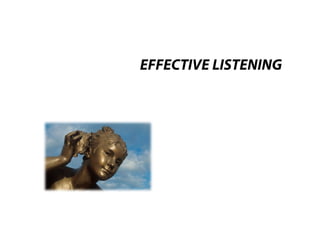
EFFECTIVE LISTENING
1. Listening Facts
2. The Listening Process
3. Bad Listening Habits
4. Barriers to Effective Listening
5. Hearing vs. Listening
6. Types of Listening
7. Guidelines to Effective Listening
LISTENING FACTS

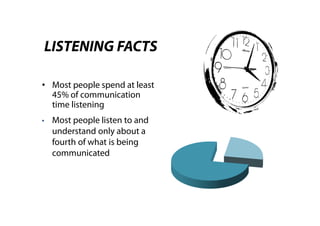
• Most people spend at least
  45% of communication
  time listening
•   Most people listen to and
    understand only about a
    fourth of what is being
    communicated
LISTENING FACTS

• 85% of individuals rate themselves as
  average or worse listeners
• Listening skills poorest when people
  interact with those closest to them. They
  interrupt and jump to conclusions more
  frequently
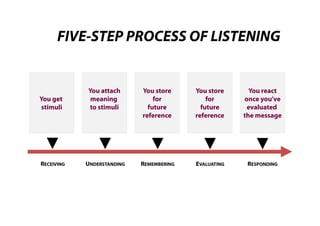
FIVE-STEP PROCESS OF LISTENING


            You attach      You store     You store      You react
You get      meaning            for           for      once you’ve
stimuli     to stimuli        future        future      evaluated
                            reference     reference    the message


RECEIVING   UNDERSTANDING   REMEMBERING   EVALUATING    RESPONDING
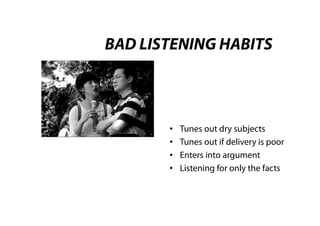
BAD LISTENING HABITS


       •   Tunes out dry subjects
       •   Tunes out if delivery is poor
       •   Enters into argument
       •   Listening for only the facts
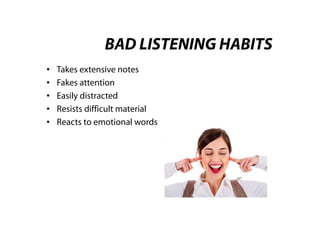
BAD LISTENING HABITS
•   Takes extensive notes
•   Fakes attention
•   Easily distracted
•   Resists difficult material
•   Reacts to emotional words
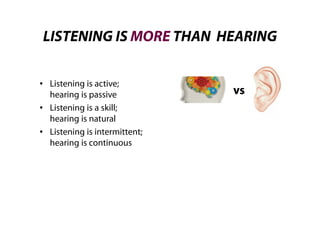
LISTENING IS MORE THAN HEARING

• Listening is active;
  hearing is passive           vs
• Listening is a skill;
  hearing is natural
• Listening is intermittent;
  hearing is continuous
Listening implies a choice.
    You must choose to
participate in the process
       of listening.
GUIDELINES FOR
EFFECTIVE LISTENING
     Control the Environment
                       Be Alert
         Be Mentally Prepared
      Be Emotionally Prepared
   Judge content, not delivery
             Provide feedback
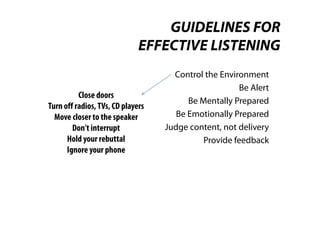
GUIDELINES FOR
                              EFFECTIVE LISTENING
                                     Control the Environment
                                                       Be Alert
          Close doors
                                         Be Mentally Prepared
Turn off radios, TVs, CD players
  Move closer to the speaker          Be Emotionally Prepared
        Don’t interrupt            Judge content, not delivery
      Hold your rebuttal                     Provide feedback
      Ignore your phone
GUIDELINES FOR
                           EFFECTIVE LISTENING
                                Control the Environment
                                                  Be Alert
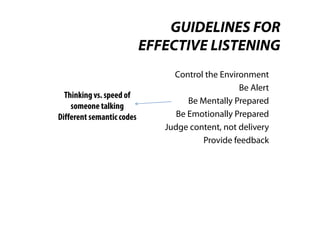
  Thinking vs. speed of
                                    Be Mentally Prepared
    someone talking
Different semantic codes         Be Emotionally Prepared
                              Judge content, not delivery
                                        Provide feedback
GUIDELINES FOR
                      EFFECTIVE LISTENING
                           Control the Environment
                                             Be Alert
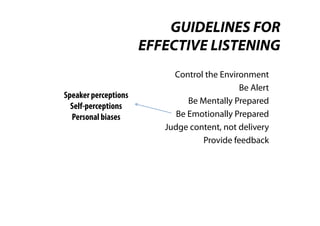
Speaker perceptions
                               Be Mentally Prepared
  Self-perceptions
  Personal biases           Be Emotionally Prepared
                         Judge content, not delivery
                                   Provide feedback
GUIDELINES FOR
EFFECTIVE LISTENING
     Control the Environment
                       Be Alert
         Be Mentally Prepared
      Be Emotionally Prepared
   Judge content, not delivery
             Provide feedback
EFFECTIVE LISTENING

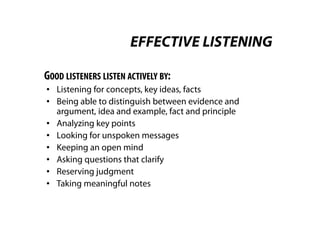
GOOD LISTENERS LISTEN ACTIVELY BY:
• Listening for concepts, key ideas, facts
• Being able to distinguish between evidence and
  argument, idea and example, fact and principle
• Analyzing key points
• Looking for unspoken messages
• Keeping an open mind
• Asking questions that clarify
• Reserving judgment
• Taking meaningful notes
THANK YOU!


               All image licensed under
             creative commons licenses

Effective listening

  • 1.
  • 2.
    EFFECTIVE LISTENING 1. ListeningFacts 2. The Listening Process 3. Bad Listening Habits 4. Barriers to Effective Listening 5. Hearing vs. Listening 6. Types of Listening 7. Guidelines to Effective Listening
  • 3.
    LISTENING FACTS • Mostpeople spend at least 45% of communication time listening • Most people listen to and understand only about a fourth of what is being communicated
  • 4.
    LISTENING FACTS • 85%of individuals rate themselves as average or worse listeners • Listening skills poorest when people interact with those closest to them. They interrupt and jump to conclusions more frequently
  • 5.
    FIVE-STEP PROCESS OFLISTENING You attach You store You store You react You get meaning for for once you’ve stimuli to stimuli future future evaluated reference reference the message RECEIVING UNDERSTANDING REMEMBERING EVALUATING RESPONDING
  • 6.
    BAD LISTENING HABITS • Tunes out dry subjects • Tunes out if delivery is poor • Enters into argument • Listening for only the facts
  • 7.
    BAD LISTENING HABITS • Takes extensive notes • Fakes attention • Easily distracted • Resists difficult material • Reacts to emotional words
  • 8.
    LISTENING IS MORETHAN HEARING • Listening is active; hearing is passive vs • Listening is a skill; hearing is natural • Listening is intermittent; hearing is continuous
  • 9.
    Listening implies achoice. You must choose to participate in the process of listening.
  • 10.
    GUIDELINES FOR EFFECTIVE LISTENING Control the Environment Be Alert Be Mentally Prepared Be Emotionally Prepared Judge content, not delivery Provide feedback
  • 11.
    GUIDELINES FOR EFFECTIVE LISTENING Control the Environment Be Alert Close doors Be Mentally Prepared Turn off radios, TVs, CD players Move closer to the speaker Be Emotionally Prepared Don’t interrupt Judge content, not delivery Hold your rebuttal Provide feedback Ignore your phone
  • 12.
    GUIDELINES FOR EFFECTIVE LISTENING Control the Environment Be Alert Thinking vs. speed of Be Mentally Prepared someone talking Different semantic codes Be Emotionally Prepared Judge content, not delivery Provide feedback
  • 13.
    GUIDELINES FOR EFFECTIVE LISTENING Control the Environment Be Alert Speaker perceptions Be Mentally Prepared Self-perceptions Personal biases Be Emotionally Prepared Judge content, not delivery Provide feedback
  • 14.
    GUIDELINES FOR EFFECTIVE LISTENING Control the Environment Be Alert Be Mentally Prepared Be Emotionally Prepared Judge content, not delivery Provide feedback
  • 15.
    EFFECTIVE LISTENING GOOD LISTENERSLISTEN ACTIVELY BY: • Listening for concepts, key ideas, facts • Being able to distinguish between evidence and argument, idea and example, fact and principle • Analyzing key points • Looking for unspoken messages • Keeping an open mind • Asking questions that clarify • Reserving judgment • Taking meaningful notes
  • 16.
    THANK YOU! All image licensed under creative commons licenses