#RSAC
SESSION ID:
James Christiansen Bradley J. Schaufenbuel, CISSP
Don’t Get Left in the Dust:
How to Evolve from CISO to CIRO
CXO-W04
Director of Information Security
Midland States Bank
bschaufenbuel@midlandsb.com
VP – Information Risk Management
Accuvant
jchristiansen@accuvant.com
JC-JC
#RSAC
Agenda
 The Evolution of the Role
 Drivers of CIRO Emergence
 What Makes the CIRO Different
 Making the Transition
 How to Apply
 Summary
JC-JC
CIRO
2
#RSAC
Introduction
 The security landscape is
changing.
 There is a disconnect between the
objectives of the traditional CISO
and the businesses they serve.
 It is time to evolve with the
organizations we serve.
JC-JC
3
#RSAC
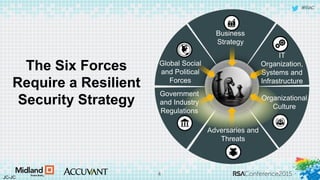
The Six Forces
Require a Resilient
Security Strategy
Business
Strategy
Global Social
and Political
Forces
Government
and Industry
Regulations
Adversaries and
Threats
Organizational
Culture
IT
Organization,
Systems and
Infrastructure
JC-JC
4
#RSAC
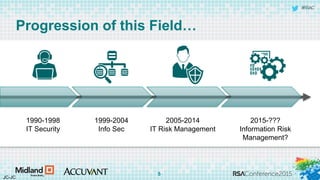
Progression of this Field…
1990-1998
IT Security
1999-2004
Info Sec
2005-2014
IT Risk Management
2015-???
Information Risk
Management?
JC-JC
5
#RSAC
The Security
Journey
A business aligned strategy includes
understanding the business and compliance
objectives, threats, and risks
AD HOC
INFRASTRUCTURE
BASED
COMPLIANCE
BASED
THREAT BASED
BUSINESS ALIGNED
RISK
BASED
Shortcut =
Failure to
Pass
INTEL DRIVEN
JC-JC
6
#RSAC
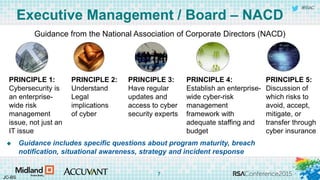
Guidance from the National Association of Corporate Directors (NACD)
Executive Management / Board – NACD
 Guidance includes specific questions about program maturity, breach
notification, situational awareness, strategy and incident response
PRINCIPLE 1:
Cybersecurity is
an enterprise-
wide risk
management
issue, not just an
IT issue
PRINCIPLE 2:
Understand
Legal
implications
of cyber
PRINCIPLE 3:
Have regular
updates and
access to cyber
security experts
PRINCIPLE 4:
Establish an enterprise-
wide cyber-risk
management
framework with
adequate staffing and
budget
PRINCIPLE 5:
Discussion of
which risks to
avoid, accept,
mitigate, or
transfer through
cyber insurance
JC-BS
7
#RSAC
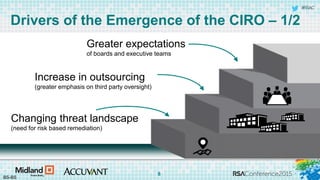
Drivers of the Emergence of the CIRO – 1/2
Increase in outsourcing
(greater emphasis on third party oversight)
Changing threat landscape
(need for risk based remediation)
Greater expectations
of boards and executive teams
BS-BS
8
#RSAC
Drivers of the Emergence
of the CIRO – 2/2
 Misalignment of security
spending with business risk
 Lack of support for taking
calculated risks
 Divergence amongst existing
information governance functions
BS-BS
9
#RSAC
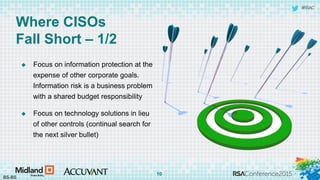
Where CISOs
Fall Short – 1/2
 Focus on information protection at the
expense of other corporate goals.
Information risk is a business problem
with a shared budget responsibility
 Focus on technology solutions in lieu
of other controls (continual search for
the next silver bullet)
BS-BS
10
#RSAC
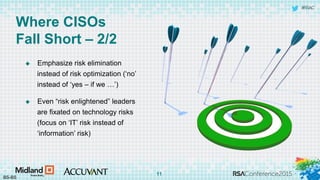
 Emphasize risk elimination
instead of risk optimization (‘no’
instead of ‘yes – if we …’)
 Even “risk enlightened” leaders
are fixated on technology risks
(focus on ‘IT’ risk instead of
‘information’ risk)
Where CISOs
Fall Short – 2/2
BS-BS
11
#RSAC
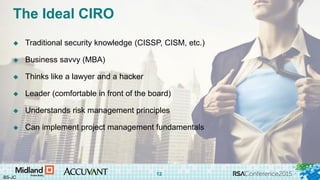
The Ideal CIRO
 Traditional security knowledge (CISSP, CISM, etc.)
 Business savvy (MBA)
 Thinks like a lawyer and a hacker
 Leader (comfortable in front of the board)
 Understands risk management principles
 Can implement project management fundamentals
BS-JC
12
#RSAC
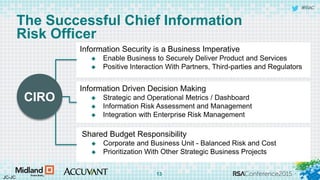
The Successful Chief Information
Risk Officer
CIRO
Information Driven Decision Making
 Strategic and Operational Metrics / Dashboard
 Information Risk Assessment and Management
 Integration with Enterprise Risk Management
Information Security is a Business Imperative
 Enable Business to Securely Deliver Product and Services
 Positive Interaction With Partners, Third-parties and Regulators
Shared Budget Responsibility
 Corporate and Business Unit - Balanced Risk and Cost
 Prioritization With Other Strategic Business Projects
JC-JC
13
#RSAC
What Makes the CIRO Different?
 Organizational profile – Executive
team member with board access
 Organizational alignment – Strategy
dovetails with organization’s
 Depth and breadth of skills
 Business risk based approach
 Leadership
JC-JC
14
#RSAC
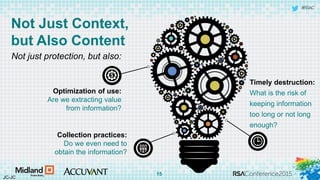
Not Just Context,
but Also Content
Not just protection, but also:
Timely destruction:
What is the risk of
keeping information
too long or not long
enough?
Optimization of use:
Are we extracting value
from information?
Collection practices:
Do we even need to
obtain the information?
JC-JC
15
#RSAC
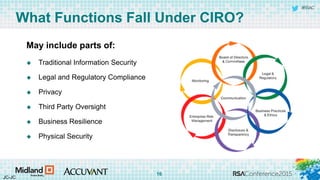
What Functions Fall Under CIRO?
May include parts of:
 Traditional Information Security
 Legal and Regulatory Compliance
 Privacy
 Third Party Oversight
 Business Resilience
 Physical Security
JC-JC
16
#RSAC
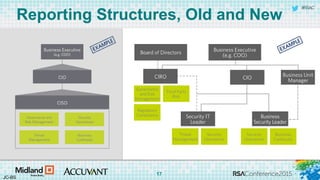
Reporting Structures, Old and New
JC-BS
17
#RSAC
Advantages of New
Organizational Structure
Aligns information risk with business priorities
Visibility into organizational or product changes
Supports shared responsibility for information risk
Ensures that all types of information risk are addressed
Able to address board, executive management and customers
BS-BS
18
#RSAC
Do We Need Another C-Level Position?
 Value of information (and associated risk)
rising.
 Executive composition should parallel
board’s fiduciary duties.
 Consolidation of existing C-level positions
(CPO, CISO / CSO, etc.)
BS-BS
19
#RSAC
Skills Required to Make the CIRO Transition
Thorough understanding of risk management concepts
 Factor Analysis of Information Risk (FAIR)1
1Source: Risk Management Insight (riskmanagementinsight.com)
Executive level communication skills
 Presentation Skills – Toastmasters
 Written Skills – College & Editors / Colleagues
Thorough understanding of your organization’s business,
objectives and growth plans
 Regular meetings with business executives
BS-BS
20
#RSAC
The Information Risk Transformation
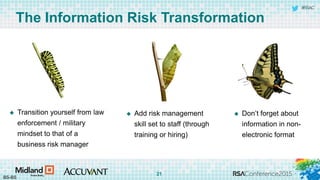
 Transition yourself from law
enforcement / military
mindset to that of a
business risk manager
 Add risk management
skill set to staff (through
training or hiring)
 Don’t forget about
information in non-
electronic format
BS-BS
21
#RSAC
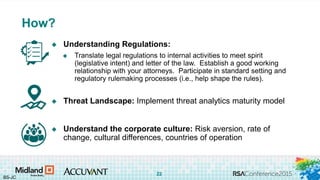
 Understanding Regulations:
 Translate legal regulations to internal activities to meet spirit
(legislative intent) and letter of the law. Establish a good working
relationship with your attorneys. Participate in standard setting and
regulatory rulemaking processes (i.e., help shape the rules).
 Threat Landscape: Implement threat analytics maturity model
 Understand the corporate culture: Risk aversion, rate of
change, cultural differences, countries of operation
How?
BS-JC
22
#RSAC
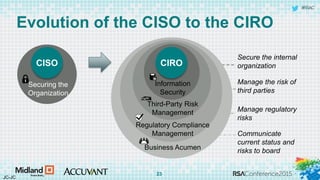
Evolution of the CISO to the CIRO
Securing the
Organization
CISO
Secure the internal
organization
Manage the risk of
third parties
Manage regulatory
risks
Communicate
current status and
risks to boardBusiness Acumen
Regulatory Compliance
Management
Third-Party Risk
Management
Information
Security
CIRO
JC-JC
23
#RSAC
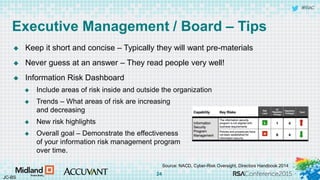
 Keep it short and concise – Typically they will want pre-materials
 Never guess at an answer – They read people very well!
 Information Risk Dashboard
 Include areas of risk inside and outside the organization
 Trends – What areas of risk are increasing
and decreasing
 New risk highlights
 Overall goal – Demonstrate the effectiveness
of your information risk management program
over time.
Executive Management / Board – Tips
Source: NACD, Cyber-Risk Oversight, Directors Handbook 2014
JC-BS
24
#RSAC
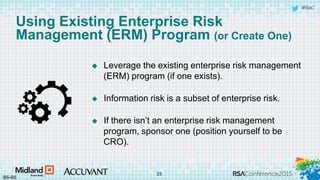
Using Existing Enterprise Risk
Management (ERM) Program (or Create One)
 Leverage the existing enterprise risk management
(ERM) program (if one exists).
 Information risk is a subset of enterprise risk.
 If there isn’t an enterprise risk management
program, sponsor one (position yourself to be
CRO).
BS-BS
25
#RSAC
Leveraging Information Risk
to Drive Value
Concrete Examples:
 Factoring in an information risk discount on an
acquisition valuation / purchase price
 Leveraging fraud and security data to improve
customer experience
BS-JC
26
#RSAC
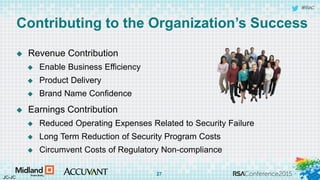
 Revenue Contribution
 Enable Business Efficiency
 Product Delivery
 Brand Name Confidence
 Earnings Contribution
 Reduced Operating Expenses Related to Security Failure
 Long Term Reduction of Security Program Costs
 Circumvent Costs of Regulatory Non-compliance
27
Contributing to the Organization’s Success
JC-JC
#RSAC
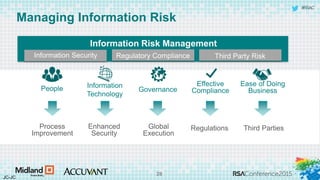
Managing Information Risk
28
Ease of Doing
Business
Effective
Compliance
Information
Technology
GovernancePeople
Information Security Regulatory Compliance Third Party Risk
Information Risk Management
JC-JC
Enhanced
Security
Global
Execution
Process
Improvement
Third PartiesRegulations
#RSAC
The
Reward  Earned respect from organizational peers
 Inclusion in your organization’s strategic
decision making processes and forums
 Perception shifts from marginal cost
center to value adding unit
JC-BS
29
#RSAC
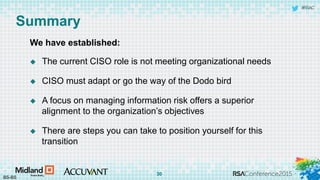
Summary
We have established:
 The current CISO role is not meeting organizational needs
 CISO must adapt or go the way of the Dodo bird
 A focus on managing information risk offers a superior
alignment to the organization’s objectives
 There are steps you can take to position yourself for this
transition
BS-BS
30
#RSAC
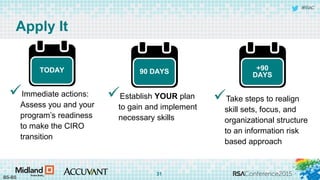
Apply It
TODAY
Immediate actions:
Assess you and your
program’s readiness
to make the CIRO
transition
Establish YOUR plan
to gain and implement
necessary skills
90 DAYS
Take steps to realign
skill sets, focus, and
organizational structure
to an information risk
based approach
+90
DAYS
BS-BS
31
#RSAC
Resources
 The Evolution of the CISO
(accuvant.com/resources/risk-and-the-ciso-
role#sthash.TUMIWWV7.dpuf)
 NACD – Cyber-Risk Oversight Handbook
(nacdonline.org/cyber)
 Introduction to Factor Analysis of Information
Risk (FAIR) (riskmanagementinsight.com)
 Six Forces of Security Strategy
(accuvant.com/resources/accuvants-six-
forces-of-security-strategy)
32
BS-BS
#RSAC
Questions?
jchristiansen@accuvant.com bschaufenbuel@midlandsb.com
33

Don't Get Left In The Dust How To Evolve From Ciso To Ciro

  • 1.
    #RSAC SESSION ID: James ChristiansenBradley J. Schaufenbuel, CISSP Don’t Get Left in the Dust: How to Evolve from CISO to CIRO CXO-W04 Director of Information Security Midland States Bank bschaufenbuel@midlandsb.com VP – Information Risk Management Accuvant jchristiansen@accuvant.com JC-JC
  • 2.
    #RSAC Agenda  The Evolutionof the Role  Drivers of CIRO Emergence  What Makes the CIRO Different  Making the Transition  How to Apply  Summary JC-JC CIRO 2
  • 3.
    #RSAC Introduction  The securitylandscape is changing.  There is a disconnect between the objectives of the traditional CISO and the businesses they serve.  It is time to evolve with the organizations we serve. JC-JC 3
  • 4.
    #RSAC The Six Forces Requirea Resilient Security Strategy Business Strategy Global Social and Political Forces Government and Industry Regulations Adversaries and Threats Organizational Culture IT Organization, Systems and Infrastructure JC-JC 4
  • 5.
    #RSAC Progression of thisField… 1990-1998 IT Security 1999-2004 Info Sec 2005-2014 IT Risk Management 2015-??? Information Risk Management? JC-JC 5
  • 6.
    #RSAC The Security Journey A businessaligned strategy includes understanding the business and compliance objectives, threats, and risks AD HOC INFRASTRUCTURE BASED COMPLIANCE BASED THREAT BASED BUSINESS ALIGNED RISK BASED Shortcut = Failure to Pass INTEL DRIVEN JC-JC 6
  • 7.
    #RSAC Guidance from theNational Association of Corporate Directors (NACD) Executive Management / Board – NACD  Guidance includes specific questions about program maturity, breach notification, situational awareness, strategy and incident response PRINCIPLE 1: Cybersecurity is an enterprise- wide risk management issue, not just an IT issue PRINCIPLE 2: Understand Legal implications of cyber PRINCIPLE 3: Have regular updates and access to cyber security experts PRINCIPLE 4: Establish an enterprise- wide cyber-risk management framework with adequate staffing and budget PRINCIPLE 5: Discussion of which risks to avoid, accept, mitigate, or transfer through cyber insurance JC-BS 7
  • 8.
    #RSAC Drivers of theEmergence of the CIRO – 1/2 Increase in outsourcing (greater emphasis on third party oversight) Changing threat landscape (need for risk based remediation) Greater expectations of boards and executive teams BS-BS 8
  • 9.
    #RSAC Drivers of theEmergence of the CIRO – 2/2  Misalignment of security spending with business risk  Lack of support for taking calculated risks  Divergence amongst existing information governance functions BS-BS 9
  • 10.
    #RSAC Where CISOs Fall Short– 1/2  Focus on information protection at the expense of other corporate goals. Information risk is a business problem with a shared budget responsibility  Focus on technology solutions in lieu of other controls (continual search for the next silver bullet) BS-BS 10
  • 11.
    #RSAC  Emphasize riskelimination instead of risk optimization (‘no’ instead of ‘yes – if we …’)  Even “risk enlightened” leaders are fixated on technology risks (focus on ‘IT’ risk instead of ‘information’ risk) Where CISOs Fall Short – 2/2 BS-BS 11
  • 12.
    #RSAC The Ideal CIRO Traditional security knowledge (CISSP, CISM, etc.)  Business savvy (MBA)  Thinks like a lawyer and a hacker  Leader (comfortable in front of the board)  Understands risk management principles  Can implement project management fundamentals BS-JC 12
  • 13.
    #RSAC The Successful ChiefInformation Risk Officer CIRO Information Driven Decision Making  Strategic and Operational Metrics / Dashboard  Information Risk Assessment and Management  Integration with Enterprise Risk Management Information Security is a Business Imperative  Enable Business to Securely Deliver Product and Services  Positive Interaction With Partners, Third-parties and Regulators Shared Budget Responsibility  Corporate and Business Unit - Balanced Risk and Cost  Prioritization With Other Strategic Business Projects JC-JC 13
  • 14.
    #RSAC What Makes theCIRO Different?  Organizational profile – Executive team member with board access  Organizational alignment – Strategy dovetails with organization’s  Depth and breadth of skills  Business risk based approach  Leadership JC-JC 14
  • 15.
    #RSAC Not Just Context, butAlso Content Not just protection, but also: Timely destruction: What is the risk of keeping information too long or not long enough? Optimization of use: Are we extracting value from information? Collection practices: Do we even need to obtain the information? JC-JC 15
  • 16.
    #RSAC What Functions FallUnder CIRO? May include parts of:  Traditional Information Security  Legal and Regulatory Compliance  Privacy  Third Party Oversight  Business Resilience  Physical Security JC-JC 16
  • 17.
  • 18.
    #RSAC Advantages of New OrganizationalStructure Aligns information risk with business priorities Visibility into organizational or product changes Supports shared responsibility for information risk Ensures that all types of information risk are addressed Able to address board, executive management and customers BS-BS 18
  • 19.
    #RSAC Do We NeedAnother C-Level Position?  Value of information (and associated risk) rising.  Executive composition should parallel board’s fiduciary duties.  Consolidation of existing C-level positions (CPO, CISO / CSO, etc.) BS-BS 19
  • 20.
    #RSAC Skills Required toMake the CIRO Transition Thorough understanding of risk management concepts  Factor Analysis of Information Risk (FAIR)1 1Source: Risk Management Insight (riskmanagementinsight.com) Executive level communication skills  Presentation Skills – Toastmasters  Written Skills – College & Editors / Colleagues Thorough understanding of your organization’s business, objectives and growth plans  Regular meetings with business executives BS-BS 20
  • 21.
    #RSAC The Information RiskTransformation  Transition yourself from law enforcement / military mindset to that of a business risk manager  Add risk management skill set to staff (through training or hiring)  Don’t forget about information in non- electronic format BS-BS 21
  • 22.
    #RSAC  Understanding Regulations: Translate legal regulations to internal activities to meet spirit (legislative intent) and letter of the law. Establish a good working relationship with your attorneys. Participate in standard setting and regulatory rulemaking processes (i.e., help shape the rules).  Threat Landscape: Implement threat analytics maturity model  Understand the corporate culture: Risk aversion, rate of change, cultural differences, countries of operation How? BS-JC 22
  • 23.
    #RSAC Evolution of theCISO to the CIRO Securing the Organization CISO Secure the internal organization Manage the risk of third parties Manage regulatory risks Communicate current status and risks to boardBusiness Acumen Regulatory Compliance Management Third-Party Risk Management Information Security CIRO JC-JC 23
  • 24.
    #RSAC  Keep itshort and concise – Typically they will want pre-materials  Never guess at an answer – They read people very well!  Information Risk Dashboard  Include areas of risk inside and outside the organization  Trends – What areas of risk are increasing and decreasing  New risk highlights  Overall goal – Demonstrate the effectiveness of your information risk management program over time. Executive Management / Board – Tips Source: NACD, Cyber-Risk Oversight, Directors Handbook 2014 JC-BS 24
  • 25.
    #RSAC Using Existing EnterpriseRisk Management (ERM) Program (or Create One)  Leverage the existing enterprise risk management (ERM) program (if one exists).  Information risk is a subset of enterprise risk.  If there isn’t an enterprise risk management program, sponsor one (position yourself to be CRO). BS-BS 25
  • 26.
    #RSAC Leveraging Information Risk toDrive Value Concrete Examples:  Factoring in an information risk discount on an acquisition valuation / purchase price  Leveraging fraud and security data to improve customer experience BS-JC 26
  • 27.
    #RSAC  Revenue Contribution Enable Business Efficiency  Product Delivery  Brand Name Confidence  Earnings Contribution  Reduced Operating Expenses Related to Security Failure  Long Term Reduction of Security Program Costs  Circumvent Costs of Regulatory Non-compliance 27 Contributing to the Organization’s Success JC-JC
  • 28.
    #RSAC Managing Information Risk 28 Easeof Doing Business Effective Compliance Information Technology GovernancePeople Information Security Regulatory Compliance Third Party Risk Information Risk Management JC-JC Enhanced Security Global Execution Process Improvement Third PartiesRegulations
  • 29.
    #RSAC The Reward  Earnedrespect from organizational peers  Inclusion in your organization’s strategic decision making processes and forums  Perception shifts from marginal cost center to value adding unit JC-BS 29
  • 30.
    #RSAC Summary We have established: The current CISO role is not meeting organizational needs  CISO must adapt or go the way of the Dodo bird  A focus on managing information risk offers a superior alignment to the organization’s objectives  There are steps you can take to position yourself for this transition BS-BS 30
  • 31.
    #RSAC Apply It TODAY Immediate actions: Assessyou and your program’s readiness to make the CIRO transition Establish YOUR plan to gain and implement necessary skills 90 DAYS Take steps to realign skill sets, focus, and organizational structure to an information risk based approach +90 DAYS BS-BS 31
  • 32.
    #RSAC Resources  The Evolutionof the CISO (accuvant.com/resources/risk-and-the-ciso- role#sthash.TUMIWWV7.dpuf)  NACD – Cyber-Risk Oversight Handbook (nacdonline.org/cyber)  Introduction to Factor Analysis of Information Risk (FAIR) (riskmanagementinsight.com)  Six Forces of Security Strategy (accuvant.com/resources/accuvants-six- forces-of-security-strategy) 32 BS-BS
  • 33.