












“Active Listening”
Presented By: Tahreem Mehmood
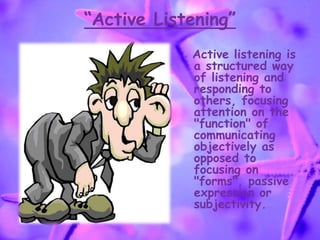
“Active Listening”
Active listening is
a structured way
of listening and
responding to
others, focusing
attention on the
"function" of
communicating
objectively as
opposed to
focusing on
"forms", passive
expression or
subjectivity.
What Is the Difference
between Hearing and Listening?
• Hearing is the process of perceiving
sound produced by any sound source in
the environment while listening is the
process of deriving meaning from
organized sounds.
• Hearing = Physiological
• Listening = Psychological
Dr. Julie said:
• “You never listen” is not just the
complaint of a problematic
relationship; the richness of life
doesn’t lie in the loudness and the
beat, but in the timbres and the
variations that you can discern if
you simply pay attention.
When and How to use ACTIVE
LISTENING:
Active listening is especially useful in two
general situations:
• When you are not certain you understand
what the other person means.
• When an important or emotionally charged
message is being sent. Senders will often
cue you to the fact that they are saying
something particularly significant.
Example
• CLOE: I'll never get a transfer.
MARIE: You're feeling really frustrated.
aren't you? (Active Listening.)
CLOE: Yeah. Everyplace I go they tell me
to leave a resume. And then they never
call.
MARIE: You think you're getting the
runaround. (Active Listening.)
CLOE: Exactly. If they haven't got any
jobs, why don't they just say so?
“Importance of Active
Listening”
m
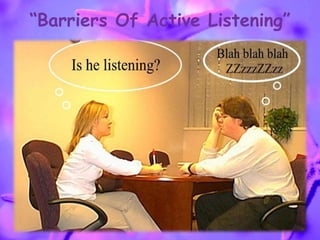
“Barriers Of Active Listening”
Noise
Note Taking
Thinking about Responses
s
OF ACTIVE LISTENING
and
Listen & Rephrase
• Rephrasing a message shows the
speaker you are listening to her
message.
• Listen carefully to a speaker's
message, mentally culling the most
important facts.
Ask informed Questions
• Active listeners ask questions strictly to
gain important information about a
speaker's message.
• These questions are direct, to the point
and show the listener you are listening,
while giving you important information.
Listen & Watch
• People speak with words, but they also
speak through body language.
• Active listeners look for body language cues
as a source of information.
Conclusion
Kevin Murphy says:
“The better you listen, the luckier you will get”
“Thank You”

Active listening presentation

  • 1.
  • 4.
    “Active Listening” Active listeningis a structured way of listening and responding to others, focusing attention on the "function" of communicating objectively as opposed to focusing on "forms", passive expression or subjectivity.
  • 5.
    What Is theDifference between Hearing and Listening? • Hearing is the process of perceiving sound produced by any sound source in the environment while listening is the process of deriving meaning from organized sounds. • Hearing = Physiological • Listening = Psychological
  • 6.
    Dr. Julie said: •“You never listen” is not just the complaint of a problematic relationship; the richness of life doesn’t lie in the loudness and the beat, but in the timbres and the variations that you can discern if you simply pay attention.
  • 7.
    When and Howto use ACTIVE LISTENING: Active listening is especially useful in two general situations: • When you are not certain you understand what the other person means. • When an important or emotionally charged message is being sent. Senders will often cue you to the fact that they are saying something particularly significant.
  • 8.
    Example • CLOE: I'llnever get a transfer. MARIE: You're feeling really frustrated. aren't you? (Active Listening.) CLOE: Yeah. Everyplace I go they tell me to leave a resume. And then they never call. MARIE: You think you're getting the runaround. (Active Listening.) CLOE: Exactly. If they haven't got any jobs, why don't they just say so?
  • 10.
  • 16.
  • 19.
  • 20.
  • 21.
  • 22.
  • 23.
  • 24.
  • 25.
    Listen & Rephrase •Rephrasing a message shows the speaker you are listening to her message. • Listen carefully to a speaker's message, mentally culling the most important facts.
  • 26.
    Ask informed Questions •Active listeners ask questions strictly to gain important information about a speaker's message. • These questions are direct, to the point and show the listener you are listening, while giving you important information.
  • 27.
    Listen & Watch •People speak with words, but they also speak through body language. • Active listeners look for body language cues as a source of information.
  • 28.
  • 29.
    Kevin Murphy says: “Thebetter you listen, the luckier you will get”
  • 30.