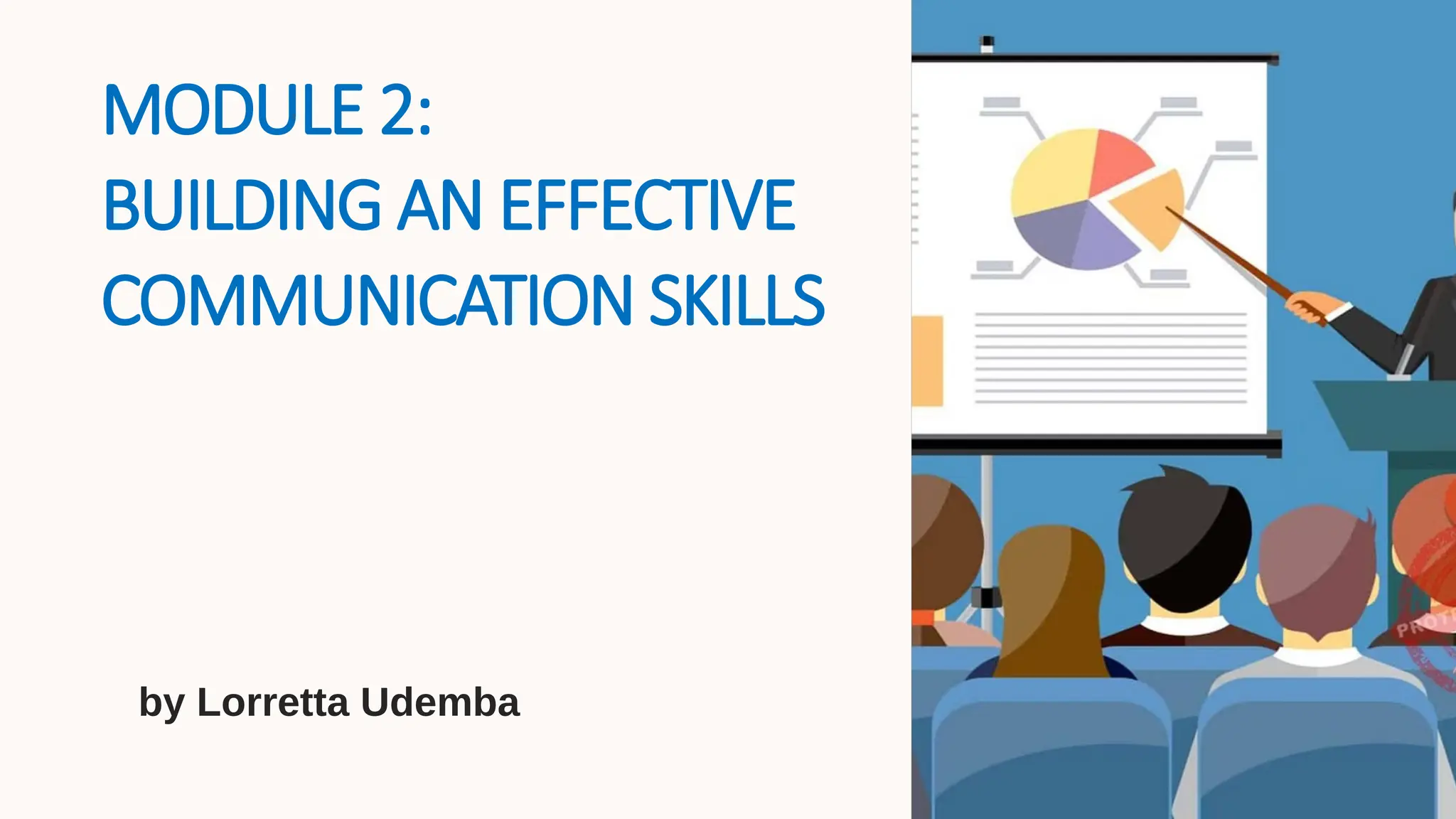
MODULE 2:
BUILDING AN EFFECTIVE
COMMUNICATION SKILLS
by Lorretta Udemba
INTRODUCTION
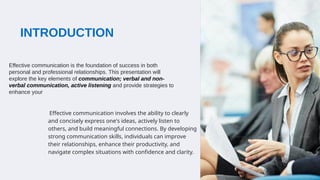
Effective communication involves the ability to clearly
and concisely express one's ideas, actively listen to
others, and build meaningful connections. By developing
strong communication skills, individuals can improve
their relationships, enhance their productivity, and
navigate complex situations with confidence and clarity.
Effective communication is the foundation of success in both
personal and professional relationships. This presentation will
explore the key elements of communication; verbal and non-
verbal communication, active listening and provide strategies to
enhance your
Importance of Effective Communication in the Workplace
Improved Relationships
Effective communication helps
build trust, foster
understanding, and strengthen
relationships with colleagues,
friends, and family members.
When people feel heard and
understood, it can lead to more
meaningful and satisfying
interactions.
Enhanced Productivity
In the workplace, effective
communication can improve
collaboration, streamline
decision-making, and
increase overall productivity.
By clearly conveying
information and
expectations, teams can
work more efficiently
towards shared goals.
Conflict Resolution
When conflicts arise, effective
communication skills can help
individuals navigate these
situations with empathy,
diplomacy, and a problem-
solving mindset. This can lead
to more positive outcomes and
strengthen relationships in the
long run.
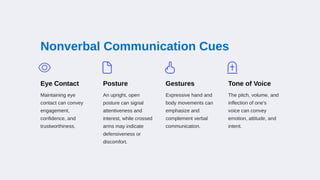
Nonverbal Communication Cues
Eye Contact
Maintaining eye
contact can convey
engagement,
confidence, and
trustworthiness.
Posture
An upright, open
posture can signal
attentiveness and
interest, while crossed
arms may indicate
defensiveness or
discomfort.
Gestures
Expressive hand and
body movements can
emphasize and
complement verbal
communication.
Tone of Voice
The pitch, volume, and
inflection of one's
voice can convey
emotion, attitude, and
intent.
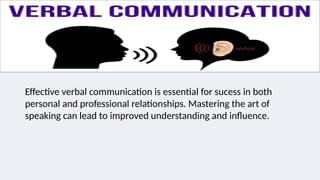
Effective verbal communication is essential for sucess in both
personal and professional relationships. Mastering the art of
speaking can lead to improved understanding and influence.
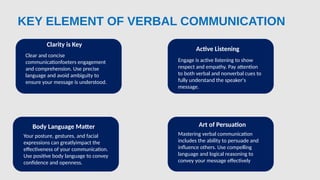
KEY ELEMENT OF VERBAL COMMUNICATION
Personal thoughts, emotions, or
multitasking can hinder our ability to
focus on the speaker.
Noises, interruptions, or
environmental factors can make it
difficult to concentrate.
Making assumptions or judgments
about the speaker can prevent us
from truly listening.
Passive listening, where we merely
hear the words without truly
understanding, can limit the
effectiveness of communication.
KEY ELEMENT OF VERBAL COMMUNICATION
Personal thoughts, emotions, or
multitasking can hinder our ability to
focus on the speaker.
Noises, interruptions, or
environmental factors can make it
difficult to concentrate.
Making assumptions or judgments
about the speaker can prevent us
from truly listening.
Passive listening, where we merely
hear the words without truly
understanding, can limit the
effectiveness of communication.
Clarity is Key
Clear and concise
communicationfoeters engagement
and comprehension. Use precise
language and avoid ambiguity to
ensure your message is understood.
Active Listening
Engage is active listening to show
respect and empathy. Pay attention
to both verbal and nonverbal cues to
fully understand the speaker's
message.
Body Language Matter
Your posture, gestures, and facial
expressions can greatlyimpact the
effectiveness of your communication.
Use positive body language to convey
confidence and openness.
Art of Persuation
Mastering verbal communication
includes the ability to persuade and
influence others. Use compelling
language and logical reasoning to
convey your message effectively
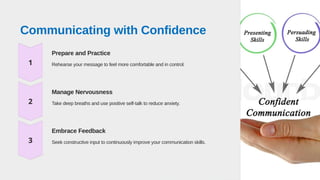
Communicating with Confidence
Prepare and Practice
Rehearse your message to feel more comfortable and in control.
Manage Nervousness
Take deep breaths and use positive self-talk to reduce anxiety.
Embrace Feedback
Seek constructive input to continuously improve your communication skills.
Assertiveness and Confidence
Communicate Clearly
Assertive communication involves
expressing your thoughts, feelings, and
needs in a clear, direct, and respectful
manner. This helps ensure that your
message is understood and your boundaries
are respected.
Stand Your Ground
Being assertive means standing up for your
rights and beliefs without being aggressive
or passive. It's about finding a balance
between being firm and maintaining a
cooperative, problem-solving approach.
Develop Self-Confidence
Confident communication stems from a deep
belief in one's own abilities and worth. By
cultivating self-confidence, individuals can
express themselves more effectively and
navigate challenging situations with poise
and resilience.
Engage with Empathy
Assertive communication does not mean
being insensitive or disregarding the needs
of others. Effective communicators can
advocate for their own interests while also
showing empathy and consideration for the
perspectives of others.
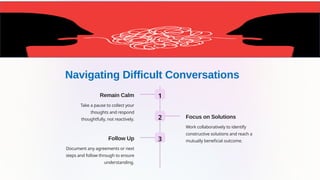
Navigating Difficult Conversations
1
Remain Calm
Take a pause to collect your
thoughts and respond
thoughtfully, not reactively. 2 Focus on Solutions
Work collaboratively to identify
constructive solutions and reach a
mutually beneficial outcome.
3
Follow Up
Document any agreements or next
steps and follow through to ensure
understanding.
In a Nutshell.....
1 Invest in Communication
Developing strong communication
skills is crucial for professional and
personal success.
2 Practice and Refine
Continually seek feedback and
opportunities to enhance your
communication abilities.
3 Adapt to Context
Tailor your communication style to the situation and audience for maximum impact.
Introduction to
Listening Skills
• Effective listening is a crucial skill for personal and
professional success. It involves actively engaging with the
speaker, understanding their message, and responding
thoughtfully.
• Mastering listening can enhance communication, build
stronger relationships, and foster personal growth.
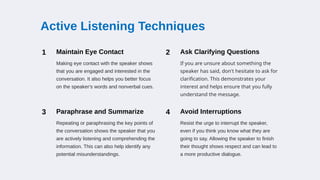
Active Listening Techniques
1 Maintain Eye Contact
Making eye contact with the speaker shows
that you are engaged and interested in the
conversation. It also helps you better focus
on the speaker's words and nonverbal cues.
2 Ask Clarifying Questions
If you are unsure about something the
speaker has said, don't hesitate to ask for
clarification. This demonstrates your
interest and helps ensure that you fully
understand the message.
3 Paraphrase and Summarize
Repeating or paraphrasing the key points of
the conversation shows the speaker that you
are actively listening and comprehending the
information. This can also help identify any
potential misunderstandings.
4 Avoid Interruptions
Resist the urge to interrupt the speaker,
even if you think you know what they are
going to say. Allowing the speaker to finish
their thought shows respect and can lead to
a more productive dialogue.
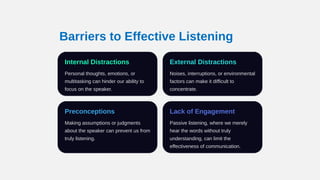
Barriers to Effective Listening
Internal Distractions
Personal thoughts, emotions, or
multitasking can hinder our ability to
focus on the speaker.
External Distractions
Noises, interruptions, or environmental
factors can make it difficult to
concentrate.
Preconceptions
Making assumptions or judgments
about the speaker can prevent us from
truly listening.
Lack of Engagement
Passive listening, where we merely
hear the words without truly
understanding, can limit the
effectiveness of communication.
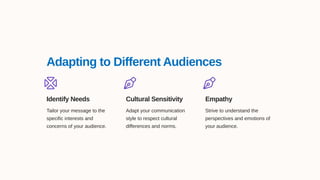
Adapting to Different Audiences
Identify Needs
Tailor your message to the
specific interests and
concerns of your audience.
Cultural Sensitivity
Adapt your communication
style to respect cultural
differences and norms.
Empathy
Strive to understand the
perspectives and emotions of
your audience.
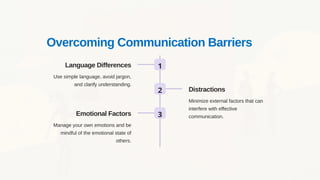
Overcoming Communication Barriers
1
Language Differences
Use simple language, avoid jargon,
and clarify understanding.
2 Distractions
Minimize external factors that can
interfere with effective
communication.
3
Emotional Factors
Manage your own emotions and be
mindful of the emotional state of
others.
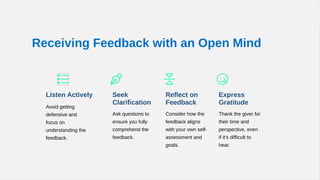
Receiving Feedback with an Open Mind
Listen Actively
Avoid getting
defensive and
focus on
understanding the
feedback.
Seek
Clarification
Ask questions to
ensure you fully
comprehend the
feedback.
Reflect on
Feedback
Consider how the
feedback aligns
with your own self-
assessment and
goals.
Express
Gratitude
Thank the giver for
their time and
perspective, even
if it's difficult to
hear.
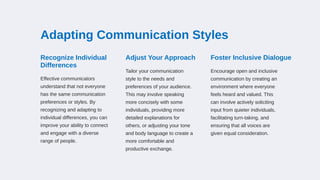
Adapting Communication Styles
Recognize Individual
Differences
Effective communicators
understand that not everyone
has the same communication
preferences or styles. By
recognizing and adapting to
individual differences, you can
improve your ability to connect
and engage with a diverse
range of people.
Adjust Your Approach
Tailor your communication
style to the needs and
preferences of your audience.
This may involve speaking
more concisely with some
individuals, providing more
detailed explanations for
others, or adjusting your tone
and body language to create a
more comfortable and
productive exchange.
Foster Inclusive Dialogue
Encourage open and inclusive
communication by creating an
environment where everyone
feels heard and valued. This
can involve actively soliciting
input from quieter individuals,
facilitating turn-taking, and
ensuring that all voices are
given equal consideration.
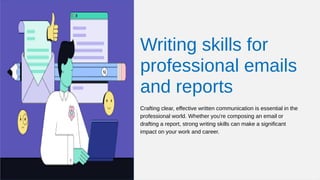
Writing skills for
professional emails
and reports
Crafting clear, effective written communication is essential in the
professional world. Whether you're composing an email or
drafting a report, strong writing skills can make a significant
impact on your work and career.
Key Element of a Job Application Email
• Subject Line: Clear and concise, indicating the purpose of the email (e.g., "Application for [Job Title] Position").
• Salutation: Address the recipient formally, using their name if known (e.g., "Dear Mr./Ms. [Last Name]" or "Hiring
Manager”
• Introduction: Briefly introduce yourself and mention the specific position you are applying for. You may also include
where you found the job listing or how you learned about the opportunity.
• Body: This section should include the main content of your application. Key elements to include are:
• Your qualifications: Highlight relevant skills, experiences, and achievements that make you a suitable candidate for
the position.
• Why you're interested: Explain why you are interested in the position and the company, demonstrating your
knowledge of the company's values, mission, or recent achievements.
Key Element of a Job Application Email cont..
• Fit for the role: Discuss how your background aligns with the job requirements and how you can contribute to the company's goals.
• Any additional information: Mention any attachments (resume, cover letter, portfolio) or provide links to online profiles (LinkedIn,
personal website) if applicable.
• Closing: Express appreciation for the opportunity to apply and your enthusiasm for the position. Include a polite request for further
consideration (e.g., "I look forward to the opportunity to discuss how my skills can contribute to [Company Name]"). End with a
professional closing (e.g., "Sincerely," "Best regards,") followed by your full name.
• Signature: Include your contact information (phone number and email address) below your name. If you have a professional email
signature, you can include it as well.
• Attachments: If required or requested, attach your resume, cover letter, and any other relevant documents. Ensure that the file
names are clear and professional.
• Follow-up: Indicate your availability for an interview or any next steps. Mention that you are open to further communication and
provide alternative contact methods if necessary.
• Remember to proofread your email carefully for spelling, grammar, and formatting errors before sending it. A well-crafted job
application email can significantly enhance your chances of being considered for the position.
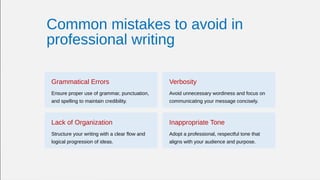
Common mistakes to avoid in
professional writing
Grammatical Errors
Ensure proper use of grammar, punctuation,
and spelling to maintain credibility.
Verbosity
Avoid unnecessary wordiness and focus on
communicating your message concisely.
Lack of Organization
Structure your writing with a clear flow and
logical progression of ideas.
Inappropriate Tone
Adopt a professional, respectful tone that
aligns with your audience and purpose.
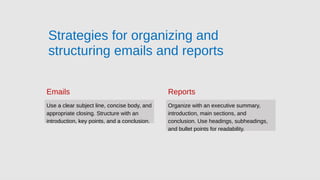
Strategies for organizing and
structuring emails and reports
Emails
Use a clear subject line, concise body, and
appropriate closing. Structure with an
introduction, key points, and a conclusion.
Reports
Organize with an executive summary,
introduction, main sections, and
conclusion. Use headings, subheadings,
and bullet points for readability.
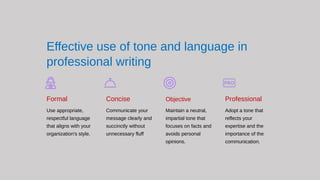
Effective use of tone and language in
professional writing
Formal
Use appropriate,
respectful language
that aligns with your
organization's style.
Concise
Communicate your
message clearly and
succinctly without
unnecessary fluff.
Objective
Maintain a neutral,
impartial tone that
focuses on facts and
avoids personal
opinions.
Professional
Adopt a tone that
reflects your
expertise and the
importance of the
communication.
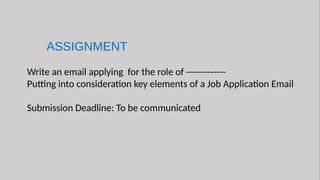
ASSIGNMENT
Write an email applying for the role of -------------
Putting into consideration key elements of a Job Application Email
Submission Deadline: To be communicated
• Effective communication is a critical
skill that can be developed through
practice and a commitment to
continuous improvement.
• By applying the strategies and
techniques discussed in this
presentation, you can become a more
confident and influential
communicator, unlocking new
opportunities for personal and
professional growth.
• Practice and hone your communication skills
with every opportunity you get
• Learn to listen more and speak less
• If you miss a point ask the speaker to repeat in
a polite way
• Feedback does not always have to be positive,
but regardless, learn to receive it with an open
mind
• Communication is not a one-way traffic
• Don't write the way you speak..
• Maintain a professional tone always
BUILDING AN EFFECTIVE COMMUNICATION SKILLS -

BUILDING AN EFFECTIVE COMMUNICATION SKILLS -

  • 1.
    MODULE 2: BUILDING ANEFFECTIVE COMMUNICATION SKILLS by Lorretta Udemba
  • 2.
    INTRODUCTION Effective communication involvesthe ability to clearly and concisely express one's ideas, actively listen to others, and build meaningful connections. By developing strong communication skills, individuals can improve their relationships, enhance their productivity, and navigate complex situations with confidence and clarity. Effective communication is the foundation of success in both personal and professional relationships. This presentation will explore the key elements of communication; verbal and non- verbal communication, active listening and provide strategies to enhance your
  • 3.
    Importance of EffectiveCommunication in the Workplace Improved Relationships Effective communication helps build trust, foster understanding, and strengthen relationships with colleagues, friends, and family members. When people feel heard and understood, it can lead to more meaningful and satisfying interactions. Enhanced Productivity In the workplace, effective communication can improve collaboration, streamline decision-making, and increase overall productivity. By clearly conveying information and expectations, teams can work more efficiently towards shared goals. Conflict Resolution When conflicts arise, effective communication skills can help individuals navigate these situations with empathy, diplomacy, and a problem- solving mindset. This can lead to more positive outcomes and strengthen relationships in the long run.
  • 4.
    Nonverbal Communication Cues EyeContact Maintaining eye contact can convey engagement, confidence, and trustworthiness. Posture An upright, open posture can signal attentiveness and interest, while crossed arms may indicate defensiveness or discomfort. Gestures Expressive hand and body movements can emphasize and complement verbal communication. Tone of Voice The pitch, volume, and inflection of one's voice can convey emotion, attitude, and intent.
  • 5.
    Effective verbal communicationis essential for sucess in both personal and professional relationships. Mastering the art of speaking can lead to improved understanding and influence.
  • 6.
    KEY ELEMENT OFVERBAL COMMUNICATION Personal thoughts, emotions, or multitasking can hinder our ability to focus on the speaker. Noises, interruptions, or environmental factors can make it difficult to concentrate. Making assumptions or judgments about the speaker can prevent us from truly listening. Passive listening, where we merely hear the words without truly understanding, can limit the effectiveness of communication. KEY ELEMENT OF VERBAL COMMUNICATION Personal thoughts, emotions, or multitasking can hinder our ability to focus on the speaker. Noises, interruptions, or environmental factors can make it difficult to concentrate. Making assumptions or judgments about the speaker can prevent us from truly listening. Passive listening, where we merely hear the words without truly understanding, can limit the effectiveness of communication. Clarity is Key Clear and concise communicationfoeters engagement and comprehension. Use precise language and avoid ambiguity to ensure your message is understood. Active Listening Engage is active listening to show respect and empathy. Pay attention to both verbal and nonverbal cues to fully understand the speaker's message. Body Language Matter Your posture, gestures, and facial expressions can greatlyimpact the effectiveness of your communication. Use positive body language to convey confidence and openness. Art of Persuation Mastering verbal communication includes the ability to persuade and influence others. Use compelling language and logical reasoning to convey your message effectively
  • 7.
    Communicating with Confidence Prepareand Practice Rehearse your message to feel more comfortable and in control. Manage Nervousness Take deep breaths and use positive self-talk to reduce anxiety. Embrace Feedback Seek constructive input to continuously improve your communication skills.
  • 8.
    Assertiveness and Confidence CommunicateClearly Assertive communication involves expressing your thoughts, feelings, and needs in a clear, direct, and respectful manner. This helps ensure that your message is understood and your boundaries are respected. Stand Your Ground Being assertive means standing up for your rights and beliefs without being aggressive or passive. It's about finding a balance between being firm and maintaining a cooperative, problem-solving approach. Develop Self-Confidence Confident communication stems from a deep belief in one's own abilities and worth. By cultivating self-confidence, individuals can express themselves more effectively and navigate challenging situations with poise and resilience. Engage with Empathy Assertive communication does not mean being insensitive or disregarding the needs of others. Effective communicators can advocate for their own interests while also showing empathy and consideration for the perspectives of others.
  • 9.
    Navigating Difficult Conversations 1 RemainCalm Take a pause to collect your thoughts and respond thoughtfully, not reactively. 2 Focus on Solutions Work collaboratively to identify constructive solutions and reach a mutually beneficial outcome. 3 Follow Up Document any agreements or next steps and follow through to ensure understanding.
  • 10.
    In a Nutshell..... 1Invest in Communication Developing strong communication skills is crucial for professional and personal success. 2 Practice and Refine Continually seek feedback and opportunities to enhance your communication abilities. 3 Adapt to Context Tailor your communication style to the situation and audience for maximum impact.
  • 11.
    Introduction to Listening Skills •Effective listening is a crucial skill for personal and professional success. It involves actively engaging with the speaker, understanding their message, and responding thoughtfully. • Mastering listening can enhance communication, build stronger relationships, and foster personal growth.
  • 12.
    Active Listening Techniques 1Maintain Eye Contact Making eye contact with the speaker shows that you are engaged and interested in the conversation. It also helps you better focus on the speaker's words and nonverbal cues. 2 Ask Clarifying Questions If you are unsure about something the speaker has said, don't hesitate to ask for clarification. This demonstrates your interest and helps ensure that you fully understand the message. 3 Paraphrase and Summarize Repeating or paraphrasing the key points of the conversation shows the speaker that you are actively listening and comprehending the information. This can also help identify any potential misunderstandings. 4 Avoid Interruptions Resist the urge to interrupt the speaker, even if you think you know what they are going to say. Allowing the speaker to finish their thought shows respect and can lead to a more productive dialogue.
  • 13.
    Barriers to EffectiveListening Internal Distractions Personal thoughts, emotions, or multitasking can hinder our ability to focus on the speaker. External Distractions Noises, interruptions, or environmental factors can make it difficult to concentrate. Preconceptions Making assumptions or judgments about the speaker can prevent us from truly listening. Lack of Engagement Passive listening, where we merely hear the words without truly understanding, can limit the effectiveness of communication.
  • 14.
    Adapting to DifferentAudiences Identify Needs Tailor your message to the specific interests and concerns of your audience. Cultural Sensitivity Adapt your communication style to respect cultural differences and norms. Empathy Strive to understand the perspectives and emotions of your audience.
  • 15.
    Overcoming Communication Barriers 1 LanguageDifferences Use simple language, avoid jargon, and clarify understanding. 2 Distractions Minimize external factors that can interfere with effective communication. 3 Emotional Factors Manage your own emotions and be mindful of the emotional state of others.
  • 16.
    Receiving Feedback withan Open Mind Listen Actively Avoid getting defensive and focus on understanding the feedback. Seek Clarification Ask questions to ensure you fully comprehend the feedback. Reflect on Feedback Consider how the feedback aligns with your own self- assessment and goals. Express Gratitude Thank the giver for their time and perspective, even if it's difficult to hear.
  • 17.
    Adapting Communication Styles RecognizeIndividual Differences Effective communicators understand that not everyone has the same communication preferences or styles. By recognizing and adapting to individual differences, you can improve your ability to connect and engage with a diverse range of people. Adjust Your Approach Tailor your communication style to the needs and preferences of your audience. This may involve speaking more concisely with some individuals, providing more detailed explanations for others, or adjusting your tone and body language to create a more comfortable and productive exchange. Foster Inclusive Dialogue Encourage open and inclusive communication by creating an environment where everyone feels heard and valued. This can involve actively soliciting input from quieter individuals, facilitating turn-taking, and ensuring that all voices are given equal consideration.
  • 18.
    Writing skills for professionalemails and reports Crafting clear, effective written communication is essential in the professional world. Whether you're composing an email or drafting a report, strong writing skills can make a significant impact on your work and career.
  • 19.
    Key Element ofa Job Application Email • Subject Line: Clear and concise, indicating the purpose of the email (e.g., "Application for [Job Title] Position"). • Salutation: Address the recipient formally, using their name if known (e.g., "Dear Mr./Ms. [Last Name]" or "Hiring Manager” • Introduction: Briefly introduce yourself and mention the specific position you are applying for. You may also include where you found the job listing or how you learned about the opportunity. • Body: This section should include the main content of your application. Key elements to include are: • Your qualifications: Highlight relevant skills, experiences, and achievements that make you a suitable candidate for the position. • Why you're interested: Explain why you are interested in the position and the company, demonstrating your knowledge of the company's values, mission, or recent achievements.
  • 20.
    Key Element ofa Job Application Email cont.. • Fit for the role: Discuss how your background aligns with the job requirements and how you can contribute to the company's goals. • Any additional information: Mention any attachments (resume, cover letter, portfolio) or provide links to online profiles (LinkedIn, personal website) if applicable. • Closing: Express appreciation for the opportunity to apply and your enthusiasm for the position. Include a polite request for further consideration (e.g., "I look forward to the opportunity to discuss how my skills can contribute to [Company Name]"). End with a professional closing (e.g., "Sincerely," "Best regards,") followed by your full name. • Signature: Include your contact information (phone number and email address) below your name. If you have a professional email signature, you can include it as well. • Attachments: If required or requested, attach your resume, cover letter, and any other relevant documents. Ensure that the file names are clear and professional. • Follow-up: Indicate your availability for an interview or any next steps. Mention that you are open to further communication and provide alternative contact methods if necessary. • Remember to proofread your email carefully for spelling, grammar, and formatting errors before sending it. A well-crafted job application email can significantly enhance your chances of being considered for the position.
  • 21.
    Common mistakes toavoid in professional writing Grammatical Errors Ensure proper use of grammar, punctuation, and spelling to maintain credibility. Verbosity Avoid unnecessary wordiness and focus on communicating your message concisely. Lack of Organization Structure your writing with a clear flow and logical progression of ideas. Inappropriate Tone Adopt a professional, respectful tone that aligns with your audience and purpose.
  • 22.
    Strategies for organizingand structuring emails and reports Emails Use a clear subject line, concise body, and appropriate closing. Structure with an introduction, key points, and a conclusion. Reports Organize with an executive summary, introduction, main sections, and conclusion. Use headings, subheadings, and bullet points for readability.
  • 23.
    Effective use oftone and language in professional writing Formal Use appropriate, respectful language that aligns with your organization's style. Concise Communicate your message clearly and succinctly without unnecessary fluff. Objective Maintain a neutral, impartial tone that focuses on facts and avoids personal opinions. Professional Adopt a tone that reflects your expertise and the importance of the communication.
  • 24.
    ASSIGNMENT Write an emailapplying for the role of ------------- Putting into consideration key elements of a Job Application Email Submission Deadline: To be communicated
  • 25.
    • Effective communicationis a critical skill that can be developed through practice and a commitment to continuous improvement. • By applying the strategies and techniques discussed in this presentation, you can become a more confident and influential communicator, unlocking new opportunities for personal and professional growth. • Practice and hone your communication skills with every opportunity you get • Learn to listen more and speak less • If you miss a point ask the speaker to repeat in a polite way • Feedback does not always have to be positive, but regardless, learn to receive it with an open mind • Communication is not a one-way traffic • Don't write the way you speak.. • Maintain a professional tone always

Editor's Notes

  • #6 Mastering the art of verbal communication is a continuous journey. Practice active listening, use clear and concise language , and be mindful of your body language to become a more effective communicator
  • #19 A job application email is often the first point of contact between a candidate and a potential employer. Its key elements typically include:
  • #20 A job application email is often the first point of contact between a candidate and a potential employer. Its key elements typically include: