Deviation, OOS & Complaint
Investigation and CAPA
1
Dr. A. Amsavel, M.Sc., B.Ed., Ph.D.
Overview
• Definition
• Requirement
• Deviation, OOS and reporting
• Investigation
– RCA– RCA
– Investigative tools: Why –Why , Cause & Effect and FTA
– Human error
• CAPA
• Implementation
• Investigation report
• Verification for effectiveness
2
Definition
Correction: An action to eliminate a detected nonconformity.
Remedial action : Repair, rework, or adjustment
Corrective Action: The action taken to eliminate the causes of an
existing nonconformity, defect or other undesirable situation
in order to prevent recurrence.
Preventive Action: The action taken to eliminate the cause of aPreventive Action: The action taken to eliminate the cause of a
potential nonconformity, defect, or other undesirable situation
in order to prevent occurrence.
Nonconformity: non-fulfillment of a specified requirement.
Any material or process that does not meet its required
specifications or documented procedure.
Note: There is no definition for CAPA in the drug cGMP regulation
3
Root Cause
 Root Cause identification is the most important
step
 Root Cause Analysis (RCA) is a systematic
approach to identify the actual root causes of aapproach to identify the actual root causes of a
problem.
 Problems will only be solved if the corrective
action implemented is addessing the real root
cause accurately
4
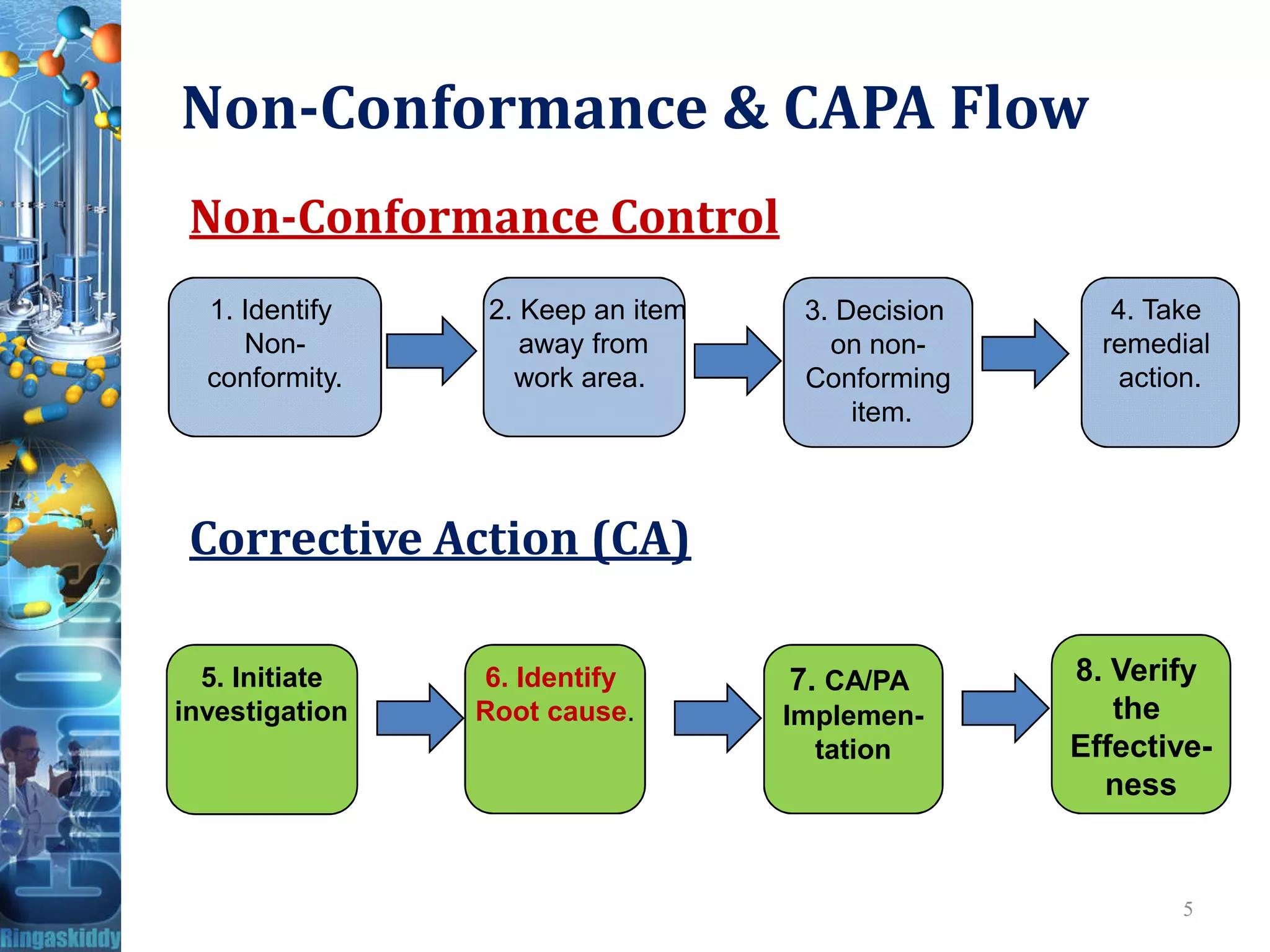
Non-Conformance & CAPA Flow
Non-Conformance Control
1. Identify
Non-
conformity.
2. Keep an item
away from
work area.
3. Decision
on non-
Conforming
item.
4. Take
remedial
action.
Corrective Action (CA)
5
5. Initiate
investigation
6. Identify
Root cause.
7. CA/PA
Implemen-
tation
8. Verify
the
Effective-
ness
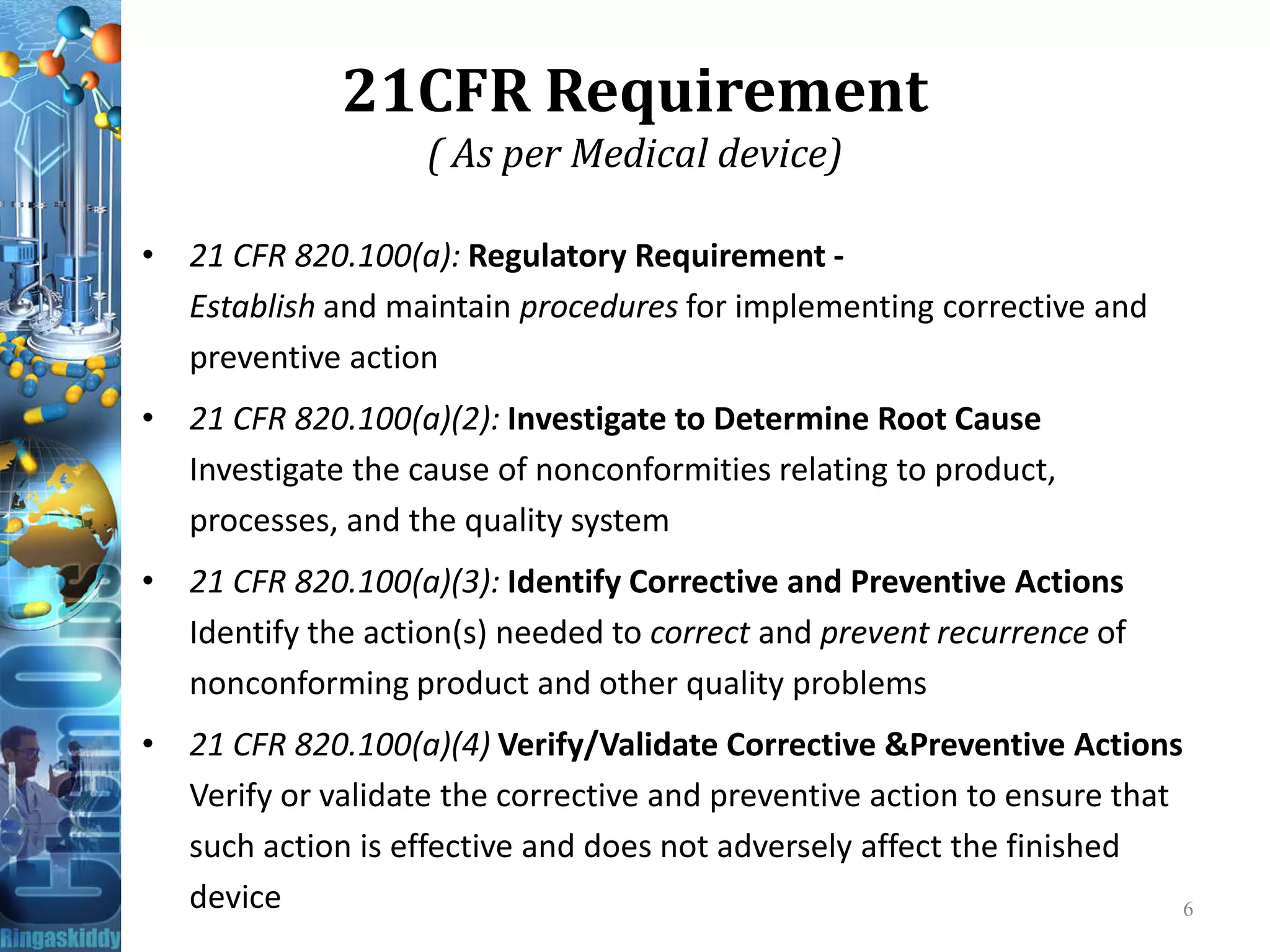
21CFR Requirement
( As per Medical device)
• 21 CFR 820.100(a): Regulatory Requirement -
Establish and maintain procedures for implementing corrective and
preventive action
• 21 CFR 820.100(a)(2): Investigate to Determine Root Cause
Investigate the cause of nonconformities relating to product,Investigate the cause of nonconformities relating to product,
processes, and the quality system
• 21 CFR 820.100(a)(3): Identify Corrective and Preventive Actions
Identify the action(s) needed to correct and prevent recurrence of
nonconforming product and other quality problems
• 21 CFR 820.100(a)(4) Verify/Validate Corrective &Preventive Actions
Verify or validate the corrective and preventive action to ensure that
such action is effective and does not adversely affect the finished
device 6
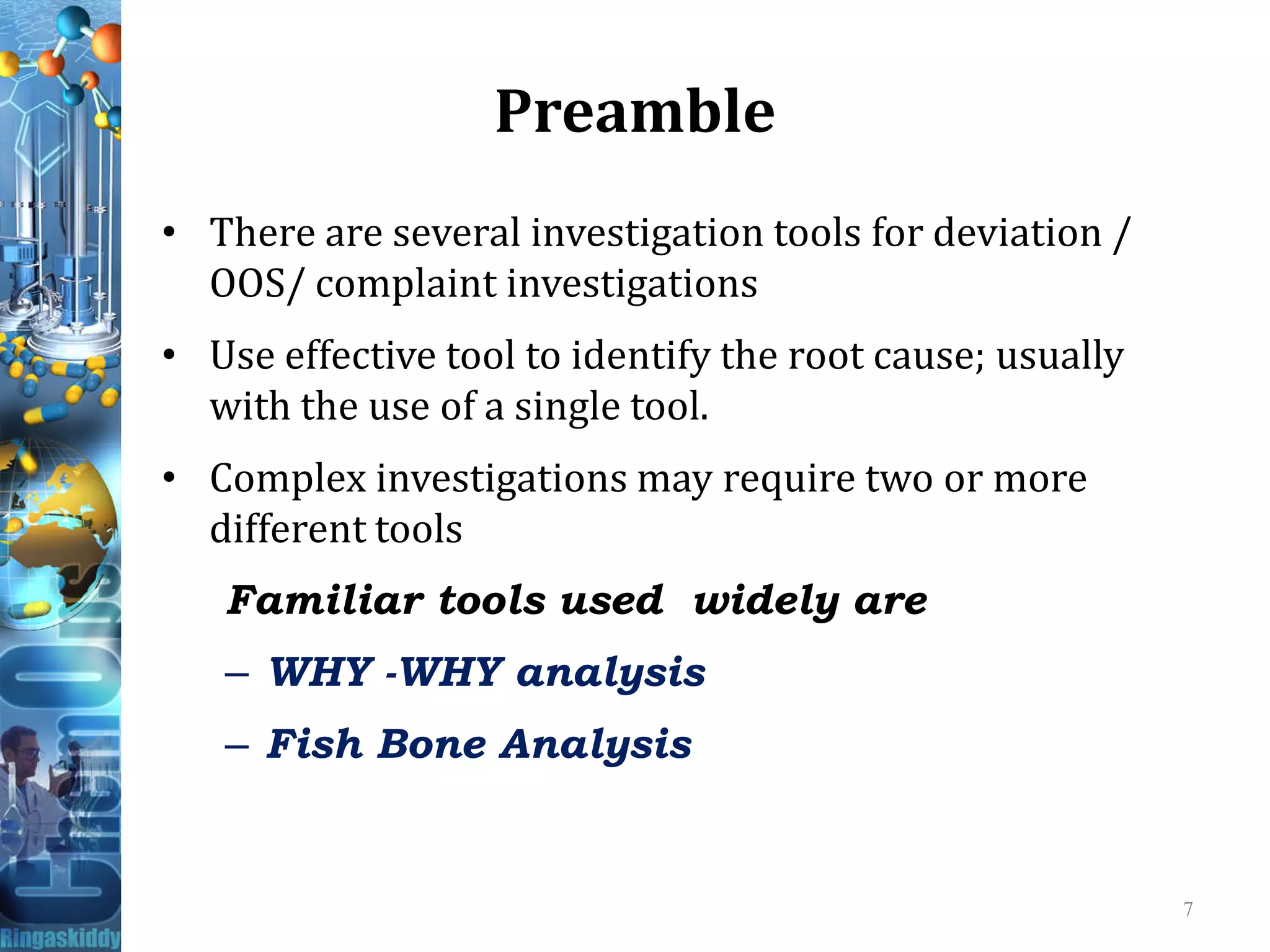
Preamble
• There are several investigation tools for deviation /
OOS/ complaint investigations
• Use effective tool to identify the root cause; usually
with the use of a single tool.
• Complex investigations may require two or more• Complex investigations may require two or more
different tools
Familiar tools used widely are
– WHY -WHY analysis
– Fish Bone Analysis
7
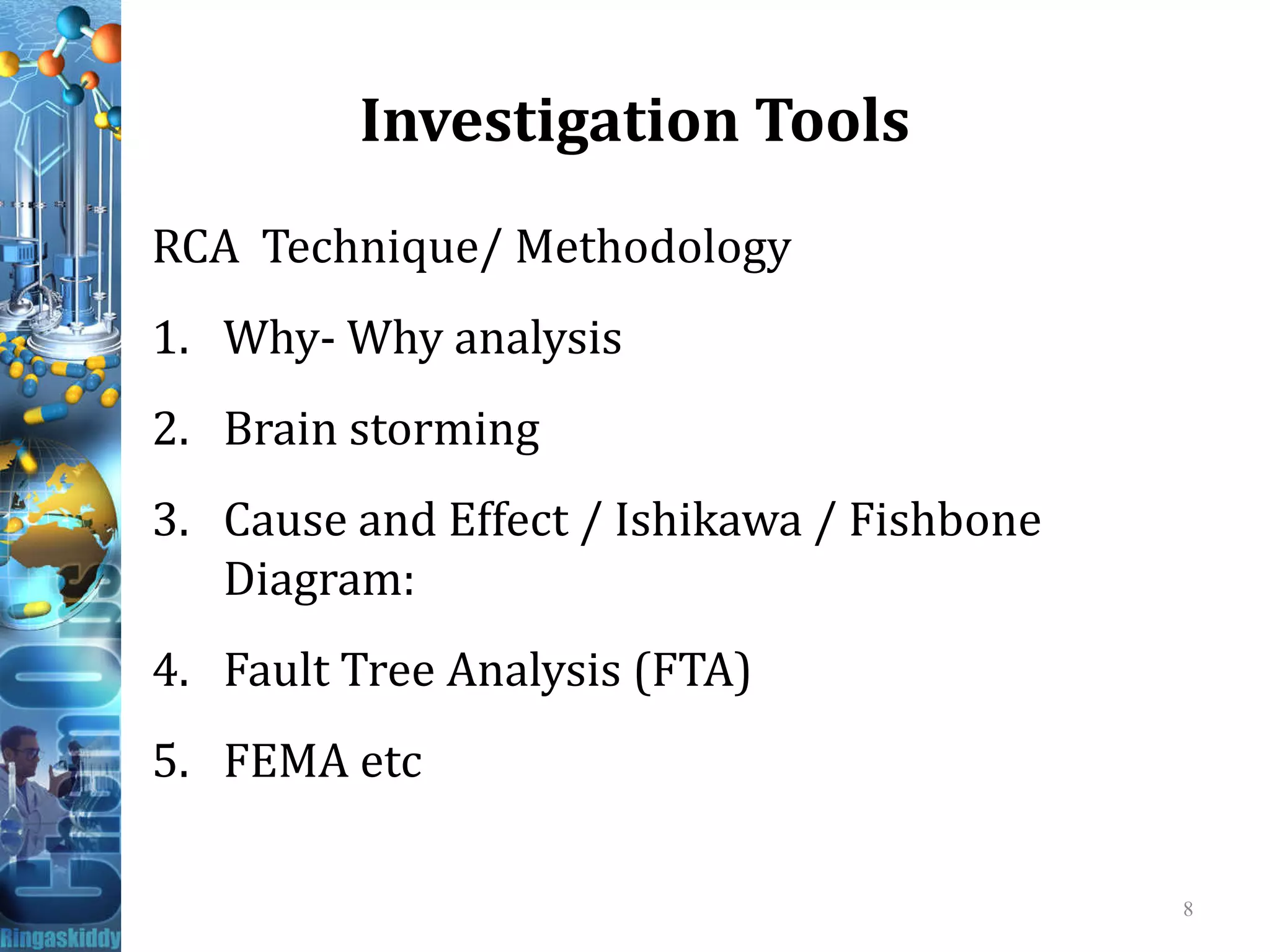
Investigation Tools
RCA Technique/ Methodology
1. Why- Why analysis
2. Brain storming
3. Cause and Effect / Ishikawa / Fishbone
Diagram:
4. Fault Tree Analysis (FTA)
5. FEMA etc
8
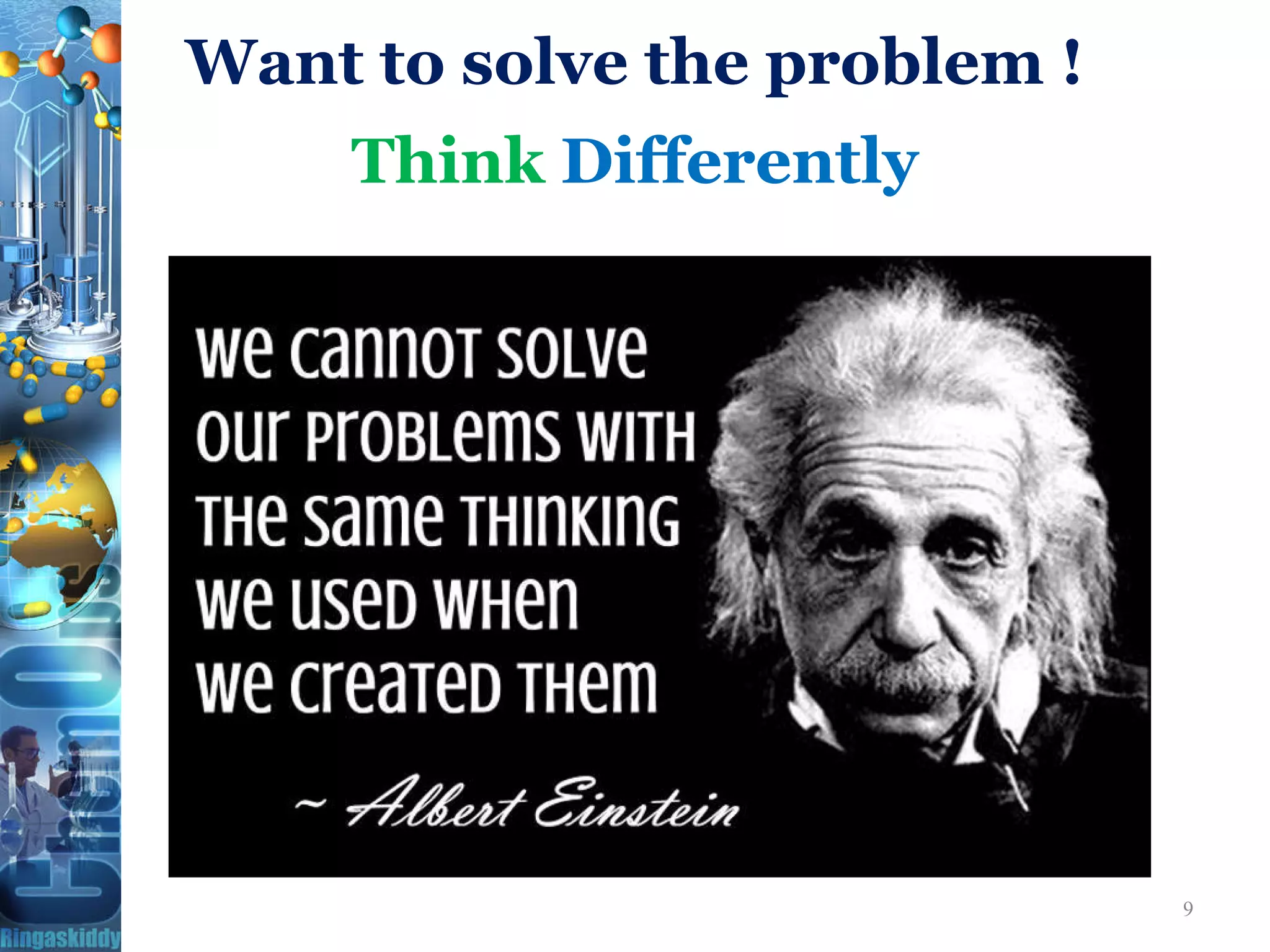
Want to solve the problem !
Think Differently
9
How to Report Deviation & OOS
1. Description – Describe clearly the Problem/Failure.
2. Determine: What, Why, Where, When, Who, How?
3. Immediate Actions taken : Contain/ stop continue
4. Immediate ( known ) Product Quality Impact4. Immediate ( known ) Product Quality Impact
5. Complete the above within 24 hours from time of an incident
identified
6. Initial ( preliminary ) QA Review
– Above section must be completed within 2 days of receipt
– Complete the investigation as per SOP (preferably 3-5 days)
10
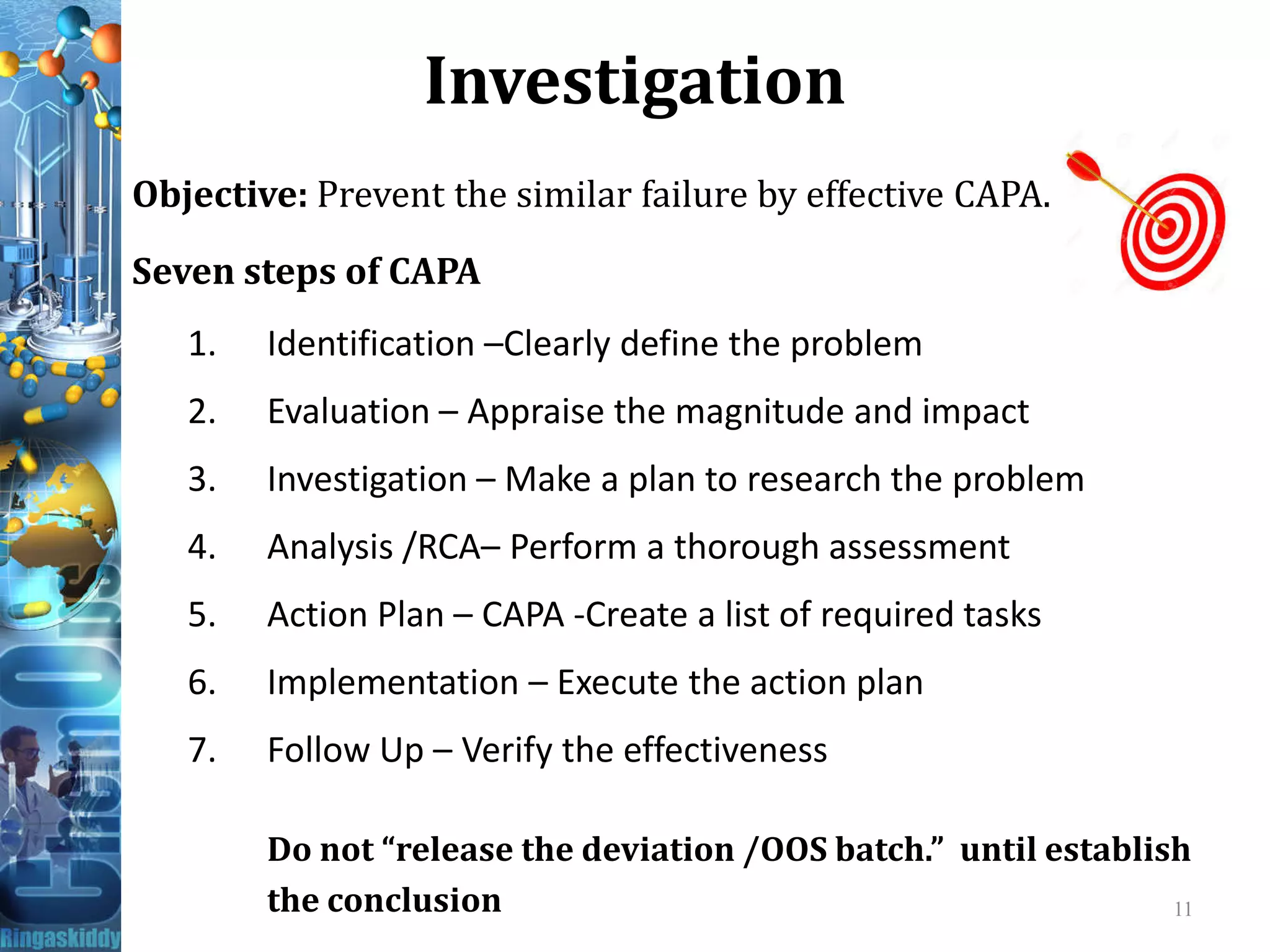
Investigation
Objective: Prevent the similar failure by effective CAPA.
Seven steps of CAPA
1. Identification –Clearly define the problem
2. Evaluation – Appraise the magnitude and impact
3. Investigation – Make a plan to research the problem3. Investigation – Make a plan to research the problem
4. Analysis /RCA– Perform a thorough assessment
5. Action Plan – CAPA -Create a list of required tasks
6. Implementation – Execute the action plan
7. Follow Up – Verify the effectiveness
Do not “release the deviation /OOS batch.” until establish
the conclusion 11
Deviation/Incident Reporting
• State the incident Clearly /measurable terms
– What, When, where, how often, how much,
• Emphasize the quality risk,
–safety, death, injury, rework, etc.–safety, death, injury, rework, etc.
• Do not write incident as
–negative descriptors, inflammatory statements
–words that are broad and do not describe the
conditions or behaviour such as careless, complacency,
neglect, oversight etc
12
Deviation/Incident Reporting
“If An Incident /problem is well defined , a problem half
solved”
– Keep in mind it is to Correct, Prevent & Improve
– No shortcut to conclude as human error
5W:
What is affected• What is affected
• Where does the problem takes place
• When is the problem indentified
• Who is indentified
• What is the consequence
2H:
• How much is affected
• How often has the problem occurred 13
Investigation Process
• Review past history /similar issue
• Review records and documents
• Review process/operations
• Review the situation/ environment
• Interview people closest to the problem
• Inspect and test the product/ material
• Gemba-Inspect equipment & facilities at site
14
Investigation Steps
• Information must be captured from the
people who were involved
• Gather the facts quickly to avoid the loos• Gather the facts quickly to avoid the loos
of information/ evidence
• Determine what historical data is available
• Determine what is known rather than
what is “from memory”
15
Investigation Recording
• Record the details
– Location
– Date and time of occurrence, discovery
– Personnel ( titles / names ) involved– Personnel ( titles / names ) involved
• Explain why the event is different from what
is expected
– Initial scope:
– Product / materials
– Lot/batch / campaign
– Equipment / train 16
Investigation: Review of Documents
• Review of BPR
• Review of Test data/records
• Review of situation surround of an incident
• Review of Systems / facility/ Equipment
• Eg. Environment, Log book, cleaning, handling
• Verify any such past incidence & report
• Any additional testing required
17
Root Cause Analysis (RCA)
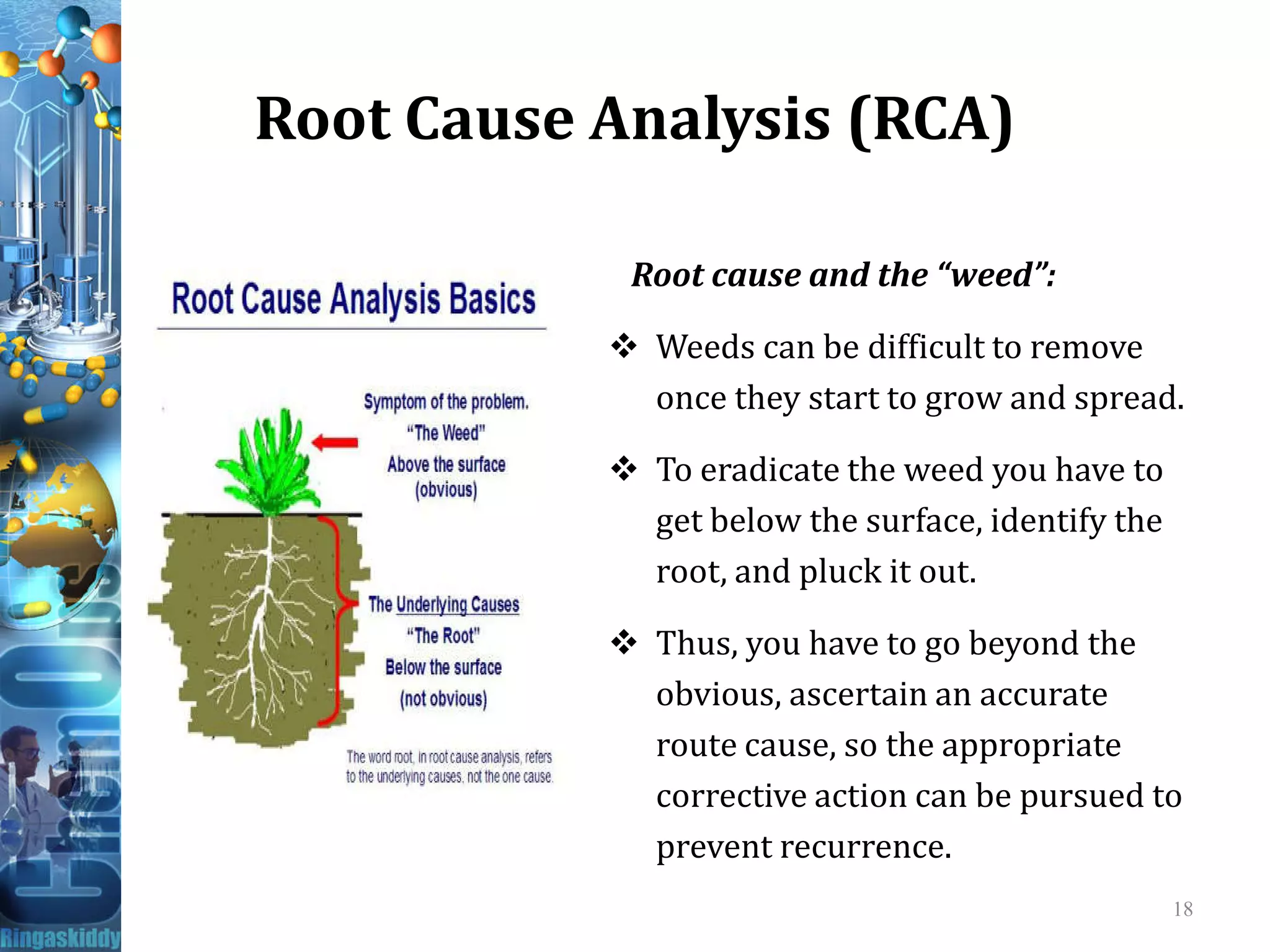
Root cause and the “weed”:
 Weeds can be difficult to remove
once they start to grow and spread.
 To eradicate the weed you have to
18
 To eradicate the weed you have to
get below the surface, identify the
root, and pluck it out.
 Thus, you have to go beyond the
obvious, ascertain an accurate
route cause, so the appropriate
corrective action can be pursued to
prevent recurrence.
Root Cause Analysis (RCA)
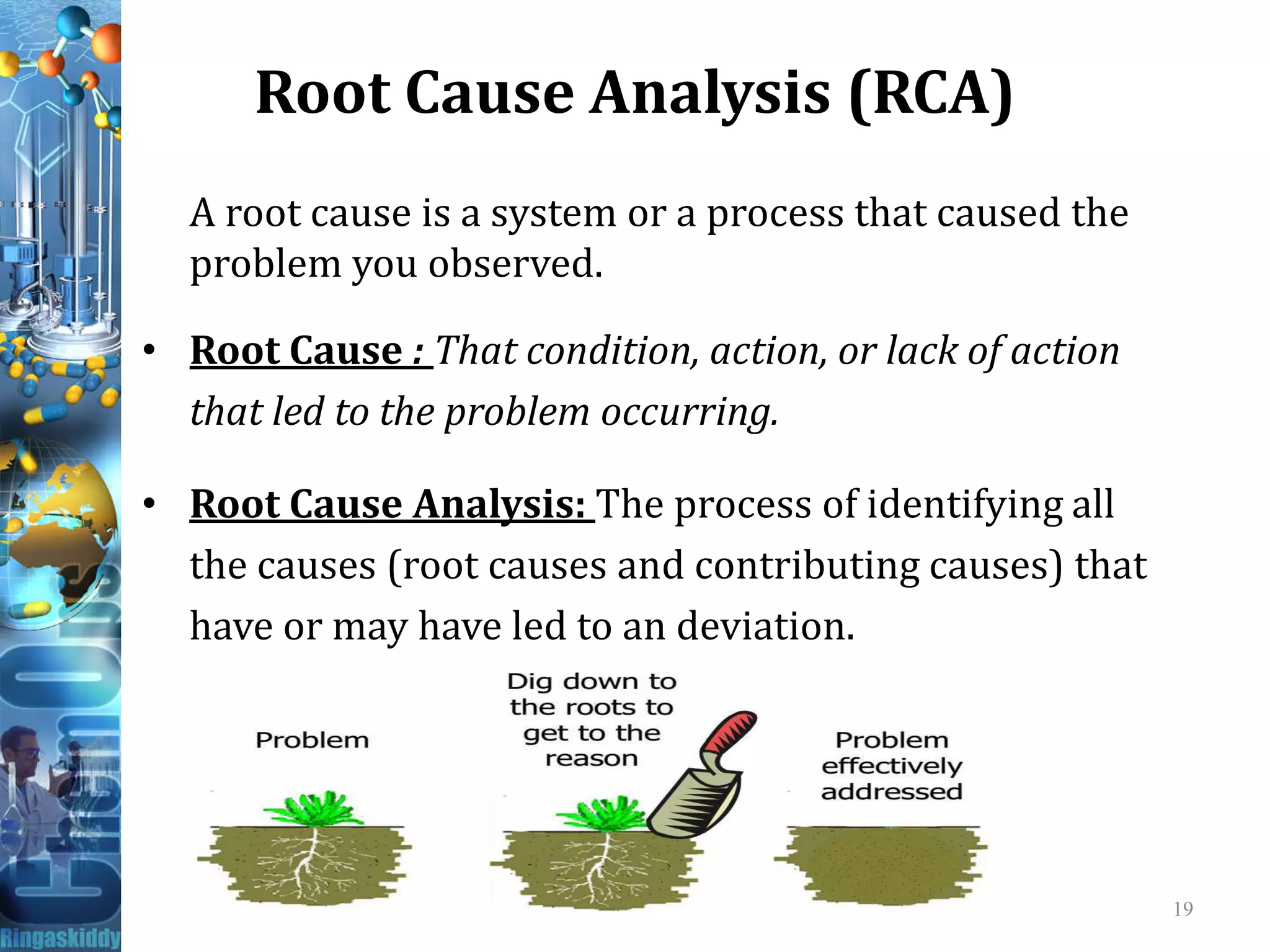
A root cause is a system or a process that caused the
problem you observed.
• Root Cause : That condition, action, or lack of action
that led to the problem occurring.
• Root Cause Analysis: The process of identifying all
the causes (root causes and contributing causes) that
have or may have led to an deviation.
19
Possible Reasons for Failure
• Human Error
• Equipment Failure
• Procedure is Inadequate or Not Clear
• Procedure not Followed• Procedure not Followed
• Training Inadequate
• Design Error
• Poor Communication
20
What are Human Errors?
A mistake made by a person rather than a
machine that produces a result that is
Undesirable
• The organization does everything to prevent the• The organization does everything to prevent the
problem.
• However, the employee ( operator/ peer/ supervisor/
management ) still make a mistake
• Everyone can make error no matter how well trained
and motivated
21
Human Error or Violation?
• Two types of human failure: Errors and violations.
• Identify them correctly and to be addressed appropriately
– A laboratory technician performing two tests simultaneously ,
but used the wrong sample for one of the tests
– A production operator filled out a cleaning record without– A production operator filled out a cleaning record without
performing the task
• A violation is a deliberate deviation from a rule or
procedure.
– What influences to Error or Violation
• Eg: Time pressure, design of controls, procedures, training and
experience, fatigue, and levels of supervision etc.
22
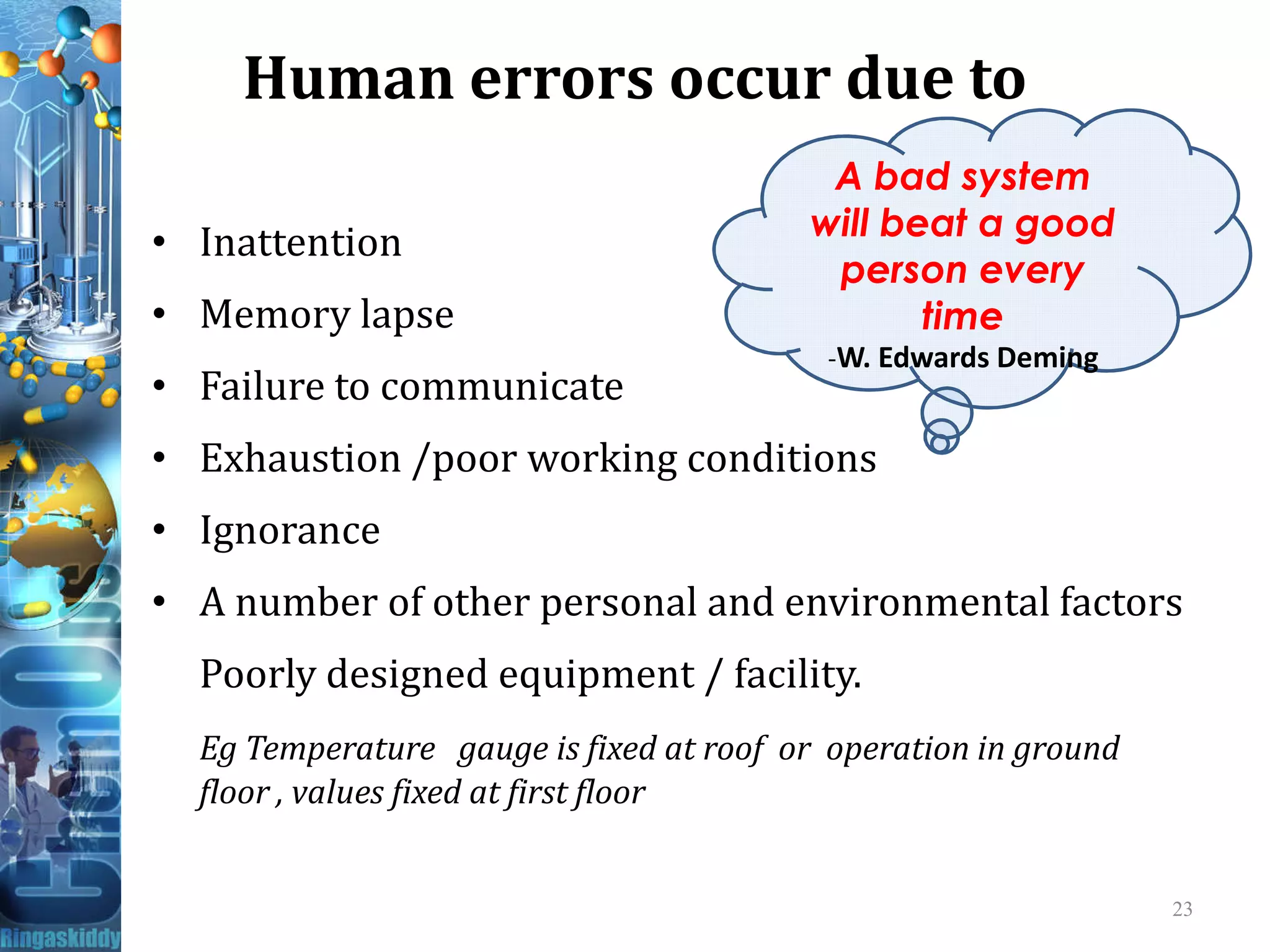
Human errors occur due to
• Inattention
• Memory lapse
• Failure to communicate
• Exhaustion /poor working conditions
A bad system
will beat a good
person every
time
-W. Edwards Deming
• Exhaustion /poor working conditions
• Ignorance
• A number of other personal and environmental factors
Poorly designed equipment / facility.
Eg Temperature gauge is fixed at roof or operation in ground
floor , values fixed at first floor
23
Human Error
• Human errors are not root causes
• Human errors are symptoms or consequences of
deeper causes
• Develop error-tolerant systems to prevent errors
• Design of the job, equipment, procedures, and training.• Design of the job, equipment, procedures, and training.
“Change the People
Without Changing the System and
the Problems Continue.”
-Don Norman 24
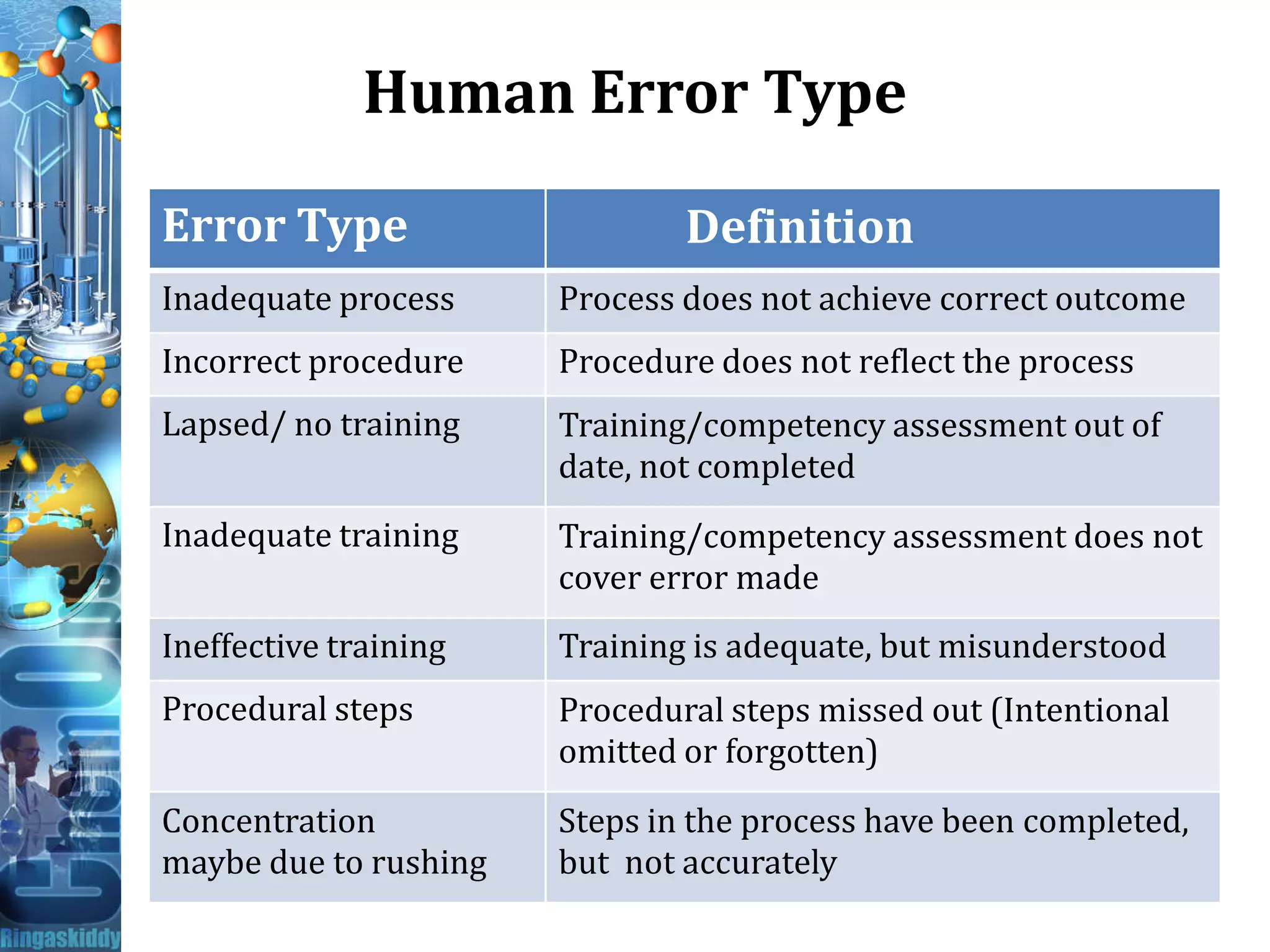
Human Error Type
Error Type Definition
Inadequate process Process does not achieve correct outcome
Incorrect procedure Procedure does not reflect the process
Lapsed/ no training Training/competency assessment out of
date, not completeddate, not completed
Inadequate training Training/competency assessment does not
cover error made
Ineffective training Training is adequate, but misunderstood
Procedural steps Procedural steps missed out (Intentional
omitted or forgotten)
Concentration
maybe due to rushing
Steps in the process have been completed,
but not accurately
Investigation tools
26
“You Can’t Solve A Problem
Until You Are Asking
The Right Question”The Right Question”
27
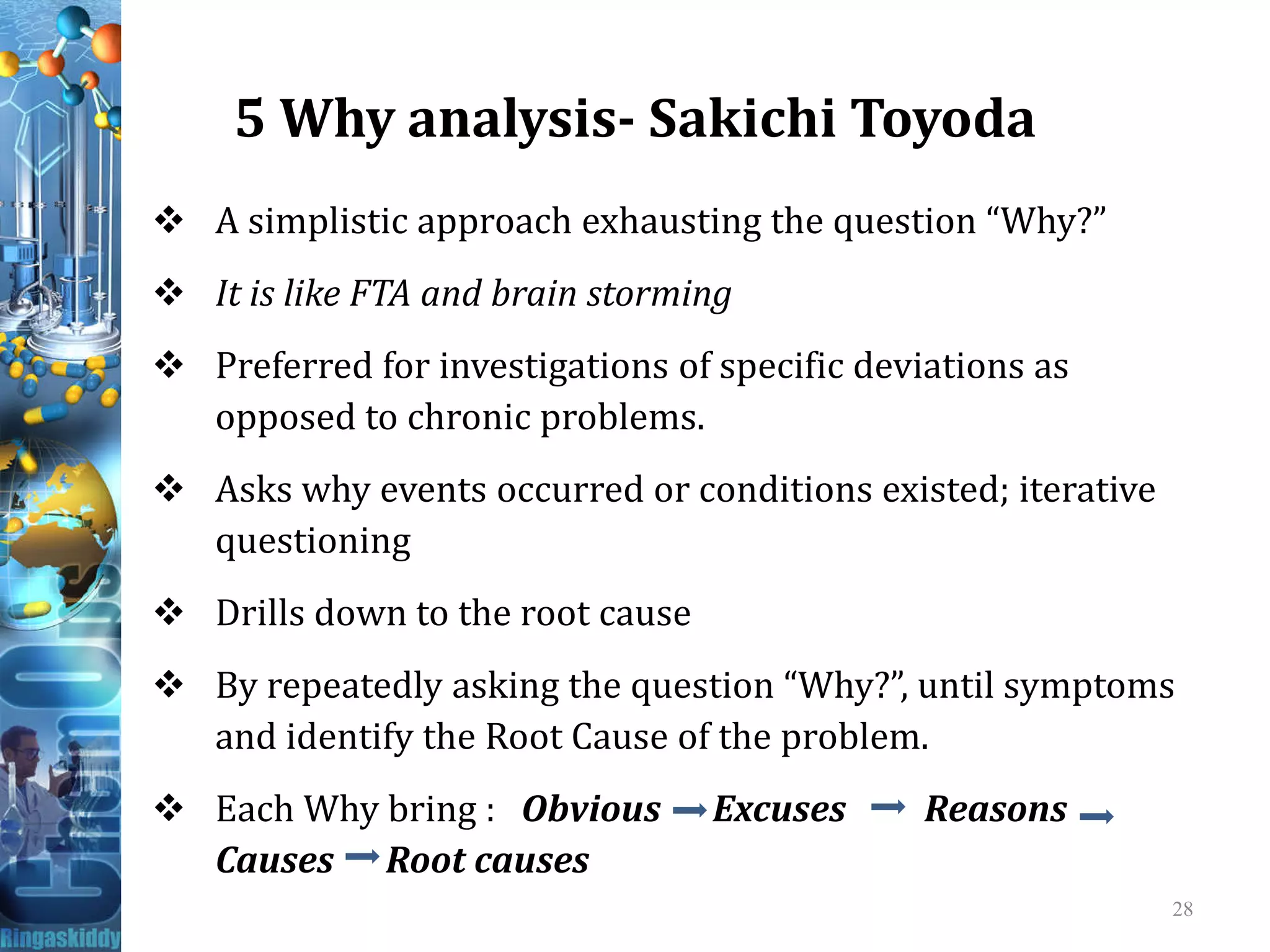
5 Why analysis- Sakichi Toyoda
 A simplistic approach exhausting the question “Why?”
 It is like FTA and brain storming
 Preferred for investigations of specific deviations as
opposed to chronic problems.
 Asks why events occurred or conditions existed; iterative Asks why events occurred or conditions existed; iterative
questioning
 Drills down to the root cause
 By repeatedly asking the question “Why?”, until symptoms
and identify the Root Cause of the problem.
 Each Why bring : Obvious Excuses Reasons
Causes Root causes
28
Disadvantages of 5 Why Analysis
 This time consuming brainstorming process may be
tedious for team members trying to reach
consensus.
 Results are not reproducible or consistent. Another Results are not reproducible or consistent. Another
team analyzing the same issue may reach a different
solution.
 Some time Root causes may not be identified.
29
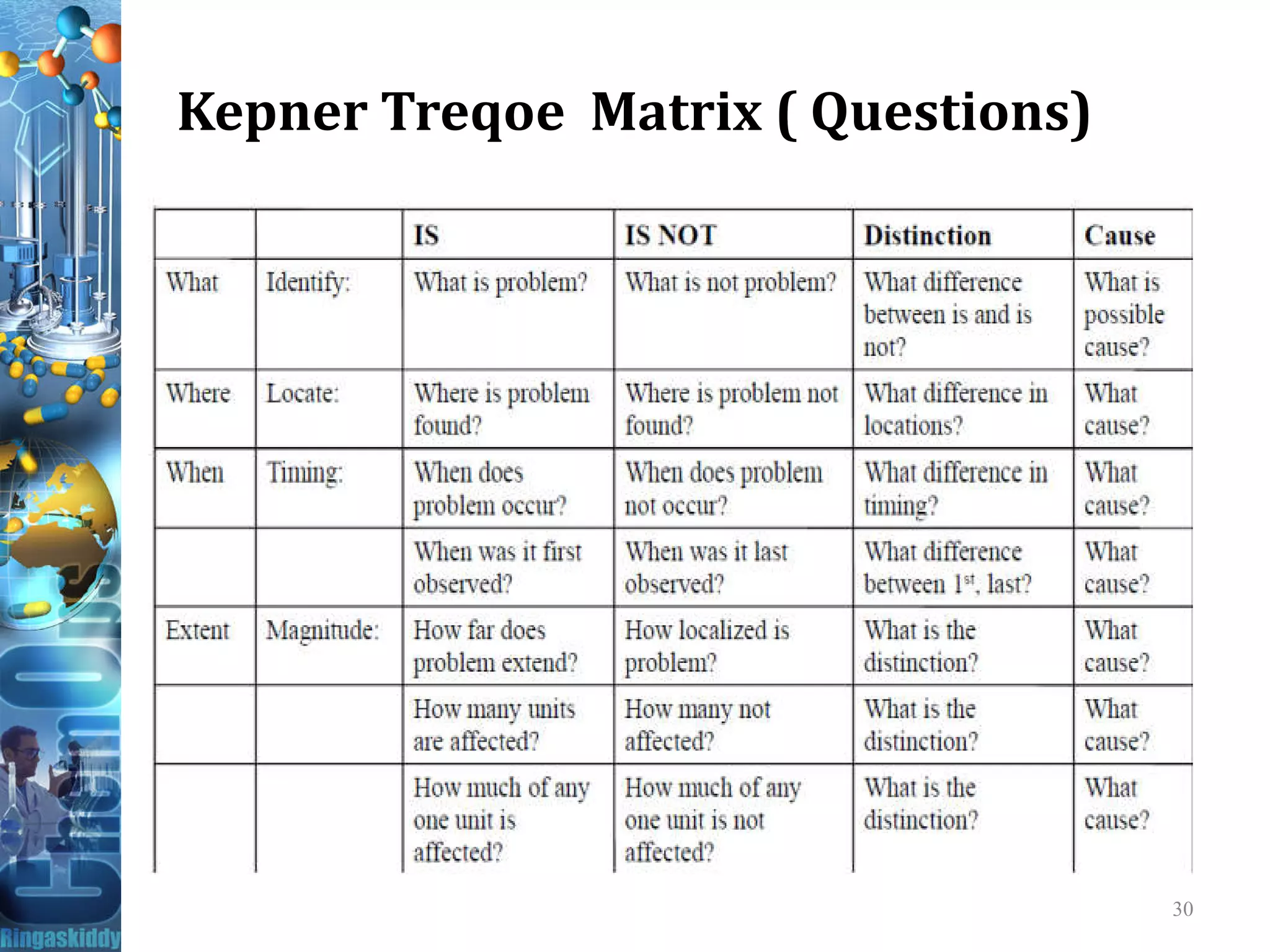
Kepner Treqoe Matrix ( Questions)
30
Cause and Effect /Fishbone Diagram
• It is also called as Ishikawa Diagram
• Establish a team which possess knowledge on this
• Write the Problem Statement at Head of a Fish bone.
• 6M or 5ME As Main Branch: Manpower, Machines,• 6M or 5ME As Main Branch: Manpower, Machines,
Materials, Methods, Measures, Milieu / Environment.
• Identify the main categories of possible causes
• Add the sub-branch/factors in the diagram until to get
useful information.
• Place these at ends of branches emanating from the
back bone. 31
Cause and Effect /Fishbone Diagram
 Brainstorm all possible causes and place these in the
suitable area of the diagram.
 Use checklist /questions to support brainstorming
 Do not discourage the members ideas
 Analyze the results of the fishbone after obtained
adequate detail to identify most likely causes.
 List most likely causes in priority order. First item
being the cause or most probable cause.
 Typical Fishbone diagram....
32
Typical Fishbone Diagram
33
Typical Fishbone Diagram
34
Example of Fish Bone Questions
Measurement:
• Is process performed as per established parameters?
• Are all measurement /entries / data correct?
• Calculations correct and verified?• Calculations correct and verified?
• Are measuring devices appropriate, qualified & calibrated?
• Do previous inspection or maintenance results indicate
potential problems?
• Is quantity of input and output correct. Is quality suitable
• Is there any previous atypical results or trending history ie OOT
• Recent documentation history?
35
Example of Fish Bone Questions
Method / Process:
• Is the process validated?
• Is the process operating within its validated
parameters?
• Any deviations from standard operating procedures?• Any deviations from standard operating procedures?
• Is the right procedure used?
• Is the procedure accurate / clear?
• Samples pulled at appropriate steps?
• Any sampling issues?
• Were processing steps properly verified?
36
Example of Fish Bone Questions
Machine/Equipment:
• Has equipment been recently replaced or repaired?
• Is qualified & and suitable assessed
• It is within calibration?
• Is preventative maintenance completed?
• Maintenance records reviewed?
• Are any equipment cleanliness issues?
• Equipment capacity or availability an issue?
• Is equipment being used for its intended purpose?
37
Example of Fish Bone Questions
Materials:
• Are material / components tested & approved ?
• Is properly released and issued ?
• Are materials charged correct quantity & in sequence?• Are materials charged correct quantity & in sequence?
• Material properly stored – temperature / humidity?
• Is within expiration dating?
• Is properly labeled & segregated adequately?
• Is it from new source / vendor?
• Material sensitive/ protected
38
Example of Fish Bone Questions
Environment
• Is any environmental condition that contributed to failure?
• Is temperature maintained in the area and product ?
• Is equipment / room properly cleaned?• Is equipment / room properly cleaned?
• Is cleaning validated?
• Cleaning agent /sanitization solutions used is appropriate ?
• Check the conditions :Air Flow, Pressure, Temperature, %RH
• Is any other activity performed at the same time that could
contributed
• Is personnel monitored and maintained within limits
39
Example of Fish Bone Questions
People /Men
• Are personnel properly trained in the procedures?
• Are the operators familiar with the activity?
• Are adequate number of personnel worked in the• Are adequate number of personnel worked in the
particular procedure?
• Verify break/ shift change or any other issue
• Is adequate oversight of operators possible?
• Are procedures available to operators conducting the
activity?
40
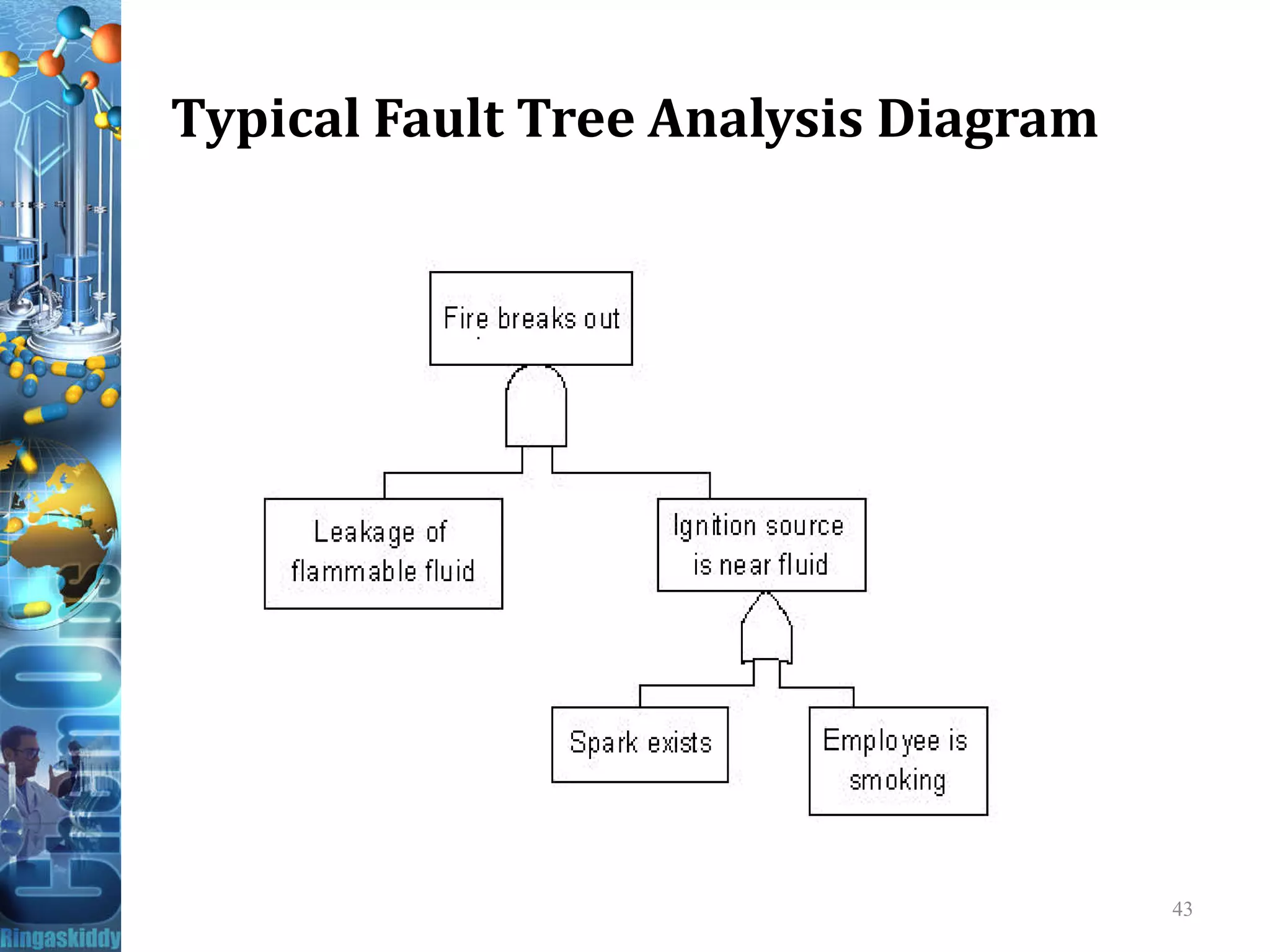
Fault Tree Analysis
 FTA can be used to investigate complaints, deviations, unusual
events
 It is a kind of deductive procedure used to determine failures and
human errors that could cause Failure/ undesired events
 Approach to failure of the functionality of a product or a process. Approach to failure of the functionality of a product or a process.
 FTA is pictorial presentation of the fault modes based on logical
reasoning
 FTA build by probable causes to identify potential causes of
system failure before actual failure occur.
 Conclusion after completing an FTA.
41
Fault Tree Analysis Steps
 Define the fault condition and write down the top level failure.
 Using technical information and professional judgments,
determine the possible reasons for the failure to occur and write
down below the failure in the tree..
 Continue to break down each element with additional gates toContinue to break down each element with additional gates to
lower levels.
 Consider the relationships between the elements to help you
decide whether to use an "and" or an "or" logic gate.
 Finalize and review the complete diagram. The chain can only be
terminated in a basic fault: human, hardware or software.
 If possible, evaluate the probability of occurrence at each elements
42
Typical Fault Tree Analysis Diagram
43
Fault Tree Analysis Diagram
44
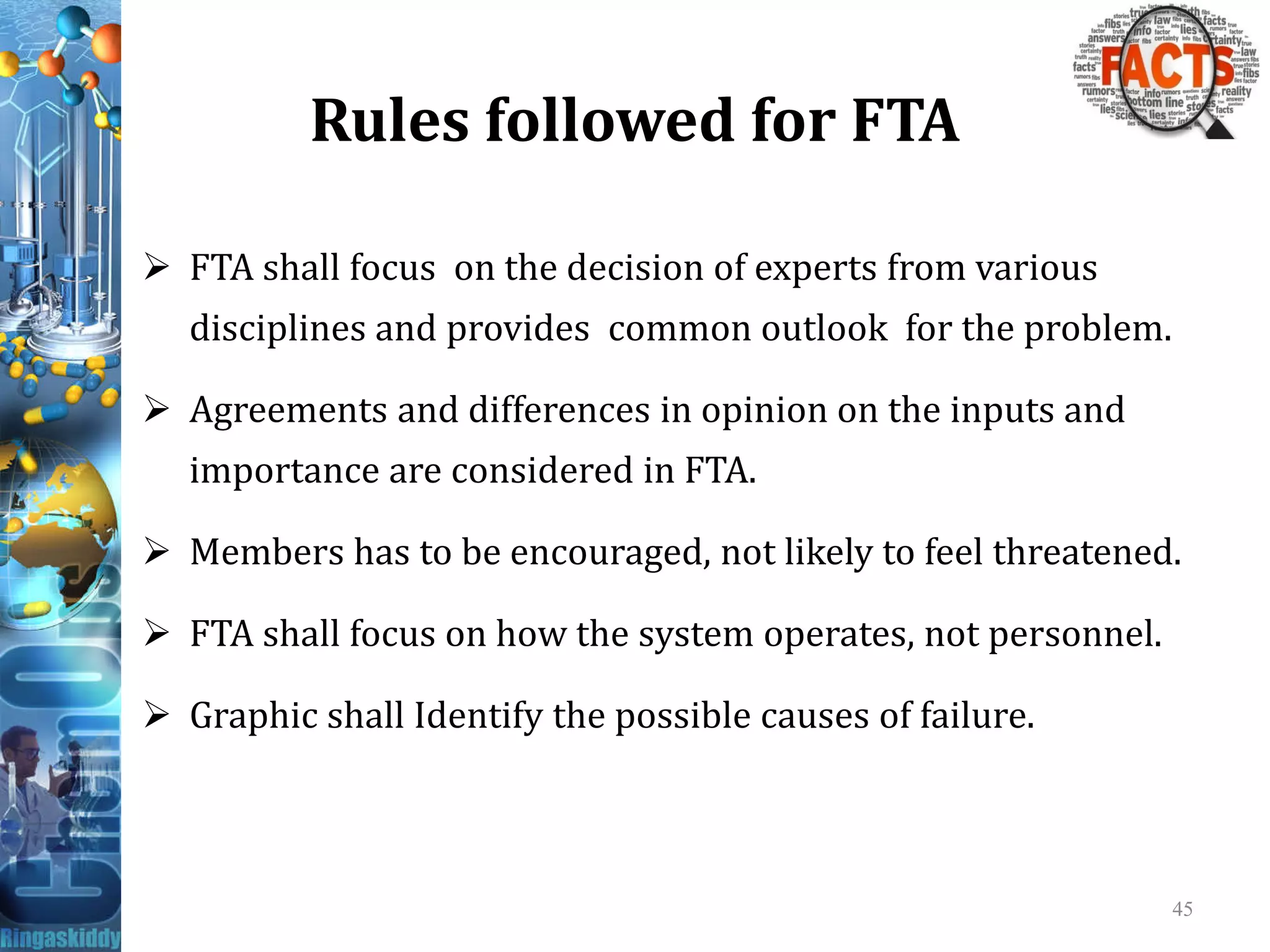
Rules followed for FTA
 FTA shall focus on the decision of experts from various
disciplines and provides common outlook for the problem.
 Agreements and differences in opinion on the inputs and
importance are considered in FTA.importance are considered in FTA.
 Members has to be encouraged, not likely to feel threatened.
 FTA shall focus on how the system operates, not personnel.
 Graphic shall Identify the possible causes of failure.
45
Avoid during Investigation
• Do not focus “Who made a mistake?” Focus on “Why
did this go wrong?”
• To avoid reaching erroneous / incomplete conclusions
in the rush state.
• Scope and extent of failure is not understood fully• Scope and extent of failure is not understood fully
• Being superficial ( at symptom level ) and not reaching
the depth ( at root cause level ).
• Lack of timely conclusion leading to improper product
realisation.
• Thus failure is subsequently repeated.
46
OOS Reporting & Investigation
• Description – clearly state the problem
• Phase1 – Check list – Chemist & supervisor
• Hypothesis test
• Retest
• Investigation
– Laboratory / Manufacturing
– RCA – investigation tool / methodology
– Fishbone diagram- men/ method/material/machine
– Process details/ analysis detail
– CFT :QA, QC, Production Technical service, Engineering , R&D etc
• Identify Other Batches Potentially Affected
– Justify Selection & Consider distributed lots if any
• Conclusion
• Documentation
47
Evaluation of product Impact
• Evaluate Product Impact / Disposition
– Additional testing / results
– Provide reason for accept / rejection of the batch
– Justify the exclusion of other batch if required
– Consider toxicological evaluation if required
– Reprocess/ reworking
– Stability
48
Investigation: Document Review
• Review all documents and records of the
manufacturing process.
• A written record of the review includes:
1. A clear statement of the reason
2. Summary of manufacturing process aspects that
could cause the problem
3. Results of documentation review with probable
cause.
4. Results of previous reviews
5. Description of corrective actions to be taken.
49
Resolution
Typical Resolutions to Causes
 Procedural changes / updates
 Process Changes
 Engineering changes
 Process validation Process validation
 New training programs
Typical Resolutions to Symptoms
 Fix it /Re-work / Correct
 Re-Training
 Disciplinary action
50
Conclusion of Investigation
• If a cause is found, invalidate the initial result
and use the retest value(s) in its place.
• If the OOS is confirmed the batch is rejected.• If the OOS is confirmed the batch is rejected.
• If the OOS is inconclusive and the retests are
within specification, then QA may be able to
justify releasing the batch.
51
52
Contents of Investigation Report
• Reason for the Investigation
– What event or finding initiated the investigation
– How and when Identified
• Evaluation• Evaluation
– Consider related activities and impact (immediate
& overall)
• Describe What Happened
– When
– Where
– What immediate actions were taken
53
CAPA
• Identify Corrective Actions
– Resist: operator error corrected with retraining
– May include additional monitoring / assessment
– Implementation must be timely– Implementation must be timely
• Identify Preventive Actions
– Success depends on adequate identification of root
cause
– Interim solution may include additional monitoring
54
Effectiveness Verification of CAPA
• After implementation of CAPA effectiveness has to be verified
• Check that proper controls are established
• Verify the proposed training / communications
• Verify that CAPA show the improvement and there is no such
problem reoccurs
• Verify that all the recommended changes are implemented and
documented
• Verify that implemented CAPA, is not have any other adverse
impact
• Document the effectiveness verification
55
Q&A
Thank you
56

Deviation, OOS & complaint investigation and CAPA

  • 1.
    Deviation, OOS &Complaint Investigation and CAPA 1 Dr. A. Amsavel, M.Sc., B.Ed., Ph.D.
  • 2.
    Overview • Definition • Requirement •Deviation, OOS and reporting • Investigation – RCA– RCA – Investigative tools: Why –Why , Cause & Effect and FTA – Human error • CAPA • Implementation • Investigation report • Verification for effectiveness 2
  • 3.
    Definition Correction: An actionto eliminate a detected nonconformity. Remedial action : Repair, rework, or adjustment Corrective Action: The action taken to eliminate the causes of an existing nonconformity, defect or other undesirable situation in order to prevent recurrence. Preventive Action: The action taken to eliminate the cause of aPreventive Action: The action taken to eliminate the cause of a potential nonconformity, defect, or other undesirable situation in order to prevent occurrence. Nonconformity: non-fulfillment of a specified requirement. Any material or process that does not meet its required specifications or documented procedure. Note: There is no definition for CAPA in the drug cGMP regulation 3
  • 4.
    Root Cause  RootCause identification is the most important step  Root Cause Analysis (RCA) is a systematic approach to identify the actual root causes of aapproach to identify the actual root causes of a problem.  Problems will only be solved if the corrective action implemented is addessing the real root cause accurately 4
  • 5.
    Non-Conformance & CAPAFlow Non-Conformance Control 1. Identify Non- conformity. 2. Keep an item away from work area. 3. Decision on non- Conforming item. 4. Take remedial action. Corrective Action (CA) 5 5. Initiate investigation 6. Identify Root cause. 7. CA/PA Implemen- tation 8. Verify the Effective- ness
  • 6.
    21CFR Requirement ( Asper Medical device) • 21 CFR 820.100(a): Regulatory Requirement - Establish and maintain procedures for implementing corrective and preventive action • 21 CFR 820.100(a)(2): Investigate to Determine Root Cause Investigate the cause of nonconformities relating to product,Investigate the cause of nonconformities relating to product, processes, and the quality system • 21 CFR 820.100(a)(3): Identify Corrective and Preventive Actions Identify the action(s) needed to correct and prevent recurrence of nonconforming product and other quality problems • 21 CFR 820.100(a)(4) Verify/Validate Corrective &Preventive Actions Verify or validate the corrective and preventive action to ensure that such action is effective and does not adversely affect the finished device 6
  • 7.
    Preamble • There areseveral investigation tools for deviation / OOS/ complaint investigations • Use effective tool to identify the root cause; usually with the use of a single tool. • Complex investigations may require two or more• Complex investigations may require two or more different tools Familiar tools used widely are – WHY -WHY analysis – Fish Bone Analysis 7
  • 8.
    Investigation Tools RCA Technique/Methodology 1. Why- Why analysis 2. Brain storming 3. Cause and Effect / Ishikawa / Fishbone Diagram: 4. Fault Tree Analysis (FTA) 5. FEMA etc 8
  • 9.
    Want to solvethe problem ! Think Differently 9
  • 10.
    How to ReportDeviation & OOS 1. Description – Describe clearly the Problem/Failure. 2. Determine: What, Why, Where, When, Who, How? 3. Immediate Actions taken : Contain/ stop continue 4. Immediate ( known ) Product Quality Impact4. Immediate ( known ) Product Quality Impact 5. Complete the above within 24 hours from time of an incident identified 6. Initial ( preliminary ) QA Review – Above section must be completed within 2 days of receipt – Complete the investigation as per SOP (preferably 3-5 days) 10
  • 11.
    Investigation Objective: Prevent thesimilar failure by effective CAPA. Seven steps of CAPA 1. Identification –Clearly define the problem 2. Evaluation – Appraise the magnitude and impact 3. Investigation – Make a plan to research the problem3. Investigation – Make a plan to research the problem 4. Analysis /RCA– Perform a thorough assessment 5. Action Plan – CAPA -Create a list of required tasks 6. Implementation – Execute the action plan 7. Follow Up – Verify the effectiveness Do not “release the deviation /OOS batch.” until establish the conclusion 11
  • 12.
    Deviation/Incident Reporting • Statethe incident Clearly /measurable terms – What, When, where, how often, how much, • Emphasize the quality risk, –safety, death, injury, rework, etc.–safety, death, injury, rework, etc. • Do not write incident as –negative descriptors, inflammatory statements –words that are broad and do not describe the conditions or behaviour such as careless, complacency, neglect, oversight etc 12
  • 13.
    Deviation/Incident Reporting “If AnIncident /problem is well defined , a problem half solved” – Keep in mind it is to Correct, Prevent & Improve – No shortcut to conclude as human error 5W: What is affected• What is affected • Where does the problem takes place • When is the problem indentified • Who is indentified • What is the consequence 2H: • How much is affected • How often has the problem occurred 13
  • 14.
    Investigation Process • Reviewpast history /similar issue • Review records and documents • Review process/operations • Review the situation/ environment • Interview people closest to the problem • Inspect and test the product/ material • Gemba-Inspect equipment & facilities at site 14
  • 15.
    Investigation Steps • Informationmust be captured from the people who were involved • Gather the facts quickly to avoid the loos• Gather the facts quickly to avoid the loos of information/ evidence • Determine what historical data is available • Determine what is known rather than what is “from memory” 15
  • 16.
    Investigation Recording • Recordthe details – Location – Date and time of occurrence, discovery – Personnel ( titles / names ) involved– Personnel ( titles / names ) involved • Explain why the event is different from what is expected – Initial scope: – Product / materials – Lot/batch / campaign – Equipment / train 16
  • 17.
    Investigation: Review ofDocuments • Review of BPR • Review of Test data/records • Review of situation surround of an incident • Review of Systems / facility/ Equipment • Eg. Environment, Log book, cleaning, handling • Verify any such past incidence & report • Any additional testing required 17
  • 18.
    Root Cause Analysis(RCA) Root cause and the “weed”:  Weeds can be difficult to remove once they start to grow and spread.  To eradicate the weed you have to 18  To eradicate the weed you have to get below the surface, identify the root, and pluck it out.  Thus, you have to go beyond the obvious, ascertain an accurate route cause, so the appropriate corrective action can be pursued to prevent recurrence.
  • 19.
    Root Cause Analysis(RCA) A root cause is a system or a process that caused the problem you observed. • Root Cause : That condition, action, or lack of action that led to the problem occurring. • Root Cause Analysis: The process of identifying all the causes (root causes and contributing causes) that have or may have led to an deviation. 19
  • 20.
    Possible Reasons forFailure • Human Error • Equipment Failure • Procedure is Inadequate or Not Clear • Procedure not Followed• Procedure not Followed • Training Inadequate • Design Error • Poor Communication 20
  • 21.
    What are HumanErrors? A mistake made by a person rather than a machine that produces a result that is Undesirable • The organization does everything to prevent the• The organization does everything to prevent the problem. • However, the employee ( operator/ peer/ supervisor/ management ) still make a mistake • Everyone can make error no matter how well trained and motivated 21
  • 22.
    Human Error orViolation? • Two types of human failure: Errors and violations. • Identify them correctly and to be addressed appropriately – A laboratory technician performing two tests simultaneously , but used the wrong sample for one of the tests – A production operator filled out a cleaning record without– A production operator filled out a cleaning record without performing the task • A violation is a deliberate deviation from a rule or procedure. – What influences to Error or Violation • Eg: Time pressure, design of controls, procedures, training and experience, fatigue, and levels of supervision etc. 22
  • 23.
    Human errors occurdue to • Inattention • Memory lapse • Failure to communicate • Exhaustion /poor working conditions A bad system will beat a good person every time -W. Edwards Deming • Exhaustion /poor working conditions • Ignorance • A number of other personal and environmental factors Poorly designed equipment / facility. Eg Temperature gauge is fixed at roof or operation in ground floor , values fixed at first floor 23
  • 24.
    Human Error • Humanerrors are not root causes • Human errors are symptoms or consequences of deeper causes • Develop error-tolerant systems to prevent errors • Design of the job, equipment, procedures, and training.• Design of the job, equipment, procedures, and training. “Change the People Without Changing the System and the Problems Continue.” -Don Norman 24
  • 25.
    Human Error Type ErrorType Definition Inadequate process Process does not achieve correct outcome Incorrect procedure Procedure does not reflect the process Lapsed/ no training Training/competency assessment out of date, not completeddate, not completed Inadequate training Training/competency assessment does not cover error made Ineffective training Training is adequate, but misunderstood Procedural steps Procedural steps missed out (Intentional omitted or forgotten) Concentration maybe due to rushing Steps in the process have been completed, but not accurately
  • 26.
  • 27.
    “You Can’t SolveA Problem Until You Are Asking The Right Question”The Right Question” 27
  • 28.
    5 Why analysis-Sakichi Toyoda  A simplistic approach exhausting the question “Why?”  It is like FTA and brain storming  Preferred for investigations of specific deviations as opposed to chronic problems.  Asks why events occurred or conditions existed; iterative Asks why events occurred or conditions existed; iterative questioning  Drills down to the root cause  By repeatedly asking the question “Why?”, until symptoms and identify the Root Cause of the problem.  Each Why bring : Obvious Excuses Reasons Causes Root causes 28
  • 29.
    Disadvantages of 5Why Analysis  This time consuming brainstorming process may be tedious for team members trying to reach consensus.  Results are not reproducible or consistent. Another Results are not reproducible or consistent. Another team analyzing the same issue may reach a different solution.  Some time Root causes may not be identified. 29
  • 30.
    Kepner Treqoe Matrix( Questions) 30
  • 31.
    Cause and Effect/Fishbone Diagram • It is also called as Ishikawa Diagram • Establish a team which possess knowledge on this • Write the Problem Statement at Head of a Fish bone. • 6M or 5ME As Main Branch: Manpower, Machines,• 6M or 5ME As Main Branch: Manpower, Machines, Materials, Methods, Measures, Milieu / Environment. • Identify the main categories of possible causes • Add the sub-branch/factors in the diagram until to get useful information. • Place these at ends of branches emanating from the back bone. 31
  • 32.
    Cause and Effect/Fishbone Diagram  Brainstorm all possible causes and place these in the suitable area of the diagram.  Use checklist /questions to support brainstorming  Do not discourage the members ideas  Analyze the results of the fishbone after obtained adequate detail to identify most likely causes.  List most likely causes in priority order. First item being the cause or most probable cause.  Typical Fishbone diagram.... 32
  • 33.
  • 34.
  • 35.
    Example of FishBone Questions Measurement: • Is process performed as per established parameters? • Are all measurement /entries / data correct? • Calculations correct and verified?• Calculations correct and verified? • Are measuring devices appropriate, qualified & calibrated? • Do previous inspection or maintenance results indicate potential problems? • Is quantity of input and output correct. Is quality suitable • Is there any previous atypical results or trending history ie OOT • Recent documentation history? 35
  • 36.
    Example of FishBone Questions Method / Process: • Is the process validated? • Is the process operating within its validated parameters? • Any deviations from standard operating procedures?• Any deviations from standard operating procedures? • Is the right procedure used? • Is the procedure accurate / clear? • Samples pulled at appropriate steps? • Any sampling issues? • Were processing steps properly verified? 36
  • 37.
    Example of FishBone Questions Machine/Equipment: • Has equipment been recently replaced or repaired? • Is qualified & and suitable assessed • It is within calibration? • Is preventative maintenance completed? • Maintenance records reviewed? • Are any equipment cleanliness issues? • Equipment capacity or availability an issue? • Is equipment being used for its intended purpose? 37
  • 38.
    Example of FishBone Questions Materials: • Are material / components tested & approved ? • Is properly released and issued ? • Are materials charged correct quantity & in sequence?• Are materials charged correct quantity & in sequence? • Material properly stored – temperature / humidity? • Is within expiration dating? • Is properly labeled & segregated adequately? • Is it from new source / vendor? • Material sensitive/ protected 38
  • 39.
    Example of FishBone Questions Environment • Is any environmental condition that contributed to failure? • Is temperature maintained in the area and product ? • Is equipment / room properly cleaned?• Is equipment / room properly cleaned? • Is cleaning validated? • Cleaning agent /sanitization solutions used is appropriate ? • Check the conditions :Air Flow, Pressure, Temperature, %RH • Is any other activity performed at the same time that could contributed • Is personnel monitored and maintained within limits 39
  • 40.
    Example of FishBone Questions People /Men • Are personnel properly trained in the procedures? • Are the operators familiar with the activity? • Are adequate number of personnel worked in the• Are adequate number of personnel worked in the particular procedure? • Verify break/ shift change or any other issue • Is adequate oversight of operators possible? • Are procedures available to operators conducting the activity? 40
  • 41.
    Fault Tree Analysis FTA can be used to investigate complaints, deviations, unusual events  It is a kind of deductive procedure used to determine failures and human errors that could cause Failure/ undesired events  Approach to failure of the functionality of a product or a process. Approach to failure of the functionality of a product or a process.  FTA is pictorial presentation of the fault modes based on logical reasoning  FTA build by probable causes to identify potential causes of system failure before actual failure occur.  Conclusion after completing an FTA. 41
  • 42.
    Fault Tree AnalysisSteps  Define the fault condition and write down the top level failure.  Using technical information and professional judgments, determine the possible reasons for the failure to occur and write down below the failure in the tree..  Continue to break down each element with additional gates toContinue to break down each element with additional gates to lower levels.  Consider the relationships between the elements to help you decide whether to use an "and" or an "or" logic gate.  Finalize and review the complete diagram. The chain can only be terminated in a basic fault: human, hardware or software.  If possible, evaluate the probability of occurrence at each elements 42
  • 43.
    Typical Fault TreeAnalysis Diagram 43
  • 44.
  • 45.
    Rules followed forFTA  FTA shall focus on the decision of experts from various disciplines and provides common outlook for the problem.  Agreements and differences in opinion on the inputs and importance are considered in FTA.importance are considered in FTA.  Members has to be encouraged, not likely to feel threatened.  FTA shall focus on how the system operates, not personnel.  Graphic shall Identify the possible causes of failure. 45
  • 46.
    Avoid during Investigation •Do not focus “Who made a mistake?” Focus on “Why did this go wrong?” • To avoid reaching erroneous / incomplete conclusions in the rush state. • Scope and extent of failure is not understood fully• Scope and extent of failure is not understood fully • Being superficial ( at symptom level ) and not reaching the depth ( at root cause level ). • Lack of timely conclusion leading to improper product realisation. • Thus failure is subsequently repeated. 46
  • 47.
    OOS Reporting &Investigation • Description – clearly state the problem • Phase1 – Check list – Chemist & supervisor • Hypothesis test • Retest • Investigation – Laboratory / Manufacturing – RCA – investigation tool / methodology – Fishbone diagram- men/ method/material/machine – Process details/ analysis detail – CFT :QA, QC, Production Technical service, Engineering , R&D etc • Identify Other Batches Potentially Affected – Justify Selection & Consider distributed lots if any • Conclusion • Documentation 47
  • 48.
    Evaluation of productImpact • Evaluate Product Impact / Disposition – Additional testing / results – Provide reason for accept / rejection of the batch – Justify the exclusion of other batch if required – Consider toxicological evaluation if required – Reprocess/ reworking – Stability 48
  • 49.
    Investigation: Document Review •Review all documents and records of the manufacturing process. • A written record of the review includes: 1. A clear statement of the reason 2. Summary of manufacturing process aspects that could cause the problem 3. Results of documentation review with probable cause. 4. Results of previous reviews 5. Description of corrective actions to be taken. 49
  • 50.
    Resolution Typical Resolutions toCauses  Procedural changes / updates  Process Changes  Engineering changes  Process validation Process validation  New training programs Typical Resolutions to Symptoms  Fix it /Re-work / Correct  Re-Training  Disciplinary action 50
  • 51.
    Conclusion of Investigation •If a cause is found, invalidate the initial result and use the retest value(s) in its place. • If the OOS is confirmed the batch is rejected.• If the OOS is confirmed the batch is rejected. • If the OOS is inconclusive and the retests are within specification, then QA may be able to justify releasing the batch. 51
  • 52.
  • 53.
    Contents of InvestigationReport • Reason for the Investigation – What event or finding initiated the investigation – How and when Identified • Evaluation• Evaluation – Consider related activities and impact (immediate & overall) • Describe What Happened – When – Where – What immediate actions were taken 53
  • 54.
    CAPA • Identify CorrectiveActions – Resist: operator error corrected with retraining – May include additional monitoring / assessment – Implementation must be timely– Implementation must be timely • Identify Preventive Actions – Success depends on adequate identification of root cause – Interim solution may include additional monitoring 54
  • 55.
    Effectiveness Verification ofCAPA • After implementation of CAPA effectiveness has to be verified • Check that proper controls are established • Verify the proposed training / communications • Verify that CAPA show the improvement and there is no such problem reoccurs • Verify that all the recommended changes are implemented and documented • Verify that implemented CAPA, is not have any other adverse impact • Document the effectiveness verification 55
  • 56.