Safety Management SystemFRAMEWORKS P SINGH
Safety management system“Safety Management System” is a management tool for the management of safety by an organisation, reflecting an organised and orderly approach.
SMS FrameworkSMS Framework is to provide one standard format (basic conceptual structure) for aviation service providers to use developing and implementing an SMS.It provides a functional framework consisting of a set of expectations for SMS processes.SMS Framework supports the entire SMSIt provide a clearer understanding of components, elements and processes.
SMS Framework - ComponentThe  ICAO  SMS framework   consists  of four components  and  twelve  elements1.	Safety policy and objectives2.    Safety risk management3.   Safety assurance4.   Safety promotion
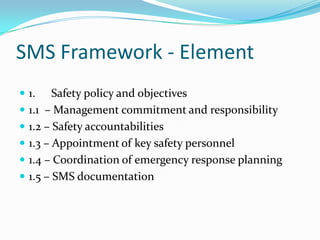
SMS Framework - Element1.	Safety policy and objectives1.1  – Management commitment and responsibility1.2 – Safety accountabilities1.3 – Appointment of key safety personnel1.4 – Coordination of emergency response planning 1.5 – SMS documentation
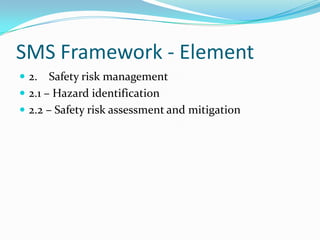
SMS Framework - Element2.    Safety risk management2.1 – Hazard identification2.2 – Safety risk assessment and mitigation
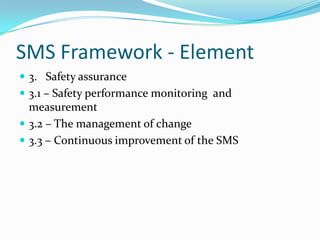
SMS Framework - Element3.   Safety assurance3.1 – Safety performance monitoring  and measurement3.2 – The management of change3.3 – Continuous improvement of the SMS
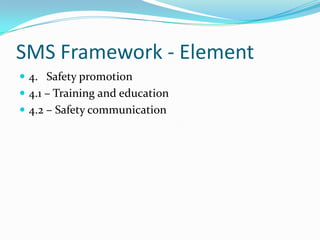
SMS Framework - Element4.   Safety promotion4.1 – Training and education4.2 – Safety communication
SAFETY RISK MANAGEMENT A service provider shall develop and maintain safety data collection and processing systems (SDCPS) that provide for the identification of hazards and the analysis, assessment and mitigation of safety risks SDCPS shall include reactive, proactive and predictive methods of safety data collection
    2.1 Hazard identification a) reporting of hazards, events or safety concerns; b) collection and storage of safety data; c) analysis of the safety data; and d) distribution of the safety information distilled from the safety data
 2.2 Safety performance monitoring and measurement Safety performance monitoring and measurement means shall include the following: a) hazard reporting systems; b) safety audits; c) safety surveys; d) safety reviews; e) safety studies; and f) internal safety investigations
  4.2 Safety communication a) ensure that all staff are fully aware of the SMS; b) convey safety-critical information; c) explain why particular safety actions are taken; d) explain why safety procedures are introduced or changed; and e) convey generic safety information
   4.2 Safety communication Formal means of safety communication shall include inter alia: a) safety policies and procedures; b) newsletters; c) bulletins; and d) websites
PLAN FOR IMPLEMENTATIONPhase 2: At one-year (20.07.2011)a) a documented safety management plan; b) documented policies and procedures relating to the required SMS components; c) a process for occurrence reporting with the associated supportive elements such as training, a method of collecting, storing and distributing data, and a risk management process
Phase IIPhase II — Reactive processes should put into practice those elements of the SMS implementation plan that refer to safety risk management based on reactive processes: a. hazard identification and safety risk management using reactive processes;
Phase IIb. training relevant to: 1. SMS implementation plan components; and 2. safety risk management (reactive processes). c. documentation relevant to: 1. SMS implementation plan components; and 2. safety risk management (reactive processes).
                     THANKSThanks for visit.Please write comments onspsinghame@gmail.comtrg.orientflights@gmail.com

Safety Management System framework

  • 1.
  • 2.
    Safety management system“SafetyManagement System” is a management tool for the management of safety by an organisation, reflecting an organised and orderly approach.
  • 3.
    SMS FrameworkSMS Frameworkis to provide one standard format (basic conceptual structure) for aviation service providers to use developing and implementing an SMS.It provides a functional framework consisting of a set of expectations for SMS processes.SMS Framework supports the entire SMSIt provide a clearer understanding of components, elements and processes.
  • 4.
    SMS Framework -ComponentThe ICAO SMS framework consists of four components and twelve elements1. Safety policy and objectives2. Safety risk management3. Safety assurance4. Safety promotion
  • 5.
    SMS Framework -Element1. Safety policy and objectives1.1 – Management commitment and responsibility1.2 – Safety accountabilities1.3 – Appointment of key safety personnel1.4 – Coordination of emergency response planning 1.5 – SMS documentation
  • 6.
    SMS Framework -Element2. Safety risk management2.1 – Hazard identification2.2 – Safety risk assessment and mitigation
  • 7.
    SMS Framework -Element3. Safety assurance3.1 – Safety performance monitoring and measurement3.2 – The management of change3.3 – Continuous improvement of the SMS
  • 8.
    SMS Framework -Element4. Safety promotion4.1 – Training and education4.2 – Safety communication
  • 9.
    SAFETY RISK MANAGEMENTA service provider shall develop and maintain safety data collection and processing systems (SDCPS) that provide for the identification of hazards and the analysis, assessment and mitigation of safety risks SDCPS shall include reactive, proactive and predictive methods of safety data collection
  • 10.
    2.1 Hazard identification a) reporting of hazards, events or safety concerns; b) collection and storage of safety data; c) analysis of the safety data; and d) distribution of the safety information distilled from the safety data
  • 11.
    2.2 Safetyperformance monitoring and measurement Safety performance monitoring and measurement means shall include the following: a) hazard reporting systems; b) safety audits; c) safety surveys; d) safety reviews; e) safety studies; and f) internal safety investigations
  • 12.
    4.2Safety communication a) ensure that all staff are fully aware of the SMS; b) convey safety-critical information; c) explain why particular safety actions are taken; d) explain why safety procedures are introduced or changed; and e) convey generic safety information
  • 13.
    4.2 Safety communication Formal means of safety communication shall include inter alia: a) safety policies and procedures; b) newsletters; c) bulletins; and d) websites
  • 14.
    PLAN FOR IMPLEMENTATIONPhase2: At one-year (20.07.2011)a) a documented safety management plan; b) documented policies and procedures relating to the required SMS components; c) a process for occurrence reporting with the associated supportive elements such as training, a method of collecting, storing and distributing data, and a risk management process
  • 15.
    Phase IIPhase II— Reactive processes should put into practice those elements of the SMS implementation plan that refer to safety risk management based on reactive processes: a. hazard identification and safety risk management using reactive processes;
  • 16.
    Phase IIb. trainingrelevant to: 1. SMS implementation plan components; and 2. safety risk management (reactive processes). c. documentation relevant to: 1. SMS implementation plan components; and 2. safety risk management (reactive processes).
  • 17.
    THANKSThanks for visit.Please write comments onspsinghame@gmail.comtrg.orientflights@gmail.com