
Sharpen Your Business  Writing Skills  Instructor:  Ron Macklin Session One
Instructor Qualifications Technical Writer/Illustrator  Published Author (2 books & 125 articles ) Sound-View Summaries (3 years) Director, Visual Communications & Distribution Services (Motorola, Inc.)  Communications Consultant to Motorola, IBM, Xerox, Weyco, Boeing, City of Los Angeles, City of Scottsdale, Mayo Clinic, Pennzoil, Sun Kist Growers, Giant Foods and many others.
Introductions Please tell us a little about yourself and your employer………
George Orwell said, “ Good writing is like a windowpane.”
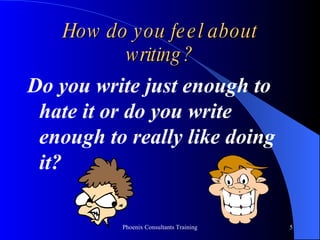
How do you feel about writing? Do you write just enough to hate it or do you write enough to really like doing it?
Remember It doesn’t matter how your writing starts out; what matters is how it ends up.
Remember This When Writing 50% of the U.S. population reads below an 8 th  grade level and about 90 million adults are functionally illiterate Because of this problem, U.S. companies lose $60 billion annually in lost productivity
Your Reason for Attending? Have two questions for each of you…. What motivated you to take this class? What would you like to take away? Please, don’t be bashful……
Fact Over 60 million people, in this country, write as part of their jobs
What we are  NOT  going to do in this class…..   Teach Rocket Science or Brain Surgery Embarrass anyone. Ask you do do anything you cannot do. Send you away without something you can use everyday.
We are going to build on….. What you’ve already learned in other writing classes Your life experience Your considerable ability to adjust your thinking Your established style of writing at this moment in time
What you learn today You will put to use tomorrow You will adjust to any topic Will help you write in a way that anyone  can understand Will help you deliver information to readers in a manner adapted to their needs, level of understanding, and background
Take a Look at some Materials Available to You…… The Elements of Style The Elements of Grammar The Elements of Editing Can order on Amazon.Com or buy at Barnes and Noble
What we  ARE  going to do in this class….. Teach you to identify, evaluate and organize pertinent information. Teach you to write like you speak. Teach you to assemble pertinent data into meaningful communication. Teach you to have confidence in your ability to communicate difficult concepts and ideas.
In Other Words…… We are going to use  SKILLS , not  FRILLS !
The Skills Needed to…. Write energized documents that have the desired impact on your readers Provide the strategy and resources to write clear, accurate, and logical documents Show respect for your reader To write with a positive attitude, not with arrogance
Some Interesting Facts Most of us spend 14% of our business day writing 20% of our message content is misunderstood by the receiver 20% of what we write shouldn’t have been written at all We should write to express, not to impress
John Dryden said, “ Learn to write well, or not to write at all.” English Poet (1631-1700)
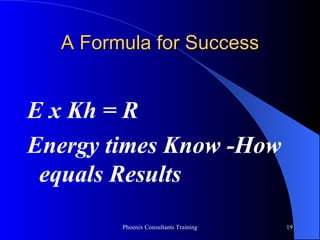
A Formula for Success E x Kh = R Energy times Know -How equals Results
A Good Place to Begin… In any class that requires one to arrange and evaluate information…(Outlining)  We like to start with a sure-fire, easy-to-remember, way of doing that… It is a useful and easy to remember analogy…..(for those of you who play cards)
Poker Chip Analogy During this Class please think in values …(A simple form of outlining) Blue   Chips Red  Chips White Chips
BLUE   CHIPS The  Blue   Chip ideas are of the highest in value they will represent….. MAJOR POINTS OR IDEAS Usually the first sentence in every paragraph
RED  CHIPS The  Red  Chips are Secondary in value they will represent…… SUBORDINATE  POINTS OR IDEAS Sentences directly supporting the main thought in the first sentence
WHITE CHIPS The  White Chips  are Tertiary in value they will represent…… Reinforcing Points or Ideas Additional sentences reinforcing the main and subordinate thoughts
IN ALL YOUR COMMUNICATION Categorize the material to be presented in these values: BLUE , Major points RED , Subordinate points WHITE , Supporting points
EXAMPLE IN COMMUNICATION When communicating we must deal with  PEOPLE THIS WILL BE OUR  BLUE   CHIP
BLUE  CHIP is When communicating we must deal with PEOPLE SUBORDINATE IDEAS When dealing with people there are two basic steps to be used: Step 1 is to Ask the Three People Questions. Step 2 is to Use Motivators. THESE TWO BASIC STEPS ARE  RED  CHIPS
RED  CHIPS are The two basic steps to be used SUPPORTING MATERIAL In step One, The Three People Questions are: What is your purpose? Who is involved? What do they want? THESE POINTS ARE  WHITE  CHIPS
WHITE  CHIPS CONTINUED ADDITIONAL SUPPORTING MATERIAL In step Two, The Motivators are: Catch and Hold Their Attention Show Them the Way THESE POINTS ARE  WHITE  CHIPS
Review Blue   Chip = Main thought. First sentence in paragraph Red  Chip = Sentences supporting the main thought or sentence White  Chip = Additional reinforcing  sentences needed in the development of the main thought All these make up a paragraph
Remember The Poker Chips They will serve you well in  your efforts to evaluate the data used to communicate with other people; whether you are writing or speaking.
The Principles of Business  Writing Organizing Ideas Evaluate and Organize Data Generating Content Organizing and Presenting Data to fit the Needs of Your Audience
What’s involved? Thinking  logically (creating a ‘block’ of ideas) Turning  the ‘block’ into a document Being clear , concise, & understandable in a way that’s appropriate for a specific audience Reviewing  Written Communications and their formats to ensure accuracy Creating  a Rapport with Words & Phrases (clarity and precision) Developing  the ability to “translate”  information for non-specialists
What’s involved  (continued) Define  unfamiliar terms Avoid  jargon and acronyms (where possible) Use  the proper  voice  in writing Be  as specific and simple as possible Use  present tense most of the time Condense , condense, condense
What is involved (continued) Use past tense only to describe things already done Be quantitative (avoid using “a lot”, “very”, “much”, and “significantly”
Have Clarity & Precision When Writing: Definitions Descriptions Narratives Instructions Procedures Letters E-mail
What is a Definition? Explanations or Meanings An act of Determining Statement Expressing the Essential Nature of Something Describing, Explaining, or Making Definite & Clear
What is a Description? To Give a Mental Image of Something Experienced A Descriptive Statement or Account Description means the presentation of physical, quantifiable details about some object (those you can count or measure)
Physical Details Include: Color, Shape, Size, Texture, Materials of construction, Ingredients, Weight, Height, Width, Depth, and so on The best way to present this physical, quantifiable detail is the Part-by-Part Approach
What is a Narrative? A Story Something That is Narrated
What are Instructions? A Precept A Direction Calling for Compliance An Outline or Manual of Technical Procedure Directions The Action, Practice, or Profession of   Teaching
What is a Procedure? A Particular Way of Accomplishing Something or of Acting A Protocol A Series of Steps Followed in a Regular Definite Order
What is a Business Letter? Simply stated, “A Business Letter is a written message.” Its purpose is to communicate  with  or  for  an institution or company Or to establish a record of some transaction
What is a Business E-Mail? An electronic Letter or Memo They should be written with as much concern as a business letter They should reflect good Grammar and Spelling  They are a reflection of your ability and attention to detail
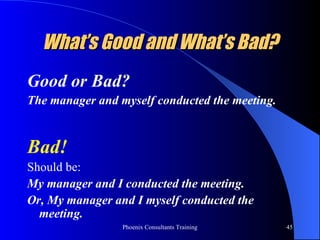
What’s Good and What’s Bad? Good or Bad? The manager and myself conducted the meeting. Bad!   Should be:  My manager and I conducted the meeting.  Or, My manager and I myself conducted the meeting.
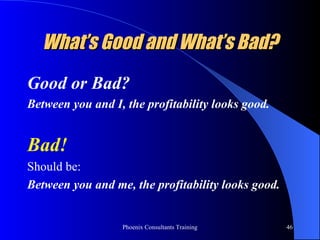
What’s Good and What’s Bad? Good or Bad? Between you and I, the profitability looks good. Bad!   Should be:  Between you and me, the profitability looks good.
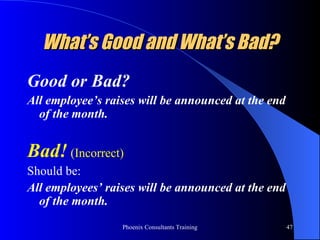
What’s Good and What’s Bad? Good or Bad? All employee’s raises will be announced at the end of the month. Bad!  (Incorrect) Should be:  All employees’ raises will be announced at the end of the month.
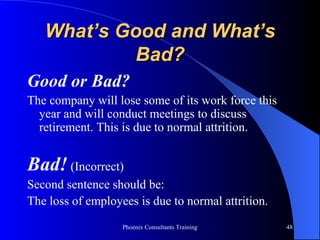
What’s Good and What’s Bad? Good or Bad? The company will lose some of its work force this year and will conduct meetings to discuss retirement. This is due to normal attrition. Bad!  (Incorrect) Second sentence should be:  The loss of employees is due to normal attrition.
What’s Good and What’s Bad? Good or Bad? The procedures manual  is written in a passive style. Good!
What’s Good and What’s Bad? Good or Bad? Everybody is entitled to their own opinion. Bad! Should be:  Everybody is entitled to his or her own  opinion. Or, All persons are entitled to their own opinions.
Let’s talk about…. Brevity and Conciseness (Review Manual)
I Have a Question for You…..   Can you tell me the shortest complete   sentence in the English Language? “ GO”
Another Question for You…. What three parts make up every   presentation written or otherwise? 1.  Introduction 2.  Body 3.  Conclusion
Another Question for You…. Is it permissible to use other people’s ideas in your writing? Think about it…. Yes! If you give them appropriate credit
John Burke said “ If you steal from one author, it’s plagiarism. If you steal from two, it’s research.”
What is Plagiarism? Plagiarism is defined in the Ohio University Student Handbook as “presenting the ideas or writing of someone else as one’s own”.  It’s a form of theft and could be punishable by law
Let’s Move on to a more pleasant subject………
An Example of Clarity in Writing…….. Which would you prefer?   This: Objective consideration of contemporary phenomena compels the conclusion that success or failure in competitive activities exhibits no tendency to be commensurate with innate capacity, but that a considerable element of the unpredictable must inevitably be taken into account. (George Orwell’s translation into bureaucratic fuzz)
Or This: I returned to see under the Sun that the swift do not have the race, nor the mighty ones the battle, nor do the wise also have the food, nor the understanding ones also have the riches, nor do even those having knowledge have the favor; because time and unforseen occurance befall them all. (The actual scripture at Ecclesiastes 9:11)
Or What about this…… It doesn’t matter if you’re fast, mighty, rich, or smart, we’re all victims of time and chance.
SOME OTHER  EXAMPLES………
Check This Out…… This unequivocal expostulation stated herein is an extremity on my behalf, warranted by an incessant lackadaisical attitude on the part of a specific second party herewith being addressed, concerning the issue of insufficient, irregular, erratic, and unresponsive correspondence extenuatingly condoned on the part of the same aforementioned party.
In Brief….. Write
Clarity in Writing….. Will help to get your document read
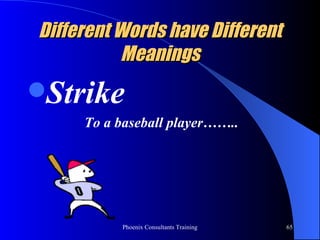
Different Words have Different Meanings Strike To a baseball player……..
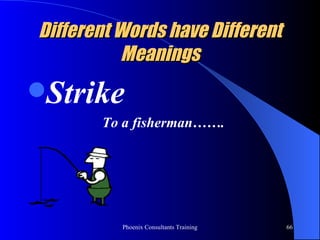
Different Words have Different Meanings Strike To a fisherman…….
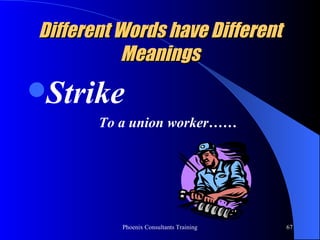
Different Words have Different Meanings Strike To a union worker……
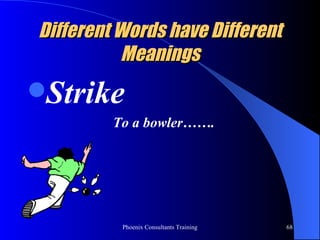
Different Words have Different Meanings Strike To a bowler…….
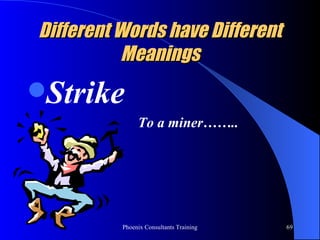
Different Words have Different Meanings Strike To a miner……..
Let’s Go Further…….. Using the principles we have covered so far Let’s get a little more detailed
Let’s Get a Little More Involved Do another exercise with a little more detail than the previous two
Aristotle said this: “ We are what we repeatedly do. Excellence then, is not an act, but a habit.”

Business Writing Level 1

  • 1.
    Sharpen Your Business Writing Skills Instructor: Ron Macklin Session One
  • 2.
    Instructor Qualifications TechnicalWriter/Illustrator Published Author (2 books & 125 articles ) Sound-View Summaries (3 years) Director, Visual Communications & Distribution Services (Motorola, Inc.) Communications Consultant to Motorola, IBM, Xerox, Weyco, Boeing, City of Los Angeles, City of Scottsdale, Mayo Clinic, Pennzoil, Sun Kist Growers, Giant Foods and many others.
  • 3.
    Introductions Please tellus a little about yourself and your employer………
  • 4.
    George Orwell said,“ Good writing is like a windowpane.”
  • 5.
    How do youfeel about writing? Do you write just enough to hate it or do you write enough to really like doing it?
  • 6.
    Remember It doesn’tmatter how your writing starts out; what matters is how it ends up.
  • 7.
    Remember This WhenWriting 50% of the U.S. population reads below an 8 th grade level and about 90 million adults are functionally illiterate Because of this problem, U.S. companies lose $60 billion annually in lost productivity
  • 8.
    Your Reason forAttending? Have two questions for each of you…. What motivated you to take this class? What would you like to take away? Please, don’t be bashful……
  • 9.
    Fact Over 60million people, in this country, write as part of their jobs
  • 10.
    What we are NOT going to do in this class….. Teach Rocket Science or Brain Surgery Embarrass anyone. Ask you do do anything you cannot do. Send you away without something you can use everyday.
  • 11.
    We are goingto build on….. What you’ve already learned in other writing classes Your life experience Your considerable ability to adjust your thinking Your established style of writing at this moment in time
  • 12.
    What you learntoday You will put to use tomorrow You will adjust to any topic Will help you write in a way that anyone can understand Will help you deliver information to readers in a manner adapted to their needs, level of understanding, and background
  • 13.
    Take a Lookat some Materials Available to You…… The Elements of Style The Elements of Grammar The Elements of Editing Can order on Amazon.Com or buy at Barnes and Noble
  • 14.
    What we ARE going to do in this class….. Teach you to identify, evaluate and organize pertinent information. Teach you to write like you speak. Teach you to assemble pertinent data into meaningful communication. Teach you to have confidence in your ability to communicate difficult concepts and ideas.
  • 15.
    In Other Words……We are going to use SKILLS , not FRILLS !
  • 16.
    The Skills Neededto…. Write energized documents that have the desired impact on your readers Provide the strategy and resources to write clear, accurate, and logical documents Show respect for your reader To write with a positive attitude, not with arrogance
  • 17.
    Some Interesting FactsMost of us spend 14% of our business day writing 20% of our message content is misunderstood by the receiver 20% of what we write shouldn’t have been written at all We should write to express, not to impress
  • 18.
    John Dryden said,“ Learn to write well, or not to write at all.” English Poet (1631-1700)
  • 19.
    A Formula forSuccess E x Kh = R Energy times Know -How equals Results
  • 20.
    A Good Placeto Begin… In any class that requires one to arrange and evaluate information…(Outlining) We like to start with a sure-fire, easy-to-remember, way of doing that… It is a useful and easy to remember analogy…..(for those of you who play cards)
  • 21.
    Poker Chip AnalogyDuring this Class please think in values …(A simple form of outlining) Blue Chips Red Chips White Chips
  • 22.
    BLUE CHIPS The Blue Chip ideas are of the highest in value they will represent….. MAJOR POINTS OR IDEAS Usually the first sentence in every paragraph
  • 23.
    RED CHIPSThe Red Chips are Secondary in value they will represent…… SUBORDINATE POINTS OR IDEAS Sentences directly supporting the main thought in the first sentence
  • 24.
    WHITE CHIPS The White Chips are Tertiary in value they will represent…… Reinforcing Points or Ideas Additional sentences reinforcing the main and subordinate thoughts
  • 25.
    IN ALL YOURCOMMUNICATION Categorize the material to be presented in these values: BLUE , Major points RED , Subordinate points WHITE , Supporting points
  • 26.
    EXAMPLE IN COMMUNICATIONWhen communicating we must deal with PEOPLE THIS WILL BE OUR BLUE CHIP
  • 27.
    BLUE CHIPis When communicating we must deal with PEOPLE SUBORDINATE IDEAS When dealing with people there are two basic steps to be used: Step 1 is to Ask the Three People Questions. Step 2 is to Use Motivators. THESE TWO BASIC STEPS ARE RED CHIPS
  • 28.
    RED CHIPSare The two basic steps to be used SUPPORTING MATERIAL In step One, The Three People Questions are: What is your purpose? Who is involved? What do they want? THESE POINTS ARE WHITE CHIPS
  • 29.
    WHITE CHIPSCONTINUED ADDITIONAL SUPPORTING MATERIAL In step Two, The Motivators are: Catch and Hold Their Attention Show Them the Way THESE POINTS ARE WHITE CHIPS
  • 30.
    Review Blue Chip = Main thought. First sentence in paragraph Red Chip = Sentences supporting the main thought or sentence White Chip = Additional reinforcing sentences needed in the development of the main thought All these make up a paragraph
  • 31.
    Remember The PokerChips They will serve you well in your efforts to evaluate the data used to communicate with other people; whether you are writing or speaking.
  • 32.
    The Principles ofBusiness Writing Organizing Ideas Evaluate and Organize Data Generating Content Organizing and Presenting Data to fit the Needs of Your Audience
  • 33.
    What’s involved? Thinking logically (creating a ‘block’ of ideas) Turning the ‘block’ into a document Being clear , concise, & understandable in a way that’s appropriate for a specific audience Reviewing Written Communications and their formats to ensure accuracy Creating a Rapport with Words & Phrases (clarity and precision) Developing the ability to “translate” information for non-specialists
  • 34.
    What’s involved (continued) Define unfamiliar terms Avoid jargon and acronyms (where possible) Use the proper voice in writing Be as specific and simple as possible Use present tense most of the time Condense , condense, condense
  • 35.
    What is involved(continued) Use past tense only to describe things already done Be quantitative (avoid using “a lot”, “very”, “much”, and “significantly”
  • 36.
    Have Clarity &Precision When Writing: Definitions Descriptions Narratives Instructions Procedures Letters E-mail
  • 37.
    What is aDefinition? Explanations or Meanings An act of Determining Statement Expressing the Essential Nature of Something Describing, Explaining, or Making Definite & Clear
  • 38.
    What is aDescription? To Give a Mental Image of Something Experienced A Descriptive Statement or Account Description means the presentation of physical, quantifiable details about some object (those you can count or measure)
  • 39.
    Physical Details Include:Color, Shape, Size, Texture, Materials of construction, Ingredients, Weight, Height, Width, Depth, and so on The best way to present this physical, quantifiable detail is the Part-by-Part Approach
  • 40.
    What is aNarrative? A Story Something That is Narrated
  • 41.
    What are Instructions?A Precept A Direction Calling for Compliance An Outline or Manual of Technical Procedure Directions The Action, Practice, or Profession of Teaching
  • 42.
    What is aProcedure? A Particular Way of Accomplishing Something or of Acting A Protocol A Series of Steps Followed in a Regular Definite Order
  • 43.
    What is aBusiness Letter? Simply stated, “A Business Letter is a written message.” Its purpose is to communicate with or for an institution or company Or to establish a record of some transaction
  • 44.
    What is aBusiness E-Mail? An electronic Letter or Memo They should be written with as much concern as a business letter They should reflect good Grammar and Spelling They are a reflection of your ability and attention to detail
  • 45.
    What’s Good andWhat’s Bad? Good or Bad? The manager and myself conducted the meeting. Bad! Should be: My manager and I conducted the meeting. Or, My manager and I myself conducted the meeting.
  • 46.
    What’s Good andWhat’s Bad? Good or Bad? Between you and I, the profitability looks good. Bad! Should be: Between you and me, the profitability looks good.
  • 47.
    What’s Good andWhat’s Bad? Good or Bad? All employee’s raises will be announced at the end of the month. Bad! (Incorrect) Should be: All employees’ raises will be announced at the end of the month.
  • 48.
    What’s Good andWhat’s Bad? Good or Bad? The company will lose some of its work force this year and will conduct meetings to discuss retirement. This is due to normal attrition. Bad! (Incorrect) Second sentence should be: The loss of employees is due to normal attrition.
  • 49.
    What’s Good andWhat’s Bad? Good or Bad? The procedures manual is written in a passive style. Good!
  • 50.
    What’s Good andWhat’s Bad? Good or Bad? Everybody is entitled to their own opinion. Bad! Should be: Everybody is entitled to his or her own opinion. Or, All persons are entitled to their own opinions.
  • 51.
    Let’s talk about….Brevity and Conciseness (Review Manual)
  • 52.
    I Have aQuestion for You….. Can you tell me the shortest complete sentence in the English Language? “ GO”
  • 53.
    Another Question forYou…. What three parts make up every presentation written or otherwise? 1. Introduction 2. Body 3. Conclusion
  • 54.
    Another Question forYou…. Is it permissible to use other people’s ideas in your writing? Think about it…. Yes! If you give them appropriate credit
  • 55.
    John Burke said“ If you steal from one author, it’s plagiarism. If you steal from two, it’s research.”
  • 56.
    What is Plagiarism?Plagiarism is defined in the Ohio University Student Handbook as “presenting the ideas or writing of someone else as one’s own”. It’s a form of theft and could be punishable by law
  • 57.
    Let’s Move onto a more pleasant subject………
  • 58.
    An Example ofClarity in Writing…….. Which would you prefer? This: Objective consideration of contemporary phenomena compels the conclusion that success or failure in competitive activities exhibits no tendency to be commensurate with innate capacity, but that a considerable element of the unpredictable must inevitably be taken into account. (George Orwell’s translation into bureaucratic fuzz)
  • 59.
    Or This: Ireturned to see under the Sun that the swift do not have the race, nor the mighty ones the battle, nor do the wise also have the food, nor the understanding ones also have the riches, nor do even those having knowledge have the favor; because time and unforseen occurance befall them all. (The actual scripture at Ecclesiastes 9:11)
  • 60.
    Or What aboutthis…… It doesn’t matter if you’re fast, mighty, rich, or smart, we’re all victims of time and chance.
  • 61.
    SOME OTHER EXAMPLES………
  • 62.
    Check This Out……This unequivocal expostulation stated herein is an extremity on my behalf, warranted by an incessant lackadaisical attitude on the part of a specific second party herewith being addressed, concerning the issue of insufficient, irregular, erratic, and unresponsive correspondence extenuatingly condoned on the part of the same aforementioned party.
  • 63.
  • 64.
    Clarity in Writing…..Will help to get your document read
  • 65.
    Different Words haveDifferent Meanings Strike To a baseball player……..
  • 66.
    Different Words haveDifferent Meanings Strike To a fisherman…….
  • 67.
    Different Words haveDifferent Meanings Strike To a union worker……
  • 68.
    Different Words haveDifferent Meanings Strike To a bowler…….
  • 69.
    Different Words haveDifferent Meanings Strike To a miner……..
  • 70.
    Let’s Go Further……..Using the principles we have covered so far Let’s get a little more detailed
  • 71.
    Let’s Get aLittle More Involved Do another exercise with a little more detail than the previous two
  • 72.
    Aristotle said this:“ We are what we repeatedly do. Excellence then, is not an act, but a habit.”

Editor's Notes

  • #22 I have found throughout the years that evaluating thoughts and ideas makes it easier to separate the important things from the fluff. During this class I would like you to put the things you learn into these categories.
  • #23 If you come out of the class with all the blue chips, your time will have been well spent. It takes some experience in picking what material is the most valuable.
  • #24 The Red Chip ideas are the ones that require action on our part. The Blue Chip reminds us of what actions are necessary to accomplish the main thought.
  • #25 White Chip ideas provide us with the supporting information and instructions needed to accomplish the action ideas.
  • #26 Whether you are preparing a presentation or getting ready for an interview this analogy will help you prepare the Introduction, the body, and the conclusion of your effort.
  • #27 Here is a simple example of how to use the analogy in a practical way. In all communications PEOPLE are involved. So our main idea or point in communication is PEOPLE our Blue Chip.
  • #28 In any dealing with PEOPLE there are two basic steps that have to be taken. These two steps are Red Chips and they tell us what actions we need to take in dealing with people.
  • #29 Once we have determined the actions required we need to know how to carry them out. The White Chips give us the details we need to get the job done.
  • #30 Now that we have the necessary information we can begin to communicate effectively with other people. Now let’s begin to apply all this to the actual practice of Customer Relations. We begin by discussing some important keys.