Renee Hobbs
Professor of Communication Studies
Director, Media Education Lab
University of Rhode Island USA
Twitter: @reneehobbs
Media and Information
Literacy: Educational
Strategies for the
Prevention of Violent
Extremism
February 9, 2017
United National Headquarters
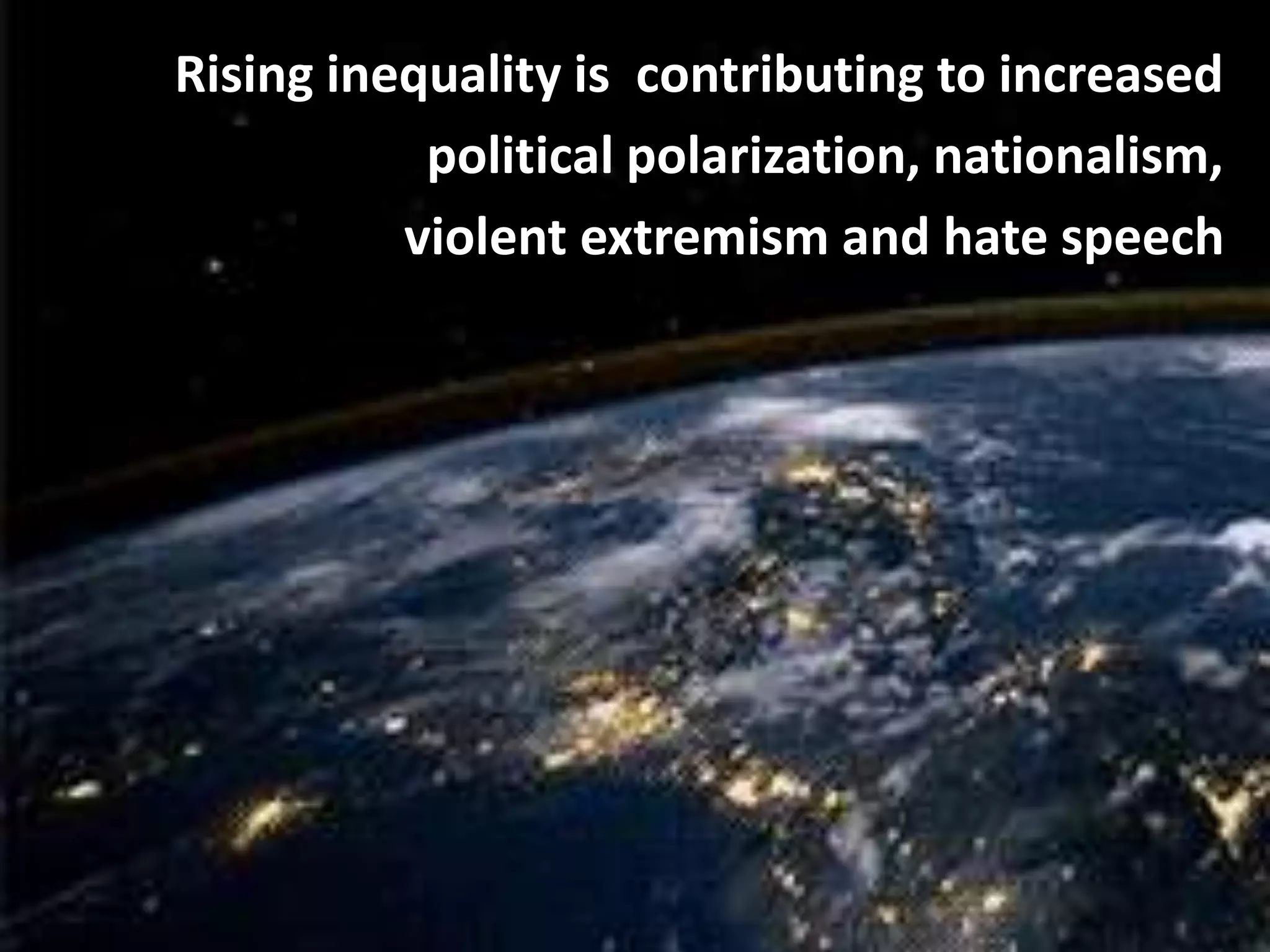
Rising inequality is contributing to increased
political polarization, nationalism,
violent extremism and hate speech
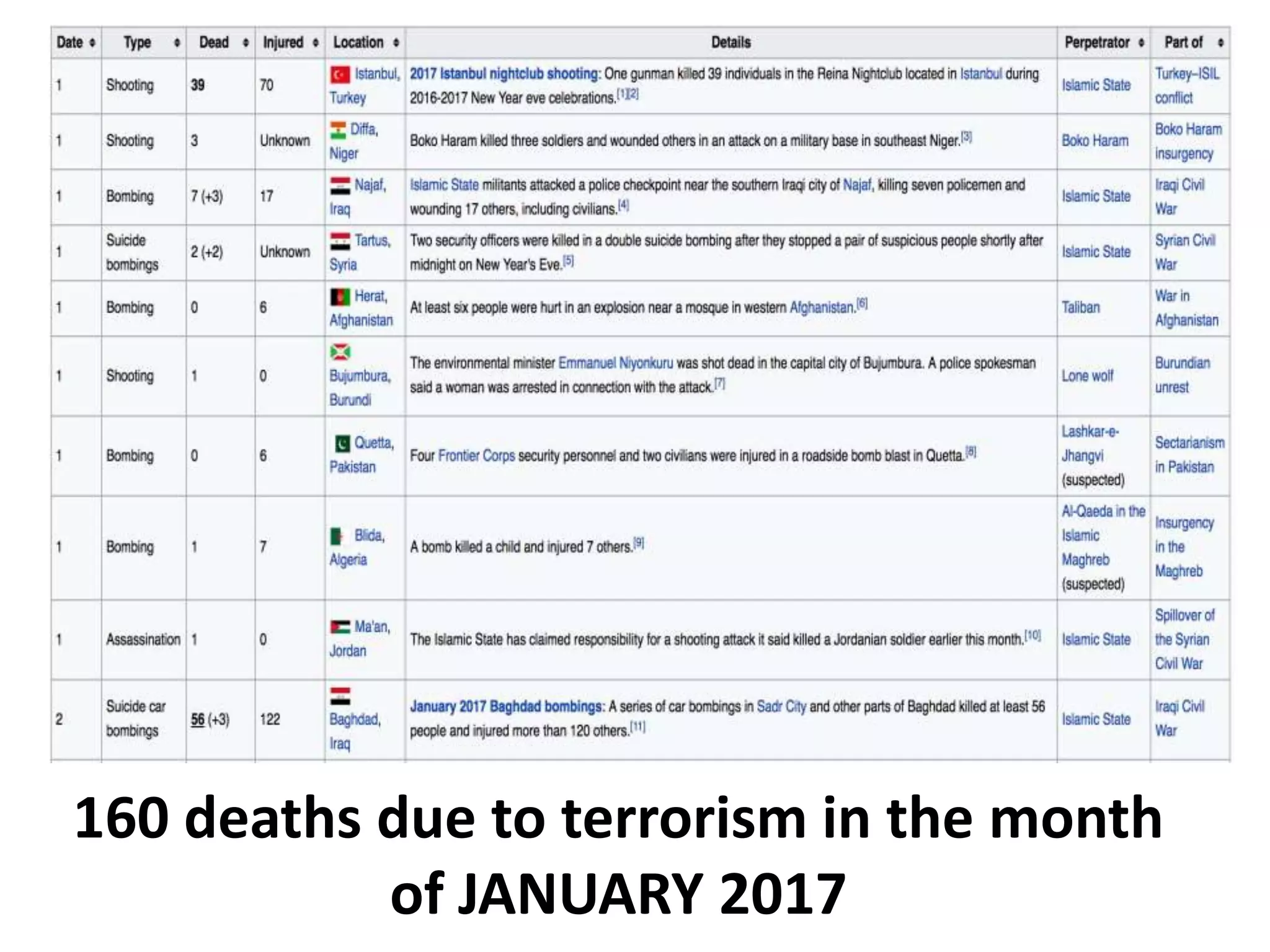
160 deaths due to terrorism in the month
of JANUARY 2017
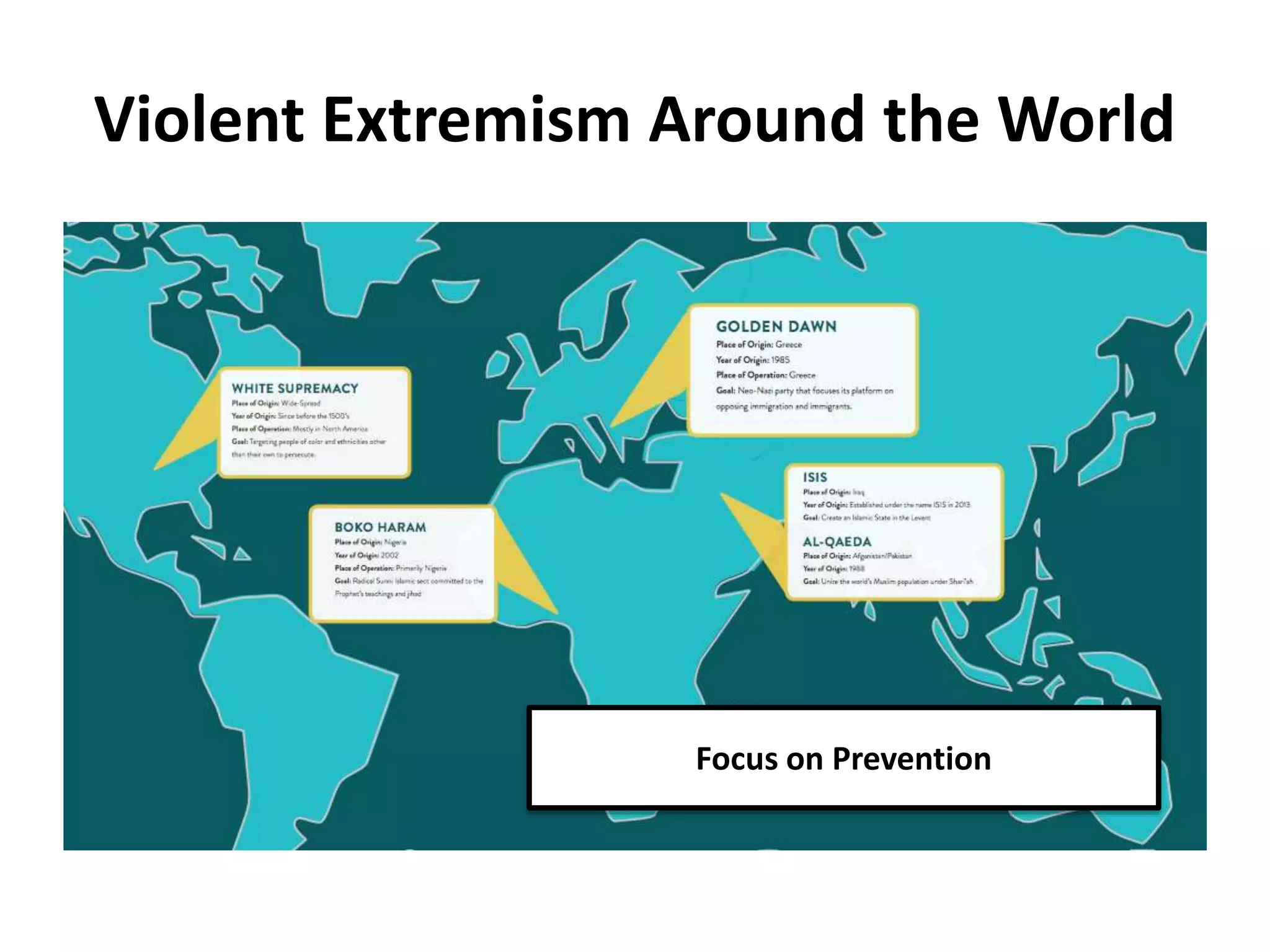
Violent Extremism Around the World
Focus on Prevention
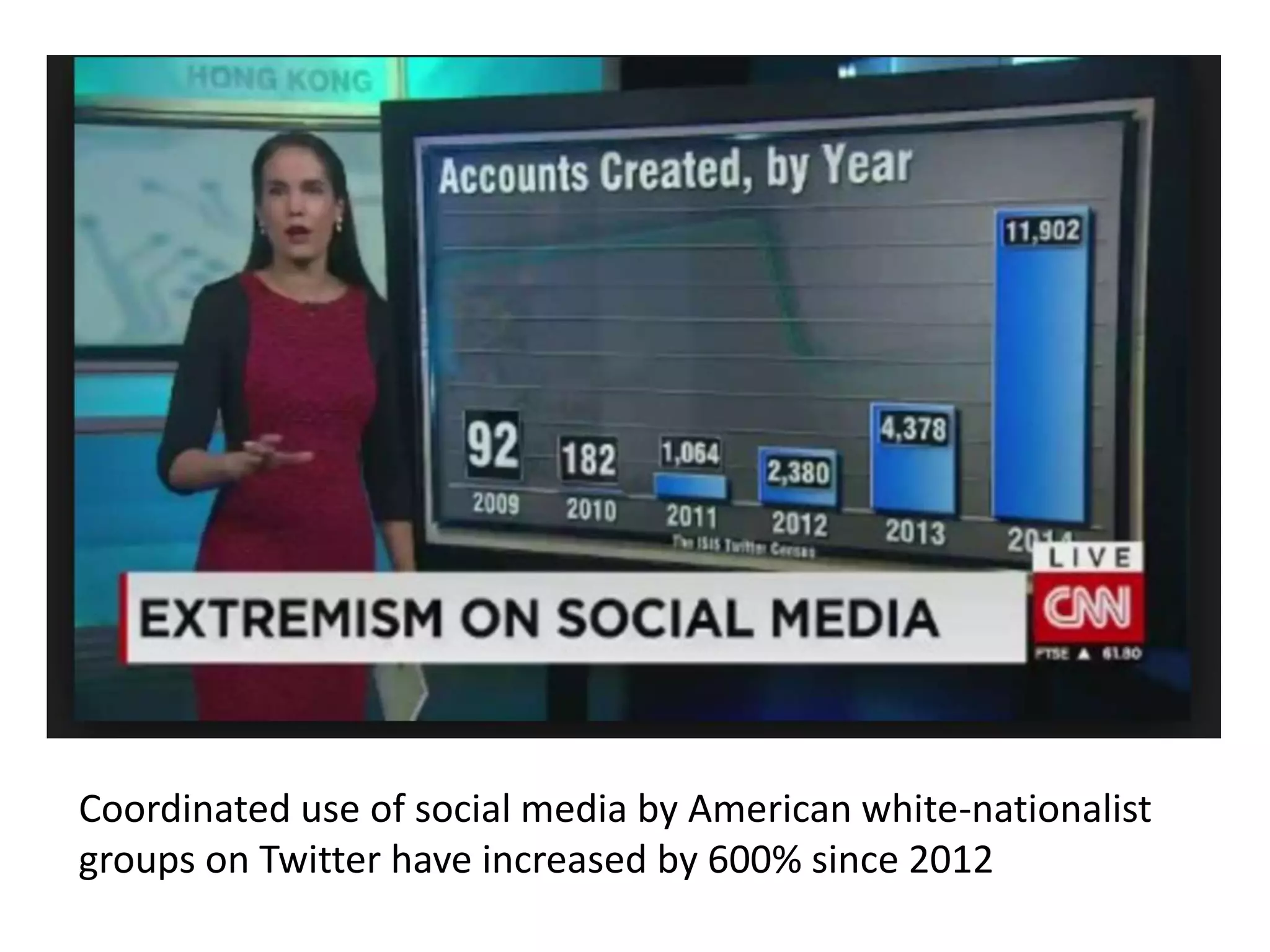
Coordinated use of social media by American white-nationalist
groups on Twitter have increased by 600% since 2012
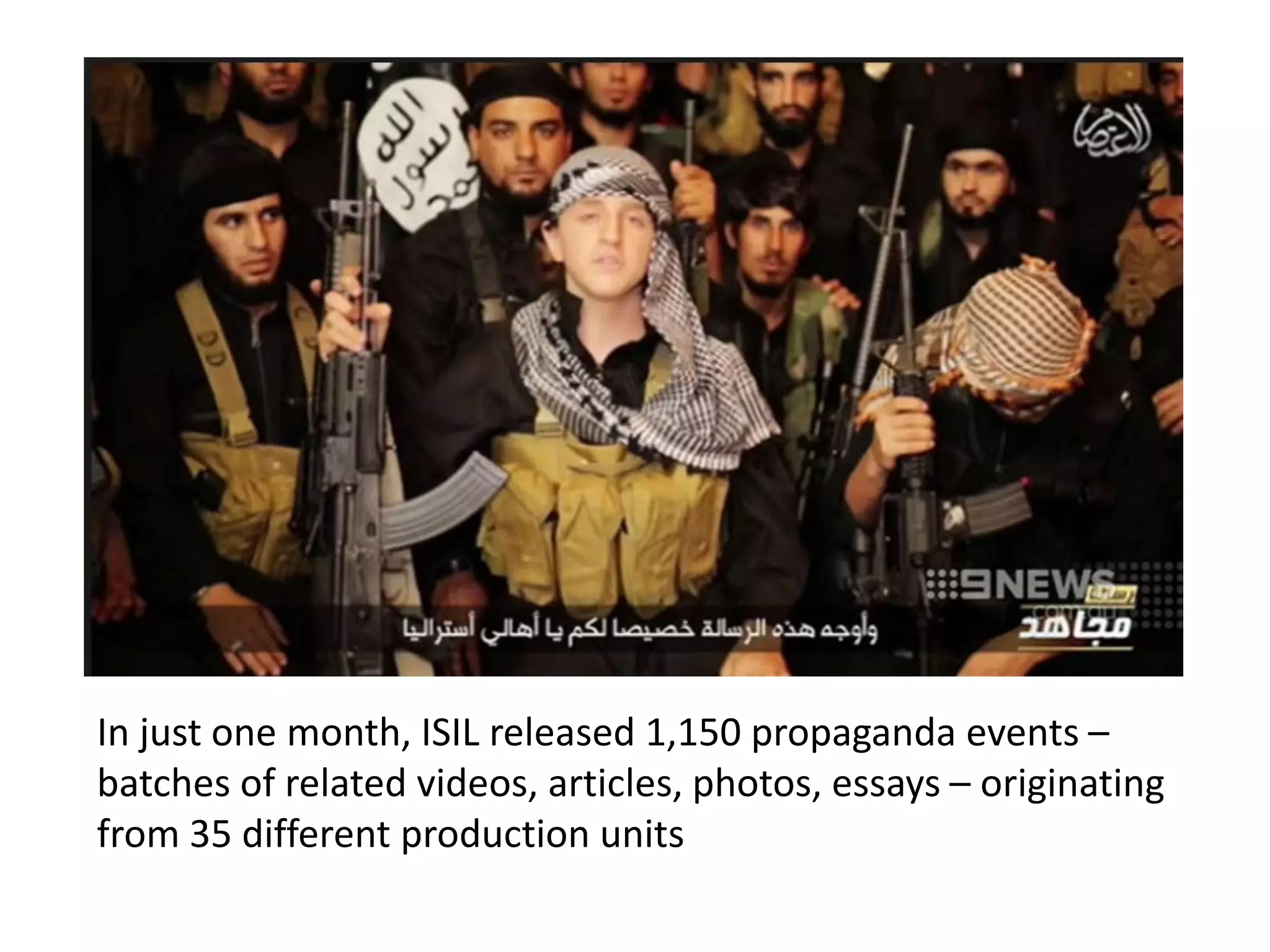
In just one month, ISIL released 1,150 propaganda events –
batches of related videos, articles, photos, essays – originating
from 35 different production units
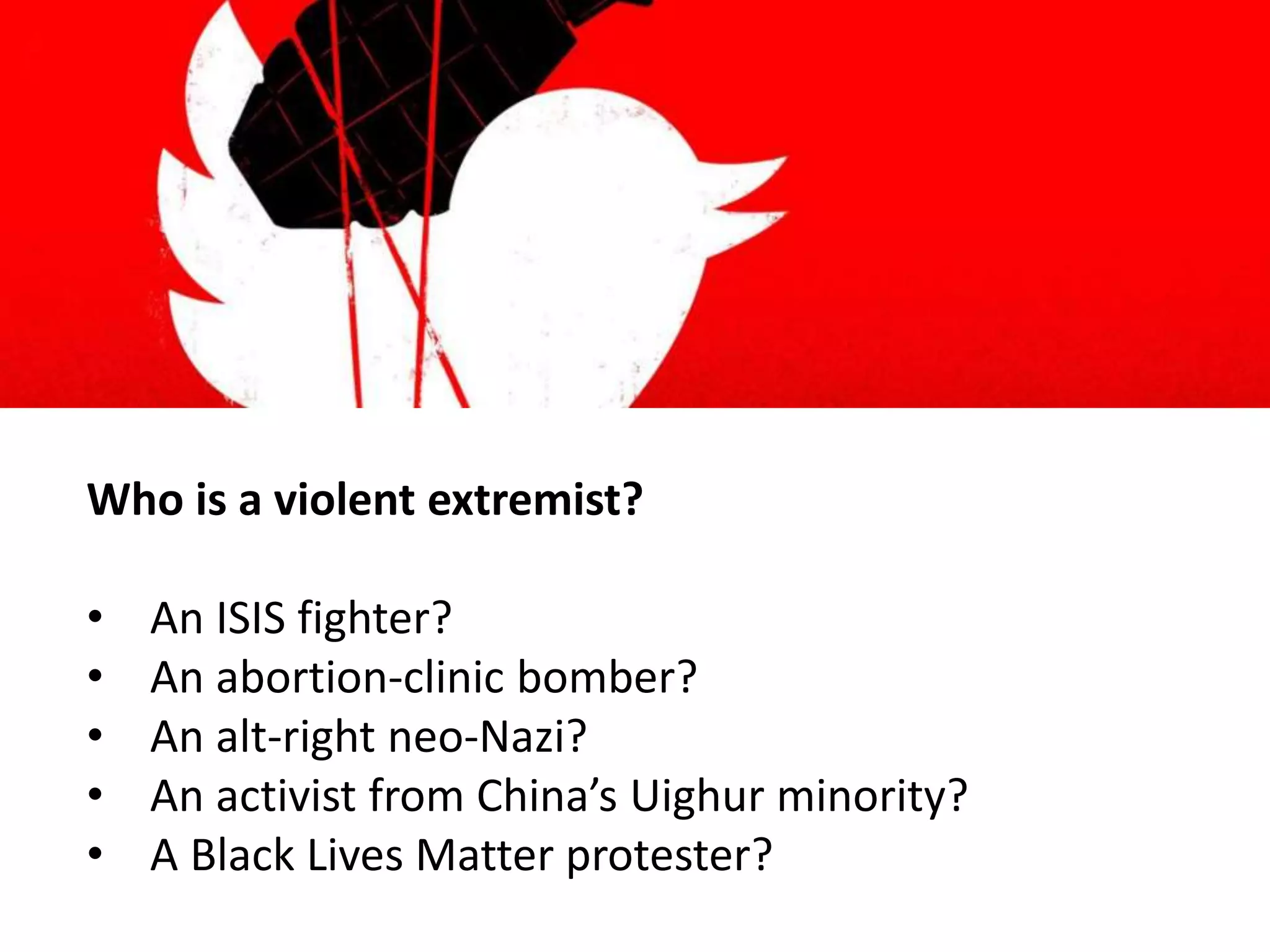
Who is a violent extremist?
• An ISIS fighter?
• An abortion-clinic bomber?
• An alt-right neo-Nazi?
• An activist from China’s Uighur minority?
• A Black Lives Matter protester?
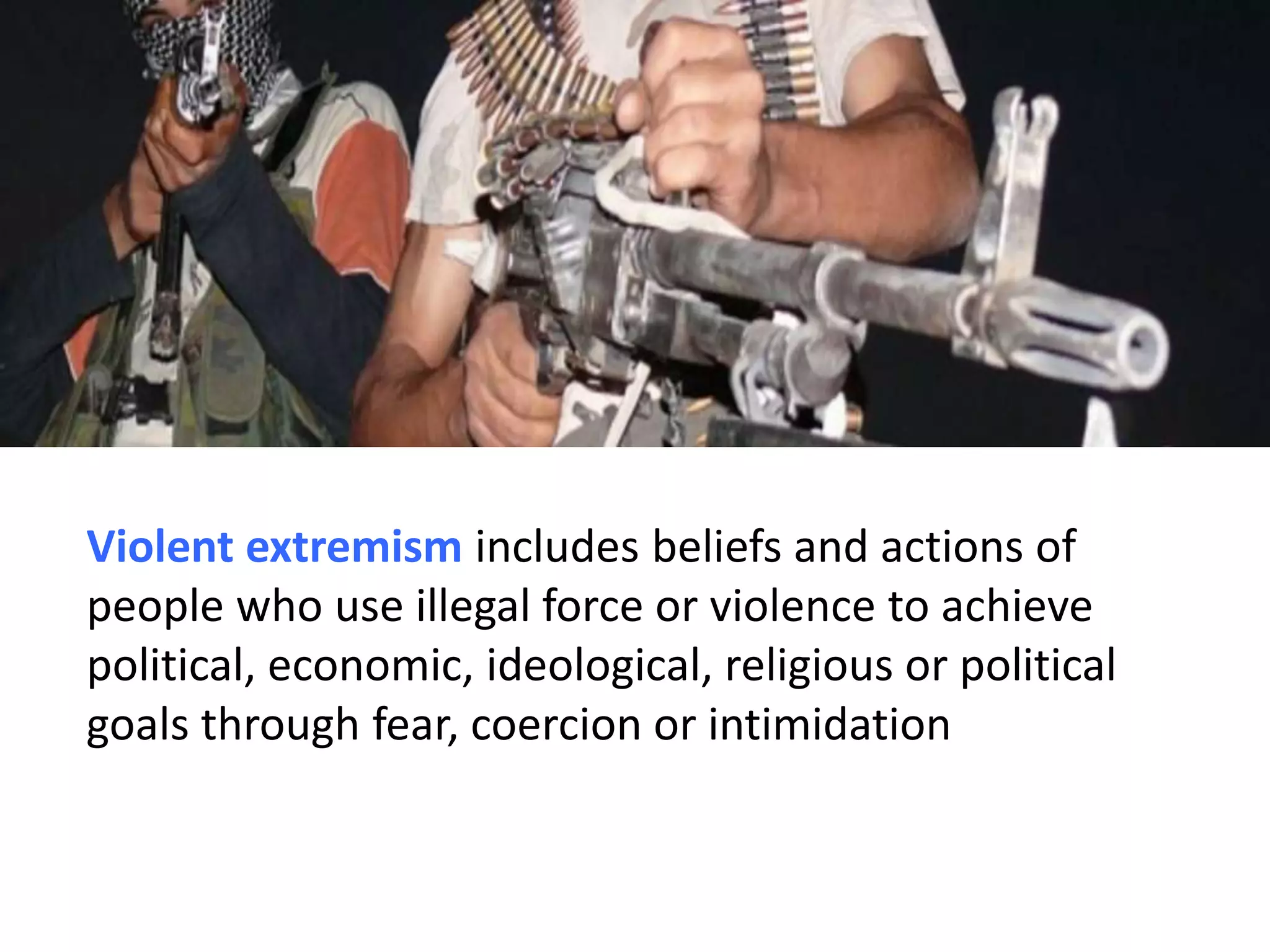
Violent extremism includes beliefs and actions of
people who use illegal force or violence to achieve
political, economic, ideological, religious or political
goals through fear, coercion or intimidation
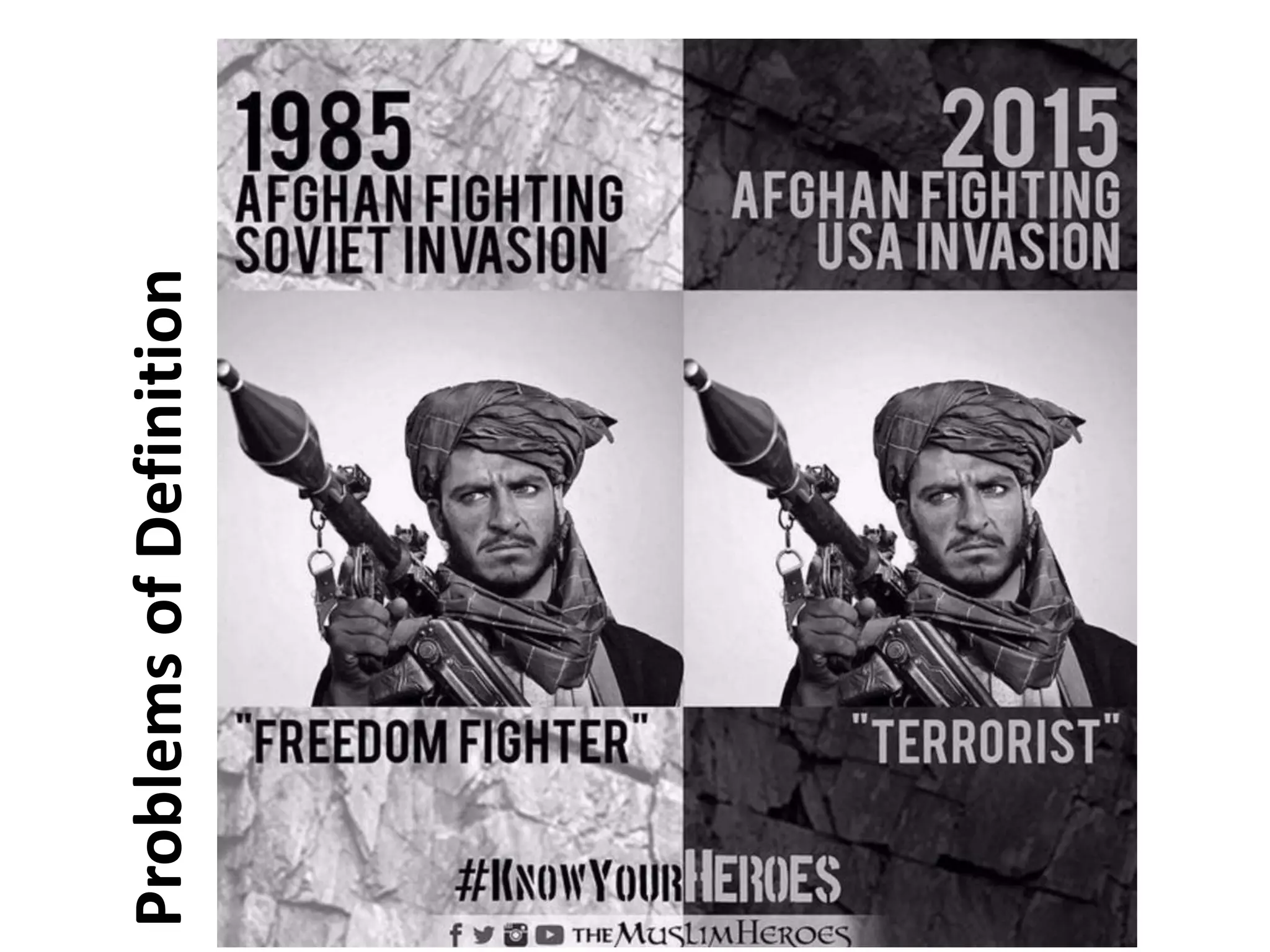
ProblemsofDefinition
How can media and
information literacy
prevent violent extremism?
What instructional strategies
are effective?
Media and Information Literacy Involves
Questioning All Forms of Authority
Media literacy, because it emphasizes a
critique of textual authority, invites
students to identify the cultural codes that
structure an author’s work, understand
how these codes function as part
of a social system, and disrupt the text
through alternative interpretations. In
learning to critically read media messages,
citizens are developing the abilities to
gather accurate, relevant information
about their society and to question
authority (both textual and, by
implication, institutional).
- Renee Hobbs, 1998
Media and Information Literacy
is a Civic Competency
Media education is an essential step
in the long march towards a truly
participatory democracy, and the
democratization of our institutions.
Widespread media literacy is
essential if all citizens are to wield
power, make rational decisions,
become effective change agents,
and have an effective involvement
with the media.
-Len Masterman, 1985
Media and Information Literacy Encourages
People to be Agents of Social Change
When people have digital and media
literacy competencies, they recognize
personal, corporate and political
agendas and are empowered to speak
out on behalf of the missing voices
and omitted perspectives in our
communities. By identifying and
attempting to solve problems, people
use their powerful voices and their
rights under law to improve the world
around them.
-Renee Hobbs, 2010
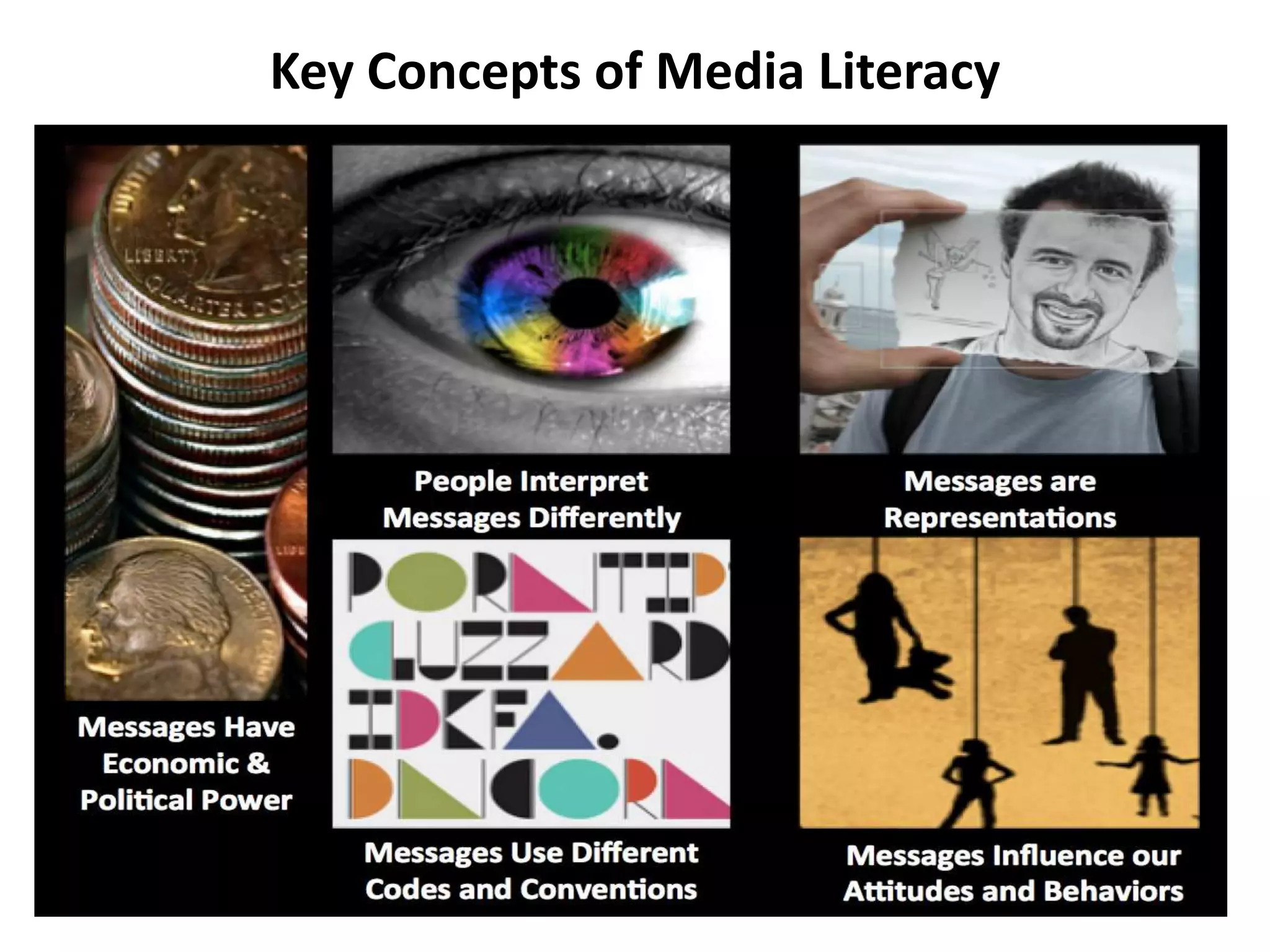
Key Concepts of Media Literacy
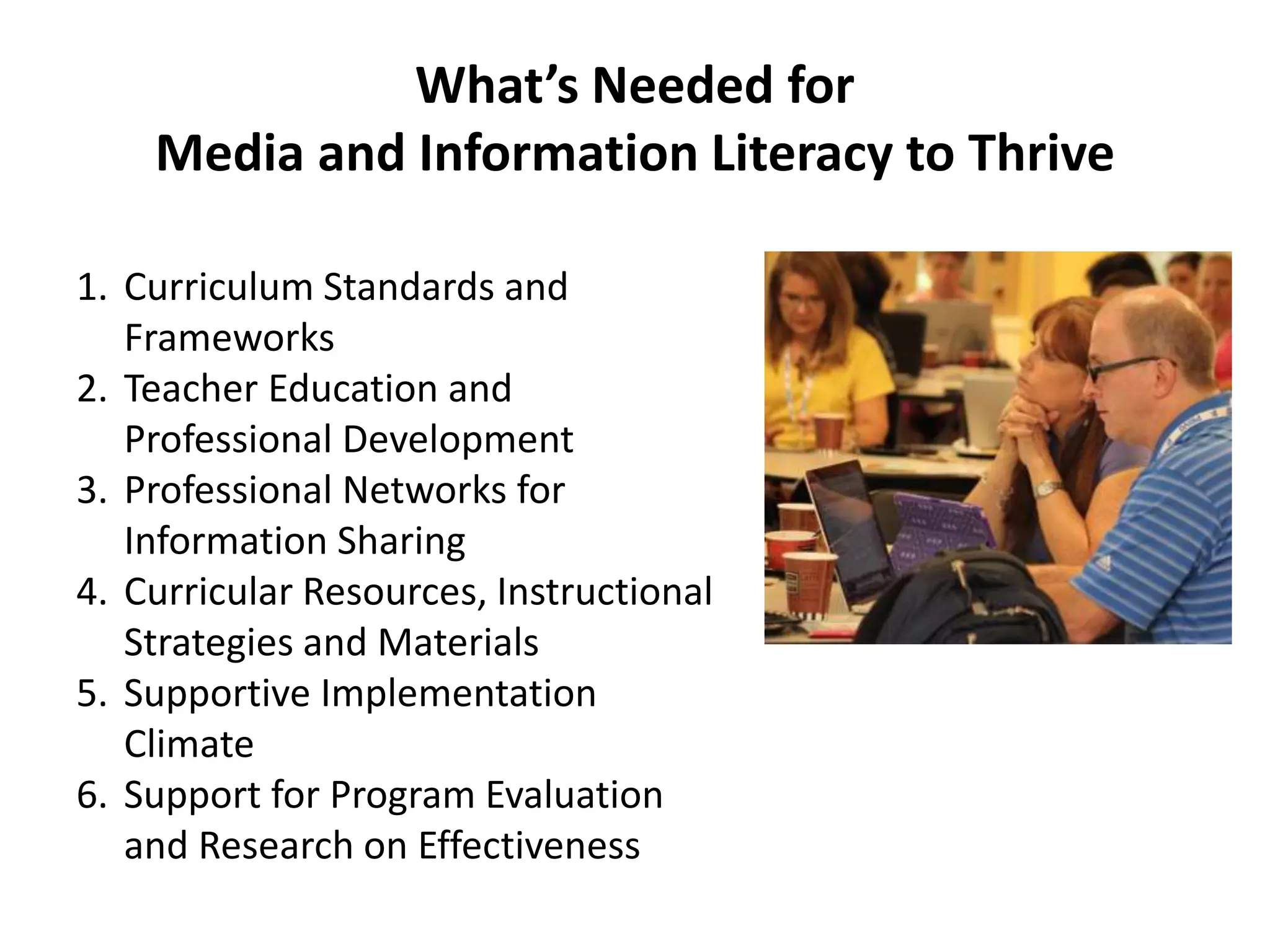
What’s Needed for
Media and Information Literacy to Thrive
1. Curriculum Standards and
Frameworks
2. Teacher Education and
Professional Development
3. Professional Networks for
Information Sharing
4. Curricular Resources, Instructional
Strategies and Materials
5. Supportive Implementation
Climate
6. Support for Program Evaluation
and Research on Effectiveness
Build Awareness of Media Messages
about Violent Extremism
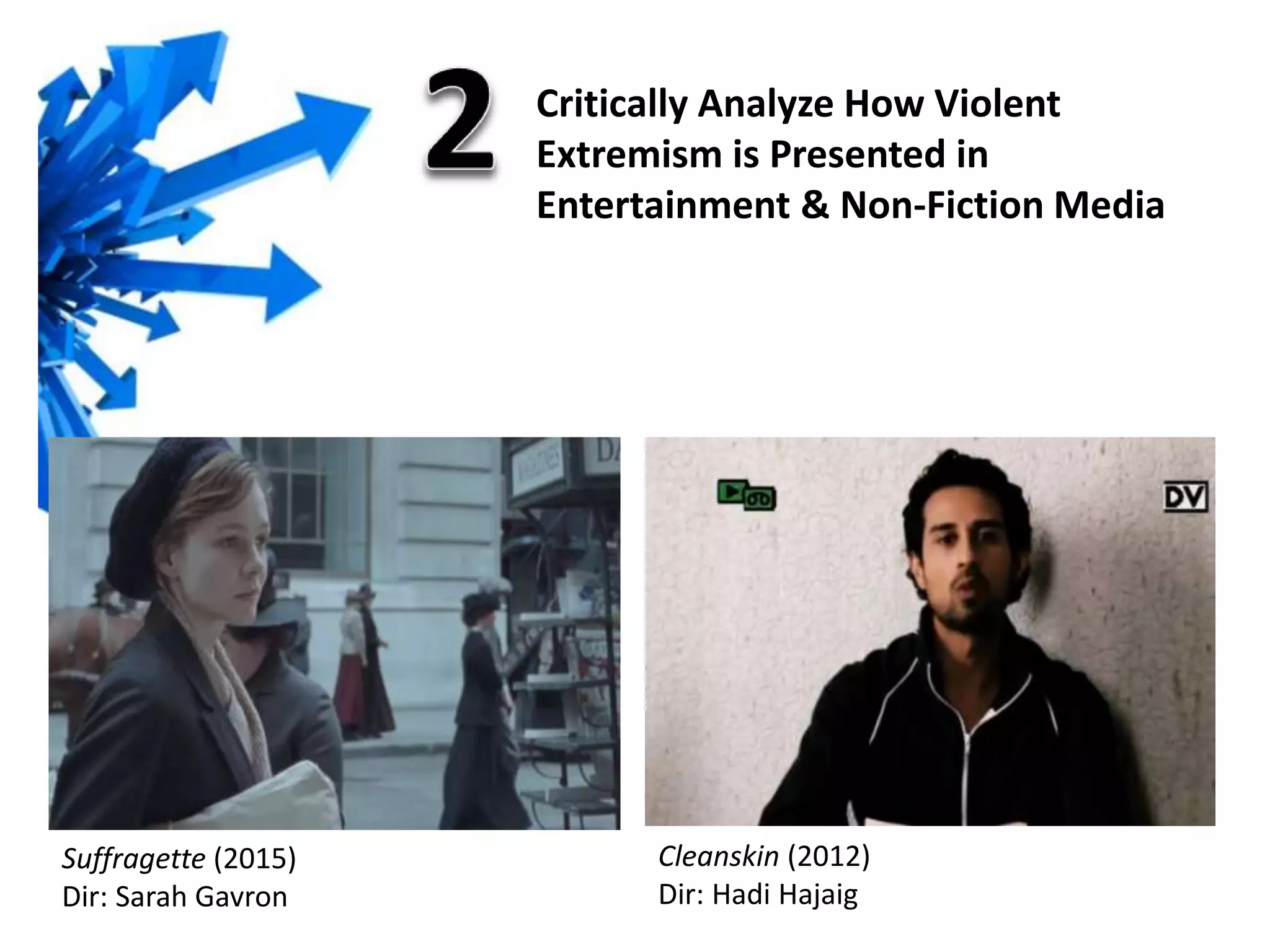
Critically Analyze How Violent
Extremism is Presented in
Entertainment & Non-Fiction Media
Recognize Propaganda and
Hate Speech
Form Authentic Relationships with
People From Other Countries
Use the Power of Communication to
Speak Out
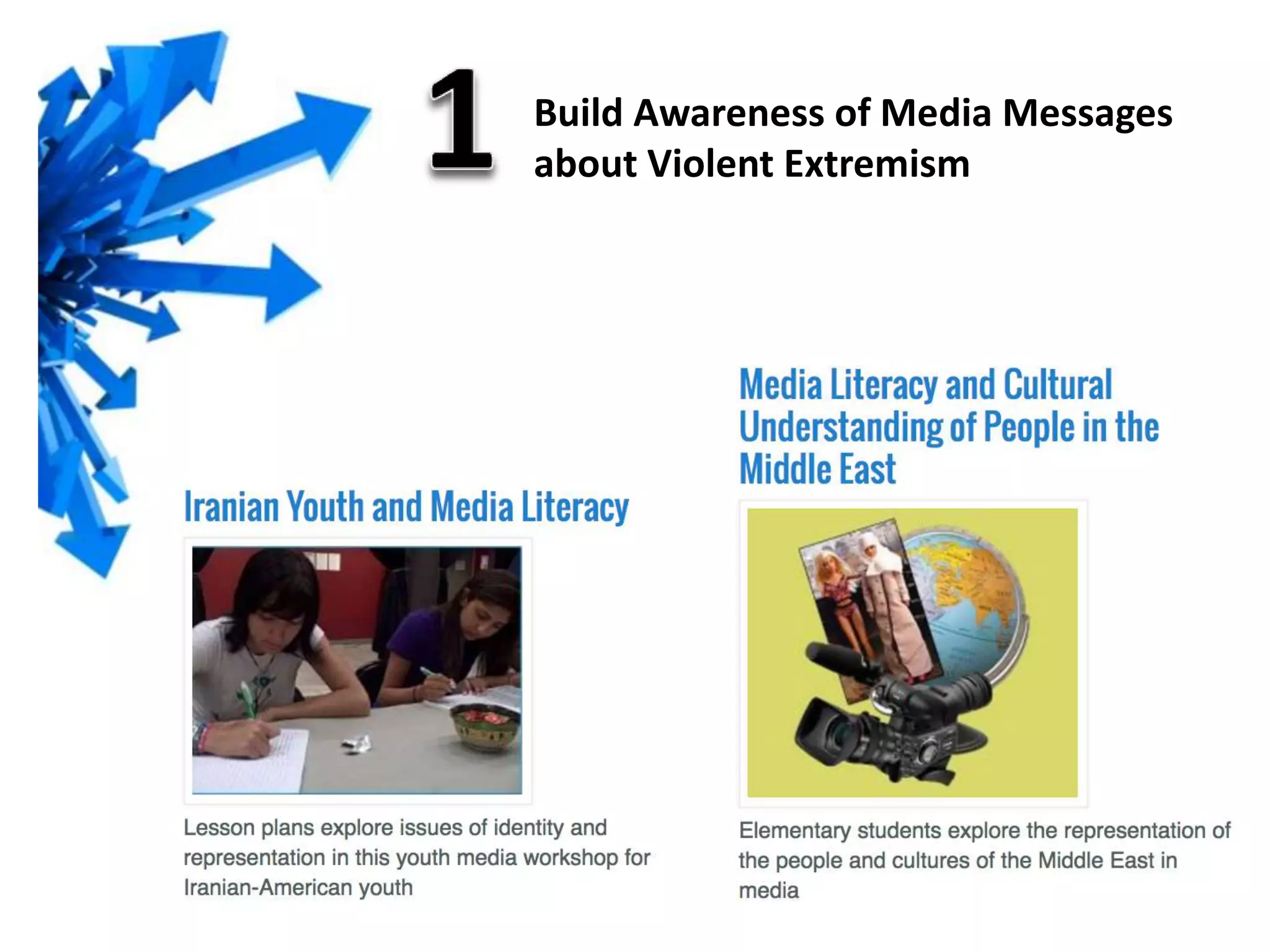
Build Awareness of Media Messages
about Violent Extremism
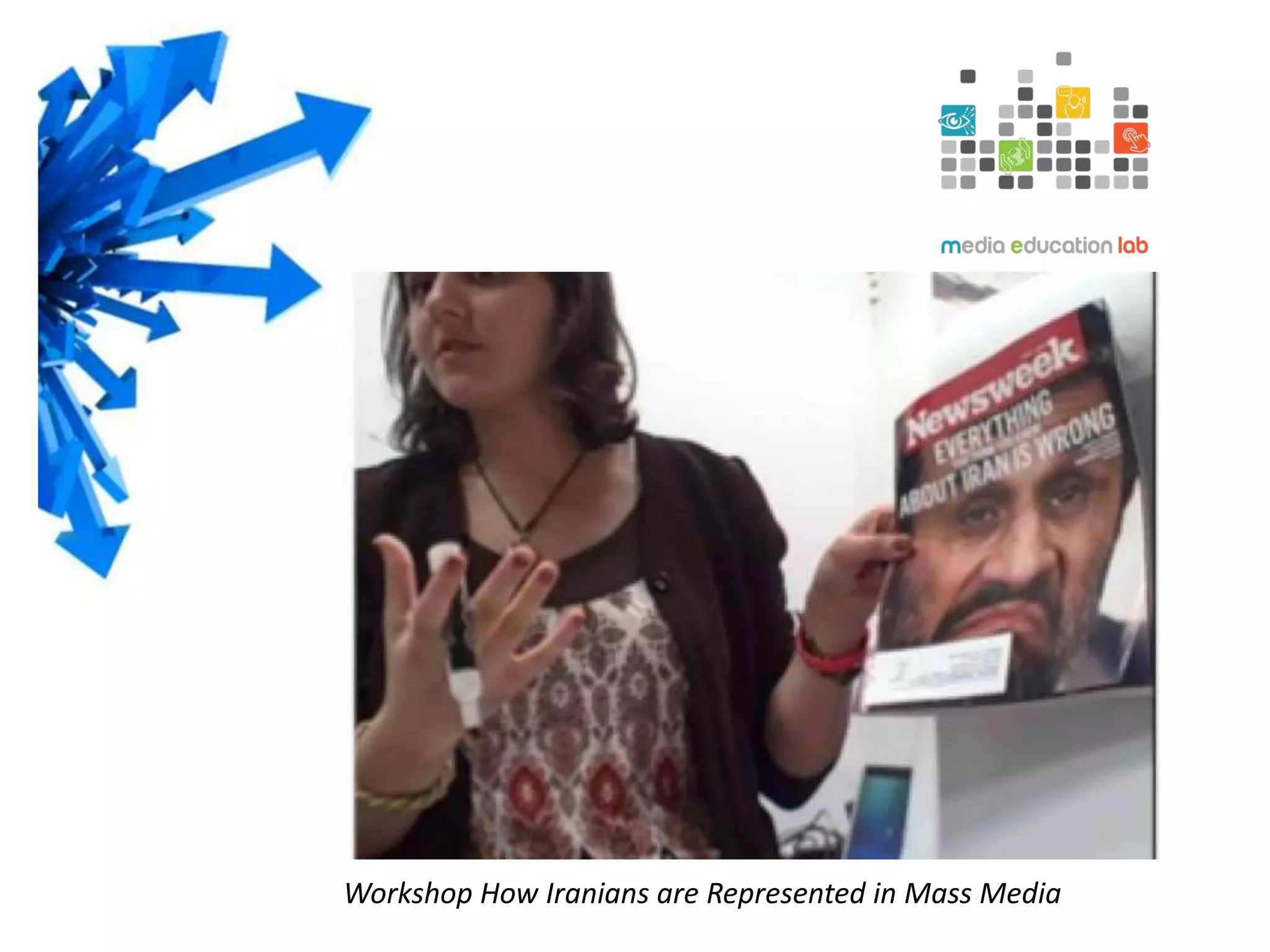
Workshop How Iranians are Represented in Mass Media
Critically Analyze How Violent
Extremism is Presented in
Entertainment & Non-Fiction Media
Cleanskin (2012)
Dir: Hadi Hajaig
Suffragette (2015)
Dir: Sarah Gavron
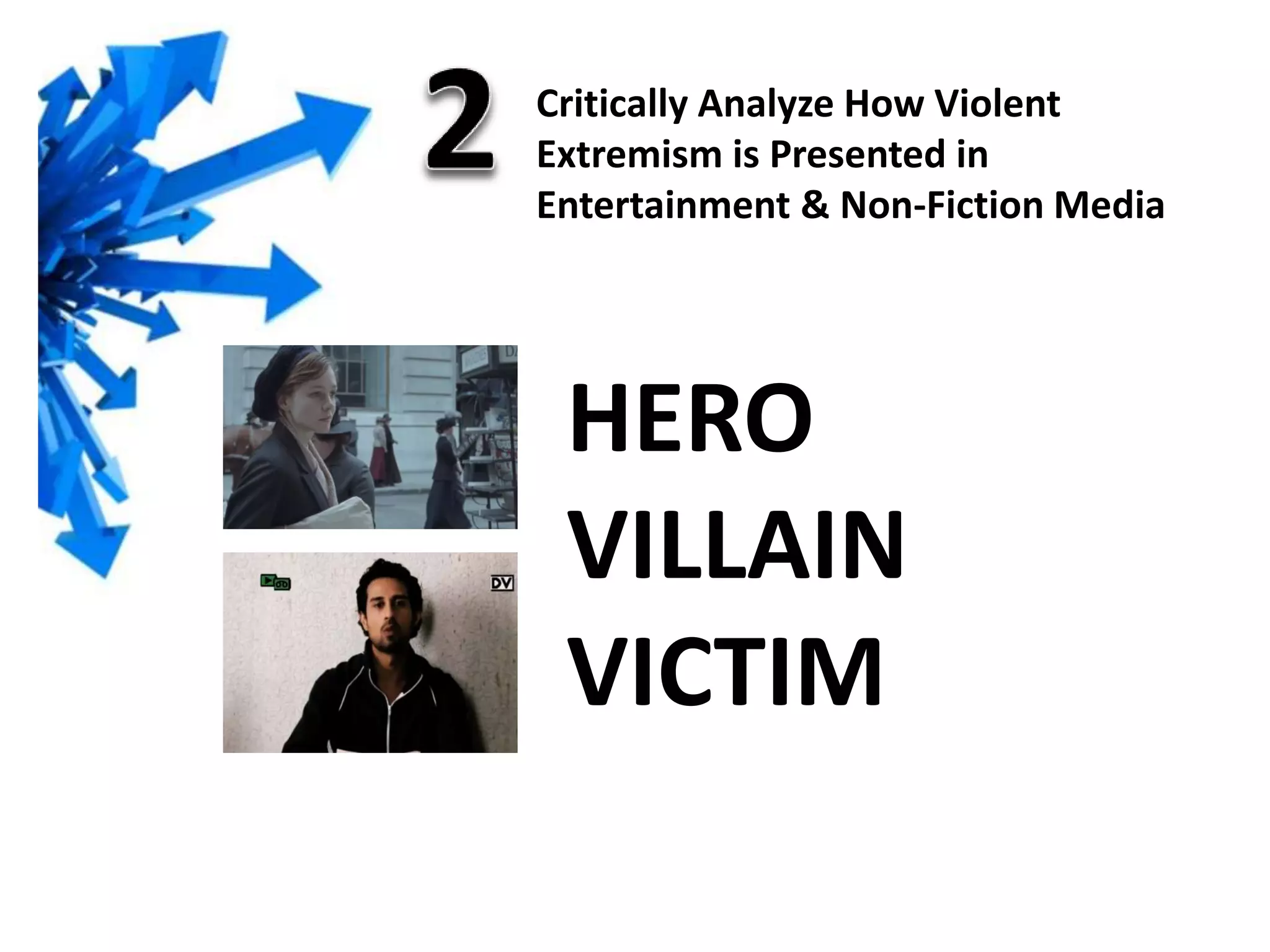
HERO
VILLAIN
VICTIM
Critically Analyze How Violent
Extremism is Presented in
Entertainment & Non-Fiction Media
Cleanskin (2012)
Dir: Hadi Hajaig
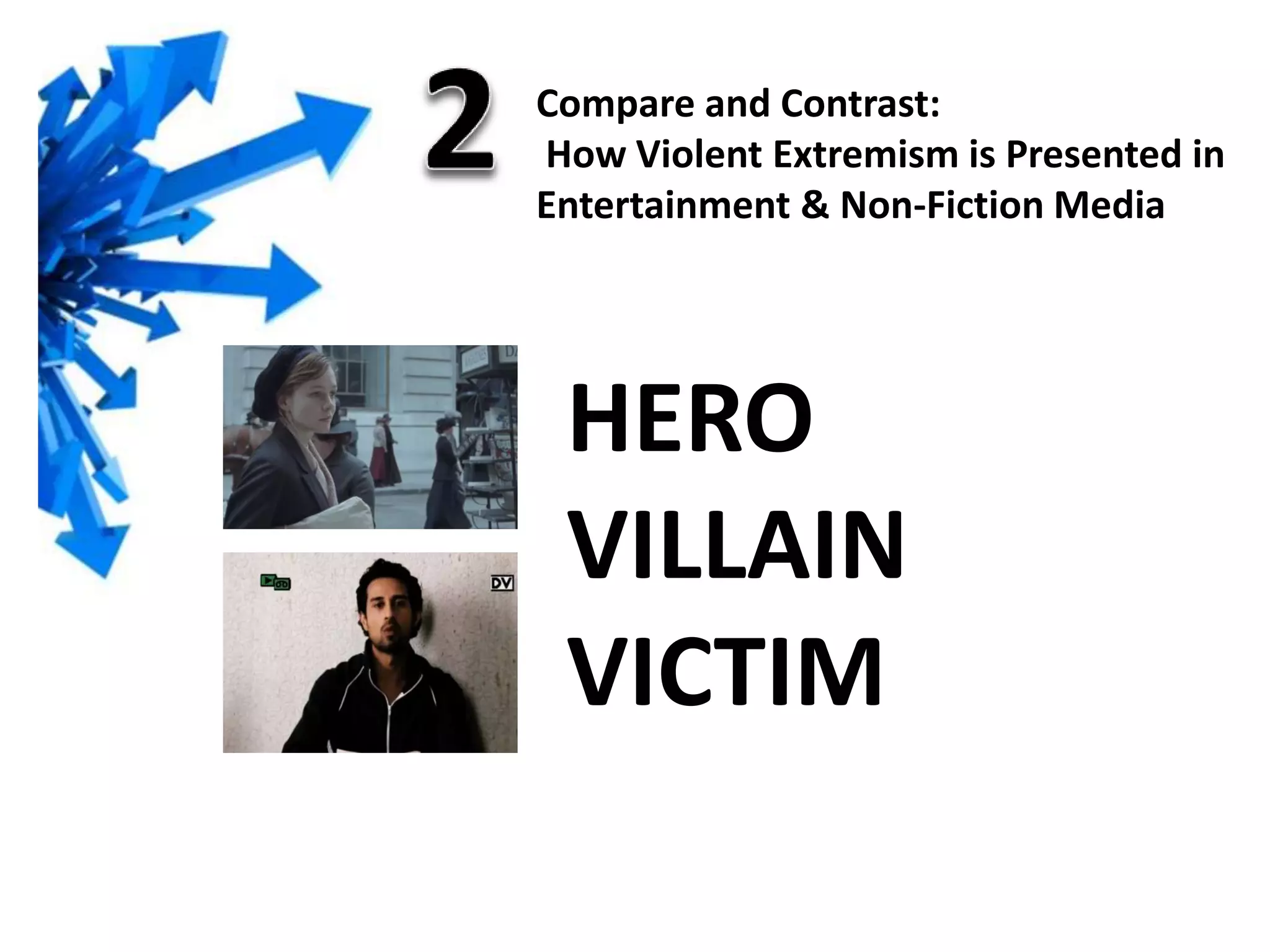
Compare and Contrast:
How Violent Extremism is Presented in
Entertainment & Non-Fiction Media
HERO
VILLAIN
VICTIM
Suffragette (2015)
Dir: Sarah Gavron
Compare and Contrast:
How Violent Extremism is Presented in
Entertainment & Non-Fiction Media
HERO
VILLAIN
VICTIM
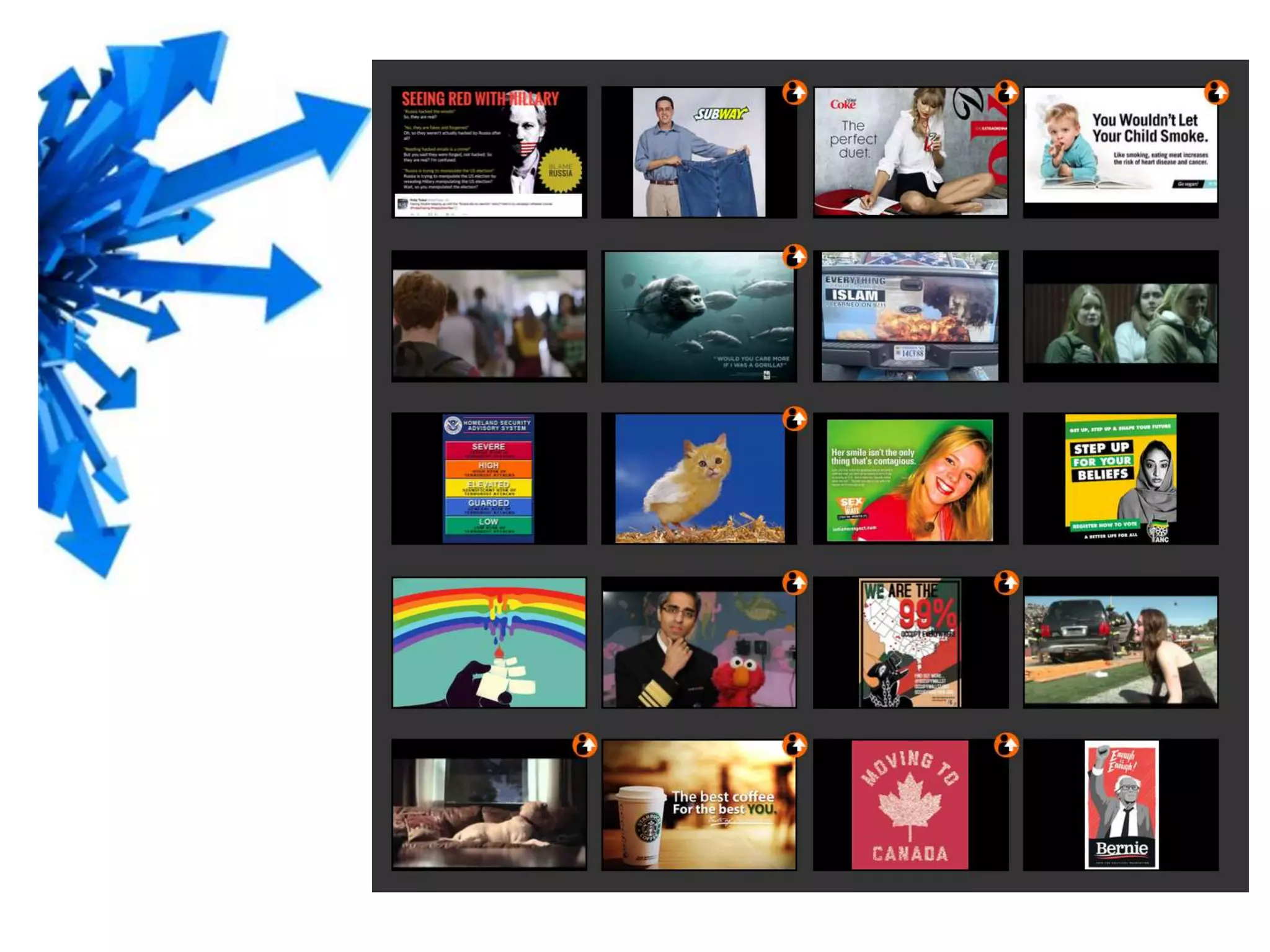
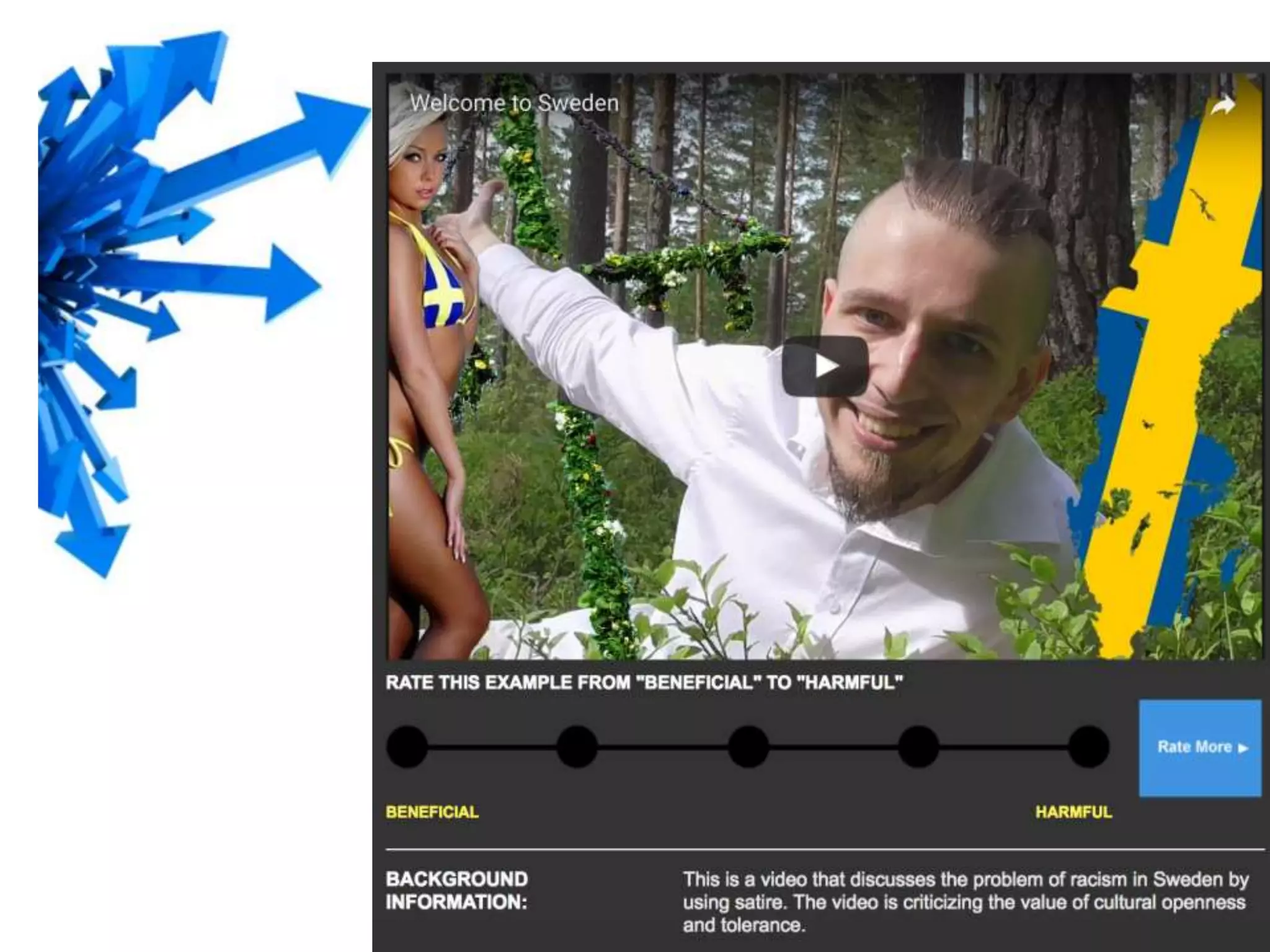
Recognize Propaganda & Hate Speech
www.mindovermedia.tv
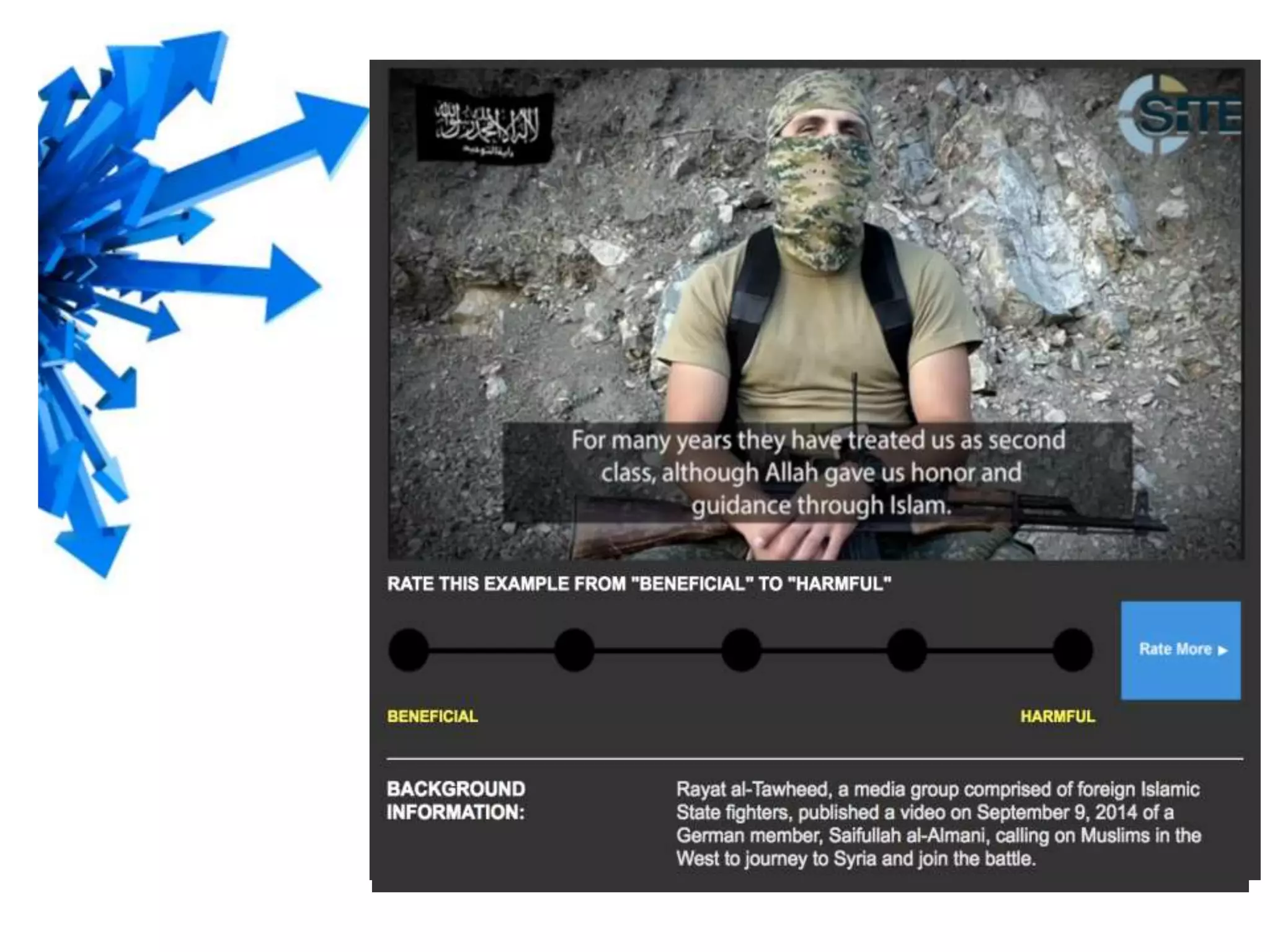
Recognize Propaganda & Hate Speech
Recognize and Resist Propaganda and
Hate Speech
Recognize and Resist Propaganda and
Hate Speech
Recognize and Resist Propaganda and
Hate Speech
Recognize and Resist Propaganda and
Hate Speech
Recognize and Resist Propaganda and
Hate Speech
Recognize Propaganda & Hate Speech
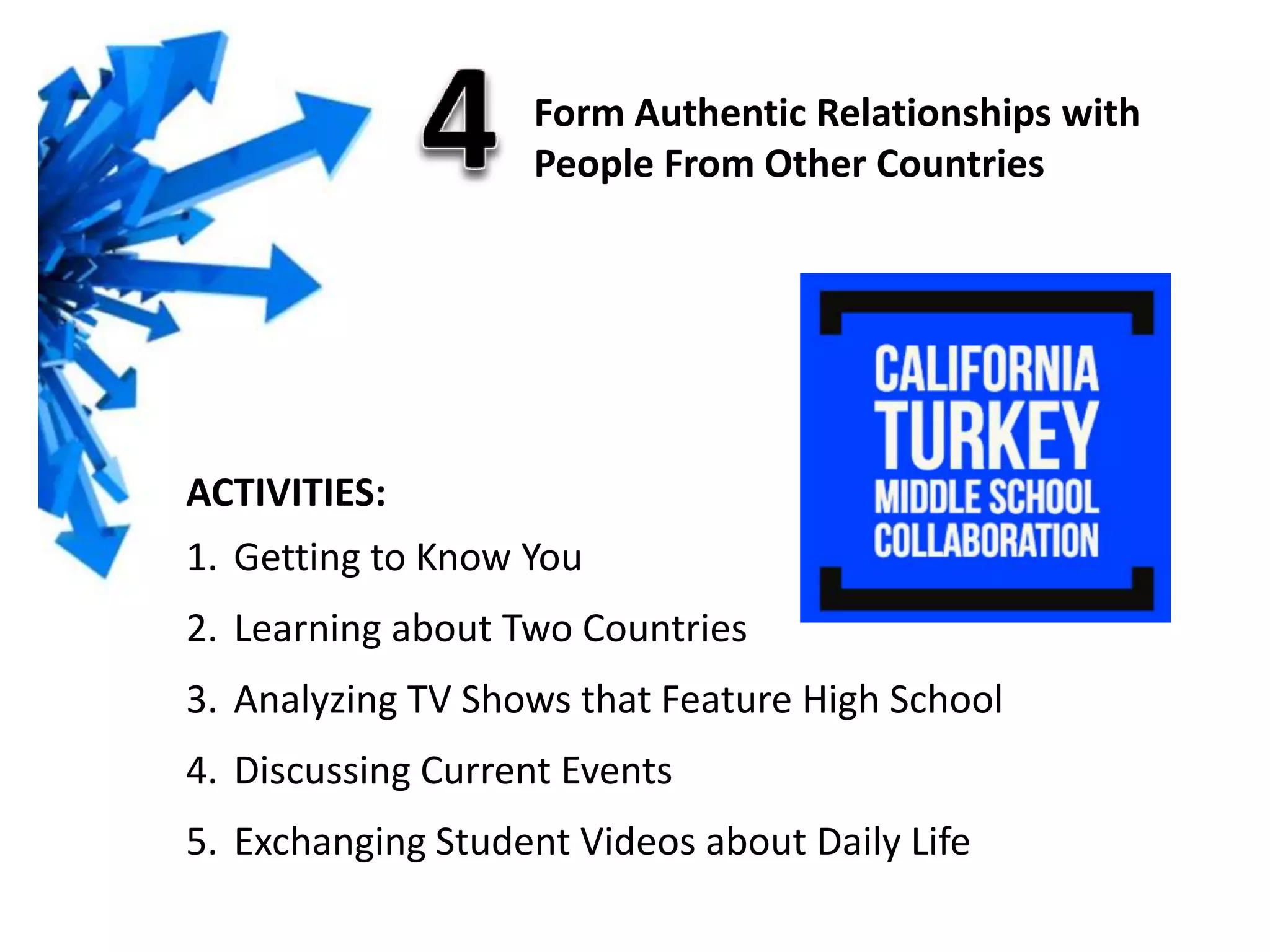
Form Authentic Relationships with
People From Other Countries
ACTIVITIES:
1. Getting to Know You
2. Learning about Two Countries
3. Analyzing TV Shows that Feature High School
4. Discussing Current Events
5. Exchanging Student Videos about Daily Life
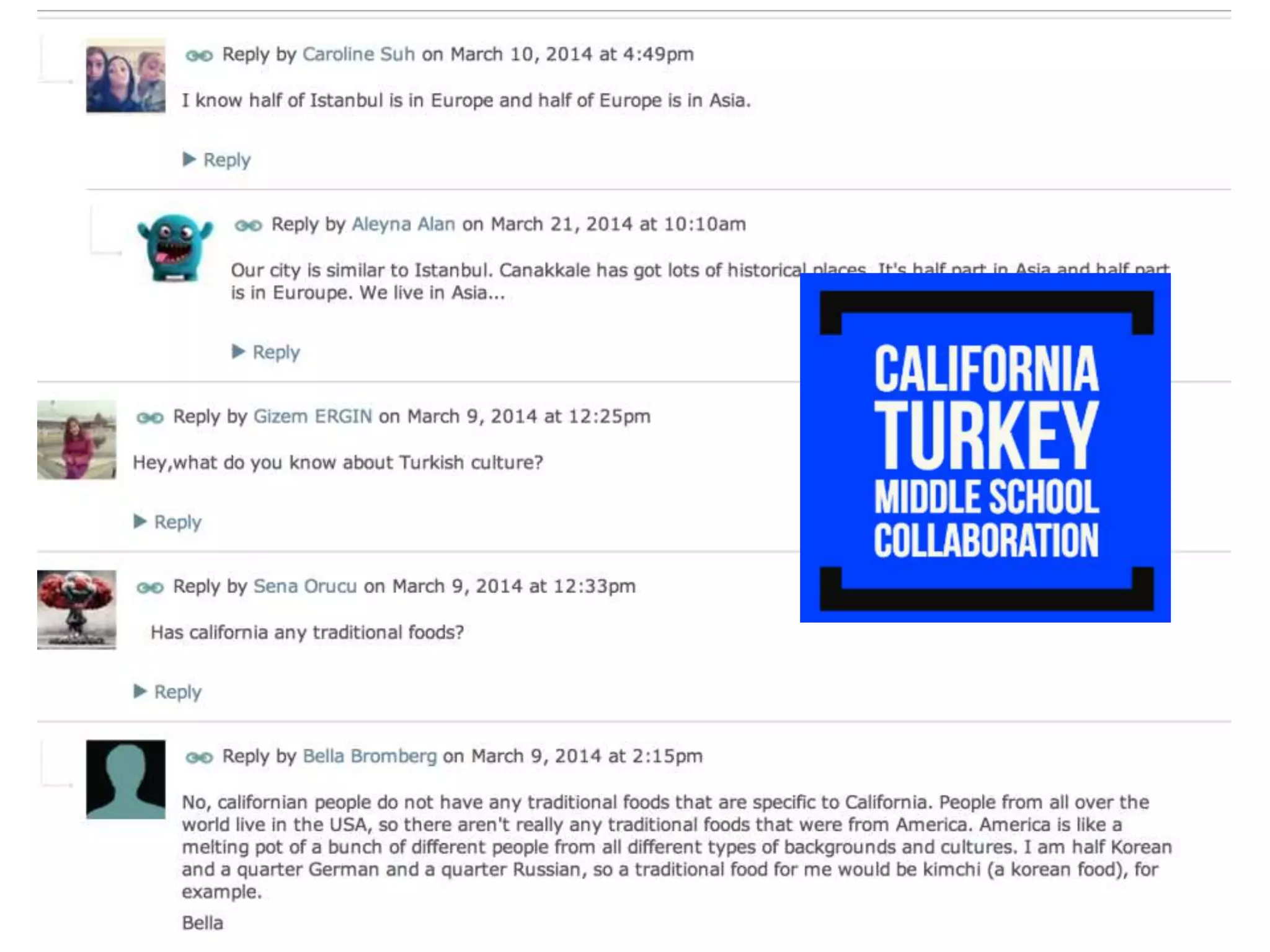
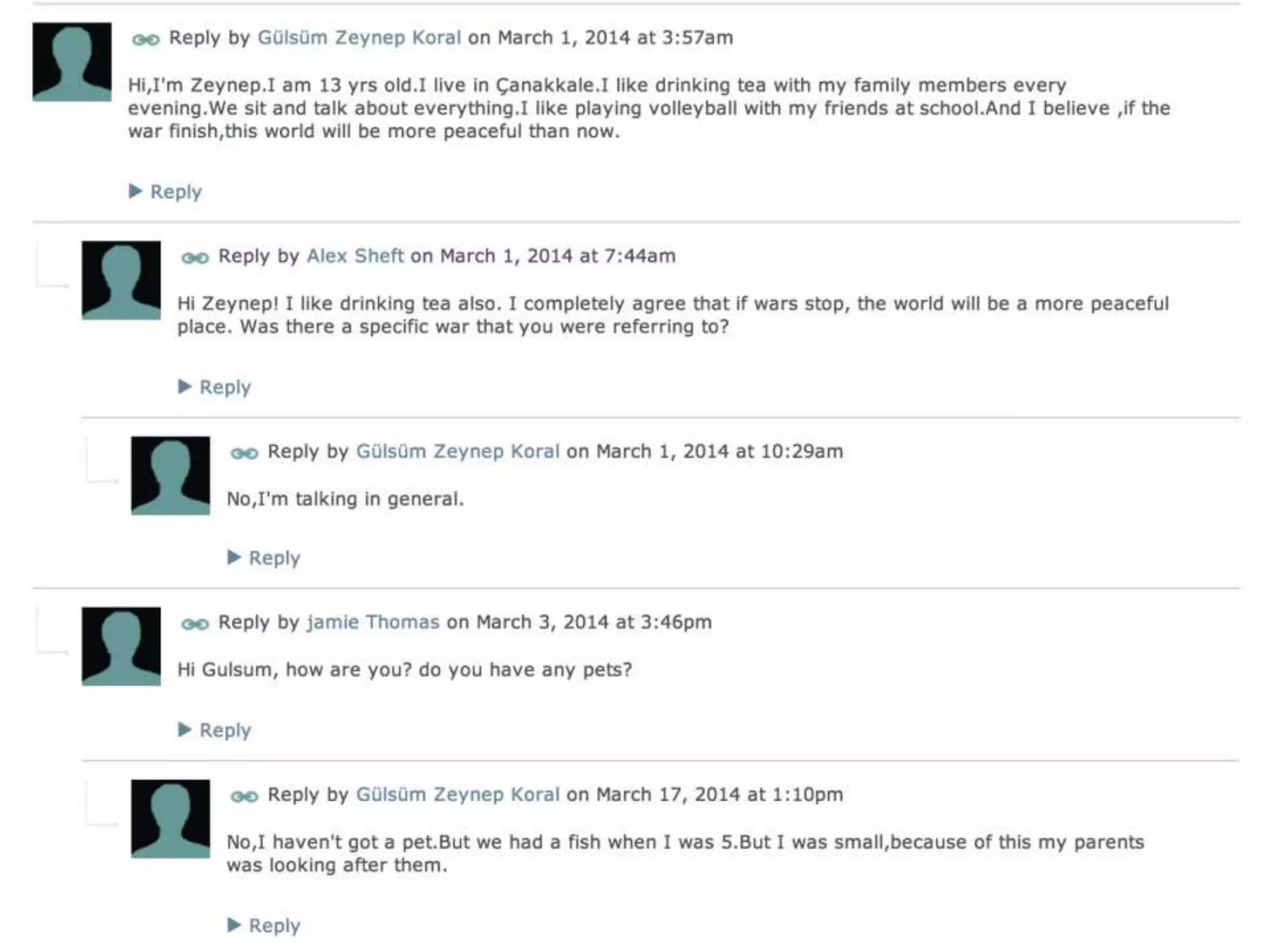
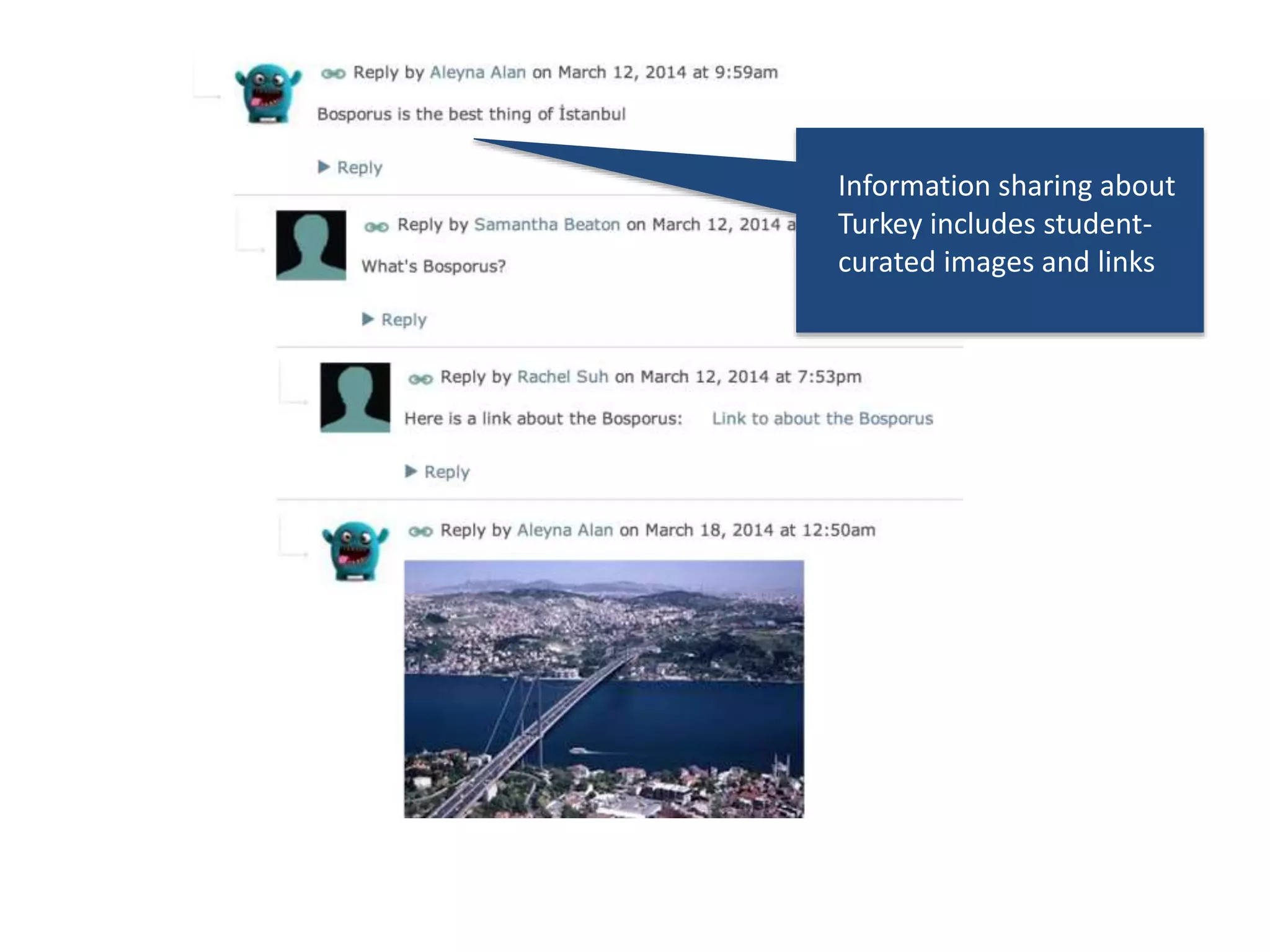
Information sharing about
Turkey includes student-
curated images and links
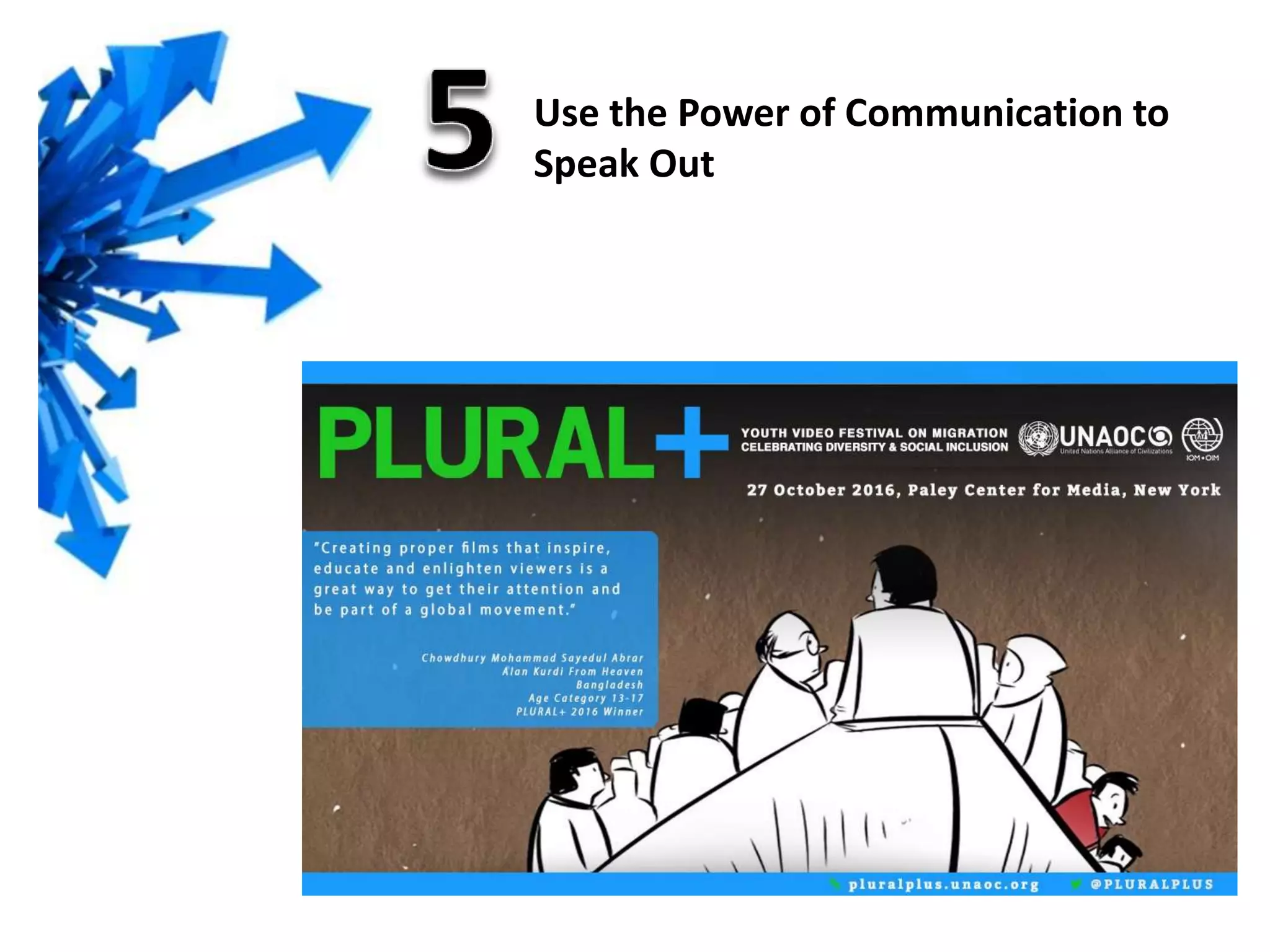
Use the Power of Communication to
Speak Out
Use the Power of Communication to
Speak Out
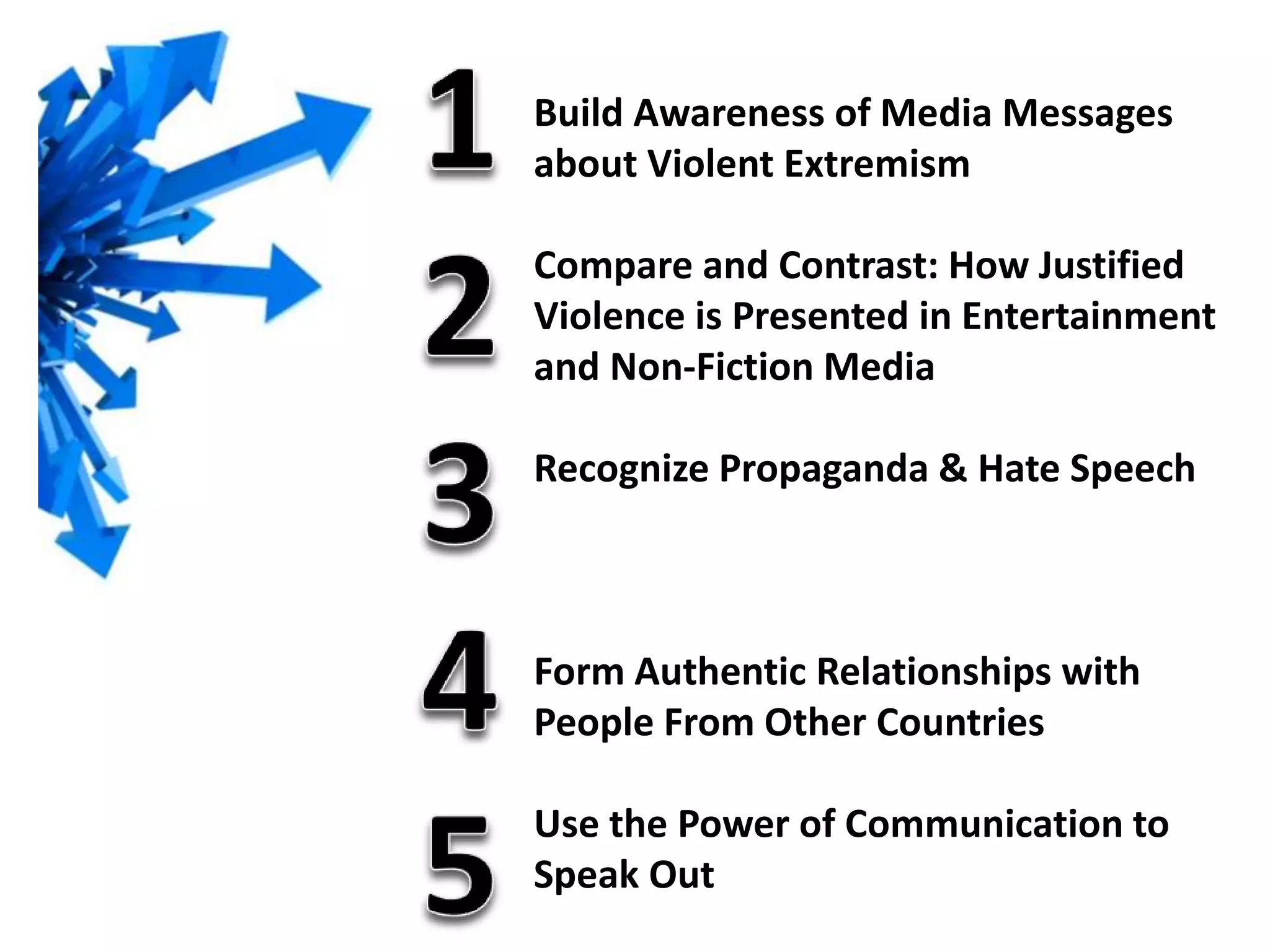
Build Awareness of Media Messages
about Violent Extremism
Compare and Contrast: How Justified
Violence is Presented in Entertainment
and Non-Fiction Media
Recognize Propaganda & Hate Speech
Form Authentic Relationships with
People From Other Countries
Use the Power of Communication to
Speak Out
What’s Needed for
Media and Information Literacy to Thrive
1. Curriculum Standards and
Frameworks
2. Teacher Education and
Professional Development
3. Professional Networks for
Information Sharing
4. Curricular Resources,
Instructional Strategies and
Materials
5. Supportive Implementation
Climate
6. Support for Program Evaluation
and Research on Effectiveness
MIL education advances critical thinking, reduces
political polarization and inspires civic engagement
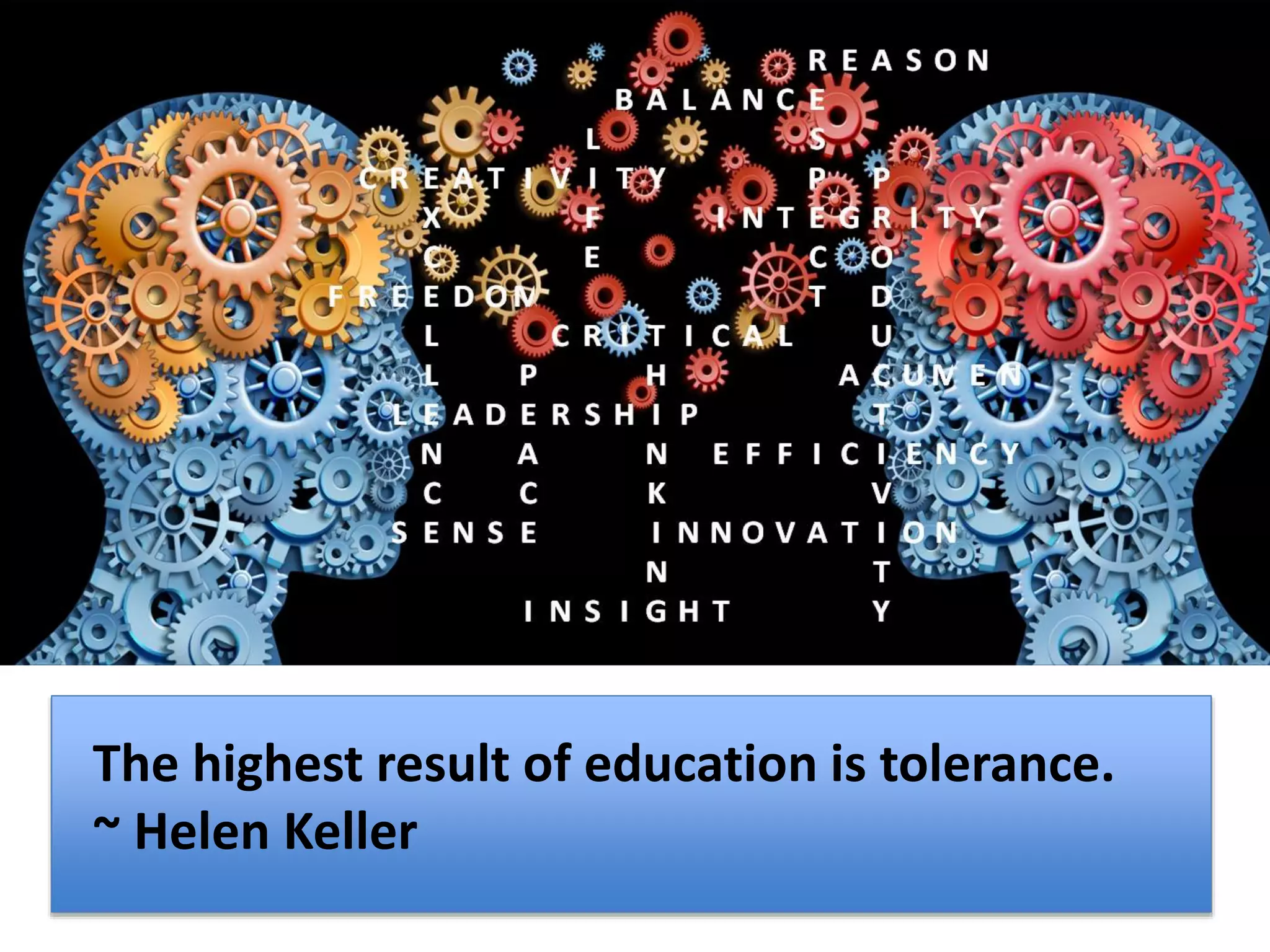
The highest result of education is tolerance.
~ Helen Keller
SOURCES
Bazaz, Aggie Ebrahimi (2009). Iranian Youth & Media Literacy Workshop. http://mediaeducationlab.com/iranian-youth-and-media-
literacy
Brooking,E. & Singer, P. (2016). War Goes Viral. Atlantic Magazine.
Gordon, E. & Mihailidis, P. (2016). The Civic Media Project. Cambridge: MIT Press.
Hobbs R. & Tuzel, S. (2017). The Use of Social Media and Popular Culture to Advance Cross Cultural Understanding. Communicar.
Hobbs, R. & McGee, S. (2014). Teaching about propaganda: An examination of the historical roots of media literacy. Journal of
Media Literacy Education 6(2), 56 – 67.
Hobbs, R. (2013). The blurring of art, journalism and advocacy: Confronting 21st century propaganda in a world of online journalism.
I/S: A Journal of Law and Policy for the Information Society 8(3), 625 – 638.
Hobbs, R., Yoon, J., Al-Humaidan,R., Ebrahimi, A. & Cabral, N. (2011). Online digital media in elementary school. Journal of Middle
East Media 7(1), 1 – 23.
Hobbs, R., Ebrahimi, A., Cabral, N., Yoon, J., & Al-Humaidan, R. (2011). Field-based teacher education in elementary media literacy
as a means to promote global understanding. Action for Teacher Education 33, 144 – 156.
Hobbs, R. (2011). A snapshot of multinational media education in six European countries. Trans: Un’istantanea multinazionale sulla
ME in sei paesi europei. Media Education. Studi, ricerche, buone pratiche [Italy] 1(1), 53 – 70
Martens, H. & Hobbs, R. (2015). How media literacy supports civic engagement in a digital age. Atlantic Journal of Communication
23(2), 120 – 137. DOI:10.1080/15456870.2014.961636
Media Education Lab (2016). Mind Over Media: Analyzing Contemporary Propaganda. [Interactive media.] www.mindovermedia.tv
Renee Hobbs
Professor of Communication Studies
Director, Media Education Lab
Harrington School of Communication & Media
University of Rhode Island USA
Email: hobbs@uri.edu
Twitter: @reneehobbs
LEARN MORE
Web: www.mediaeducationlab.com

Educational Strategies for the Prevention of Violent Extremism

  • 2.
    Renee Hobbs Professor ofCommunication Studies Director, Media Education Lab University of Rhode Island USA Twitter: @reneehobbs Media and Information Literacy: Educational Strategies for the Prevention of Violent Extremism February 9, 2017 United National Headquarters
  • 3.
    Rising inequality iscontributing to increased political polarization, nationalism, violent extremism and hate speech
  • 4.
    160 deaths dueto terrorism in the month of JANUARY 2017
  • 5.
    Violent Extremism Aroundthe World Focus on Prevention
  • 6.
    Coordinated use ofsocial media by American white-nationalist groups on Twitter have increased by 600% since 2012
  • 7.
    In just onemonth, ISIL released 1,150 propaganda events – batches of related videos, articles, photos, essays – originating from 35 different production units
  • 8.
    Who is aviolent extremist? • An ISIS fighter? • An abortion-clinic bomber? • An alt-right neo-Nazi? • An activist from China’s Uighur minority? • A Black Lives Matter protester?
  • 9.
    Violent extremism includesbeliefs and actions of people who use illegal force or violence to achieve political, economic, ideological, religious or political goals through fear, coercion or intimidation
  • 10.
  • 11.
    How can mediaand information literacy prevent violent extremism? What instructional strategies are effective?
  • 12.
    Media and InformationLiteracy Involves Questioning All Forms of Authority Media literacy, because it emphasizes a critique of textual authority, invites students to identify the cultural codes that structure an author’s work, understand how these codes function as part of a social system, and disrupt the text through alternative interpretations. In learning to critically read media messages, citizens are developing the abilities to gather accurate, relevant information about their society and to question authority (both textual and, by implication, institutional). - Renee Hobbs, 1998
  • 13.
    Media and InformationLiteracy is a Civic Competency Media education is an essential step in the long march towards a truly participatory democracy, and the democratization of our institutions. Widespread media literacy is essential if all citizens are to wield power, make rational decisions, become effective change agents, and have an effective involvement with the media. -Len Masterman, 1985
  • 14.
    Media and InformationLiteracy Encourages People to be Agents of Social Change When people have digital and media literacy competencies, they recognize personal, corporate and political agendas and are empowered to speak out on behalf of the missing voices and omitted perspectives in our communities. By identifying and attempting to solve problems, people use their powerful voices and their rights under law to improve the world around them. -Renee Hobbs, 2010
  • 15.
    Key Concepts ofMedia Literacy
  • 17.
    What’s Needed for Mediaand Information Literacy to Thrive 1. Curriculum Standards and Frameworks 2. Teacher Education and Professional Development 3. Professional Networks for Information Sharing 4. Curricular Resources, Instructional Strategies and Materials 5. Supportive Implementation Climate 6. Support for Program Evaluation and Research on Effectiveness
  • 18.
    Build Awareness ofMedia Messages about Violent Extremism Critically Analyze How Violent Extremism is Presented in Entertainment & Non-Fiction Media Recognize Propaganda and Hate Speech Form Authentic Relationships with People From Other Countries Use the Power of Communication to Speak Out
  • 19.
    Build Awareness ofMedia Messages about Violent Extremism
  • 20.
    Workshop How Iraniansare Represented in Mass Media
  • 22.
    Critically Analyze HowViolent Extremism is Presented in Entertainment & Non-Fiction Media Cleanskin (2012) Dir: Hadi Hajaig Suffragette (2015) Dir: Sarah Gavron
  • 23.
    HERO VILLAIN VICTIM Critically Analyze HowViolent Extremism is Presented in Entertainment & Non-Fiction Media
  • 24.
  • 25.
    Compare and Contrast: HowViolent Extremism is Presented in Entertainment & Non-Fiction Media HERO VILLAIN VICTIM
  • 26.
  • 27.
    Compare and Contrast: HowViolent Extremism is Presented in Entertainment & Non-Fiction Media HERO VILLAIN VICTIM
  • 28.
    Recognize Propaganda &Hate Speech www.mindovermedia.tv
  • 29.
  • 30.
    Recognize and ResistPropaganda and Hate Speech
  • 32.
    Recognize and ResistPropaganda and Hate Speech
  • 33.
    Recognize and ResistPropaganda and Hate Speech
  • 34.
    Recognize and ResistPropaganda and Hate Speech
  • 35.
    Recognize and ResistPropaganda and Hate Speech
  • 36.
  • 37.
  • 38.
    Form Authentic Relationshipswith People From Other Countries ACTIVITIES: 1. Getting to Know You 2. Learning about Two Countries 3. Analyzing TV Shows that Feature High School 4. Discussing Current Events 5. Exchanging Student Videos about Daily Life
  • 41.
    Information sharing about Turkeyincludes student- curated images and links
  • 42.
    Use the Powerof Communication to Speak Out
  • 43.
    Use the Powerof Communication to Speak Out
  • 45.
    Build Awareness ofMedia Messages about Violent Extremism Compare and Contrast: How Justified Violence is Presented in Entertainment and Non-Fiction Media Recognize Propaganda & Hate Speech Form Authentic Relationships with People From Other Countries Use the Power of Communication to Speak Out
  • 46.
    What’s Needed for Mediaand Information Literacy to Thrive 1. Curriculum Standards and Frameworks 2. Teacher Education and Professional Development 3. Professional Networks for Information Sharing 4. Curricular Resources, Instructional Strategies and Materials 5. Supportive Implementation Climate 6. Support for Program Evaluation and Research on Effectiveness
  • 47.
    MIL education advancescritical thinking, reduces political polarization and inspires civic engagement
  • 48.
    The highest resultof education is tolerance. ~ Helen Keller
  • 49.
    SOURCES Bazaz, Aggie Ebrahimi(2009). Iranian Youth & Media Literacy Workshop. http://mediaeducationlab.com/iranian-youth-and-media- literacy Brooking,E. & Singer, P. (2016). War Goes Viral. Atlantic Magazine. Gordon, E. & Mihailidis, P. (2016). The Civic Media Project. Cambridge: MIT Press. Hobbs R. & Tuzel, S. (2017). The Use of Social Media and Popular Culture to Advance Cross Cultural Understanding. Communicar. Hobbs, R. & McGee, S. (2014). Teaching about propaganda: An examination of the historical roots of media literacy. Journal of Media Literacy Education 6(2), 56 – 67. Hobbs, R. (2013). The blurring of art, journalism and advocacy: Confronting 21st century propaganda in a world of online journalism. I/S: A Journal of Law and Policy for the Information Society 8(3), 625 – 638. Hobbs, R., Yoon, J., Al-Humaidan,R., Ebrahimi, A. & Cabral, N. (2011). Online digital media in elementary school. Journal of Middle East Media 7(1), 1 – 23. Hobbs, R., Ebrahimi, A., Cabral, N., Yoon, J., & Al-Humaidan, R. (2011). Field-based teacher education in elementary media literacy as a means to promote global understanding. Action for Teacher Education 33, 144 – 156. Hobbs, R. (2011). A snapshot of multinational media education in six European countries. Trans: Un’istantanea multinazionale sulla ME in sei paesi europei. Media Education. Studi, ricerche, buone pratiche [Italy] 1(1), 53 – 70 Martens, H. & Hobbs, R. (2015). How media literacy supports civic engagement in a digital age. Atlantic Journal of Communication 23(2), 120 – 137. DOI:10.1080/15456870.2014.961636 Media Education Lab (2016). Mind Over Media: Analyzing Contemporary Propaganda. [Interactive media.] www.mindovermedia.tv
  • 50.
    Renee Hobbs Professor ofCommunication Studies Director, Media Education Lab Harrington School of Communication & Media University of Rhode Island USA Email: hobbs@uri.edu Twitter: @reneehobbs LEARN MORE Web: www.mediaeducationlab.com