Exploring
Controversial
Issues in the Classroom
October 28, 2021
Renee Hobbs
University of Rhode Island
Media Education Lab, USA
Twitter: @reneehobbs
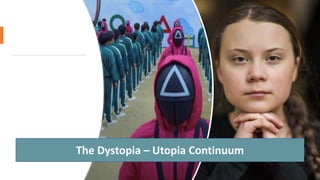
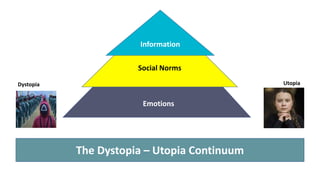
The Dystopia – Utopia Continuum
Dystopia Utopia
Emotions
Social Norms
Information
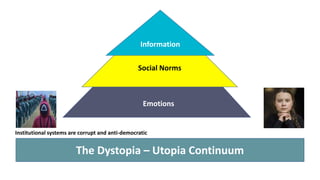
Emotions
Social Norms
Information
Institutional systems are corrupt and anti-democratic
The Dystopia – Utopia Continuum
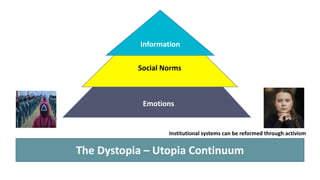
Emotions
Social Norms
Information
Institutional systems can be reformed through activism
The Dystopia – Utopia Continuum
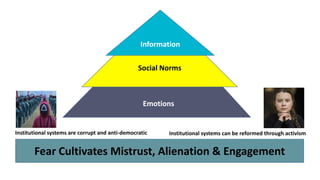
Fear Cultivates Mistrust, Alienation & Engagement
Emotions
Social Norms
Information
Institutional systems can be reformed through activism
Institutional systems are corrupt and anti-democratic
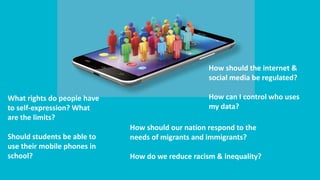
How should the internet &
social media be regulated?
How can I control who uses
my data?
How should our nation respond to the
needs of migrants and immigrants?
How do we reduce racism & inequality?
What rights do people have
to self-expression? What
are the limits?
Should students be able to
use their mobile phones in
school?
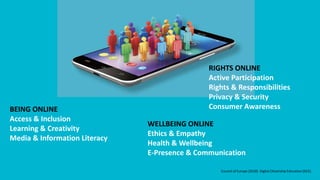
BEING ONLINE
Access & Inclusion
Learning & Creativity
Media & Information Literacy
WELLBEING ONLINE
Ethics & Empathy
Health & Wellbeing
E-Presence & Communication
RIGHTS ONLINE
Active Participation
Rights & Responsibilities
Privacy & Security
Consumer Awareness
Council of Europe (2018). Digital Citizenship Education (DCE).
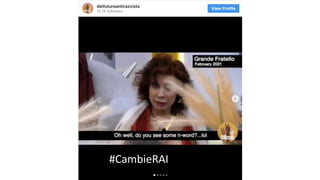
#CambieRAI
If we banish from our minds, our libraries,
and our classrooms any examination of
politics, religion, race, environment, sex,
justice, and the like, we might protect
ourselves from the possible discomfort we
might experience.
All we have to do is trivialize the curriculum
to the point that few will be bothered by
anything. If we can make instruction
completely insignificant, utterly irrelevant to
anyone’s emotional and intellectual life, then
absolutely no one should rise up to protest
the threat we pose to treasured beliefs,
valued affiliations, or well-established habits
of thought and action.
--Kylene Beers, “A Curriculum of Irrelevancy”
Media Literacy Educators Must Specialize in
Teaching the Controversies
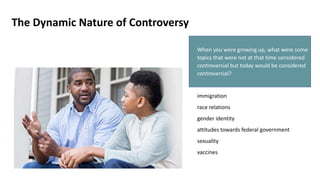
The Dynamic Nature of Controversy
When you were growing up, what were some
topics that were not at that time considered
controversial but today would be considered
controversial?
immigration
race relations
gender identity
attitudes towards federal government
sexuality
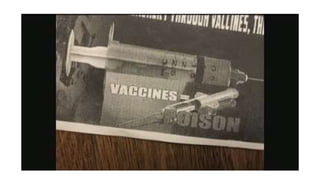
vaccines
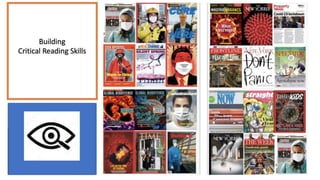
What is Propaganda?
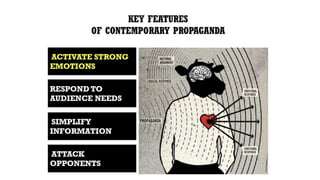
• Propaganda appears in a variety of forms
• Propaganda is strategic and intentional
• Propaganda aims to influence attitudes, opinions and
behaviors
• Propaganda can be beneficial or harmful
• Propaganda may use truth, half-truths or lies
• To be successful, propaganda taps into our deepest
values, fear, hopes and dreams
• Propaganda uses any means to accomplish its goal
Propaganda and other persuasive genres are rarely
examined or analyzed in schools
even though new forms of persuasive technologies
aim to influence emotions, attitudes, and beliefs
without awareness
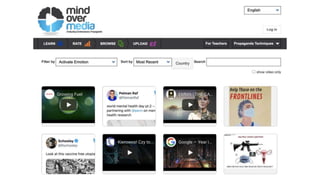
www.mindovermedia.us
GLOBAL SPENDING ON
ADVERTISING
In 2021
$749 BILLION
Google, Facebook, Amazon,
Alibaba and ByteDance received
46% of global ad spending
Sponsored Content
Influencers
Geo Location Targeting
Dark Patterns
Nudging
Personalized Advertising
Product Placement
Settled issues
Questions for which there is
broad-based agreement that a
particular decision is well-
warranted.
Open issues
Questions that are matters of live
and current controversy in the
public sphere
Two Types of Controversies
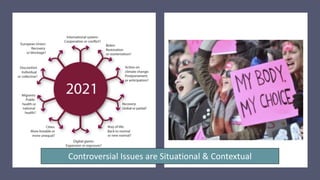
Controversial Issues are Situational & Contextual
Propaganda is used to disrupt social consensus,
helping settled issues become open controversies
Propaganda is also used to develop social consensus,
helping open controversies to become settled issues
What are some effective instructional methods
of teaching the controversies?
DISCUSSION
Groups of students are randomly assigned to small groups
to read about an issue, consider various policy proposals,
come to a consensus about a policy they would all endorse,
and then present their ideas to the others.
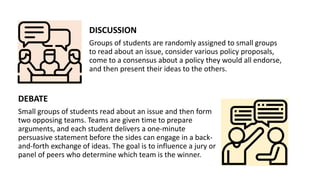
DEBATE
Small groups of students read about an issue and then form
two opposing teams. Teams are given time to prepare
arguments, and each student delivers a one-minute
persuasive statement before the sides can engage in a back-
and-forth exchange of ideas. The goal is to influence a jury or
panel of peers who determine which team is the winner.
DISCUSSION
Groups of students are randomly assigned to small groups
to read about an issue, consider various policy proposals,
come to a consensus about a policy they would all endorse,
and then present their ideas to the others.
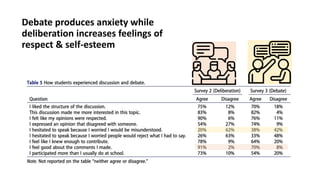
Debate produces anxiety while
deliberation increases feelings of
respect & self-esteem
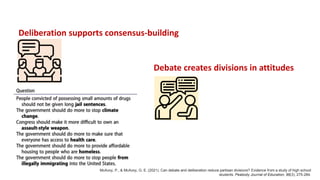
Deliberation supports consensus-building
Debate creates divisions in attitudes
McAvoy, P., & McAvoy, G. E. (2021). Can debate and deliberation reduce partisan divisions? Evidence from a study of high school
students. Peabody Journal of Education, 96(3), 275-284.
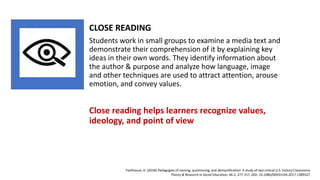
CLOSE READING
Students work in small groups to examine a media text and
demonstrate their comprehension of it by explaining key
ideas in their own words. They identify information about
the author & purpose and analyze how language, image
and other techniques are used to attract attention, arouse
emotion, and convey values.
Close reading helps learners recognize values,
ideology, and point of view
Parkhouse, H. (2018) Pedagogies of naming, questioning, and demystification: A study of two critical U.S. history Classrooms.
Theory & Research in Social Education, 46:2, 277-317, DOI: 10.1080/00933104.2017.1389327.
CREATE TO LEARN: ADVOCACY CAMPAIGN
Small groups of students learn about an issue and then
develop a media campaign to promote a particular policy or
action aimed to influence a target audience, working in teams
to identify desired attitude or behavior change. They create a
slogan, logo, and other campaign materials including video,
meme, infographic or podcast, circulating their own
messages using their social network.
Create to learn activities help learners visualize
themselves as change agents
Henry, A. (2019). Online media creation and L2 motivation: A socially situated perspective. Tesol Quarterly, 53(2), 372-404.
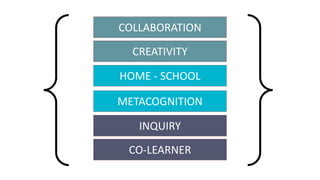
HOME - SCHOOL
CREATIVITY
COLLABORATION
METACOGNITION
INQUIRY
CO-LEARNER
Hilo High School, Hawaii
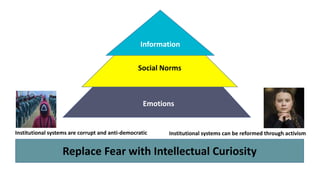
Replace Fear with Intellectual Curiosity
Emotions
Social Norms
Information
Institutional systems can be reformed through activism
Institutional systems are corrupt and anti-democratic
Consider
Your
Own
Positionality
Take
the
Plunge
Renee Hobbs
University of Rhode Island
Media Education Lab
Email: hobbs@uri.edu
Twitter: @reneehobbs
Web: www.mediaeducationlab.com
Exploring Controversial
Issues in the Classroom

Controversial Issues in the Classroom

  • 1.
    Exploring Controversial Issues in theClassroom October 28, 2021 Renee Hobbs University of Rhode Island Media Education Lab, USA Twitter: @reneehobbs
  • 3.
    The Dystopia –Utopia Continuum
  • 4.
    The Dystopia –Utopia Continuum Dystopia Utopia Emotions Social Norms Information
  • 5.
    Emotions Social Norms Information Institutional systemsare corrupt and anti-democratic The Dystopia – Utopia Continuum
  • 6.
    Emotions Social Norms Information Institutional systemscan be reformed through activism The Dystopia – Utopia Continuum
  • 7.
    Fear Cultivates Mistrust,Alienation & Engagement Emotions Social Norms Information Institutional systems can be reformed through activism Institutional systems are corrupt and anti-democratic
  • 8.
    How should theinternet & social media be regulated? How can I control who uses my data? How should our nation respond to the needs of migrants and immigrants? How do we reduce racism & inequality? What rights do people have to self-expression? What are the limits? Should students be able to use their mobile phones in school?
  • 9.
    BEING ONLINE Access &Inclusion Learning & Creativity Media & Information Literacy WELLBEING ONLINE Ethics & Empathy Health & Wellbeing E-Presence & Communication RIGHTS ONLINE Active Participation Rights & Responsibilities Privacy & Security Consumer Awareness Council of Europe (2018). Digital Citizenship Education (DCE).
  • 12.
  • 13.
    If we banishfrom our minds, our libraries, and our classrooms any examination of politics, religion, race, environment, sex, justice, and the like, we might protect ourselves from the possible discomfort we might experience. All we have to do is trivialize the curriculum to the point that few will be bothered by anything. If we can make instruction completely insignificant, utterly irrelevant to anyone’s emotional and intellectual life, then absolutely no one should rise up to protest the threat we pose to treasured beliefs, valued affiliations, or well-established habits of thought and action. --Kylene Beers, “A Curriculum of Irrelevancy”
  • 14.
    Media Literacy EducatorsMust Specialize in Teaching the Controversies
  • 15.
    The Dynamic Natureof Controversy When you were growing up, what were some topics that were not at that time considered controversial but today would be considered controversial? immigration race relations gender identity attitudes towards federal government sexuality vaccines
  • 18.
    What is Propaganda? •Propaganda appears in a variety of forms • Propaganda is strategic and intentional • Propaganda aims to influence attitudes, opinions and behaviors • Propaganda can be beneficial or harmful • Propaganda may use truth, half-truths or lies • To be successful, propaganda taps into our deepest values, fear, hopes and dreams • Propaganda uses any means to accomplish its goal
  • 19.
    Propaganda and otherpersuasive genres are rarely examined or analyzed in schools even though new forms of persuasive technologies aim to influence emotions, attitudes, and beliefs without awareness
  • 20.
  • 21.
    GLOBAL SPENDING ON ADVERTISING In2021 $749 BILLION Google, Facebook, Amazon, Alibaba and ByteDance received 46% of global ad spending Sponsored Content Influencers Geo Location Targeting Dark Patterns Nudging Personalized Advertising Product Placement
  • 22.
    Settled issues Questions forwhich there is broad-based agreement that a particular decision is well- warranted. Open issues Questions that are matters of live and current controversy in the public sphere Two Types of Controversies
  • 23.
    Controversial Issues areSituational & Contextual
  • 24.
    Propaganda is usedto disrupt social consensus, helping settled issues become open controversies Propaganda is also used to develop social consensus, helping open controversies to become settled issues
  • 29.
    What are someeffective instructional methods of teaching the controversies?
  • 31.
    DISCUSSION Groups of studentsare randomly assigned to small groups to read about an issue, consider various policy proposals, come to a consensus about a policy they would all endorse, and then present their ideas to the others.
  • 32.
    DEBATE Small groups ofstudents read about an issue and then form two opposing teams. Teams are given time to prepare arguments, and each student delivers a one-minute persuasive statement before the sides can engage in a back- and-forth exchange of ideas. The goal is to influence a jury or panel of peers who determine which team is the winner. DISCUSSION Groups of students are randomly assigned to small groups to read about an issue, consider various policy proposals, come to a consensus about a policy they would all endorse, and then present their ideas to the others.
  • 33.
    Debate produces anxietywhile deliberation increases feelings of respect & self-esteem
  • 34.
    Deliberation supports consensus-building Debatecreates divisions in attitudes McAvoy, P., & McAvoy, G. E. (2021). Can debate and deliberation reduce partisan divisions? Evidence from a study of high school students. Peabody Journal of Education, 96(3), 275-284.
  • 35.
    CLOSE READING Students workin small groups to examine a media text and demonstrate their comprehension of it by explaining key ideas in their own words. They identify information about the author & purpose and analyze how language, image and other techniques are used to attract attention, arouse emotion, and convey values. Close reading helps learners recognize values, ideology, and point of view Parkhouse, H. (2018) Pedagogies of naming, questioning, and demystification: A study of two critical U.S. history Classrooms. Theory & Research in Social Education, 46:2, 277-317, DOI: 10.1080/00933104.2017.1389327.
  • 38.
    CREATE TO LEARN:ADVOCACY CAMPAIGN Small groups of students learn about an issue and then develop a media campaign to promote a particular policy or action aimed to influence a target audience, working in teams to identify desired attitude or behavior change. They create a slogan, logo, and other campaign materials including video, meme, infographic or podcast, circulating their own messages using their social network. Create to learn activities help learners visualize themselves as change agents Henry, A. (2019). Online media creation and L2 motivation: A socially situated perspective. Tesol Quarterly, 53(2), 372-404.
  • 39.
  • 40.
  • 41.
    Replace Fear withIntellectual Curiosity Emotions Social Norms Information Institutional systems can be reformed through activism Institutional systems are corrupt and anti-democratic
  • 42.
  • 43.
  • 44.
    Renee Hobbs University ofRhode Island Media Education Lab Email: hobbs@uri.edu Twitter: @reneehobbs Web: www.mediaeducationlab.com Exploring Controversial Issues in the Classroom