


Mind Over Media:
Analyzing
Contemporary
Propaganda
Renee Hobbs
Media & Learning 2016
Brussels, Belgium
March 9, 2016
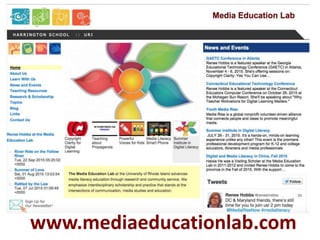
www.mediaeducationlab.com
Media systems are expanding
Literacy is expanding
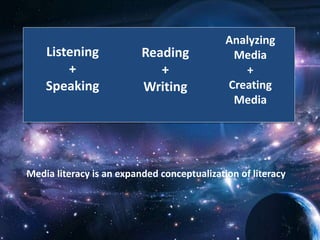
Media literacy is an expanded conceptualization of literacy
Listening
+
Speaking
Reading
+
Writing
Analyzing
Media
+
Creating
Media
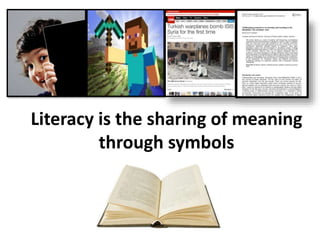
Literacy is the sharing of meaning
through symbols
ACCESS
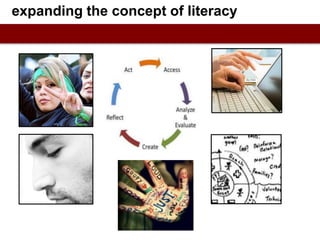
expanding the concept of literacy
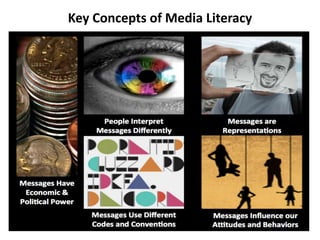
Key Concepts of Media Literacy
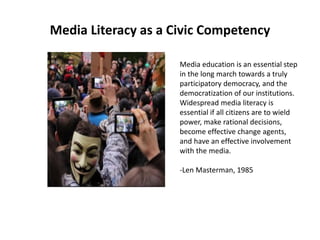
Media Literacy as a Civic Competency
Media education is an essential step
in the long march towards a truly
participatory democracy, and the
democratization of our institutions.
Widespread media literacy is
essential if all citizens are to wield
power, make rational decisions,
become effective change agents,
and have an effective involvement
with the media.
-Len Masterman, 1985
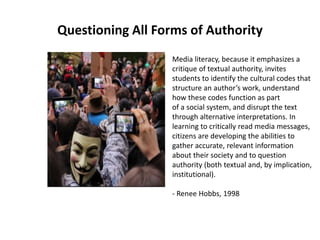
Questioning All Forms of Authority
Media literacy, because it emphasizes a
critique of textual authority, invites
students to identify the cultural codes that
structure an author’s work, understand
how these codes function as part
of a social system, and disrupt the text
through alternative interpretations. In
learning to critically read media messages,
citizens are developing the abilities to
gather accurate, relevant information
about their society and to question
authority (both textual and, by implication,
institutional).
- Renee Hobbs, 1998
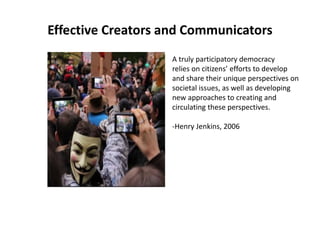
Effective Creators and Communicators
A truly participatory democracy
relies on citizens’ efforts to develop
and share their unique perspectives on
societal issues, as well as developing
new approaches to creating and
circulating these perspectives.
-Henry Jenkins, 2006
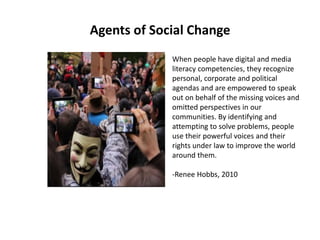
Agents of Social Change
When people have digital and media
literacy competencies, they recognize
personal, corporate and political
agendas and are empowered to speak
out on behalf of the missing voices and
omitted perspectives in our
communities. By identifying and
attempting to solve problems, people
use their powerful voices and their
rights under law to improve the world
around them.
-Renee Hobbs, 2010
Goals for Today
 Gain knowledge and deepen understanding of new forms of
contemporary propaganda
 Appreciate the value of new pedagogical approaches that
advance people’s ability to critically analyze propaganda
 Learn key strategies for offering professional development
programs in media literacy to educators
 Consider how media literacy can combat the rise of extremism
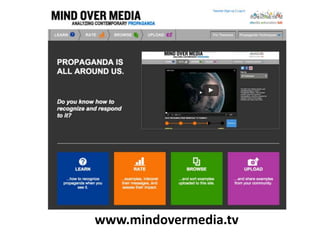
www.mindovermedia.tv
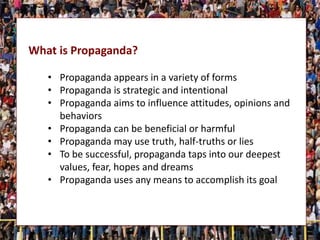
What is Propaganda?
• Propaganda appears in a variety of forms
• Propaganda is strategic and intentional
• Propaganda aims to influence attitudes, opinions and
behaviors
• Propaganda can be beneficial or harmful
• Propaganda may use truth, half-truths or lies
• To be successful, propaganda taps into our deepest
values, fear, hopes and dreams
• Propaganda uses any means to accomplish its goal
Where is Propaganda Found?
Journalism & Public Relations
Advertising
Government
Education
Entertainment
Advocacy
REFLECT
Why Teaching About Propaganda Matters
 How did you learn about propaganda when you were in
school?
 What new forms of propaganda have emerged in your
lifetime?
 What factors have contributed to the decline of teaching
and learning about contemporary propaganda?
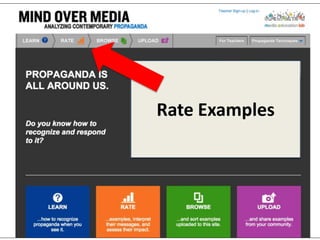
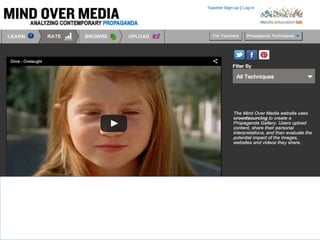
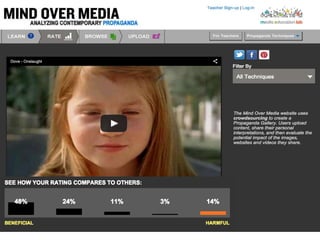
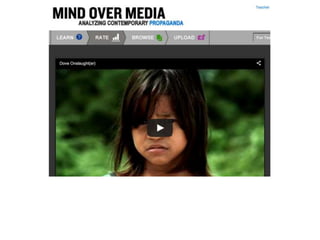
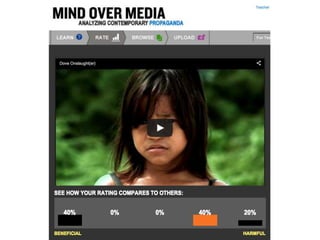
Rate Examples
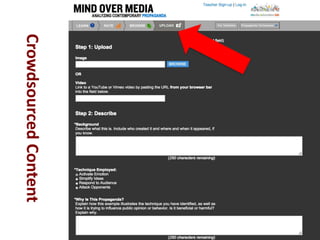
CrowdsourcedContent
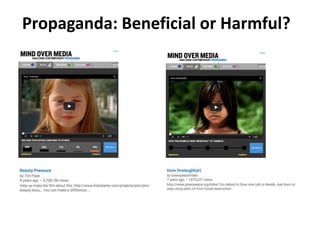
Propaganda: Beneficial or Harmful?
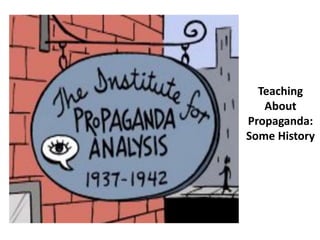
Teaching
About
Propaganda:
Some History
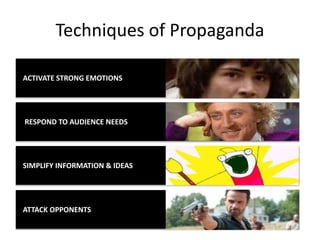
Techniques of Propaganda
ACTIVATE STRONG EMOTIONS
ATTACK OPPONENTS
SIMPLIFY INFORMATION & IDEAS
RESPOND TO AUDIENCE NEEDS
Message: What is the nature of the information
and ideas being expressed?
Techniques: What symbols and rhetorical
strategies are used to attract attention and
activate emotional response? What makes them
effective
Means of Communication & Format: How did
the message reach people and what form does it
take?
Environment: Where, when and how may
people have encountered the message?
Audience Receptivity: How may people think
and feel about the message and how free they
are to accept or reject it?
CONTEXT
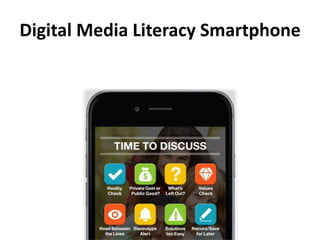
Digital Media Literacy Smartphone
www.mindovermedia.tv
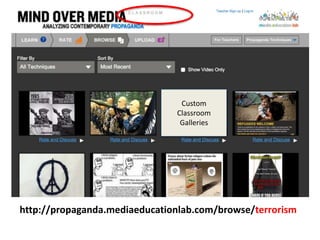
Custom
Classroom
Galleries
http://propaganda.mediaeducationlab.com/browse/terrorism
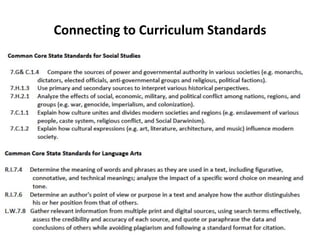
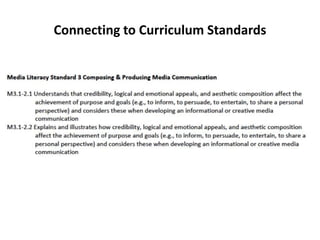
Connecting to Curriculum Standards
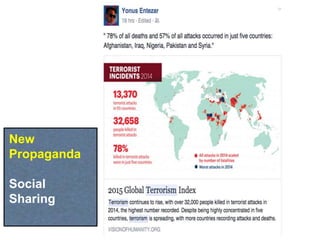
New
Propaganda
Social
Sharing
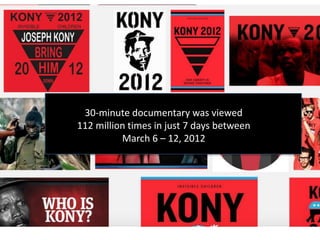
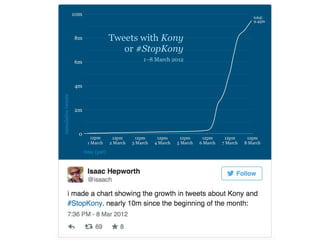
30-minute documentary was viewed
112 million times in just 7 days between
March 6 – 12, 2012
VIRALITY
when information, an image or video
gets circulated rapidly and widely
from one Internet user to another
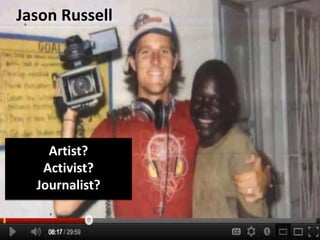
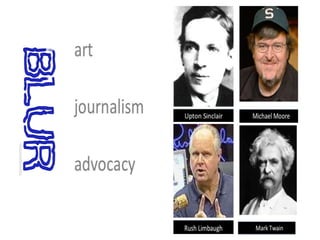
Artist?
Activist?
Journalist?
Jason Russell
All works of human creativity are ‘open’ and
‘unstable,’ susceptible to a wide range of
interpretations. As readers/viewers/listeners, we
are the critical agents in the meaning-making
process.
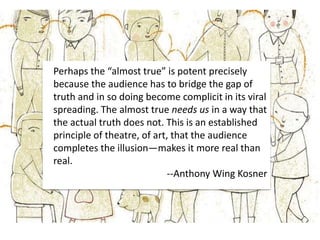
Perhaps the “almost true” is potent precisely
because the audience has to bridge the gap of
truth and in so doing become complicit in its viral
spreading. The almost true needs us in a way that
the actual truth does not. This is an established
principle of theatre, of art, that the audience
completes the illusion—makes it more real than
real.
--Anthony Wing Kosner
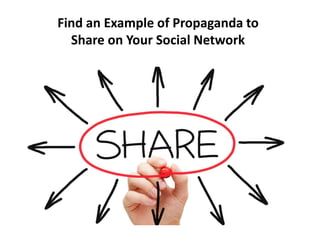
Find an Example of Propaganda to
Share on Your Social Network
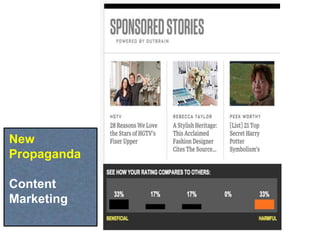
New
Propaganda
Content
Marketing
Recognizing Sponsored Content
What is it?
• What types of sponsored content do you see on your social media pages?
• What types of native advertising or sponsored content do you find on
other websites you visit?
• How can you tell that is it is sponsored content?
Why is it there?
• How does the sponsored content fit into the overall page?
• Would a user be likely to recognize it as an ad? Why or why not?
• Why did you receive this particular kind of native advertising or sponsored
content?
• What information was gathered about you in order for this content to be
placed here?
What impact does it have?
• What do online marketers know about you?
• Does it matter to you how much they know? Why or why not?
• What are the potential consequences of online ad personalization?
• Is sponsored content beneficial or harmful?
Look at your Facebook or social media pages
and find examples of sponsored content.
Take a screenshot and upload it to the Mind
Over Media website.
Recognizing Sponsored Content
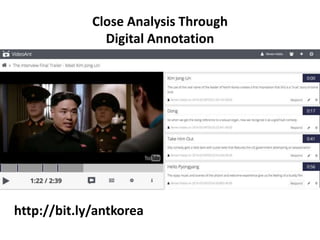
Close Analysis Through
Digital Annotation
http://bit.ly/antkorea
As both consumers and creators of media, what do
we need to know and be able to do?
• Learn to recognize new forms of propaganda in everyday life
• Practice skills of interpretation, critical analysis & responsible
media-making
• Consider how context shapes the way messages are understood
• Reflect with others on our diverse interpretations of media
messages in ways that promote understanding of and respect for
others’ perspectives
• Shift from passive receivers to critically engaged participants in
global public discourse
Some “Good Practices”
1. Choice and Relevance. Crowdsourced digital
media content ensures that examples, topics
and issues are continually relevant to how
learners experience propaganda in everyday
life
2. Beneficial or Harmful. Positioning propaganda
as potentially beneficial prevents demonization
or “othering” of propagandists
3. Respect for Difference. Focus on sharing
interpretations promotes respect for divergent
opinions, attitudes and beliefs
4. Context and Close Analysis. Focus on context
(not only techniques) deepens analysis
competencies and demonstrates the authentic
value of intellectual curiosity and knowledge
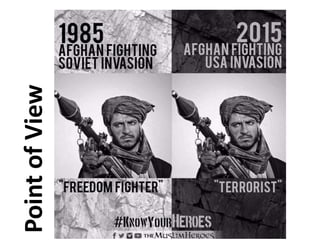
PointofView
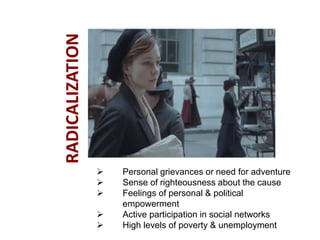
 Personal grievances or need for adventure
 Sense of righteousness about the cause
 Feelings of personal & political
empowerment
 Active participation in social networks
 High levels of poverty & unemployment
RADICALIZATION
Goals for Today
 Appreciate the need for new pedagogical approaches that
advance people’s ability to critically analyze propaganda
 Gain knowledge and deepen understanding of new forms of
contemporary propaganda
 Discuss some ”good practices" for teaching about propaganda
 Learn key strategies for offering professional development
programs in media literacy to educators
 Consider how media literacy can combat the rise of extremism
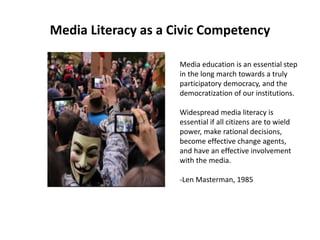
Media Literacy as a Civic Competency
Media education is an essential step
in the long march towards a truly
participatory democracy, and the
democratization of our institutions.
Widespread media literacy is
essential if all citizens are to wield
power, make rational decisions,
become effective change agents,
and have an effective involvement
with the media.
-Len Masterman, 1985
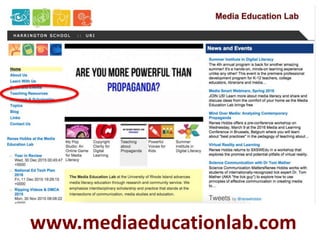
www.mediaeducationlab.com
Renee Hobbs
Professor of Communication Studies
Director, Media Education Lab
Harrington School of Communication
and Media
University of Rhode Island USA
Email: hobbs@uri.edu
Twitter: @reneehobbs
WEB: www.mediaeducationlab.com

Mind Over Media: Analyzing Contemporary Propaganda Workshop

  • 1.
    Mind Over Media: Analyzing Contemporary Propaganda ReneeHobbs Media & Learning 2016 Brussels, Belgium March 9, 2016
  • 2.
  • 3.
  • 4.
  • 5.
    Media literacy isan expanded conceptualization of literacy Listening + Speaking Reading + Writing Analyzing Media + Creating Media
  • 6.
    Literacy is thesharing of meaning through symbols
  • 7.
  • 8.
    Key Concepts ofMedia Literacy
  • 9.
    Media Literacy asa Civic Competency Media education is an essential step in the long march towards a truly participatory democracy, and the democratization of our institutions. Widespread media literacy is essential if all citizens are to wield power, make rational decisions, become effective change agents, and have an effective involvement with the media. -Len Masterman, 1985
  • 10.
    Questioning All Formsof Authority Media literacy, because it emphasizes a critique of textual authority, invites students to identify the cultural codes that structure an author’s work, understand how these codes function as part of a social system, and disrupt the text through alternative interpretations. In learning to critically read media messages, citizens are developing the abilities to gather accurate, relevant information about their society and to question authority (both textual and, by implication, institutional). - Renee Hobbs, 1998
  • 11.
    Effective Creators andCommunicators A truly participatory democracy relies on citizens’ efforts to develop and share their unique perspectives on societal issues, as well as developing new approaches to creating and circulating these perspectives. -Henry Jenkins, 2006
  • 12.
    Agents of SocialChange When people have digital and media literacy competencies, they recognize personal, corporate and political agendas and are empowered to speak out on behalf of the missing voices and omitted perspectives in our communities. By identifying and attempting to solve problems, people use their powerful voices and their rights under law to improve the world around them. -Renee Hobbs, 2010
  • 13.
    Goals for Today Gain knowledge and deepen understanding of new forms of contemporary propaganda  Appreciate the value of new pedagogical approaches that advance people’s ability to critically analyze propaganda  Learn key strategies for offering professional development programs in media literacy to educators  Consider how media literacy can combat the rise of extremism
  • 14.
  • 15.
    What is Propaganda? •Propaganda appears in a variety of forms • Propaganda is strategic and intentional • Propaganda aims to influence attitudes, opinions and behaviors • Propaganda can be beneficial or harmful • Propaganda may use truth, half-truths or lies • To be successful, propaganda taps into our deepest values, fear, hopes and dreams • Propaganda uses any means to accomplish its goal
  • 16.
    Where is PropagandaFound? Journalism & Public Relations Advertising Government Education Entertainment Advocacy
  • 17.
    REFLECT Why Teaching AboutPropaganda Matters  How did you learn about propaganda when you were in school?  What new forms of propaganda have emerged in your lifetime?  What factors have contributed to the decline of teaching and learning about contemporary propaganda?
  • 18.
  • 20.
  • 27.
  • 28.
  • 29.
    Techniques of Propaganda ACTIVATESTRONG EMOTIONS ATTACK OPPONENTS SIMPLIFY INFORMATION & IDEAS RESPOND TO AUDIENCE NEEDS
  • 30.
    Message: What isthe nature of the information and ideas being expressed? Techniques: What symbols and rhetorical strategies are used to attract attention and activate emotional response? What makes them effective Means of Communication & Format: How did the message reach people and what form does it take? Environment: Where, when and how may people have encountered the message? Audience Receptivity: How may people think and feel about the message and how free they are to accept or reject it? CONTEXT
  • 31.
  • 32.
  • 33.
  • 34.
  • 35.
  • 36.
  • 37.
    30-minute documentary wasviewed 112 million times in just 7 days between March 6 – 12, 2012
  • 38.
    VIRALITY when information, animage or video gets circulated rapidly and widely from one Internet user to another
  • 42.
  • 44.
    All works ofhuman creativity are ‘open’ and ‘unstable,’ susceptible to a wide range of interpretations. As readers/viewers/listeners, we are the critical agents in the meaning-making process.
  • 45.
    Perhaps the “almosttrue” is potent precisely because the audience has to bridge the gap of truth and in so doing become complicit in its viral spreading. The almost true needs us in a way that the actual truth does not. This is an established principle of theatre, of art, that the audience completes the illusion—makes it more real than real. --Anthony Wing Kosner
  • 46.
    Find an Exampleof Propaganda to Share on Your Social Network
  • 47.
  • 48.
    Recognizing Sponsored Content Whatis it? • What types of sponsored content do you see on your social media pages? • What types of native advertising or sponsored content do you find on other websites you visit? • How can you tell that is it is sponsored content? Why is it there? • How does the sponsored content fit into the overall page? • Would a user be likely to recognize it as an ad? Why or why not? • Why did you receive this particular kind of native advertising or sponsored content? • What information was gathered about you in order for this content to be placed here?
  • 49.
    What impact doesit have? • What do online marketers know about you? • Does it matter to you how much they know? Why or why not? • What are the potential consequences of online ad personalization? • Is sponsored content beneficial or harmful? Look at your Facebook or social media pages and find examples of sponsored content. Take a screenshot and upload it to the Mind Over Media website. Recognizing Sponsored Content
  • 50.
    Close Analysis Through DigitalAnnotation http://bit.ly/antkorea
  • 51.
    As both consumersand creators of media, what do we need to know and be able to do? • Learn to recognize new forms of propaganda in everyday life • Practice skills of interpretation, critical analysis & responsible media-making • Consider how context shapes the way messages are understood • Reflect with others on our diverse interpretations of media messages in ways that promote understanding of and respect for others’ perspectives • Shift from passive receivers to critically engaged participants in global public discourse
  • 52.
    Some “Good Practices” 1.Choice and Relevance. Crowdsourced digital media content ensures that examples, topics and issues are continually relevant to how learners experience propaganda in everyday life 2. Beneficial or Harmful. Positioning propaganda as potentially beneficial prevents demonization or “othering” of propagandists 3. Respect for Difference. Focus on sharing interpretations promotes respect for divergent opinions, attitudes and beliefs 4. Context and Close Analysis. Focus on context (not only techniques) deepens analysis competencies and demonstrates the authentic value of intellectual curiosity and knowledge
  • 53.
  • 54.
     Personal grievancesor need for adventure  Sense of righteousness about the cause  Feelings of personal & political empowerment  Active participation in social networks  High levels of poverty & unemployment RADICALIZATION
  • 56.
    Goals for Today Appreciate the need for new pedagogical approaches that advance people’s ability to critically analyze propaganda  Gain knowledge and deepen understanding of new forms of contemporary propaganda  Discuss some ”good practices" for teaching about propaganda  Learn key strategies for offering professional development programs in media literacy to educators  Consider how media literacy can combat the rise of extremism
  • 57.
    Media Literacy asa Civic Competency Media education is an essential step in the long march towards a truly participatory democracy, and the democratization of our institutions. Widespread media literacy is essential if all citizens are to wield power, make rational decisions, become effective change agents, and have an effective involvement with the media. -Len Masterman, 1985
  • 58.
  • 59.
    Renee Hobbs Professor ofCommunication Studies Director, Media Education Lab Harrington School of Communication and Media University of Rhode Island USA Email: hobbs@uri.edu Twitter: @reneehobbs WEB: www.mediaeducationlab.com